Spider Research
http://www.youtube.com/watch?v=K
OPr0LqMnW4
Spiders
Physical
Characteristics
Markings, ca
mouflage, col
ors
Size
coverings
body
parts
Behaviors
What it
eats,
how it
hunts
How it
protects
itself
adaptations
for survival
Habitat
Where
in the
world
type of
environment
shelter
Physical Characteristics Habitat
Behaviors
Goliath
Tarantula
Physical Characteristics Habitat
Behaviors
Goliath
Tarantula
hair on their bodies,
abdomens, and legs
can have a leg span of
up to 30 cm (12 in) and
can weigh over 170 g
(6.0 oz)
fangs large enough
to break the skin
of a human
venom in
their fangs bite when
threatened
venom is relatively harmless:
comparable to a wasp's sting
when threatened, they rub their
abdomen with their hind legs and
release hairs that irritate the skin
and mucous membranes
diet consists primarily of insects
and other invertebrates
have been seen feeding on
rodents, frogs, lizards, bats
and even deadly
venomous snakes.
native to the rain forest
regions of northern
South America
found commonly in marshy
or swampy areas, usually
living in burrows that they
have dug or which have
been abandoned by other
burrowing creatures.
Colors range from dark to
light brown with faint
markings on the legs
Physical Characteristics Habitat
Behaviors
Goliath
Tarantula
hair on their bodies,
abdomens, and legs
can have a leg span of
up to 30 cm (12 in) and
can weigh over 170 g
(6.0 oz)
fangs large enough
to break the skin
of a human
venom in
their fangs bite when
threatened
venom is relatively harmless:
comparable to a wasp's sting
when threatened, they rub their
abdomen with their hind legs and
release hairs that irritate the skin
and mucous membranes
diet consists primarily of insects
and other invertebrates
have been seen feeding on
rodents, frogs, lizards, bats
and even deadly
venomous snakes.
native to the rain forest
regions of northern
South America
found commonly in marshy
or swampy areas, usually
living in burrows that they
have dug or which have
been abandoned by other
burrowing creatures.
Colors range from dark to
light brown with faint
markings on the legs
Goliath
Tarantula
Physical
Characteristics
Markings,
camouflage,
colors
Size
coverings
body
parts
Behaviors
What it
eats,
how it
hunts
How it
protects
itself
adaptations
for survival
Habitat
Where
in the
world
type of
environment
shelter
Goliath Tarantula
Physical
Characteristics
Behaviors Habitat
hair on their bodies,
abdomens, and legs
can have a leg span of up to 30
cm (12 in) and can weigh over
170 g (6.0 oz)
fangs large enough to break
the skin of a human
venom in their fangs
venom is relatively harmless:
comparable to a wasp's sting
Colors range from dark to
light brown with faint
markings on the legs
bite when threatened
when threatened, they rub
their abdomen with their hind
legs and release hairs that
irritate the skin and mucous
membranes
diet consists primarily of insects
and other invertebrates
have been seen feeding on
rodents, frogs, lizards, bats and
even deadly venomous snakes.
native to the rain forest
regions of northern
South America
found commonly in marshy
or swampy areas, usually
living in burrows that they
have dug or which have
been abandoned by other
burrowing creatures.
can have a leg span of up to 30 cm (12
in) and can weigh over 170 g (6.0 oz)
fangs large enough to break skin of a human
venom in their fangs
venom is fairly harmless: like a wasp's sting
Colors dark to light brown with
markings on the legs
hair on their bodies, abdomen, and legs
bite when threatened
when threatened, rub their abdomen with
hind legs and release hairs that irritate the
skin and mucous membranes
diet consists primarily of insects and
other invertebrates
have been seen feeding on rodents, frogs,
lizards, bats and deadly venomous snakes.
OPENING
Physical
Characteristics
Behaviors Habitats
Tarantulas are one of the worlds largest spider species and the Goliath Tarantula is the
largest of the tarantulas. Although they are not native to Texas, Goliath Tarantulas are
fascinating creatures to study and have many interesting characteristics and behaviors.
native to the rain forest regions of
northern South America
commonly in marshy or swampy
areas, living in burrows that they have
dug or which have been abandoned by
other burrowing creatures.
Although they look menacing, Goliath Tarantulas are not a threat to humans.
They are an important part of the food chain in the South American ecosystem.
Their huge size and interesting behaviors make them a favorite spider to study.
In addition to their physical characteristics, tarantulas have
some interesting behaviors
Although some Goliath Tarantulas can be found here in
captivity, they do not live here in the wild.
Transition Words
1. http://www.sass.uottawa.ca/writing/kit/grammar-transitional.pdf
2. http://www.busyteacherscafe.com/worksheets/mini_offices/transition%20words.pdf
3. http://www.edmondschools.net/Portals/0/docs/Writing%20Center/Elementary/Transit
ional-Words.pdf
4. http://www.uni-klu.ac.at/hlg/sber/downloads/linking_words.pdf

Spider research

  • 1.
  • 2.
    Spiders Physical Characteristics Markings, ca mouflage, col ors Size coverings body parts Behaviors Whatit eats, how it hunts How it protects itself adaptations for survival Habitat Where in the world type of environment shelter
  • 3.
  • 4.
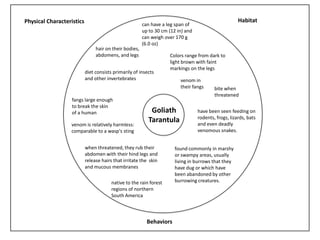
    Physical Characteristics Habitat Behaviors Goliath Tarantula hairon their bodies, abdomens, and legs can have a leg span of up to 30 cm (12 in) and can weigh over 170 g (6.0 oz) fangs large enough to break the skin of a human venom in their fangs bite when threatened venom is relatively harmless: comparable to a wasp's sting when threatened, they rub their abdomen with their hind legs and release hairs that irritate the skin and mucous membranes diet consists primarily of insects and other invertebrates have been seen feeding on rodents, frogs, lizards, bats and even deadly venomous snakes. native to the rain forest regions of northern South America found commonly in marshy or swampy areas, usually living in burrows that they have dug or which have been abandoned by other burrowing creatures. Colors range from dark to light brown with faint markings on the legs
  • 5.
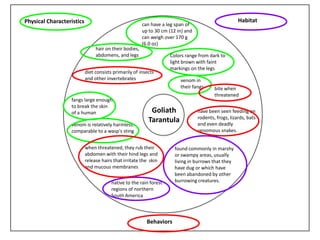
    Physical Characteristics Habitat Behaviors Goliath Tarantula hairon their bodies, abdomens, and legs can have a leg span of up to 30 cm (12 in) and can weigh over 170 g (6.0 oz) fangs large enough to break the skin of a human venom in their fangs bite when threatened venom is relatively harmless: comparable to a wasp's sting when threatened, they rub their abdomen with their hind legs and release hairs that irritate the skin and mucous membranes diet consists primarily of insects and other invertebrates have been seen feeding on rodents, frogs, lizards, bats and even deadly venomous snakes. native to the rain forest regions of northern South America found commonly in marshy or swampy areas, usually living in burrows that they have dug or which have been abandoned by other burrowing creatures. Colors range from dark to light brown with faint markings on the legs
  • 6.
    Goliath Tarantula Physical Characteristics Markings, camouflage, colors Size coverings body parts Behaviors What it eats, how it hunts Howit protects itself adaptations for survival Habitat Where in the world type of environment shelter
  • 8.
    Goliath Tarantula Physical Characteristics Behaviors Habitat hairon their bodies, abdomens, and legs can have a leg span of up to 30 cm (12 in) and can weigh over 170 g (6.0 oz) fangs large enough to break the skin of a human venom in their fangs venom is relatively harmless: comparable to a wasp's sting Colors range from dark to light brown with faint markings on the legs bite when threatened when threatened, they rub their abdomen with their hind legs and release hairs that irritate the skin and mucous membranes diet consists primarily of insects and other invertebrates have been seen feeding on rodents, frogs, lizards, bats and even deadly venomous snakes. native to the rain forest regions of northern South America found commonly in marshy or swampy areas, usually living in burrows that they have dug or which have been abandoned by other burrowing creatures.
  • 9.
    can have aleg span of up to 30 cm (12 in) and can weigh over 170 g (6.0 oz) fangs large enough to break skin of a human venom in their fangs venom is fairly harmless: like a wasp's sting Colors dark to light brown with markings on the legs hair on their bodies, abdomen, and legs bite when threatened when threatened, rub their abdomen with hind legs and release hairs that irritate the skin and mucous membranes diet consists primarily of insects and other invertebrates have been seen feeding on rodents, frogs, lizards, bats and deadly venomous snakes. OPENING Physical Characteristics Behaviors Habitats Tarantulas are one of the worlds largest spider species and the Goliath Tarantula is the largest of the tarantulas. Although they are not native to Texas, Goliath Tarantulas are fascinating creatures to study and have many interesting characteristics and behaviors. native to the rain forest regions of northern South America commonly in marshy or swampy areas, living in burrows that they have dug or which have been abandoned by other burrowing creatures. Although they look menacing, Goliath Tarantulas are not a threat to humans. They are an important part of the food chain in the South American ecosystem. Their huge size and interesting behaviors make them a favorite spider to study. In addition to their physical characteristics, tarantulas have some interesting behaviors Although some Goliath Tarantulas can be found here in captivity, they do not live here in the wild.
  • 10.
    Transition Words 1. http://www.sass.uottawa.ca/writing/kit/grammar-transitional.pdf 2.http://www.busyteacherscafe.com/worksheets/mini_offices/transition%20words.pdf 3. http://www.edmondschools.net/Portals/0/docs/Writing%20Center/Elementary/Transit ional-Words.pdf 4. http://www.uni-klu.ac.at/hlg/sber/downloads/linking_words.pdf

Editor's Notes

  • #10 Thursday- model 3 categories in the flow map and model how to open Kidspiration, save with their name, add their characteristics and save again. Bring to the floor to discuss creating their opening paragraph. Students return to computer and type their Opening. Teachers monitor, save when they finishMonday- Reivew flow map and opening paragraphs. Some students may need to finish opening. Model how to add details under each category. Students return to computer and carry on their flow maps. Pull students to floor to discuss transitionsTues- Review transitions. Give students a transition word cheat sheet Students should select appropriate transitions and add to their flow map. Model oral rehearsals to check the flow of their paperWed. Discuss how to create a closing. Students open their flow maps and write their closing and save. Students will then print out their flow maps and work in pairs to do a paired oral rehearsalThursday- Model how to move flow map into an outline. Students will remove underlines from details and create complete sentences. Model how to reorder their outline so it fits the flow of their paper. Save as a new document and print. Monday- Model how to move outline form into a word doc. Model how to remove extra spaces, Add Title and by line as well as a picture. Save as a new document and print.