SPEECH
PROCESS
BY: PAMELA C. LICAYAN
ELT. Cognates 4011 : The English System of
Phonemes
Respiration
(i.e., breathing) is the power
mechanism for speech; it provides
energy for the sound produced.
Two (2) Phases of Respiration
–Inhalation – The diaphragm contracts drawing
air down into the lungs; first the abdomen
expands, then the chest (thoracic) cavity.
–Exhalation – The diaphragm relaxes forcing air
back out of the lungs
PHONATION
the process by which the
larynx catches the stream of
exhaled breath from the lungs
and, by means of tiny vocal
folds, transforms it into vocal
sound.
Organs involved:
larynx, vocal folds
Three Aspects of Voiced Influenced
by Movements of the Vocal Folds
Pitch – the frequency of the vibration
•Loudness – the intensity of the sound
•Quality – the sound quality of the voice,
also referred to as timbre
RESONANCE
the process of
sound
modification and
amplification.
Organs involved:
pharynx, nose,
mouth
Two (2) Basic Kinds of Resonance
–Sympathetic resonance (or free resonance) in
which there is no physical contact between the
two bodies.
–Conductive resonance (or forced resonance) in
which the resonator starts vibrating because it is
in physical contact with a vibrating body.
ARTICULATION
the process by which vocal sound
becomes speech sounds, syllables, and
words.
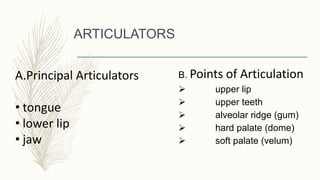
ARTICULATORS
A.Principal Articulators
• tongue
• lower lip
• jaw
B. Points of Articulation
 upper lip
 upper teeth
 alveolar ridge (gum)
 hard palate (dome)
 soft palate (velum)
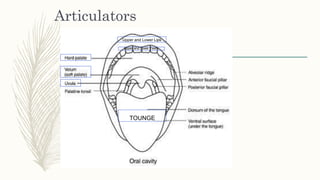
Articulators
TOUNGE
Upper and Lower Lips
Upper and Lower Teeth
Place of Articulation
Manner of Articulation

Speech process

  • 1.
    SPEECH PROCESS BY: PAMELA C.LICAYAN ELT. Cognates 4011 : The English System of Phonemes
  • 2.
    Respiration (i.e., breathing) isthe power mechanism for speech; it provides energy for the sound produced.
  • 3.
    Two (2) Phasesof Respiration –Inhalation – The diaphragm contracts drawing air down into the lungs; first the abdomen expands, then the chest (thoracic) cavity. –Exhalation – The diaphragm relaxes forcing air back out of the lungs
  • 4.
    PHONATION the process bywhich the larynx catches the stream of exhaled breath from the lungs and, by means of tiny vocal folds, transforms it into vocal sound. Organs involved: larynx, vocal folds
  • 7.
    Three Aspects ofVoiced Influenced by Movements of the Vocal Folds Pitch – the frequency of the vibration •Loudness – the intensity of the sound •Quality – the sound quality of the voice, also referred to as timbre
  • 8.
    RESONANCE the process of sound modificationand amplification. Organs involved: pharynx, nose, mouth
  • 10.
    Two (2) BasicKinds of Resonance –Sympathetic resonance (or free resonance) in which there is no physical contact between the two bodies. –Conductive resonance (or forced resonance) in which the resonator starts vibrating because it is in physical contact with a vibrating body.
  • 11.
    ARTICULATION the process bywhich vocal sound becomes speech sounds, syllables, and words.
  • 12.
    ARTICULATORS A.Principal Articulators • tongue •lower lip • jaw B. Points of Articulation  upper lip  upper teeth  alveolar ridge (gum)  hard palate (dome)  soft palate (velum)
  • 13.
    Articulators TOUNGE Upper and LowerLips Upper and Lower Teeth
  • 14.
  • 15.