Health Science Internship
Grand Strand Regional Medical Center
Speech Therapy Department
Elizabeth Cox
May -July 2016
Myrtle Beach, SC
Clemson University
Introduction
• As a Health Science student at Clemson University we are required
to complete a 180 hour internship in a career of choice.
• With a strong interest in speech therapy I was given the
opportunity to intern with Eileen McLaughlin, a speech language
pathologist (SLP) at Grand Strand Medical Center during the
Summer of 2016.
• This internship was a rewarding and memorable experience that
not only expanded my interest and passion for speech and
swallow therapy but solidified my career goals of becoming an SLP
in the future.
• This PowerPoint will serve as an overview of my internship
experience by providing information related to my internship site
and department, list my role as an intern, explain speech therapy’s
role in this hospital, and summarize the projects I worked on and
completed throughout my internship
• Grand Strand Medical Center is a 301 bed acute care hospital that is part
of the Grand Strand Health System.
• Some of the service and programs offered by Grand Strand Medical
Center are listed below.
• Breast Health, Cancer, Cardiac, Emergency Care, Imagine Services,
Spine and Neuro Care
• Grand Strand Medical Center offers the only cardiac surgery program,
neurosurgery program, and pediatric intensive care unit (PICU) in Horry
and surrounding counties.
• The hospital is a designated Level II Trauma Center and an Advanced
Primary Stroke Center
• Grand Strand Medical Center is a top performer in these key areas: Heart
Attack, Heart Failure, Pneumonia, Surgical Care
• Grand Strand offers a Graduate Medical Education (GME) program and
is a certified teaching hospital accepting residents to participate in
several different programs throughout the hospital.
Grand Strand Medical Center
“Above all else, we are committed to the care
and improvement of human life. In recognition
of this commitment, we strive to deliver high
quality, cost effective healthcare in the
communities we serve. In pursuit of our
mission, we believe the following value
statements are essential and timeless.
• We recognize and affirm the unique and
intrinsic worth of each individual.
• We treat all those we serve with compassion
and kindness.
• We act with absolute honesty, integrity and
fairness in the way we conduct our business
and the way we live our lives.
• We trust our colleagues as valuable members
of our healthcare team and pledge to treat
one another with loyalty, respect and dignity.”
Grand Strand Regional Medical Center
Mission and Vision
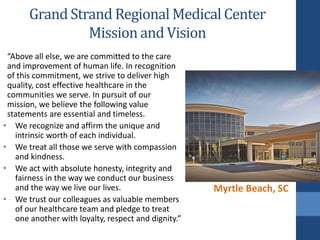
Myrtle Beach, SC
Therapy Department
• The therapy department is made up of occupational therapists
(OT), physical therapists (PT), and speech language
pathologists (SLP). These individuals work as a team to provide
quality care for patients throughout the hospital.
• The therapy department includes:
• Office space for SLP, OT, and PT
• 2 SLP outpatient treatment rooms
• Aquatic therapy room for PT
• Majority of therapy services are conducted in inpatient rooms
throughout the hospital
Speech Therapy Department
• Majority of the speech therapy
services are offered throughout the
hospital however, speech therapy is
the only part of the therapy
department that offers outpatient
services.
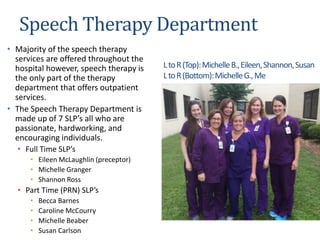
• The Speech Therapy Department is
made up of 7 SLP’s all who are
passionate, hardworking, and
encouraging individuals.
• Full Time SLP’s
• Eileen McLaughlin (preceptor)
• Michelle Granger
• Shannon Ross
• Part Time (PRN) SLP’s
• Becca Barnes
• Caroline McCourry
• Michelle Beaber
• Susan Carlson
LtoR(Top):MichelleB.,Eileen,Shannon,Susan
LtoR(Bottom):MichelleG.,Me
Speech Therapy Office
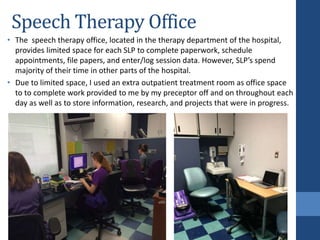
• The speech therapy office, located in the therapy department of the hospital,
provides limited space for each SLP to complete paperwork, schedule
appointments, file papers, and enter/log session data. However, SLP’s spend
majority of their time in other parts of the hospital.
• Due to limited space, I used an extra outpatient treatment room as office space
to to complete work provided to me by my preceptor off and on throughout each
day as well as to store information, research, and projects that were in progress.
Outpatient Therapy Room
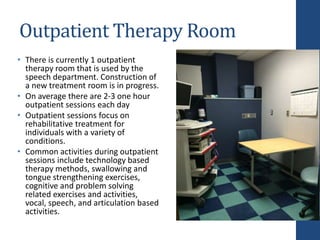
• There is currently 1 outpatient
therapy room that is used by the
speech department. Construction of
a new treatment room is in progress.
• On average there are 2-3 one hour
outpatient sessions each day
• Outpatient sessions focus on
rehabilitative treatment for
individuals with a variety of
conditions.
• Common activities during outpatient
sessions include technology based
therapy methods, swallowing and
tongue strengthening exercises,
cognitive and problem solving
related exercises and activities,
vocal, speech, and articulation based
activities.
Inpatient Treatment
• SLP’s are consulted to see patients with a variety of conditions
and diagnoses. Most commonly SLP’s are consulted to
evaluate patients who suffer from swallow difficulty
(dysphagia), speech/language difficulty (aphasia), or
decrease in cognitive/memory function Patients likely to
suffer from these difficulties are those diagnosed with:
• Stroke, TIA, or Stroke Symptoms
• Traumatic Brain Injury
• Spinal Cord Injuries
• Pneumonia
• Trauma
• Heart Attack
• Brain Hemorrhage
• Respiratory Disease
Inpatient Treatment
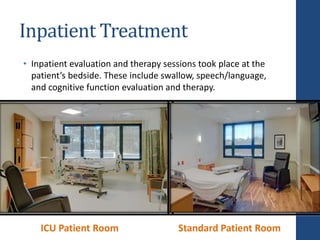
• Inpatient evaluation and therapy sessions took place at the
patient’s bedside. These include swallow, speech/language,
and cognitive function evaluation and therapy.
ICU Patient Room Standard Patient Room
My Responsibilities and Duties
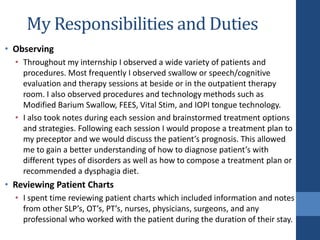
• Observing
• Throughout my internship I observed a wide variety of patients and
procedures. Most frequently I observed swallow or speech/cognitive
evaluation and therapy sessions at beside or in the outpatient therapy
room. I also observed procedures and technology methods such as
Modified Barium Swallow, FEES, Vital Stim, and IOPI tongue technology.
• I also took notes during each session and brainstormed treatment options
and strategies. Following each session I would propose a treatment plan to
my preceptor and we would discuss the patient’s prognosis. This allowed
me to gain a better understanding of how to diagnose patient’s with
different types of disorders as well as how to compose a treatment plan or
recommended a dysphagia diet.
• Reviewing Patient Charts
• I spent time reviewing patient charts which included information and notes
from other SLP’s, OT’s, PT’s, nurses, physicians, surgeons, and any
professional who worked with the patient during the duration of their stay.
My Responsibilities and Duties
• Recording Data
• During evaluation or therapy sessions I
would record data for my preceptor. For
example, when conducting a cognitive
evaluation I would keep track of the
time and how many objects the patient
correctly verbalized during the specified
time frame.
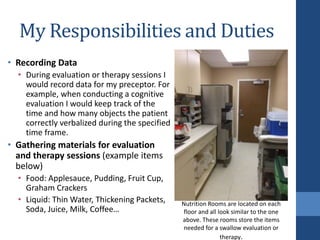
• Gathering materials for evaluation
and therapy sessions (example items
below)
• Food: Applesauce, Pudding, Fruit Cup,
Graham Crackers
• Liquid: Thin Water, Thickening Packets,
Soda, Juice, Milk, Coffee…
Nutrition Rooms are located on each
floor and all look similar to the one
above. These rooms store the items
needed for a swallow evaluation or
therapy.
My Responsibilities and Duties
• Weekly Learning Skills: Each week my preceptor had knowledge based goals
for me as to what I should learn that week relating to a career in speech
therapy. I achieved these learning goals through observation, watching
educational videos provided by my preceptor, reading information provided
by my preceptor, and researching. Gaining knowledge in the areas below
made my time observing much more beneficial. Here are a few examples of
the areas in which I gained knowledge throughout my internship
• Stroke: Types, Causes, Symptoms, Treatment, Effect on Speech/Swallow
• Brain Injury: Types, Causes, Symptoms, Treatment, Effect on Speech/Swallow
• Aspiration: Signs and Symptoms, Risks, Severity
• Aphasia: Types, Therapy Strategies
• Dysphagia: Diet Types, Therapy Strategies
• Diagnostic Testing: 5 most common tests and how to administer them
• Tracheostomies: Procedure details and it’s effects on swallow/speech
• Parkinson’s Disease: Symptoms, Effect on Speech/Swallow
• Working on Internship Projects: When not seeing patients or working on
something for my preceptor I would spend time on my projects I chose to
complete for my internship. These projects are explained further in the
PowerPoint.
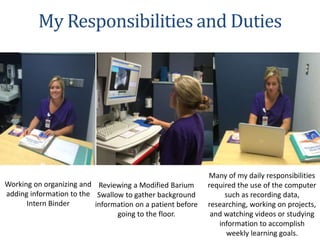
Working on organizing and
adding information to the
Intern Binder
Reviewing a Modified Barium
Swallow to gather background
information on a patient before
going to the floor.
My Responsibilities and Duties
Many of my daily responsibilities
required the use of the computer
such as recording data,
researching, working on projects,
and watching videos or studying
information to accomplish
weekly learning goals.
Typical Day
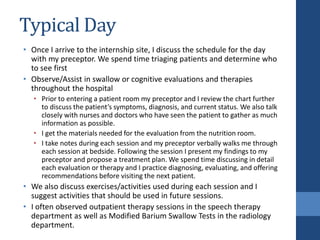
• Once I arrive to the internship site, I discuss the schedule for the day
with my preceptor. We spend time triaging patients and determine who
to see first
• Observe/Assist in swallow or cognitive evaluations and therapies
throughout the hospital
• Prior to entering a patient room my preceptor and I review the chart further
to discuss the patient’s symptoms, diagnosis, and current status. We also talk
closely with nurses and doctors who have seen the patient to gather as much
information as possible.
• I get the materials needed for the evaluation from the nutrition room.
• I take notes during each session and my preceptor verbally walks me through
each session at bedside. Following the session I present my findings to my
preceptor and propose a treatment plan. We spend time discussing in detail
each evaluation or therapy and I practice diagnosing, evaluating, and offering
recommendations before visiting the next patient.
• We also discuss exercises/activities used during each session and I
suggest activities that should be used in future sessions.
• I often observed outpatient therapy sessions in the speech therapy
department as well as Modified Barium Swallow Tests in the radiology
department.
Commonly Observed Procedures:
Modified Barium Swallow & FEES
• When SLP’s need a better look at a patient’s swallow they will use 1 of 2
procedures depending on the patient’s ability to move from their room to
radiology. These procedures visualize whether or not a patient is aspirating
and help an SLP determine their ability to eat or drink safely.
• I learned a lot from observing these procedures and spend time with my
preceptor reviewing past procedures to practice diagnosing and evaluating.
• Modified Barium Swallow:
• Procedure done in Radiology; SLP delivers the procedure with a radiologist in
attendance.
• Foods and liquids contain barium paste that makes them visual when watching the
x-ray video.
• The Modified will show the movement of the food and liquid through the mouth
and esophagus on a video recording.
• FEES: Fiberoptic Endoscopic Evaluation of Swallowing
• Procedure is done at bedside by an SLP and pulmonologist
• Food and liquid are dyed using box color dye
• A video tube is inserted through the nose until it reaches the opening of the
esophagus.
• The video shows the patient’s ability to open and close the epiglottis and
esophagus to prevent food from entering the trachea.
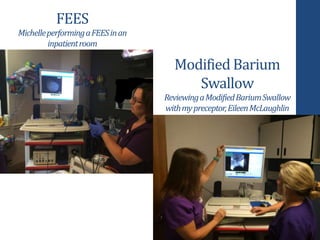
FEES
MichelleperformingaFEESinan
inpatientroom
Modified Barium
Swallow
ReviewingaModifiedBariumSwallow
withmypreceptor,EileenMcLaughlin
Project 1: Case Study
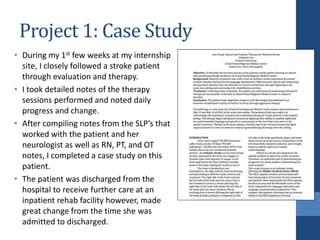
• During my 1st few weeks at my internship
site, I closely followed a stroke patient
through evaluation and therapy.
• I took detailed notes of the therapy
sessions performed and noted daily
progress and change.
• After compiling notes from the SLP’s that
worked with the patient and her
neurologist as well as RN, PT, and OT
notes, I completed a case study on this
patient.
• The patient was discharged from the
hospital to receive further care at an
inpatient rehab facility however, made
great change from the time she was
admitted to discharged.
Project 2: Dysphagia Handout
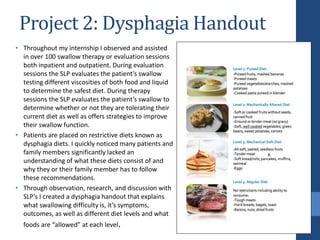
• Throughout my internship I observed and assisted
in over 100 swallow therapy or evaluation sessions
both inpatient and outpatient. During evaluation
sessions the SLP evaluates the patient’s swallow
testing different viscosities of both food and liquid
to determine the safest diet. During therapy
sessions the SLP evaluates the patient’s swallow to
determine whether or not they are tolerating their
current diet as well as offers strategies to improve
their swallow function.
• Patients are placed on restrictive diets known as
dysphagia diets. I quickly noticed many patients and
family members significantly lacked an
understanding of what these diets consist of and
why they or their family member has to follow
these recommendations.
• Through observation, research, and discussion with
SLP’s I created a dysphagia handout that explains
what swallowing difficulty is, it’s symptoms,
outcomes, as well as different diet levels and what
foods are “allowed” at each level.
Project 3: Intern Study Guide
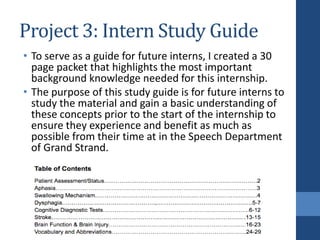
• To serve as a guide for future interns, I created a 30
page packet that highlights the most important
background knowledge needed for this internship.
• The purpose of this study guide is for future interns to
study the material and gain a basic understanding of
these concepts prior to the start of the internship to
ensure they experience and benefit as much as
possible from their time at in the Speech Department
of Grand Strand.
Project 4: Intern Notebook
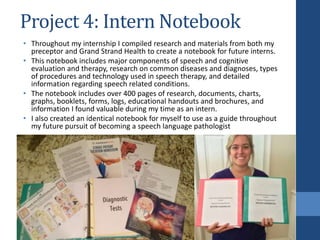
• Throughout my internship I compiled research and materials from both my
preceptor and Grand Strand Health to create a notebook for future interns.
• This notebook includes major components of speech and cognitive
evaluation and therapy, research on common diseases and diagnoses, types
of procedures and technology used in speech therapy, and detailed
information regarding speech related conditions.
• The notebook includes over 400 pages of research, documents, charts,
graphs, booklets, forms, logs, educational handouts and brochures, and
information I found valuable during my time as an intern.
• I also created an identical notebook for myself to use as a guide throughout
my future pursuit of becoming a speech language pathologist
Project 5: Vocabulary List
• During my internship I was exposed to a great amount of
terminology not only related to speech pathology but also
medical terms and abbreviations, conditions, symptoms,
surgeries, and anatomical and physiological related terms
that were unfamiliar to me at the time. I found it beneficial
to spend time looking up definitions, understanding
conditions, symptoms, diagnoses, and recognizing
abbreviations when reading charts or patient histories.
• The vocabulary list includes over 60 terms and 100
abbreviations.
• I chose to create a vocabulary list that the speech
department will be able to provide for future interns in this
specific location.
Internship Outcomes
• Completing my internship at Grand Strand Medical Center allowed me
to reach many personal goals and further prepared me for a future as a
SLP. This experience reinforced my career goals and expanded my
knowledge in many areas. I benefited from this experience not only
from a professional or educational standpoint but also from a personal
level.
• I understand and feel more prepared for the emotional aspect of
working in the health field specifically with elderly patients and patients
with life threatening conditions.
• I have a better understanding of the types of evaluation and methods
that are used for both swallowing and cognitive functioning.
• I have a better understanding of the types of therapy materials,
strategies, activities, and exercises that are used to increase swallow
function, cognitive ability, or speech and language productivity.
• I feel more confident communicating with professionals, patients, and
loved ones.
• I understand the importance of all types of therapy and how these
therapy methods interact with one another.
Internship Outcomes
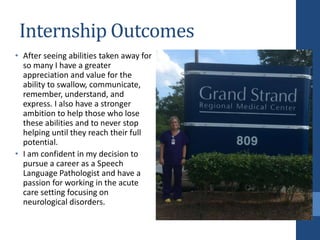
• After seeing abilities taken away for
so many I have a greater
appreciation and value for the
ability to swallow, communicate,
remember, understand, and
express. I also have a stronger
ambition to help those who lose
these abilities and to never stop
helping until they reach their full
potential.
• I am confident in my decision to
pursue a career as a Speech
Language Pathologist and have a
passion for working in the acute
care setting focusing on
neurological disorders.
Conclusion
• My experience in the Speech Therapy Department of Grand Strand
Medical Center has been far beyond words, pictures, or descriptions.
The knowledge and experience I have gained from my time spent at
my internship is invaluable to my career goals as well as my future. I
have learned an unbelievable amount of information about this
career, the field of therapy, the opportunities and endless
opportunities speech pathology provides, and the impact you have on
others. Mrs. McLaughlin along with the other SLP’s never stopped
encouraging and motivating me throughout my internship to learn
more, do more, see more and to pursue a career in this field. They
offered endless suggestions, tips, and personal advice for my future as
an SLP. I am thankful for the relationships I have built at my internship
and for the countless hours observing and seeing first hand what I
want do with my future. This experience has opened my eyes to all
that speech therapy has to offer, reinforced my career goals, and
added to my excitement of pursing a career as an SLP.

Internship PowerPoint

  • 1.
    Health Science Internship GrandStrand Regional Medical Center Speech Therapy Department Elizabeth Cox May -July 2016 Myrtle Beach, SC Clemson University
  • 2.
    Introduction • As aHealth Science student at Clemson University we are required to complete a 180 hour internship in a career of choice. • With a strong interest in speech therapy I was given the opportunity to intern with Eileen McLaughlin, a speech language pathologist (SLP) at Grand Strand Medical Center during the Summer of 2016. • This internship was a rewarding and memorable experience that not only expanded my interest and passion for speech and swallow therapy but solidified my career goals of becoming an SLP in the future. • This PowerPoint will serve as an overview of my internship experience by providing information related to my internship site and department, list my role as an intern, explain speech therapy’s role in this hospital, and summarize the projects I worked on and completed throughout my internship
  • 3.
    • Grand StrandMedical Center is a 301 bed acute care hospital that is part of the Grand Strand Health System. • Some of the service and programs offered by Grand Strand Medical Center are listed below. • Breast Health, Cancer, Cardiac, Emergency Care, Imagine Services, Spine and Neuro Care • Grand Strand Medical Center offers the only cardiac surgery program, neurosurgery program, and pediatric intensive care unit (PICU) in Horry and surrounding counties. • The hospital is a designated Level II Trauma Center and an Advanced Primary Stroke Center • Grand Strand Medical Center is a top performer in these key areas: Heart Attack, Heart Failure, Pneumonia, Surgical Care • Grand Strand offers a Graduate Medical Education (GME) program and is a certified teaching hospital accepting residents to participate in several different programs throughout the hospital. Grand Strand Medical Center
  • 4.
    “Above all else,we are committed to the care and improvement of human life. In recognition of this commitment, we strive to deliver high quality, cost effective healthcare in the communities we serve. In pursuit of our mission, we believe the following value statements are essential and timeless. • We recognize and affirm the unique and intrinsic worth of each individual. • We treat all those we serve with compassion and kindness. • We act with absolute honesty, integrity and fairness in the way we conduct our business and the way we live our lives. • We trust our colleagues as valuable members of our healthcare team and pledge to treat one another with loyalty, respect and dignity.” Grand Strand Regional Medical Center Mission and Vision Myrtle Beach, SC
  • 5.
    Therapy Department • Thetherapy department is made up of occupational therapists (OT), physical therapists (PT), and speech language pathologists (SLP). These individuals work as a team to provide quality care for patients throughout the hospital. • The therapy department includes: • Office space for SLP, OT, and PT • 2 SLP outpatient treatment rooms • Aquatic therapy room for PT • Majority of therapy services are conducted in inpatient rooms throughout the hospital
  • 6.
    Speech Therapy Department •Majority of the speech therapy services are offered throughout the hospital however, speech therapy is the only part of the therapy department that offers outpatient services. • The Speech Therapy Department is made up of 7 SLP’s all who are passionate, hardworking, and encouraging individuals. • Full Time SLP’s • Eileen McLaughlin (preceptor) • Michelle Granger • Shannon Ross • Part Time (PRN) SLP’s • Becca Barnes • Caroline McCourry • Michelle Beaber • Susan Carlson LtoR(Top):MichelleB.,Eileen,Shannon,Susan LtoR(Bottom):MichelleG.,Me
  • 7.
    Speech Therapy Office •The speech therapy office, located in the therapy department of the hospital, provides limited space for each SLP to complete paperwork, schedule appointments, file papers, and enter/log session data. However, SLP’s spend majority of their time in other parts of the hospital. • Due to limited space, I used an extra outpatient treatment room as office space to to complete work provided to me by my preceptor off and on throughout each day as well as to store information, research, and projects that were in progress.
  • 8.
    Outpatient Therapy Room •There is currently 1 outpatient therapy room that is used by the speech department. Construction of a new treatment room is in progress. • On average there are 2-3 one hour outpatient sessions each day • Outpatient sessions focus on rehabilitative treatment for individuals with a variety of conditions. • Common activities during outpatient sessions include technology based therapy methods, swallowing and tongue strengthening exercises, cognitive and problem solving related exercises and activities, vocal, speech, and articulation based activities.
  • 9.
    Inpatient Treatment • SLP’sare consulted to see patients with a variety of conditions and diagnoses. Most commonly SLP’s are consulted to evaluate patients who suffer from swallow difficulty (dysphagia), speech/language difficulty (aphasia), or decrease in cognitive/memory function Patients likely to suffer from these difficulties are those diagnosed with: • Stroke, TIA, or Stroke Symptoms • Traumatic Brain Injury • Spinal Cord Injuries • Pneumonia • Trauma • Heart Attack • Brain Hemorrhage • Respiratory Disease
  • 10.
    Inpatient Treatment • Inpatientevaluation and therapy sessions took place at the patient’s bedside. These include swallow, speech/language, and cognitive function evaluation and therapy. ICU Patient Room Standard Patient Room
  • 11.
    My Responsibilities andDuties • Observing • Throughout my internship I observed a wide variety of patients and procedures. Most frequently I observed swallow or speech/cognitive evaluation and therapy sessions at beside or in the outpatient therapy room. I also observed procedures and technology methods such as Modified Barium Swallow, FEES, Vital Stim, and IOPI tongue technology. • I also took notes during each session and brainstormed treatment options and strategies. Following each session I would propose a treatment plan to my preceptor and we would discuss the patient’s prognosis. This allowed me to gain a better understanding of how to diagnose patient’s with different types of disorders as well as how to compose a treatment plan or recommended a dysphagia diet. • Reviewing Patient Charts • I spent time reviewing patient charts which included information and notes from other SLP’s, OT’s, PT’s, nurses, physicians, surgeons, and any professional who worked with the patient during the duration of their stay.
  • 12.
    My Responsibilities andDuties • Recording Data • During evaluation or therapy sessions I would record data for my preceptor. For example, when conducting a cognitive evaluation I would keep track of the time and how many objects the patient correctly verbalized during the specified time frame. • Gathering materials for evaluation and therapy sessions (example items below) • Food: Applesauce, Pudding, Fruit Cup, Graham Crackers • Liquid: Thin Water, Thickening Packets, Soda, Juice, Milk, Coffee… Nutrition Rooms are located on each floor and all look similar to the one above. These rooms store the items needed for a swallow evaluation or therapy.
  • 13.
    My Responsibilities andDuties • Weekly Learning Skills: Each week my preceptor had knowledge based goals for me as to what I should learn that week relating to a career in speech therapy. I achieved these learning goals through observation, watching educational videos provided by my preceptor, reading information provided by my preceptor, and researching. Gaining knowledge in the areas below made my time observing much more beneficial. Here are a few examples of the areas in which I gained knowledge throughout my internship • Stroke: Types, Causes, Symptoms, Treatment, Effect on Speech/Swallow • Brain Injury: Types, Causes, Symptoms, Treatment, Effect on Speech/Swallow • Aspiration: Signs and Symptoms, Risks, Severity • Aphasia: Types, Therapy Strategies • Dysphagia: Diet Types, Therapy Strategies • Diagnostic Testing: 5 most common tests and how to administer them • Tracheostomies: Procedure details and it’s effects on swallow/speech • Parkinson’s Disease: Symptoms, Effect on Speech/Swallow • Working on Internship Projects: When not seeing patients or working on something for my preceptor I would spend time on my projects I chose to complete for my internship. These projects are explained further in the PowerPoint.
  • 14.
    Working on organizingand adding information to the Intern Binder Reviewing a Modified Barium Swallow to gather background information on a patient before going to the floor. My Responsibilities and Duties Many of my daily responsibilities required the use of the computer such as recording data, researching, working on projects, and watching videos or studying information to accomplish weekly learning goals.
  • 15.
    Typical Day • OnceI arrive to the internship site, I discuss the schedule for the day with my preceptor. We spend time triaging patients and determine who to see first • Observe/Assist in swallow or cognitive evaluations and therapies throughout the hospital • Prior to entering a patient room my preceptor and I review the chart further to discuss the patient’s symptoms, diagnosis, and current status. We also talk closely with nurses and doctors who have seen the patient to gather as much information as possible. • I get the materials needed for the evaluation from the nutrition room. • I take notes during each session and my preceptor verbally walks me through each session at bedside. Following the session I present my findings to my preceptor and propose a treatment plan. We spend time discussing in detail each evaluation or therapy and I practice diagnosing, evaluating, and offering recommendations before visiting the next patient. • We also discuss exercises/activities used during each session and I suggest activities that should be used in future sessions. • I often observed outpatient therapy sessions in the speech therapy department as well as Modified Barium Swallow Tests in the radiology department.
  • 16.
    Commonly Observed Procedures: ModifiedBarium Swallow & FEES • When SLP’s need a better look at a patient’s swallow they will use 1 of 2 procedures depending on the patient’s ability to move from their room to radiology. These procedures visualize whether or not a patient is aspirating and help an SLP determine their ability to eat or drink safely. • I learned a lot from observing these procedures and spend time with my preceptor reviewing past procedures to practice diagnosing and evaluating. • Modified Barium Swallow: • Procedure done in Radiology; SLP delivers the procedure with a radiologist in attendance. • Foods and liquids contain barium paste that makes them visual when watching the x-ray video. • The Modified will show the movement of the food and liquid through the mouth and esophagus on a video recording. • FEES: Fiberoptic Endoscopic Evaluation of Swallowing • Procedure is done at bedside by an SLP and pulmonologist • Food and liquid are dyed using box color dye • A video tube is inserted through the nose until it reaches the opening of the esophagus. • The video shows the patient’s ability to open and close the epiglottis and esophagus to prevent food from entering the trachea.
  • 17.
  • 18.
    Project 1: CaseStudy • During my 1st few weeks at my internship site, I closely followed a stroke patient through evaluation and therapy. • I took detailed notes of the therapy sessions performed and noted daily progress and change. • After compiling notes from the SLP’s that worked with the patient and her neurologist as well as RN, PT, and OT notes, I completed a case study on this patient. • The patient was discharged from the hospital to receive further care at an inpatient rehab facility however, made great change from the time she was admitted to discharged.
  • 19.
    Project 2: DysphagiaHandout • Throughout my internship I observed and assisted in over 100 swallow therapy or evaluation sessions both inpatient and outpatient. During evaluation sessions the SLP evaluates the patient’s swallow testing different viscosities of both food and liquid to determine the safest diet. During therapy sessions the SLP evaluates the patient’s swallow to determine whether or not they are tolerating their current diet as well as offers strategies to improve their swallow function. • Patients are placed on restrictive diets known as dysphagia diets. I quickly noticed many patients and family members significantly lacked an understanding of what these diets consist of and why they or their family member has to follow these recommendations. • Through observation, research, and discussion with SLP’s I created a dysphagia handout that explains what swallowing difficulty is, it’s symptoms, outcomes, as well as different diet levels and what foods are “allowed” at each level.
  • 20.
    Project 3: InternStudy Guide • To serve as a guide for future interns, I created a 30 page packet that highlights the most important background knowledge needed for this internship. • The purpose of this study guide is for future interns to study the material and gain a basic understanding of these concepts prior to the start of the internship to ensure they experience and benefit as much as possible from their time at in the Speech Department of Grand Strand.
  • 21.
    Project 4: InternNotebook • Throughout my internship I compiled research and materials from both my preceptor and Grand Strand Health to create a notebook for future interns. • This notebook includes major components of speech and cognitive evaluation and therapy, research on common diseases and diagnoses, types of procedures and technology used in speech therapy, and detailed information regarding speech related conditions. • The notebook includes over 400 pages of research, documents, charts, graphs, booklets, forms, logs, educational handouts and brochures, and information I found valuable during my time as an intern. • I also created an identical notebook for myself to use as a guide throughout my future pursuit of becoming a speech language pathologist
  • 22.
    Project 5: VocabularyList • During my internship I was exposed to a great amount of terminology not only related to speech pathology but also medical terms and abbreviations, conditions, symptoms, surgeries, and anatomical and physiological related terms that were unfamiliar to me at the time. I found it beneficial to spend time looking up definitions, understanding conditions, symptoms, diagnoses, and recognizing abbreviations when reading charts or patient histories. • The vocabulary list includes over 60 terms and 100 abbreviations. • I chose to create a vocabulary list that the speech department will be able to provide for future interns in this specific location.
  • 23.
    Internship Outcomes • Completingmy internship at Grand Strand Medical Center allowed me to reach many personal goals and further prepared me for a future as a SLP. This experience reinforced my career goals and expanded my knowledge in many areas. I benefited from this experience not only from a professional or educational standpoint but also from a personal level. • I understand and feel more prepared for the emotional aspect of working in the health field specifically with elderly patients and patients with life threatening conditions. • I have a better understanding of the types of evaluation and methods that are used for both swallowing and cognitive functioning. • I have a better understanding of the types of therapy materials, strategies, activities, and exercises that are used to increase swallow function, cognitive ability, or speech and language productivity. • I feel more confident communicating with professionals, patients, and loved ones. • I understand the importance of all types of therapy and how these therapy methods interact with one another.
  • 24.
    Internship Outcomes • Afterseeing abilities taken away for so many I have a greater appreciation and value for the ability to swallow, communicate, remember, understand, and express. I also have a stronger ambition to help those who lose these abilities and to never stop helping until they reach their full potential. • I am confident in my decision to pursue a career as a Speech Language Pathologist and have a passion for working in the acute care setting focusing on neurological disorders.
  • 25.
    Conclusion • My experiencein the Speech Therapy Department of Grand Strand Medical Center has been far beyond words, pictures, or descriptions. The knowledge and experience I have gained from my time spent at my internship is invaluable to my career goals as well as my future. I have learned an unbelievable amount of information about this career, the field of therapy, the opportunities and endless opportunities speech pathology provides, and the impact you have on others. Mrs. McLaughlin along with the other SLP’s never stopped encouraging and motivating me throughout my internship to learn more, do more, see more and to pursue a career in this field. They offered endless suggestions, tips, and personal advice for my future as an SLP. I am thankful for the relationships I have built at my internship and for the countless hours observing and seeing first hand what I want do with my future. This experience has opened my eyes to all that speech therapy has to offer, reinforced my career goals, and added to my excitement of pursing a career as an SLP.