Properties of ElectroMagnetic Radiation (Light)
Introduction
A.) Spectroscopy: A method of analysis based on the interaction, absorption or
production of light by matter. (also may include the interaction of electrons, ions or
acoustics with matter)
B.) Light: Electromagnetic radiation
Two different views of light:
1.) Wave Model
1. Wave Model
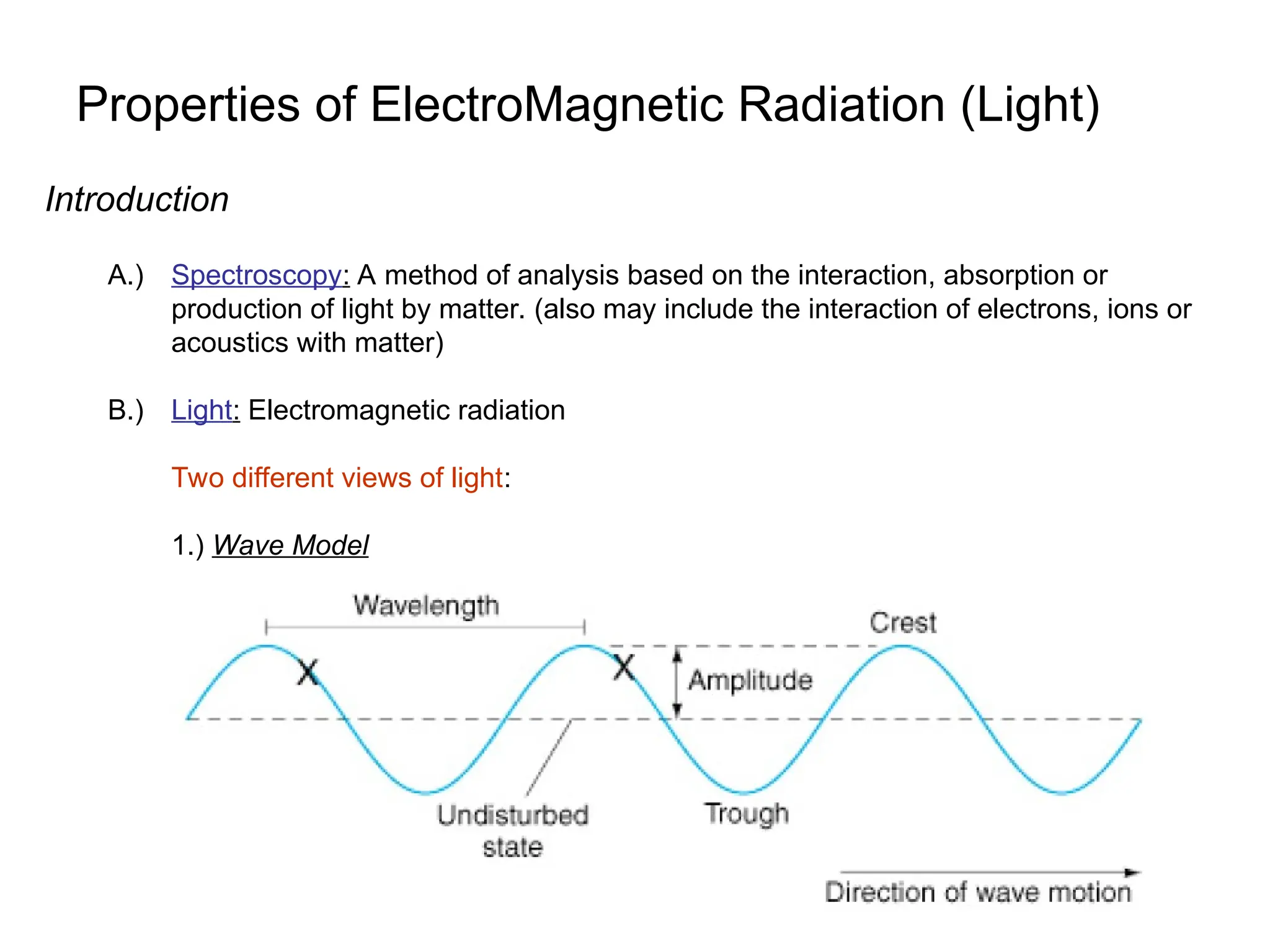
i.) represented by a sinusoidal wave traveling in space with an oscillating electric
field and perpendicular magnetic field. (electric field is what is considered or
used in most spectroscopic methods – except NMR)
ii.) description of wave model
1) amplitude (A) – height of wave’s electric vector
2) wavelength () – distance (nm, cm, m) from peak to peak
a) wave number ((cm-1
)
v
1. Wave Model
ii.) description of wave model
3) frequency () – number of cycles or oscillations per second
a) hertz (Hz) or s-1
.
4) velocity of propagation (vi) – rate of travel through space, dependent on
composition of
medium
a) vi = i
b) maximum velocity (c) – speed of light in a vacuum (3.00
x108
m/s)
c) slower in other media (~ 0.03% slower in air)
2. Particle Model
i.) light viewed as discrete particles of energy called photons
a) like other particles, light can be scattered, counted (quantized) , etc
ii. ) Energy of wave/particle:
E = h = hc/ = hc
h = Plank’s constant (6.63 x 10⁻³⁴
J.
S)
 = frequency,  = wavelength, =wave number
note:
energy is proportional to frequency and wave number (
E)
energy is inversely proportional to wavelength
()
Eo
E1
h Energy required of photon
to give this transition:

v
v
Wide Range of Types of Electromagnetic Radiation in nature.
1. Only a small fraction (350-780 nM is visible light).
2. The complete variety of electromagnetic radiation is used throughout spectroscopy.
3. Different energies allow monitoring of different types of interactions with matter.
Common Spectroscopic Methods Based on Electromagnetic Radiation
Type of
Spectroscopy
Usual
Wavelength
Range
Usual Wave
number
Range, cm-1
Type of
Quantum
Transition
Gamma-ray
emission
0.005-1.4 Å _ Nuclear
X-ray absorption,
emission,
fluorescence, and
diffraction
0.1-100 Å _ Inner electron
Vacuum ultraviolet
absorption
10-180 nm 1x10⁶
to 5x10⁴
Bonding electrons
Ultraviolet visible
absorption,
emission,
fluorescence
180 -780 nm 5x10⁴
to 1.3x10⁴
Bonding electrons
Infrared absorption
and Raman
scattering
0.78-300 m 1.3x10⁴
to 3.3x101
Rotation/vibration
of molecules
Microwave
absorption
0.75-3.75 mm 13-27 Rotation of
molecules
Electron spin
resonance
3 cm 0.33 Spin of electrons in
a magnetic field
Nuclear magnetic
resonance
0.6-10 m 1.7x10⁻²
to 1x10³
Spin of nuclei in a
magnetic field
Properties of Light
1.) Refraction: change in direction in the travel of a light beam when it comes at
an angle to a boundary (interface) between two transparent media with
different densities.
Pencil appears to bend at water/air
interface due to refraction of light
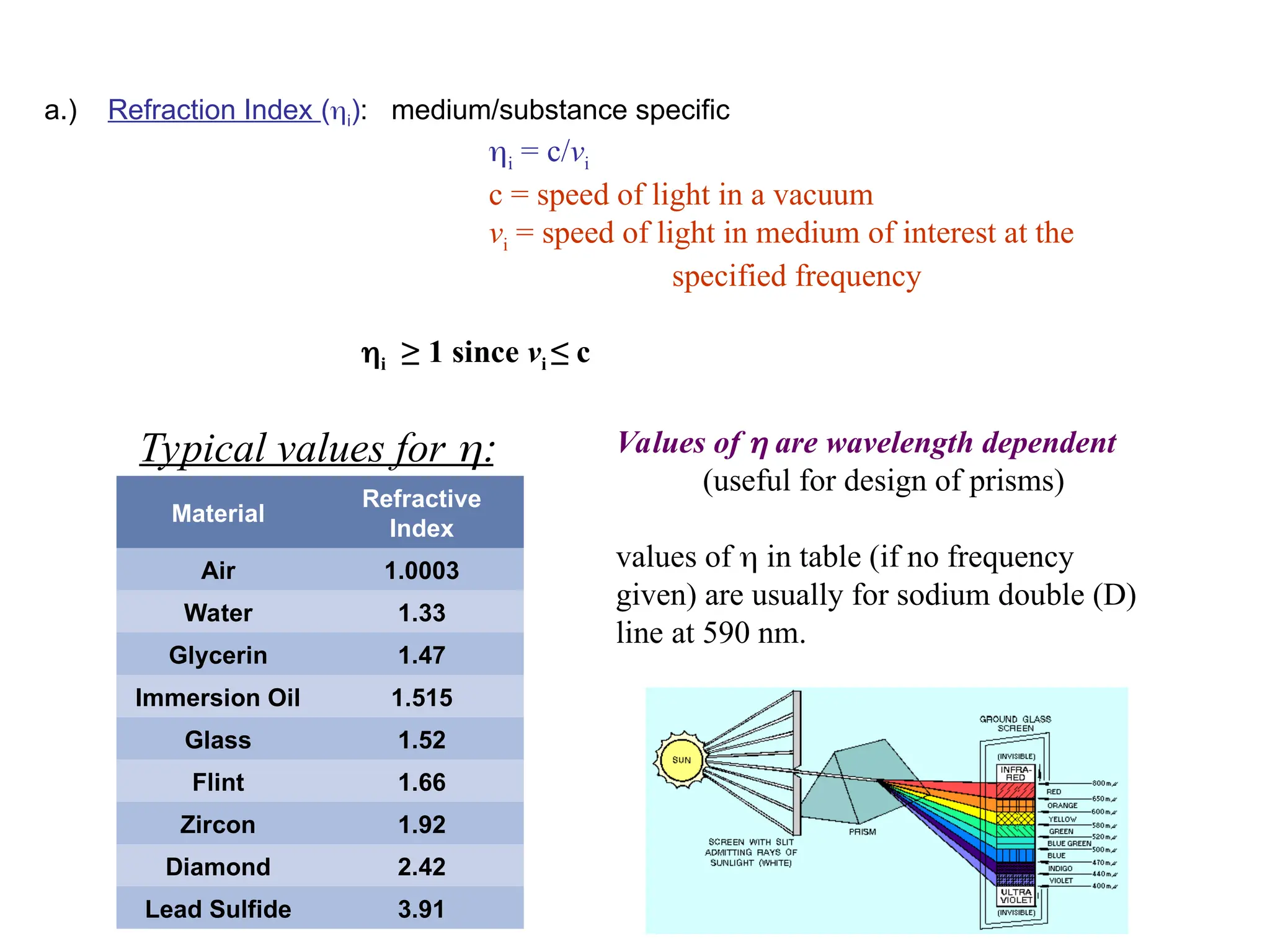
Material
Refractive
Index
Air 1.0003
Water 1.33
Glycerin 1.47
Immersion Oil 1.515
Glass 1.52
Flint 1.66
Zircon 1.92
Diamond 2.42
Lead Sulfide 3.91
a.) Refraction Index (i): medium/substance specific
i = c/vi
c = speed of light in a vacuum
vi = speed of light in medium of interest at the
specified frequency
i≥ 1 since vi ≤ c
 Typical values for  Values of  are wavelength dependent
(useful for design of prisms)
values of  in table (if no frequency
given) are usually for sodium double (D)
line at 590 nm.
b.) Snell’s Law: process of refraction
1sin1sin2
normal
Change in direction of light after it
encounters the interface. Change in
interface is given by Snell’s Law
• If 1 = 2, no change in direction, no refraction occurs
• The bigger the difference in 1 and 2, the more bending or refraction that occurs
• When light comes in at a right angle (1 = 0), no refraction occurs.
Properties of Light
2.) Reflection: when radiation crosses an interface between media that differ in
refractive index, some or all of the light travels back into the medium from
where it travel
Ansel Adams Mono Lake
• Reflected light comes out at same angle as incident beam, but on other side of normal.
- Reflection occurs at each interface (when enters and exit)
• Always occurs along with refraction, reflection increases with bigger difference in 1 and 2.
• Occurs at all angles. At 90o
to boundary (on normal) fraction reflected is given by:
Ir/Io = (2-1)2
/(2+1)2
 Ir/Io at values of 1 > 0 approaches 1 at
large angles (basis of fiber optics)
normal
Io
Ir
Properties of Light
3.) Diffraction: the bending of a parallel beam of light (or other electromagnetic
radiation) as it passes a sharp barrier or through a narrow
opening.
a.) most pronounced when size of slit or opening is approximately the same
size as the frequency of light.
Radiation of a point source of light in
all directions on other side of slit.
b.) Interference – diffraction is a consequence of interference
i.) Two types of interference.
1) constructive – waves “in-phase” electric fields are
additive
2) destructive – waves “out of phase” electric fields
subtract
When two light waves of the same
wavelength (color) combine exactly
in phase (in step) their amplitudes
add to produce a large (brighter)
wave of maximum intensity.
If the light waves combine out of
phase (out of step) their combined
amplitudes are less, and may even
totally cancel each other!
c.) Destructive Interference can be created when two waves from the
same source travel different paths to get to a point.
This may cause a difference in the phase between the two waves.
• If the paths differ by an integer multiple of a wavelength, the waves will also be in phase.
• If the waves differ by an odd multiple of half a wave then the waves will be 180 degrees out of
phase and cancel out.
d.) More then One Slit: series of constructive and destructive interference that
produces a series of high and low intensity regions – Interference Pattern
Multiple rainbows – Interference Pattern
Thomas Young double slit experiment
Patterns on screen depend on
frequency () or wavelength (),
distance between two slits (d) and
angle from normal ()
d.) Order of Interference (n): n = d sin
n=0 if two waves travel exactly the same distance, n=1 if differ by exactly 
Note: equation is frequency () or wavelength () dependent, so it is useful in separating
different  for use in spectroscopy (different ’s at different points in space)
Change slit distance Change frequency ()
Thomas Young double slit experiment
Example 2: What is the wavelength of a photon that has three times as much energy as
that of a photon whose wavelength is 779 nm?
Example 3: Calculate the output of a ruby laser at 694.3 nm when it is passing through a
piece of quartz, which has a refractive index of 1.55

Spectroscopy, its types and application.ppt

  • 1.
    Properties of ElectroMagneticRadiation (Light) Introduction A.) Spectroscopy: A method of analysis based on the interaction, absorption or production of light by matter. (also may include the interaction of electrons, ions or acoustics with matter) B.) Light: Electromagnetic radiation Two different views of light: 1.) Wave Model
  • 2.
    1. Wave Model i.)represented by a sinusoidal wave traveling in space with an oscillating electric field and perpendicular magnetic field. (electric field is what is considered or used in most spectroscopic methods – except NMR) ii.) description of wave model 1) amplitude (A) – height of wave’s electric vector 2) wavelength () – distance (nm, cm, m) from peak to peak a) wave number ((cm-1 ) v
  • 3.
    1. Wave Model ii.)description of wave model 3) frequency () – number of cycles or oscillations per second a) hertz (Hz) or s-1 . 4) velocity of propagation (vi) – rate of travel through space, dependent on composition of medium a) vi = i b) maximum velocity (c) – speed of light in a vacuum (3.00 x10⁸ m/s) c) slower in other media (~ 0.03% slower in air)
  • 4.
    2. Particle Model i.)light viewed as discrete particles of energy called photons a) like other particles, light can be scattered, counted (quantized) , etc ii. ) Energy of wave/particle: E = h = hc/ = hc h = Plank’s constant (6.63 x 10⁻³⁴ J. S)  = frequency,  = wavelength, =wave number note: energy is proportional to frequency and wave number ( E) energy is inversely proportional to wavelength () Eo E1 h Energy required of photon to give this transition:  v v
  • 5.
    Wide Range ofTypes of Electromagnetic Radiation in nature. 1. Only a small fraction (350-780 nM is visible light). 2. The complete variety of electromagnetic radiation is used throughout spectroscopy. 3. Different energies allow monitoring of different types of interactions with matter.
  • 6.
    Common Spectroscopic MethodsBased on Electromagnetic Radiation Type of Spectroscopy Usual Wavelength Range Usual Wave number Range, cm-1 Type of Quantum Transition Gamma-ray emission 0.005-1.4 Å _ Nuclear X-ray absorption, emission, fluorescence, and diffraction 0.1-100 Å _ Inner electron Vacuum ultraviolet absorption 10-180 nm 1x10⁶ to 5x10⁴ Bonding electrons Ultraviolet visible absorption, emission, fluorescence 180 -780 nm 5x10⁴ to 1.3x10⁴ Bonding electrons Infrared absorption and Raman scattering 0.78-300 m 1.3x10⁴ to 3.3x101 Rotation/vibration of molecules Microwave absorption 0.75-3.75 mm 13-27 Rotation of molecules Electron spin resonance 3 cm 0.33 Spin of electrons in a magnetic field Nuclear magnetic resonance 0.6-10 m 1.7x10⁻² to 1x10³ Spin of nuclei in a magnetic field
  • 7.
    Properties of Light 1.)Refraction: change in direction in the travel of a light beam when it comes at an angle to a boundary (interface) between two transparent media with different densities. Pencil appears to bend at water/air interface due to refraction of light
  • 8.
    Material Refractive Index Air 1.0003 Water 1.33 Glycerin1.47 Immersion Oil 1.515 Glass 1.52 Flint 1.66 Zircon 1.92 Diamond 2.42 Lead Sulfide 3.91 a.) Refraction Index (i): medium/substance specific i = c/vi c = speed of light in a vacuum vi = speed of light in medium of interest at the specified frequency i≥ 1 since vi ≤ c  Typical values for  Values of  are wavelength dependent (useful for design of prisms) values of  in table (if no frequency given) are usually for sodium double (D) line at 590 nm.
  • 9.
    b.) Snell’s Law:process of refraction 1sin1sin2 normal Change in direction of light after it encounters the interface. Change in interface is given by Snell’s Law • If 1 = 2, no change in direction, no refraction occurs • The bigger the difference in 1 and 2, the more bending or refraction that occurs • When light comes in at a right angle (1 = 0), no refraction occurs.
  • 10.
    Properties of Light 2.)Reflection: when radiation crosses an interface between media that differ in refractive index, some or all of the light travels back into the medium from where it travel Ansel Adams Mono Lake • Reflected light comes out at same angle as incident beam, but on other side of normal. - Reflection occurs at each interface (when enters and exit) • Always occurs along with refraction, reflection increases with bigger difference in 1 and 2. • Occurs at all angles. At 90o to boundary (on normal) fraction reflected is given by: Ir/Io = (2-1)2 /(2+1)2  Ir/Io at values of 1 > 0 approaches 1 at large angles (basis of fiber optics) normal Io Ir
  • 11.
    Properties of Light 3.)Diffraction: the bending of a parallel beam of light (or other electromagnetic radiation) as it passes a sharp barrier or through a narrow opening. a.) most pronounced when size of slit or opening is approximately the same size as the frequency of light. Radiation of a point source of light in all directions on other side of slit.
  • 12.
    b.) Interference –diffraction is a consequence of interference i.) Two types of interference. 1) constructive – waves “in-phase” electric fields are additive 2) destructive – waves “out of phase” electric fields subtract When two light waves of the same wavelength (color) combine exactly in phase (in step) their amplitudes add to produce a large (brighter) wave of maximum intensity. If the light waves combine out of phase (out of step) their combined amplitudes are less, and may even totally cancel each other!
  • 13.
    c.) Destructive Interferencecan be created when two waves from the same source travel different paths to get to a point. This may cause a difference in the phase between the two waves. • If the paths differ by an integer multiple of a wavelength, the waves will also be in phase. • If the waves differ by an odd multiple of half a wave then the waves will be 180 degrees out of phase and cancel out.
  • 14.
    d.) More thenOne Slit: series of constructive and destructive interference that produces a series of high and low intensity regions – Interference Pattern Multiple rainbows – Interference Pattern Thomas Young double slit experiment Patterns on screen depend on frequency () or wavelength (), distance between two slits (d) and angle from normal ()
  • 15.
    d.) Order ofInterference (n): n = d sin n=0 if two waves travel exactly the same distance, n=1 if differ by exactly  Note: equation is frequency () or wavelength () dependent, so it is useful in separating different  for use in spectroscopy (different ’s at different points in space) Change slit distance Change frequency () Thomas Young double slit experiment
  • 16.
    Example 2: Whatis the wavelength of a photon that has three times as much energy as that of a photon whose wavelength is 779 nm?
  • 17.
    Example 3: Calculatethe output of a ruby laser at 694.3 nm when it is passing through a piece of quartz, which has a refractive index of 1.55