LIGHT AS A WAVE
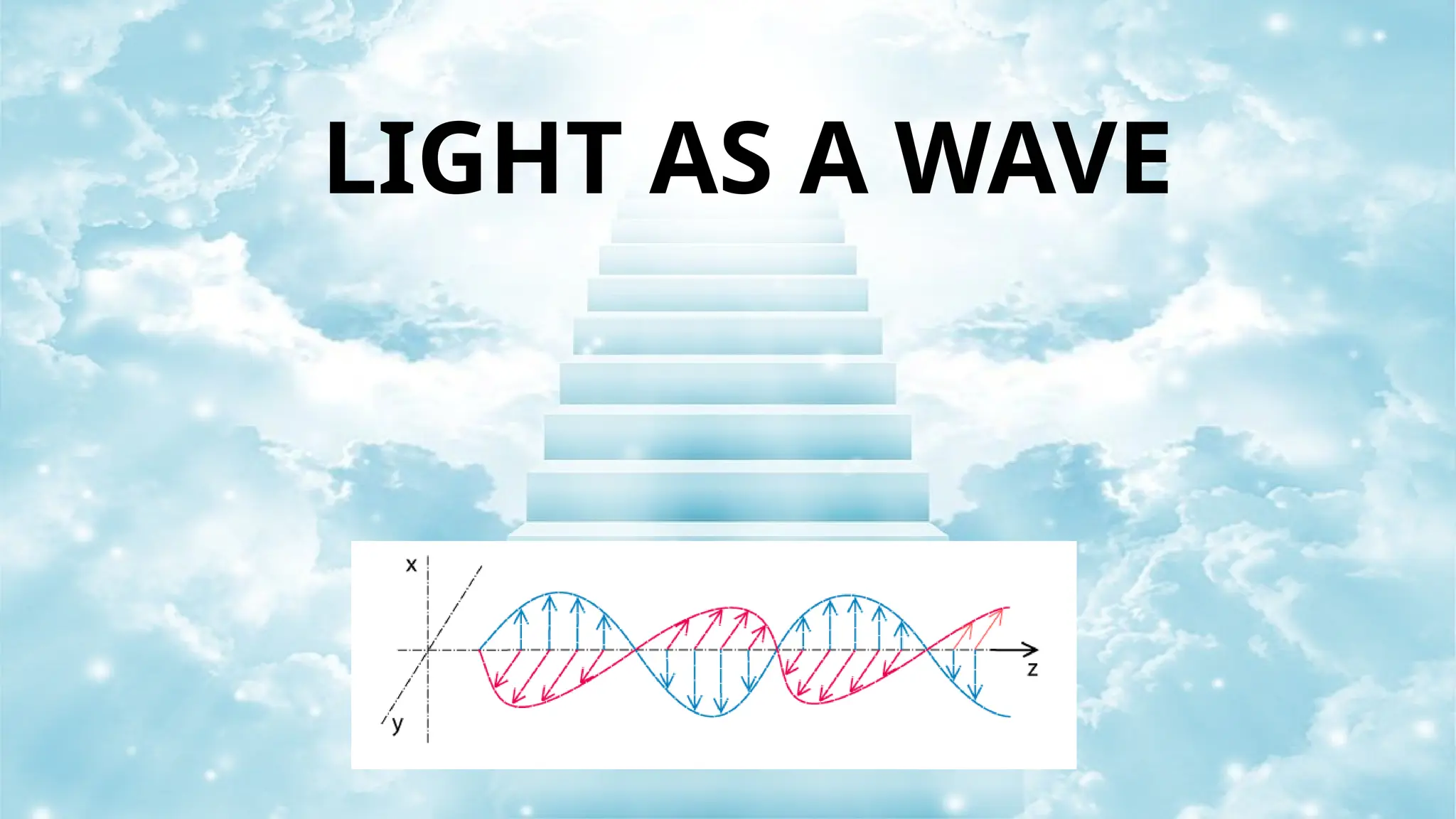
Light as a wave refers to the understanding of light's
behavior and properties through the framework of
wave theory in physics. This perspective views light as a
form of electromagnetic radiation that exhibits wave-
like characteristics as it travels through space.
Wave Nature of Light
The wave nature of light refers to its behavior as a
wave, characterized by properties such as wavelength,
frequency, and the ability to interfere and diffract. This
concept explains phenomena like colors, diffraction
patterns, and polarization, highlighting light's wave-like
characteristics alongside its particle-like behavior.
The wavelength of light refers to the distance between two consecutive peaks
or troughs of a light wave. It is usually measured in units such as meters (m),
nanometers (nm), or micrometers (μm).
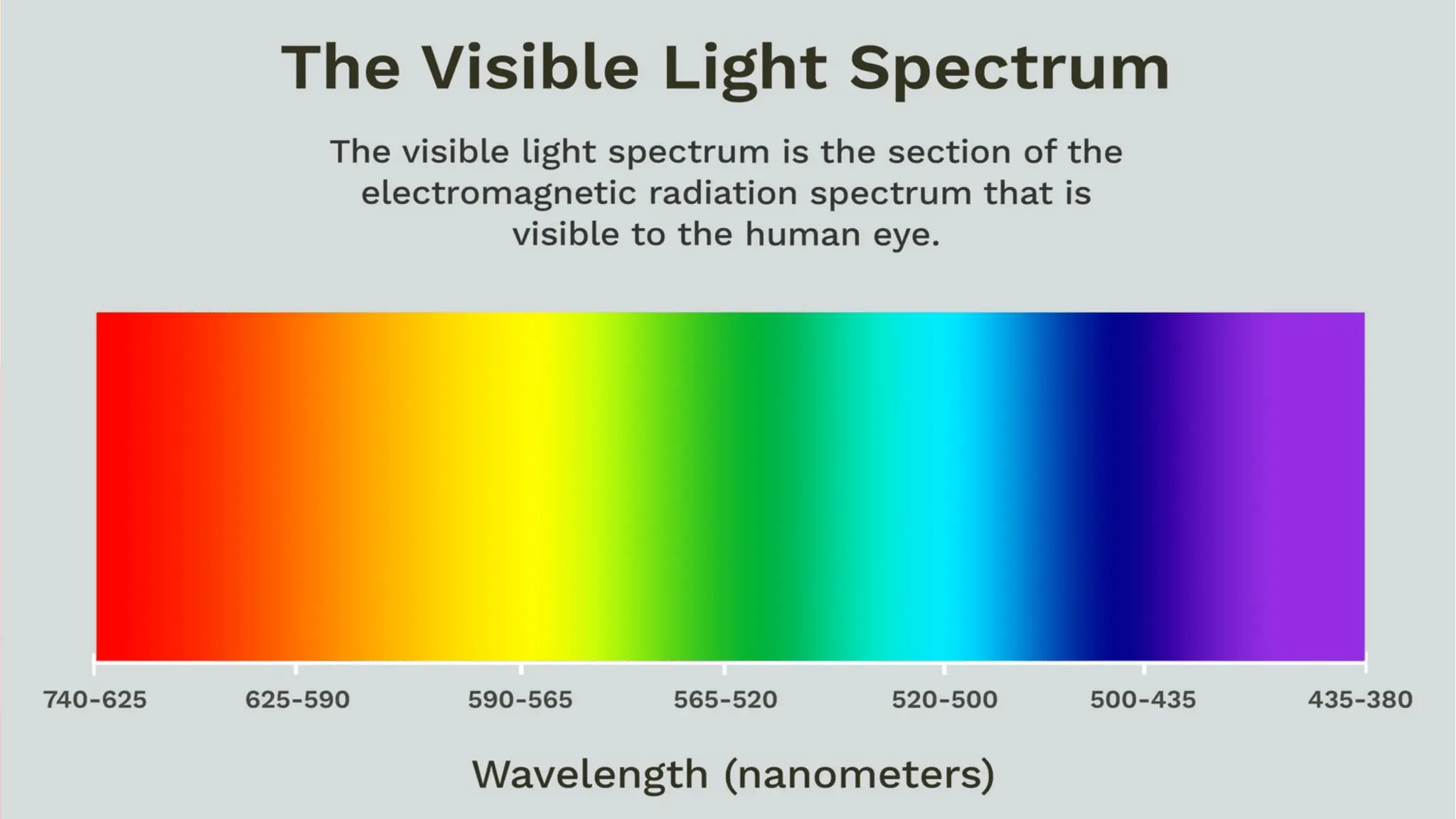
The wavelength of light varies depending on its color or frequency. In the
visible spectrum, which is the range of wavelengths visible to the human eye,
different colors correspond to different wavelengths:
• Red light typically has a wavelength of around 620-750 nm.
• Orange light ranges from approximately 590 to 620 nm.
• Yellow light has wavelengths around 570 to 590 nm.
• Green light falls within the range of 495 to 570 nm.
• Blue light typically ranges from 450 to 495 nm.
• Violet light has wavelengths around 380 to 450 nm.
Electromagnetic Spectrum of Light as a Wave
The electromagnetic spectrum encompasses the full range
of frequencies of electromagnetic radiation, including
light. When considering light as a wave, it falls within a
specific region of the electromagnetic spectrum, known as
the visible spectrum.
Electromagnetic Spectrum of Light as a Wave
• Radio Waves:
• Lowest frequency and longest wavelength.
• Used in radio communication, broadcasting, and radar.
• Microwaves:
• Slightly higher frequency and shorter wavelength compared to radio waves.
• Utilized in microwave ovens, satellite communication, and radar.
• Infrared Radiation:
• Wavelengths longer than visible light but shorter than microwaves.
• Perceived as heat; used in remote controls, thermal imaging, and infrared spectroscopy.
• Visible Light:
• The narrow range of wavelengths visible to the human eye.
• Wavelengths range from approximately 400 to 700 nanometers (nm).
• Divided into different colors: red, orange, yellow, green, blue, indigo, and violet.
• Used in everyday vision, optics, photography, and lighting.
• Ultraviolet (UV) Radiation:
• Shorter wavelengths than visible light.
• Not visible to the human eye.
• Causes sunburn and skin damage; used in sterilization, fluorescence, and some
medical treatments.
• X-Rays:
• Shorter wavelengths and higher frequencies than UV radiation.
• Used in medical imaging (X-ray radiography), security screening, and crystallography.
• Gamma Rays:
• Highest frequency and shortest wavelength in the electromagnetic spectrum.
• Emitted by radioactive decay and nuclear reactions.
• Used in cancer treatment (gamma knife) and sterilization.
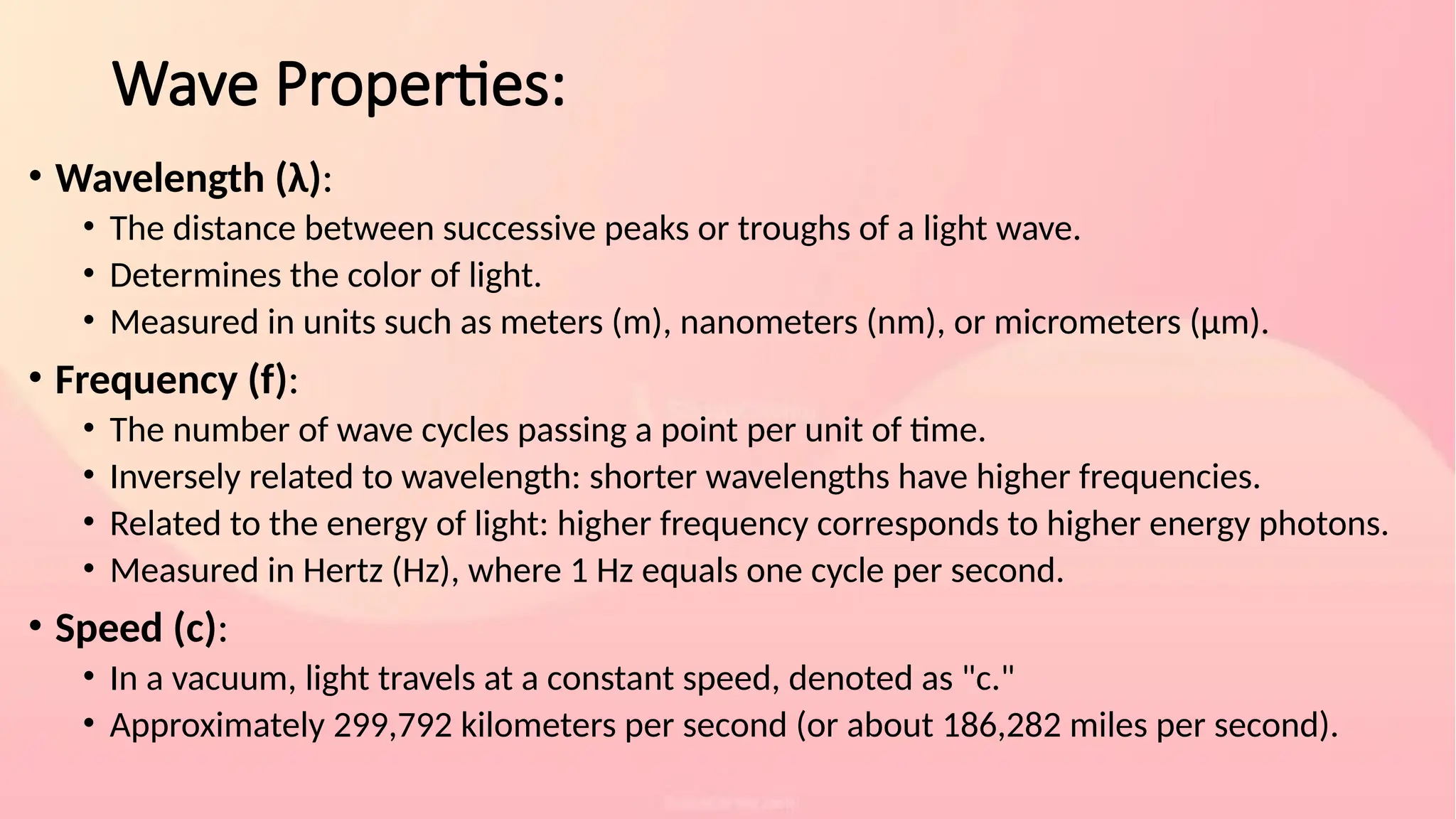
Wave Properties:
• Wavelength (Ī»):
• The distance between successive peaks or troughs of a light wave.
• Determines the color of light.
• Measured in units such as meters (m), nanometers (nm), or micrometers (μm).
• Frequency (f):
• The number of wave cycles passing a point per unit of time.
• Inversely related to wavelength: shorter wavelengths have higher frequencies.
• Related to the energy of light: higher frequency corresponds to higher energy photons.
• Measured in Hertz (Hz), where 1 Hz equals one cycle per second.
• Speed (c):
• In a vacuum, light travels at a constant speed, denoted as "c."
• Approximately 299,792 kilometers per second (or about 186,282 miles per second).
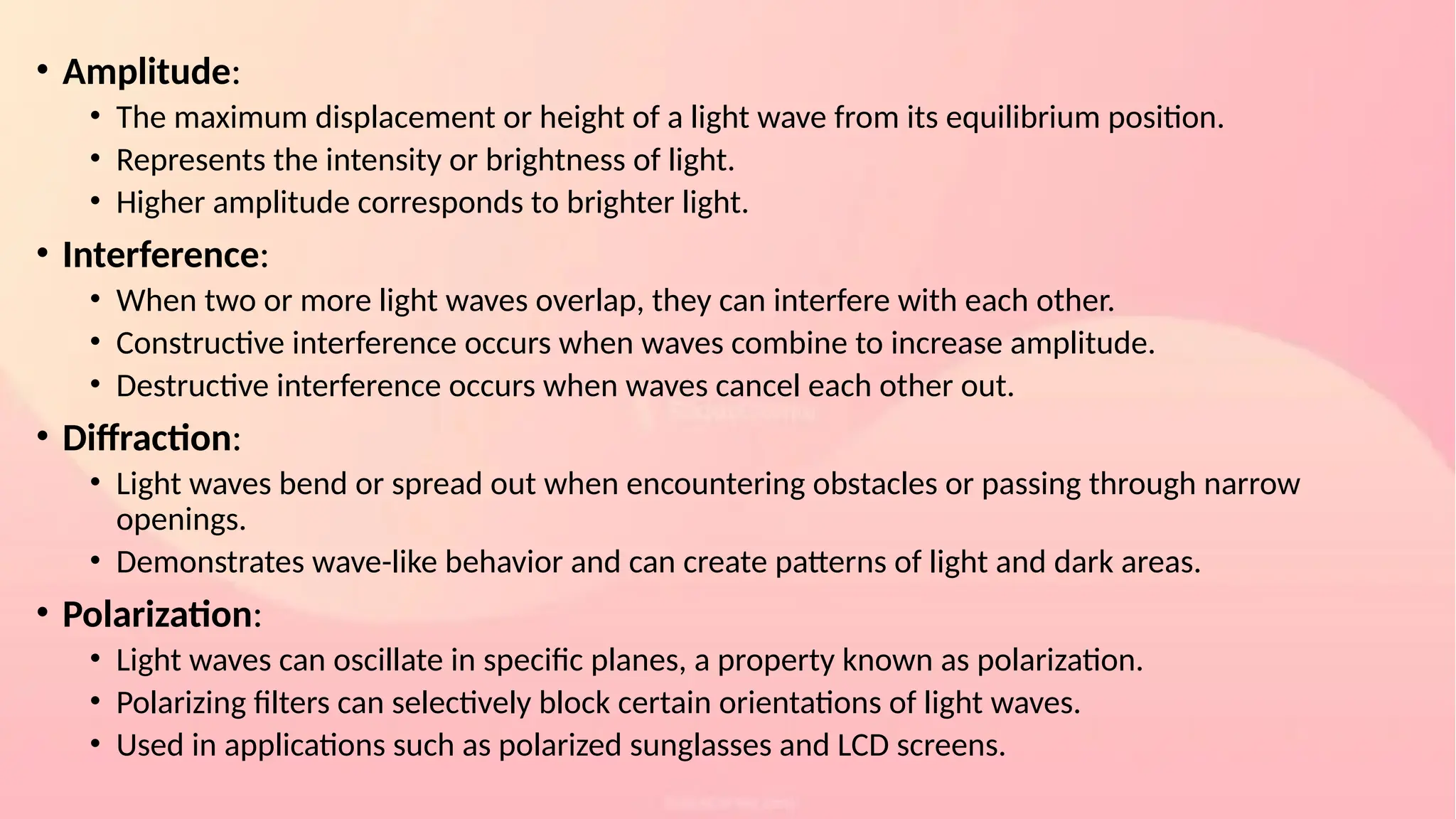
• Amplitude:
• The maximum displacement or height of a light wave from its equilibrium position.
• Represents the intensity or brightness of light.
• Higher amplitude corresponds to brighter light.
• Interference:
• When two or more light waves overlap, they can interfere with each other.
• Constructive interference occurs when waves combine to increase amplitude.
• Destructive interference occurs when waves cancel each other out.
• Diffraction:
• Light waves bend or spread out when encountering obstacles or passing through narrow
openings.
• Demonstrates wave-like behavior and can create patterns of light and dark areas.
• Polarization:
• Light waves can oscillate in specific planes, a property known as polarization.
• Polarizing filters can selectively block certain orientations of light waves.
• Used in applications such as polarized sunglasses and LCD screens.
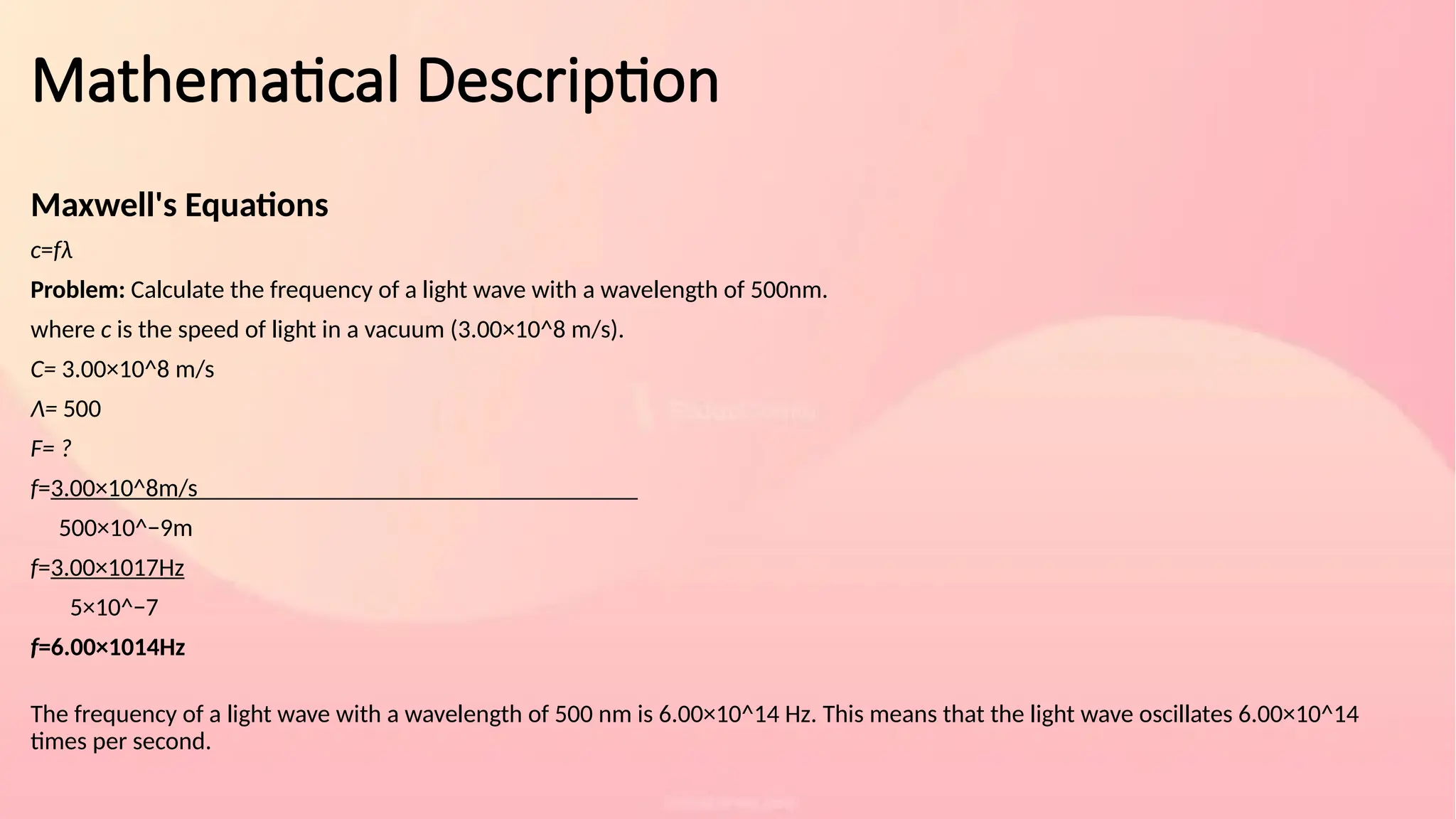
Mathematical Description
Maxwell's Equations
c=fĪ»
Problem: Calculate the frequency of a light wave with a wavelength of 500nm.
where c is the speed of light in a vacuum (3.00Ɨ10^8 m/s).
C= 3.00Ɨ10^8 m/s
Ī›= 500
F= ?
f=3.00Ɨ10^8m/s​
500Ɨ10^āˆ’9m
f=3.00Ɨ1017Hz​
5Ɨ10^āˆ’7
f=6.00Ɨ1014Hz
The frequency of a light wave with a wavelength of 500 nm is 6.00Ɨ10^14 Hz. This means that the light wave oscillates 6.00Ɨ10^14
times per second.
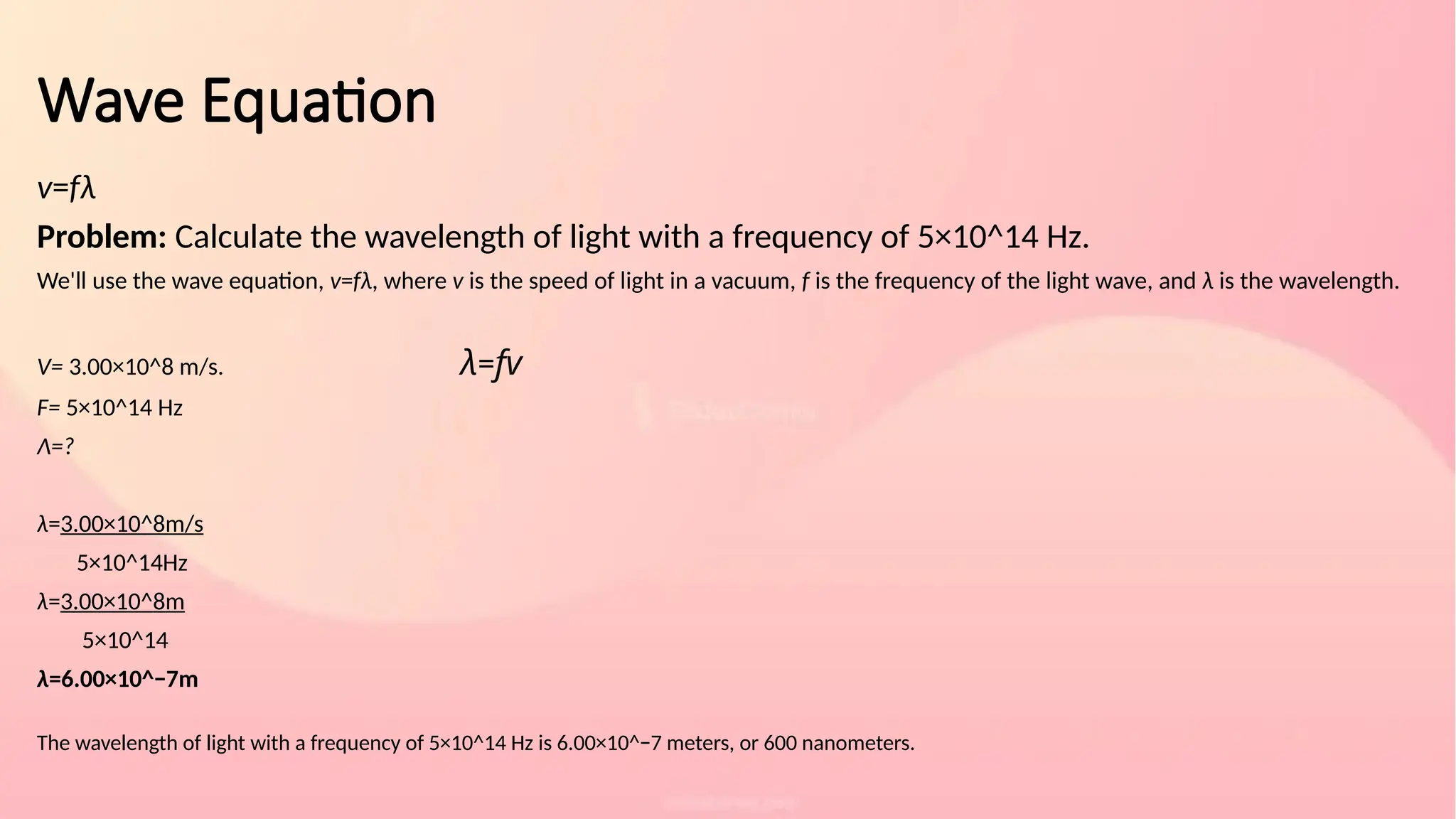
Wave Equation
v=fĪ»
Problem: Calculate the wavelength of light with a frequency of 5Ɨ10^14 Hz.
We'll use the wave equation, v=fĪ», where v is the speed of light in a vacuum, f is the frequency of the light wave, and Ī» is the wavelength.
V= 3.00Ɨ10^8 m/s. Ī»=fv​
F= 5Ɨ10^14 Hz
Ī›=?
Ī»=3.00Ɨ10^8m/s​
5Ɨ10^14Hz
Ī»=3.00Ɨ10^8​
m
5Ɨ10^14
Ī»=6.00Ɨ10^āˆ’7m
The wavelength of light with a frequency of 5Ɨ10^14 Hz is 6.00Ɨ10^āˆ’7 meters, or 600 nanometers.
THANK YOU!!!

LIGHT AS A WAVE and Light as a wave refers to the understanding of light's behavior and properties through the framework of wave theory in physics

  • 1.
  • 2.
    Light as awave refers to the understanding of light's behavior and properties through the framework of wave theory in physics. This perspective views light as a form of electromagnetic radiation that exhibits wave- like characteristics as it travels through space.
  • 3.
    Wave Nature ofLight The wave nature of light refers to its behavior as a wave, characterized by properties such as wavelength, frequency, and the ability to interfere and diffract. This concept explains phenomena like colors, diffraction patterns, and polarization, highlighting light's wave-like characteristics alongside its particle-like behavior.
  • 4.
    The wavelength oflight refers to the distance between two consecutive peaks or troughs of a light wave. It is usually measured in units such as meters (m), nanometers (nm), or micrometers (μm). The wavelength of light varies depending on its color or frequency. In the visible spectrum, which is the range of wavelengths visible to the human eye, different colors correspond to different wavelengths: • Red light typically has a wavelength of around 620-750 nm. • Orange light ranges from approximately 590 to 620 nm. • Yellow light has wavelengths around 570 to 590 nm. • Green light falls within the range of 495 to 570 nm. • Blue light typically ranges from 450 to 495 nm. • Violet light has wavelengths around 380 to 450 nm.
  • 6.
    Electromagnetic Spectrum ofLight as a Wave The electromagnetic spectrum encompasses the full range of frequencies of electromagnetic radiation, including light. When considering light as a wave, it falls within a specific region of the electromagnetic spectrum, known as the visible spectrum.
  • 7.
    Electromagnetic Spectrum ofLight as a Wave • Radio Waves: • Lowest frequency and longest wavelength. • Used in radio communication, broadcasting, and radar. • Microwaves: • Slightly higher frequency and shorter wavelength compared to radio waves. • Utilized in microwave ovens, satellite communication, and radar. • Infrared Radiation: • Wavelengths longer than visible light but shorter than microwaves. • Perceived as heat; used in remote controls, thermal imaging, and infrared spectroscopy. • Visible Light: • The narrow range of wavelengths visible to the human eye. • Wavelengths range from approximately 400 to 700 nanometers (nm). • Divided into different colors: red, orange, yellow, green, blue, indigo, and violet. • Used in everyday vision, optics, photography, and lighting.
  • 8.
    • Ultraviolet (UV)Radiation: • Shorter wavelengths than visible light. • Not visible to the human eye. • Causes sunburn and skin damage; used in sterilization, fluorescence, and some medical treatments. • X-Rays: • Shorter wavelengths and higher frequencies than UV radiation. • Used in medical imaging (X-ray radiography), security screening, and crystallography. • Gamma Rays: • Highest frequency and shortest wavelength in the electromagnetic spectrum. • Emitted by radioactive decay and nuclear reactions. • Used in cancer treatment (gamma knife) and sterilization.
  • 9.
    Wave Properties: • Wavelength(Ī»): • The distance between successive peaks or troughs of a light wave. • Determines the color of light. • Measured in units such as meters (m), nanometers (nm), or micrometers (μm). • Frequency (f): • The number of wave cycles passing a point per unit of time. • Inversely related to wavelength: shorter wavelengths have higher frequencies. • Related to the energy of light: higher frequency corresponds to higher energy photons. • Measured in Hertz (Hz), where 1 Hz equals one cycle per second. • Speed (c): • In a vacuum, light travels at a constant speed, denoted as "c." • Approximately 299,792 kilometers per second (or about 186,282 miles per second).
  • 10.
    • Amplitude: • Themaximum displacement or height of a light wave from its equilibrium position. • Represents the intensity or brightness of light. • Higher amplitude corresponds to brighter light. • Interference: • When two or more light waves overlap, they can interfere with each other. • Constructive interference occurs when waves combine to increase amplitude. • Destructive interference occurs when waves cancel each other out. • Diffraction: • Light waves bend or spread out when encountering obstacles or passing through narrow openings. • Demonstrates wave-like behavior and can create patterns of light and dark areas. • Polarization: • Light waves can oscillate in specific planes, a property known as polarization. • Polarizing filters can selectively block certain orientations of light waves. • Used in applications such as polarized sunglasses and LCD screens.
  • 11.
    Mathematical Description Maxwell's Equations c=fĪ» Problem:Calculate the frequency of a light wave with a wavelength of 500nm. where c is the speed of light in a vacuum (3.00Ɨ10^8 m/s). C= 3.00Ɨ10^8 m/s Ī›= 500 F= ? f=3.00Ɨ10^8m/s​ 500Ɨ10^āˆ’9m f=3.00Ɨ1017Hz​ 5Ɨ10^āˆ’7 f=6.00Ɨ1014Hz The frequency of a light wave with a wavelength of 500 nm is 6.00Ɨ10^14 Hz. This means that the light wave oscillates 6.00Ɨ10^14 times per second.
  • 12.
    Wave Equation v=fĪ» Problem: Calculatethe wavelength of light with a frequency of 5Ɨ10^14 Hz. We'll use the wave equation, v=fĪ», where v is the speed of light in a vacuum, f is the frequency of the light wave, and Ī» is the wavelength. V= 3.00Ɨ10^8 m/s. Ī»=fv​ F= 5Ɨ10^14 Hz Ī›=? Ī»=3.00Ɨ10^8m/s​ 5Ɨ10^14Hz Ī»=3.00Ɨ10^8​ m 5Ɨ10^14 Ī»=6.00Ɨ10^āˆ’7m The wavelength of light with a frequency of 5Ɨ10^14 Hz is 6.00Ɨ10^āˆ’7 meters, or 600 nanometers.
  • 13.