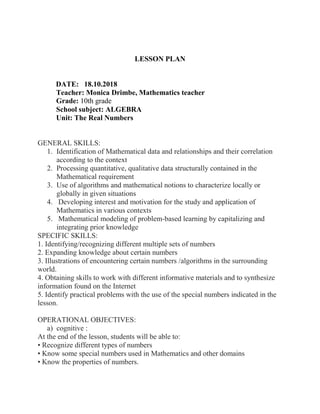
LESSON PLAN
DATE: 18.10.2018
Teacher: Monica Drimbe, Mathematics teacher
Grade: 10th grade
School subject: ALGEBRA
Unit: The Real Numbers
GENERAL SKILLS:
1. Identification of Mathematical data and relationships and their correlation
according to the context
2. Processing quantitative, qualitative data structurally contained in the
Mathematical requirement
3. Use of algorithms and mathematical notions to characterize locally or
globally in given situations
4. Developing interest and motivation for the study and application of
Mathematics in various contexts
5. Mathematical modeling of problem-based learning by capitalizing and
integrating prior knowledge
SPECIFIC SKILLS:
1. Identifying/recognizing different multiple sets of numbers
2. Expanding knowledge about certain numbers
3. Illustrations of encountering certain numbers /algorithms in the surrounding
world.
4. Obtaining skills to work with different informative materials and to synthesize
information found on the Internet
5. Identify practical problems with the use of the special numbers indicated in the
lesson.
OPERATIONAL OBJECTIVES:
a) cognitive :
At the end of the lesson, students will be able to:
• Recognize different types of numbers
• Know some special numbers used in Mathematics and other domains
• Know the properties of numbers.
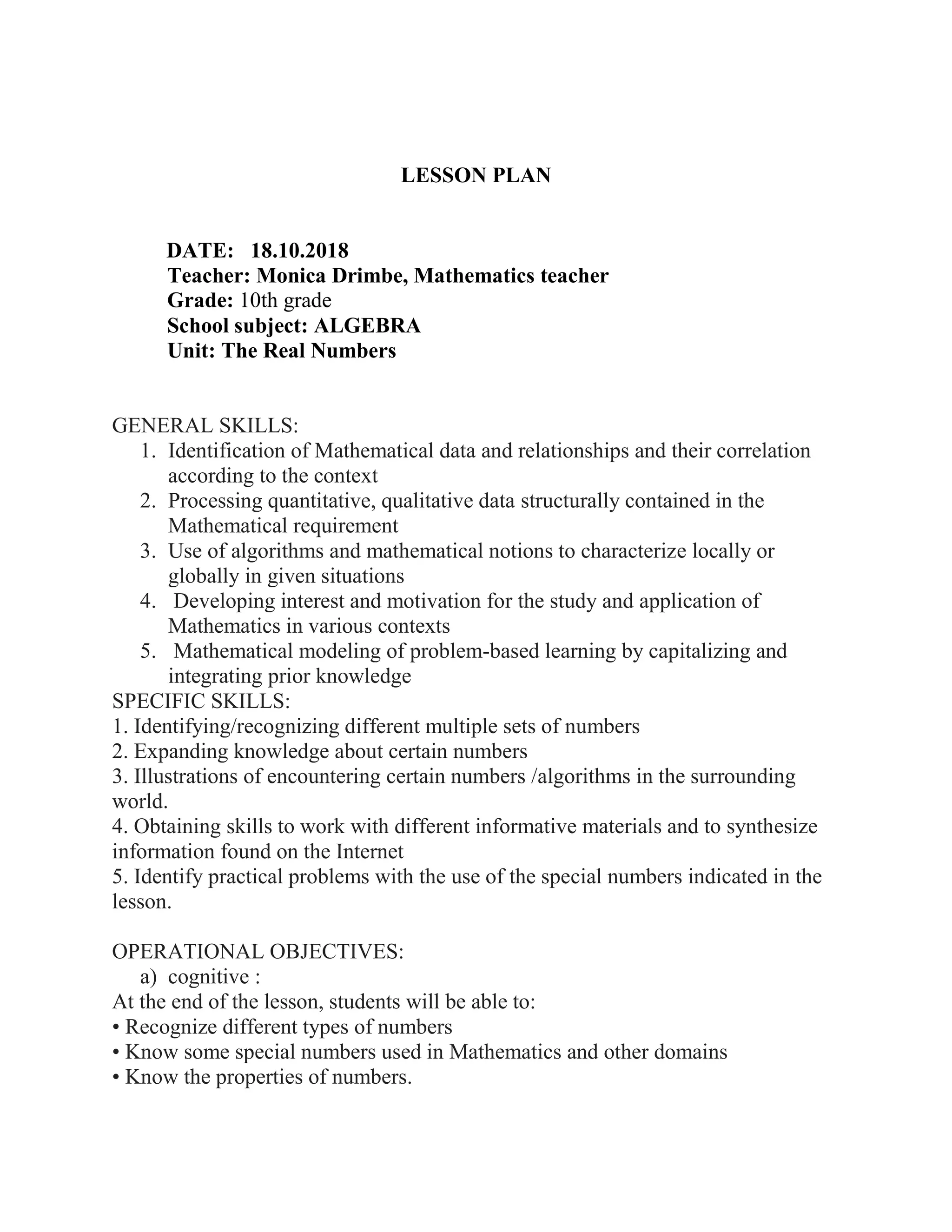
• Know some practical problems with using the special numbers indicated in the
lesson
b) emotional
• Stimulating curiosity
• developing critical and self-critical skills
• Developing the spirit of observation and concentration, attention to synthesizing
the collected information
EVALUATION COMPETENCES:
1. Using Mathematical language in different contexts.
2. Verificati of knowledge, skills, systematization of information.
3. Coherent, complete and systematized compilation of information.
4. Effective organization of the proposed Mathematic problems and drafting their
solutions.
TEACHING STRATEGIES:
- front / individual activities; group work;
METHODS:
-use of computers, exercises, conversation, demonstration, exposure, observation,
problem solving, systematic observation, exchange of information.
TEACHING MATERIALS:
-Notebooks, worksheets, computers.
BIBLIOGRAPHIC MATERIAL: the textbook, the book "The Great Theorem of
Fermat" ,written by Simon Singh author and specific Internet sites.
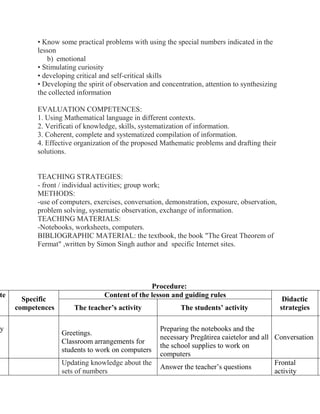
Procedure:
te
Specific
competences
Content of the lesson and guiding rules
Didactic
strategiesThe teacher’s activity The students’ activity
y
Greetings.
Classroom arrangements for
students to work on computers
Preparing the notebooks and the
necessary Pregătirea caietelor and all
the school supplies to work on
computers
Conversation
Updating knowledge about the
sets of numbers
Answer the teacher’s questions
Frontal
activity
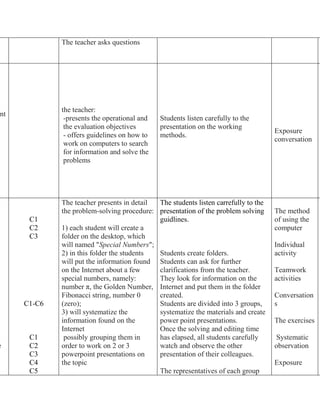
The teacher asks questions
nt
s
the teacher:
-presents the operational and
the evaluation objectives
- offers guidelines on how to
work on computers to search
for information and solve the
problems
Students listen carefully to the
presentation on the working
methods.
Exposure
conversation
n
e
C1
C2
C3
C1-C6
C1
C2
C3
C4
C5
The teacher presents in detail
the problem-solving procedure:
1) each student will create a
folder on the desktop, which
will named "Special Numbers";
2) in this folder the students
will put the information found
on the Internet about a few
special numbers, namely:
number π, the Golden Number,
Fibonacci string, number 0
(zero);
3) will systematize the
information found on the
Internet
possibly grouping them in
order to work on 2 or 3
powerpoint presentations on
the topic
The students listen carrefully to the
presentation of the problem solving
guidlines.
Students create folders.
Students can ask for further
clarifications from the teacher.
They look for information on the
Internet and put them in the folder
created.
Students are divided into 3 groups,
systematize the materials and create
power point presentations.
Once the solving and editing time
has elapsed, all students carefully
watch and observe the other
presentation of their colleagues.
The representatives of each group
The method
of using the
computer
Individual
activity
Teamwork
activities
Conversation
s
The exercises
Systematic
observation
Exposure
on
C6
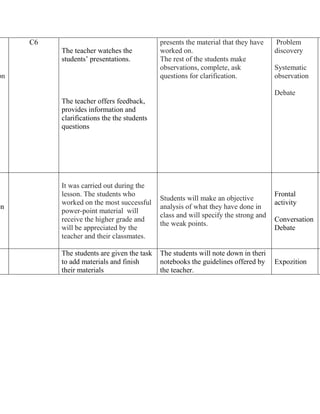
The teacher watches the
students’ presentations.
The teacher offers feedback,
provides information and
clarifications the the students
questions
presents the material that they have
worked on.
The rest of the students make
observations, complete, ask
questions for clarification.
Problem
discovery
Systematic
observation
Debate
on
It was carried out during the
lesson. The students who
worked on the most successful
power-point material will
receive the higher grade and
will be appreciated by the
teacher and their classmates.
Students will make an objective
analysis of what they have done in
class and will specify the strong and
the weak points.
Frontal
activity
Conversation
Debate
The students are given the task
to add materials and finish
their materials
The students will note down in theri
notebooks the guidelines offered by
the teacher.
Expozition

Special numbers

  • 1.
    LESSON PLAN DATE: 18.10.2018 Teacher:Monica Drimbe, Mathematics teacher Grade: 10th grade School subject: ALGEBRA Unit: The Real Numbers GENERAL SKILLS: 1. Identification of Mathematical data and relationships and their correlation according to the context 2. Processing quantitative, qualitative data structurally contained in the Mathematical requirement 3. Use of algorithms and mathematical notions to characterize locally or globally in given situations 4. Developing interest and motivation for the study and application of Mathematics in various contexts 5. Mathematical modeling of problem-based learning by capitalizing and integrating prior knowledge SPECIFIC SKILLS: 1. Identifying/recognizing different multiple sets of numbers 2. Expanding knowledge about certain numbers 3. Illustrations of encountering certain numbers /algorithms in the surrounding world. 4. Obtaining skills to work with different informative materials and to synthesize information found on the Internet 5. Identify practical problems with the use of the special numbers indicated in the lesson. OPERATIONAL OBJECTIVES: a) cognitive : At the end of the lesson, students will be able to: • Recognize different types of numbers • Know some special numbers used in Mathematics and other domains • Know the properties of numbers.
  • 2.
    • Know somepractical problems with using the special numbers indicated in the lesson b) emotional • Stimulating curiosity • developing critical and self-critical skills • Developing the spirit of observation and concentration, attention to synthesizing the collected information EVALUATION COMPETENCES: 1. Using Mathematical language in different contexts. 2. Verificati of knowledge, skills, systematization of information. 3. Coherent, complete and systematized compilation of information. 4. Effective organization of the proposed Mathematic problems and drafting their solutions. TEACHING STRATEGIES: - front / individual activities; group work; METHODS: -use of computers, exercises, conversation, demonstration, exposure, observation, problem solving, systematic observation, exchange of information. TEACHING MATERIALS: -Notebooks, worksheets, computers. BIBLIOGRAPHIC MATERIAL: the textbook, the book "The Great Theorem of Fermat" ,written by Simon Singh author and specific Internet sites. Procedure: te Specific competences Content of the lesson and guiding rules Didactic strategiesThe teacher’s activity The students’ activity y Greetings. Classroom arrangements for students to work on computers Preparing the notebooks and the necessary Pregătirea caietelor and all the school supplies to work on computers Conversation Updating knowledge about the sets of numbers Answer the teacher’s questions Frontal activity
  • 3.
    The teacher asksquestions nt s the teacher: -presents the operational and the evaluation objectives - offers guidelines on how to work on computers to search for information and solve the problems Students listen carefully to the presentation on the working methods. Exposure conversation n e C1 C2 C3 C1-C6 C1 C2 C3 C4 C5 The teacher presents in detail the problem-solving procedure: 1) each student will create a folder on the desktop, which will named "Special Numbers"; 2) in this folder the students will put the information found on the Internet about a few special numbers, namely: number π, the Golden Number, Fibonacci string, number 0 (zero); 3) will systematize the information found on the Internet possibly grouping them in order to work on 2 or 3 powerpoint presentations on the topic The students listen carrefully to the presentation of the problem solving guidlines. Students create folders. Students can ask for further clarifications from the teacher. They look for information on the Internet and put them in the folder created. Students are divided into 3 groups, systematize the materials and create power point presentations. Once the solving and editing time has elapsed, all students carefully watch and observe the other presentation of their colleagues. The representatives of each group The method of using the computer Individual activity Teamwork activities Conversation s The exercises Systematic observation Exposure
  • 4.
    on C6 The teacher watchesthe students’ presentations. The teacher offers feedback, provides information and clarifications the the students questions presents the material that they have worked on. The rest of the students make observations, complete, ask questions for clarification. Problem discovery Systematic observation Debate on It was carried out during the lesson. The students who worked on the most successful power-point material will receive the higher grade and will be appreciated by the teacher and their classmates. Students will make an objective analysis of what they have done in class and will specify the strong and the weak points. Frontal activity Conversation Debate The students are given the task to add materials and finish their materials The students will note down in theri notebooks the guidelines offered by the teacher. Expozition