Discrete Mathematics:
Combinatorics and
Probability
Here is where your presentation begins
11th Grade
Contents of this template
You can delete this slide when you’re done editing the presentation
Fonts To view this template correctly in PowerPoint, download and install the fonts we used
Used and alternative resources An assortment of graphic resources that are suitable for use in this presentation
Thanks slide You must keep it so that proper credits for our design are given
Colors All the colors used in this presentation
Icons and infographic resources These can be used in the template, and their size and color can be edited
Editable presentation theme You can edit the master slides easily. For more info, click here
For more info:
SLIDESGO | BLOG | FAQs
You can visit our sister projects:
FREEPIK | FLATICON | STORYSET | WEPIK | VIDEVO
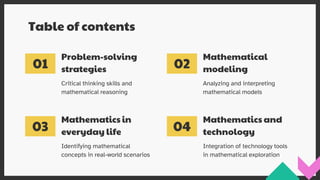
Mathematical
modeling
01
Problem-solving
strategies
Mathematics and
technology
Table of contents
Identifying mathematical
concepts in real-world scenarios
Critical thinking skills and
mathematical reasoning
Analyzing and interpreting
mathematical models
Integration of technology tools
in mathematical exploration
03
02
04
Mathematics in
everyday life
Introduction
From mathematical modeling to the
integration of technology tools, these
lessons empower students to
appreciate the versatility and relevance
of mathematics across diverse
contexts. Through this comprehensive
approach, students not only master
mathematical concepts but also
develop essential skills for navigating
the complexities of the modern world
In high school and middle school math
lessons, students delve into various
engaging topics. They explore
problem-solving strategies, honing
critical thinking and logical
reasoning skills. Additionally, at that
age, math lessons focus on the
practical application of mathematics,
revealing its role in everyday life
Problem-solving
strategies
01
Apply problem-solving strategies in various contexts
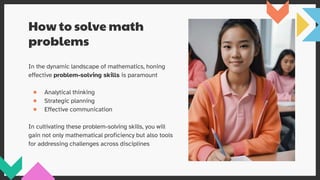
How to solve math
problems
In the dynamic landscape of mathematics, honing
effective problem-solving skills is paramount
● Analytical thinking
● Strategic planning
● Effective communication
In cultivating these problem-solving skills, you will
gain not only mathematical proficiency but also tools
for addressing challenges across disciplines
Analytical thinking
A systematical and logical approach
to mathematical problems is the
foundation for many disciplines
Cultivate the ability to break down
complex problems into several
manageable parts
Break down
complex problems
Systematic and
logical approach
Structure mathematical
reasoning coherently in a
logical sequence
The use of diagrams, graphs,
and charts to supplement
written explanations
Mastering mathematical communication
The importance of
articulating mathematical
ideas with precision
Engage with peers'
mathematical explanations
and provide feedback
Justify mathematical
solutions, providing proof to
validate conclusions
Adapt your communication
style to different audiences
to convey ideas
Clarity and
precision
Logical
organization
Visual
representation
Active
listening
Justification
and proof
Versatile
communication
Patterns, precision
and problem-solving
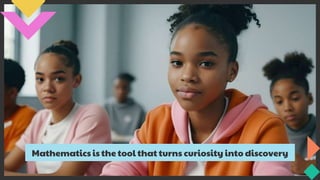
Mathematics is the tool that turns curiosity into discovery
123,000
Numbers unfold as a canvas of infinite potential
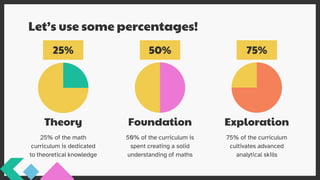
Let’s use some percentages!
25% of the math
curriculum is dedicated
to theoretical knowledge
Theory
50% of the curriculum is
spent creating a solid
understanding of maths
Foundation
75% of the curriculum
cultivates advanced
analytical skills
Exploration
50% 75%
25%
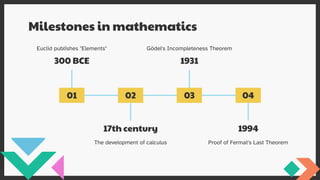
Milestones in mathematics
300 BCE
Euclid publishes "Elements"
17th century
The development of calculus
1931
Gödel's Incompleteness Theorem
1994
Proof of Fermat's Last Theorem
01 02 03 04
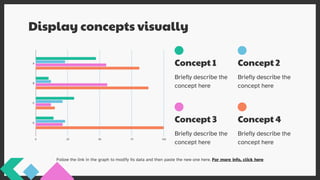
Display concepts visually
Follow the link in the graph to modify its data and then paste the new one here. For more info, click here
Concept 1
Concept 3
Concept 2
Briefly describe the
concept here
Concept 4
Briefly describe the
concept here
Briefly describe the
concept here
Briefly describe the
concept here
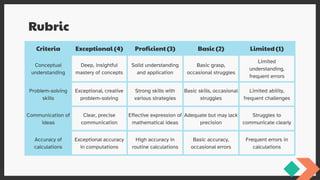
Rubric
Criteria Exceptional (4) Proficient (3) Basic (2) Limited (1)
Conceptual
understanding
Deep, insightful
mastery of concepts
Solid understanding
and application
Basic grasp,
occasional struggles
Limited
understanding,
frequent errors
Problem-solving
skills
Exceptional, creative
problem-solving
Strong skills with
various strategies
Basic skills, occasional
struggles
Limited ability,
frequent challenges
Communication of
ideas
Clear, precise
communication
Effective expression of
mathematical ideas
Adequate but may lack
precision
Struggles to
communicate clearly
Accuracy of
calculations
Exceptional accuracy
in computations
High accuracy in
routine calculations
Basic accuracy,
occasional errors
Frequent errors in
calculations
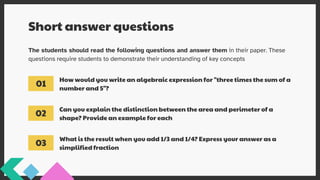
Short answer questions
The students should read the following questions and answer them in their paper. These
questions require students to demonstrate their understanding of key concepts
How would you write an algebraic expression for "three times the sum of a
number and 5"?
Can you explain the distinction between the area and perimeter of a
shape? Provide an example for each
What is the result when you add 1/3 and 1/4? Express your answer as a
simplified fraction
01
02
03
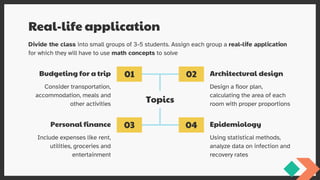
Budgeting for a trip
Real-life application
Topics
Personal finance
Architectural design
Epidemiology
Divide the class into small groups of 3-5 students. Assign each group a real-life application
for which they will have to use math concepts to solve
Consider transportation,
accommodation, meals and
other activities
Design a floor plan,
calculating the area of each
room with proper proportions
Include expenses like rent,
utilities, groceries and
entertainment
Using statistical methods,
analyze data on infection and
recovery rates
01 02
03 04
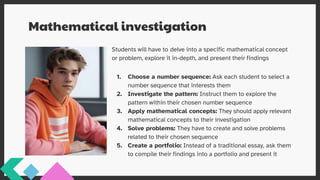
Mathematical investigation
Students will have to delve into a specific mathematical concept
or problem, explore it in-depth, and present their findings
1. Choose a number sequence: Ask each student to select a
number sequence that interests them
2. Investigate the pattern: Instruct them to explore the
pattern within their chosen number sequence
3. Apply mathematical concepts: They should apply relevant
mathematical concepts to their investigation
4. Solve problems: They have to create and solve problems
related to their chosen sequence
5. Create a portfolio: Instead of a traditional essay, ask them
to compile their findings into a portfolio and present it
Conclusions
Recap the main
mathematical concepts
covered during the lesson
Emphasize the practical
relevance of the concepts
and skills of the lesson
Provide a glimpse into the
upcoming lessons for
continuity of learning
Summarize
key concepts
Real-world
applications
Preview
next steps
CREDITS: This presentation template was created by Slidesgo, and
includes icons by Flaticon, and infographics & images by Freepik
Thanks!
Do you have any questions?
youremail@freepik.com
+34 654 321 432
yourwebsite.com
Please keep this slide for attribution
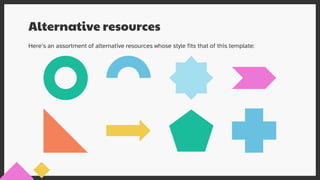
Here’s an assortment of alternative resources whose style fits that of this template:
Alternative resources
Resources
Did you like the resources used in this template? Get them on these websites:
Illustrations:
● Geometric shapes pattern
Photos:
● AI-generated images by Freepik AI Image Generator
Instructions for use
If you have a free account, in order to use this template, you must credit Slidesgo by keeping the Thanks slide. Please
refer to the next slide to read the instructions for premium users.
As a Free user, you are allowed to:
● Modify this template.
● Use it for both personal and commercial projects.
You are not allowed to:
● Sublicense, sell or rent any of Slidesgo Content (or a modified version of Slidesgo Content).
● Distribute Slidesgo Content unless it has been expressly authorized by Slidesgo.
● Include Slidesgo Content in an online or offline database or file.
● Offer Slidesgo templates (or modified versions of Slidesgo templates) for download.
● Acquire the copyright of Slidesgo Content.
For more information about editing slides, please read our FAQs or visit our blog:
https://slidesgo.com/faqs and https://slidesgo.com/slidesgo-school
As a Premium user, you can use this template without attributing Slidesgo or keeping the "Thanks" slide.
You are allowed to:
● Modify this template.
● Use it for both personal and commercial purposes.
● Hide or delete the “Thanks” slide and the mention to Slidesgo in the credits.
● Share this template in an editable format with people who are not part of your team.
You are not allowed to:
● Sublicense, sell or rent this Slidesgo Template (or a modified version of this Slidesgo Template).
● Distribute this Slidesgo Template (or a modified version of this Slidesgo Template) or include it in a database or in
any other product or service that offers downloadable images, icons or presentations that may be subject to
distribution or resale.
● Use any of the elements that are part of this Slidesgo Template in an isolated and separated way from this
Template.
● Register any of the elements that are part of this template as a trademark or logo, or register it as a work in an
intellectual property registry or similar.
For more information about editing slides, please read our FAQs or visit our blog:
https://slidesgo.com/faqs and https://slidesgo.com/slidesgo-school
Instructions for use (premium users)
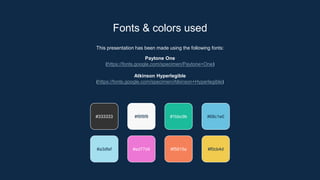
This presentation has been made using the following fonts:
Paytone One
(https://fonts.google.com/specimen/Paytone+One)
Atkinson Hyperlegible
(https://fonts.google.com/specimen/Atkinson+Hyperlegible)
#333333 #f8f8f8 #1bbc9b #68c1e0
#a3dfef #ed77d4 #f5815a #f0cb4d
Fonts & colors used
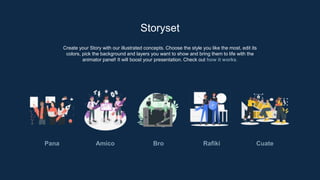
Create your Story with our illustrated concepts. Choose the style you like the most, edit its
colors, pick the background and layers you want to show and bring them to life with the
animator panel! It will boost your presentation. Check out how it works.
Storyset
Pana Amico Bro Rafiki Cuate
You can easily resize these resources without losing quality. To change the color, just ungroup the resource and click
on the object you want to change. Then, click on the paint bucket and select the color you want. Group the resource again
when you’re done. You can also look for more infographics on Slidesgo.
Use our editable graphic resources...
JANUARY FEBRUARY MARCH APRIL
PHASE 1
Task 1
Task 2
JANUARY FEBRUARY MARCH APRIL MAY JUNE
PHASE 1
PHASE 2
Task 1
Task 2
Task 1
Task 2
You can resize these icons without losing quality.
You can change the stroke and fill color; just select the icon and click on the paint bucket/pen.
In Google Slides, you can also use Flaticon’s extension, allowing you to customize and add even more icons.
...and our sets of editable icons
Educational Icons Medical Icons
Business Icons Teamwork Icons
Help & Support Icons Avatar Icons
Creative Process Icons Performing Arts Icons
Nature Icons
SEO & Marketing Icons
Discrete Mathematics_ Combinatorics and Probability by Slidesgo.pptx

Discrete Mathematics_ Combinatorics and Probability by Slidesgo.pptx

  • 1.
    Discrete Mathematics: Combinatorics and Probability Hereis where your presentation begins 11th Grade
  • 2.
    Contents of thistemplate You can delete this slide when you’re done editing the presentation Fonts To view this template correctly in PowerPoint, download and install the fonts we used Used and alternative resources An assortment of graphic resources that are suitable for use in this presentation Thanks slide You must keep it so that proper credits for our design are given Colors All the colors used in this presentation Icons and infographic resources These can be used in the template, and their size and color can be edited Editable presentation theme You can edit the master slides easily. For more info, click here For more info: SLIDESGO | BLOG | FAQs You can visit our sister projects: FREEPIK | FLATICON | STORYSET | WEPIK | VIDEVO
  • 3.
    Mathematical modeling 01 Problem-solving strategies Mathematics and technology Table ofcontents Identifying mathematical concepts in real-world scenarios Critical thinking skills and mathematical reasoning Analyzing and interpreting mathematical models Integration of technology tools in mathematical exploration 03 02 04 Mathematics in everyday life
  • 4.
    Introduction From mathematical modelingto the integration of technology tools, these lessons empower students to appreciate the versatility and relevance of mathematics across diverse contexts. Through this comprehensive approach, students not only master mathematical concepts but also develop essential skills for navigating the complexities of the modern world In high school and middle school math lessons, students delve into various engaging topics. They explore problem-solving strategies, honing critical thinking and logical reasoning skills. Additionally, at that age, math lessons focus on the practical application of mathematics, revealing its role in everyday life

  • 5.

  • 6.
    How to solvemath problems In the dynamic landscape of mathematics, honing effective problem-solving skills is paramount ● Analytical thinking ● Strategic planning ● Effective communication In cultivating these problem-solving skills, you will gain not only mathematical proficiency but also tools for addressing challenges across disciplines
  • 7.
    Analytical thinking A systematicaland logical approach to mathematical problems is the foundation for many disciplines Cultivate the ability to break down complex problems into several manageable parts Break down complex problems Systematic and logical approach
  • 8.
    Structure mathematical reasoning coherentlyin a logical sequence The use of diagrams, graphs, and charts to supplement written explanations Mastering mathematical communication The importance of articulating mathematical ideas with precision Engage with peers' mathematical explanations and provide feedback Justify mathematical solutions, providing proof to validate conclusions Adapt your communication style to different audiences to convey ideas Clarity and precision Logical organization Visual representation Active listening Justification and proof Versatile communication
  • 9.
  • 10.
    Mathematics is thetool that turns curiosity into discovery
  • 11.
    123,000 Numbers unfold asa canvas of infinite potential
  • 12.
    Let’s use somepercentages! 25% of the math curriculum is dedicated to theoretical knowledge Theory 50% of the curriculum is spent creating a solid understanding of maths Foundation 75% of the curriculum cultivates advanced analytical skills Exploration 50% 75% 25%
  • 13.
    Milestones in mathematics 300BCE Euclid publishes "Elements" 17th century The development of calculus 1931 Gödel's Incompleteness Theorem 1994 Proof of Fermat's Last Theorem 01 02 03 04
  • 14.
    Display concepts visually Followthe link in the graph to modify its data and then paste the new one here. For more info, click here Concept 1 Concept 3 Concept 2 Briefly describe the concept here Concept 4 Briefly describe the concept here Briefly describe the concept here Briefly describe the concept here
  • 15.
    Rubric Criteria Exceptional (4)Proficient (3) Basic (2) Limited (1) Conceptual understanding Deep, insightful mastery of concepts Solid understanding and application Basic grasp, occasional struggles Limited understanding, frequent errors Problem-solving skills Exceptional, creative problem-solving Strong skills with various strategies Basic skills, occasional struggles Limited ability, frequent challenges Communication of ideas Clear, precise communication Effective expression of mathematical ideas Adequate but may lack precision Struggles to communicate clearly Accuracy of calculations Exceptional accuracy in computations High accuracy in routine calculations Basic accuracy, occasional errors Frequent errors in calculations
  • 16.
    Short answer questions Thestudents should read the following questions and answer them in their paper. These questions require students to demonstrate their understanding of key concepts How would you write an algebraic expression for "three times the sum of a number and 5"? Can you explain the distinction between the area and perimeter of a shape? Provide an example for each What is the result when you add 1/3 and 1/4? Express your answer as a simplified fraction 01 02 03
  • 17.
    Budgeting for atrip Real-life application Topics Personal finance Architectural design Epidemiology Divide the class into small groups of 3-5 students. Assign each group a real-life application for which they will have to use math concepts to solve Consider transportation, accommodation, meals and other activities Design a floor plan, calculating the area of each room with proper proportions Include expenses like rent, utilities, groceries and entertainment Using statistical methods, analyze data on infection and recovery rates 01 02 03 04
  • 18.
    Mathematical investigation Students willhave to delve into a specific mathematical concept or problem, explore it in-depth, and present their findings 1. Choose a number sequence: Ask each student to select a number sequence that interests them 2. Investigate the pattern: Instruct them to explore the pattern within their chosen number sequence 3. Apply mathematical concepts: They should apply relevant mathematical concepts to their investigation 4. Solve problems: They have to create and solve problems related to their chosen sequence 5. Create a portfolio: Instead of a traditional essay, ask them to compile their findings into a portfolio and present it
  • 19.
    Conclusions Recap the main mathematicalconcepts covered during the lesson Emphasize the practical relevance of the concepts and skills of the lesson Provide a glimpse into the upcoming lessons for continuity of learning Summarize key concepts Real-world applications Preview next steps
  • 20.
    CREDITS: This presentationtemplate was created by Slidesgo, and includes icons by Flaticon, and infographics & images by Freepik Thanks! Do you have any questions? youremail@freepik.com +34 654 321 432 yourwebsite.com Please keep this slide for attribution
  • 21.
    Here’s an assortmentof alternative resources whose style fits that of this template: Alternative resources
  • 22.
    Resources Did you likethe resources used in this template? Get them on these websites: Illustrations: ● Geometric shapes pattern Photos: ● AI-generated images by Freepik AI Image Generator
  • 23.
    Instructions for use Ifyou have a free account, in order to use this template, you must credit Slidesgo by keeping the Thanks slide. Please refer to the next slide to read the instructions for premium users. As a Free user, you are allowed to: ● Modify this template. ● Use it for both personal and commercial projects. You are not allowed to: ● Sublicense, sell or rent any of Slidesgo Content (or a modified version of Slidesgo Content). ● Distribute Slidesgo Content unless it has been expressly authorized by Slidesgo. ● Include Slidesgo Content in an online or offline database or file. ● Offer Slidesgo templates (or modified versions of Slidesgo templates) for download. ● Acquire the copyright of Slidesgo Content. For more information about editing slides, please read our FAQs or visit our blog: https://slidesgo.com/faqs and https://slidesgo.com/slidesgo-school
  • 24.
    As a Premiumuser, you can use this template without attributing Slidesgo or keeping the "Thanks" slide. You are allowed to: ● Modify this template. ● Use it for both personal and commercial purposes. ● Hide or delete the “Thanks” slide and the mention to Slidesgo in the credits. ● Share this template in an editable format with people who are not part of your team. You are not allowed to: ● Sublicense, sell or rent this Slidesgo Template (or a modified version of this Slidesgo Template). ● Distribute this Slidesgo Template (or a modified version of this Slidesgo Template) or include it in a database or in any other product or service that offers downloadable images, icons or presentations that may be subject to distribution or resale. ● Use any of the elements that are part of this Slidesgo Template in an isolated and separated way from this Template. ● Register any of the elements that are part of this template as a trademark or logo, or register it as a work in an intellectual property registry or similar. For more information about editing slides, please read our FAQs or visit our blog: https://slidesgo.com/faqs and https://slidesgo.com/slidesgo-school Instructions for use (premium users)
  • 25.
    This presentation hasbeen made using the following fonts: Paytone One (https://fonts.google.com/specimen/Paytone+One) Atkinson Hyperlegible (https://fonts.google.com/specimen/Atkinson+Hyperlegible) #333333 #f8f8f8 #1bbc9b #68c1e0 #a3dfef #ed77d4 #f5815a #f0cb4d Fonts & colors used
  • 26.
    Create your Storywith our illustrated concepts. Choose the style you like the most, edit its colors, pick the background and layers you want to show and bring them to life with the animator panel! It will boost your presentation. Check out how it works. Storyset Pana Amico Bro Rafiki Cuate
  • 27.
    You can easilyresize these resources without losing quality. To change the color, just ungroup the resource and click on the object you want to change. Then, click on the paint bucket and select the color you want. Group the resource again when you’re done. You can also look for more infographics on Slidesgo. Use our editable graphic resources...
  • 30.
    JANUARY FEBRUARY MARCHAPRIL PHASE 1 Task 1 Task 2 JANUARY FEBRUARY MARCH APRIL MAY JUNE PHASE 1 PHASE 2 Task 1 Task 2 Task 1 Task 2
  • 33.
    You can resizethese icons without losing quality. You can change the stroke and fill color; just select the icon and click on the paint bucket/pen. In Google Slides, you can also use Flaticon’s extension, allowing you to customize and add even more icons. ...and our sets of editable icons
  • 34.
  • 35.
  • 36.
    Help & SupportIcons Avatar Icons
  • 37.
    Creative Process IconsPerforming Arts Icons
  • 38.
  • 39.