PRESENTED BY
Murabiya Udit
FPT-MB2-05
FRM (515)
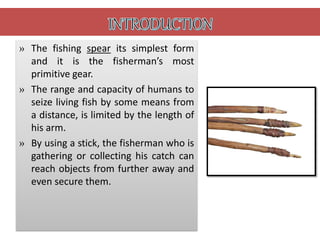
» The fishing spear its simplest form
and it is the fisherman’s most
primitive gear.
» The range and capacity of humans to
seize living fish by some means from
a distance, is limited by the length of
his arm.
» By using a stick, the fisherman who is
gathering or collecting his catch can
reach objects from further away and
even secure them.
What is spearing ?
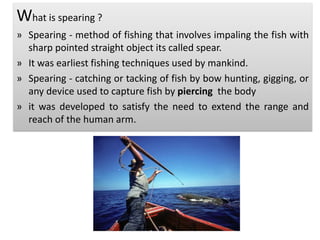
» Spearing - method of fishing that involves impaling the fish with
sharp pointed straight object its called spear.
» It was earliest fishing techniques used by mankind.
» Spearing - catching or tacking of fish by bow hunting, gigging, or
any device used to capture fish by piercing the body
» it was developed to satisfy the need to extend the range and
reach of the human arm.
How spearing is working ?
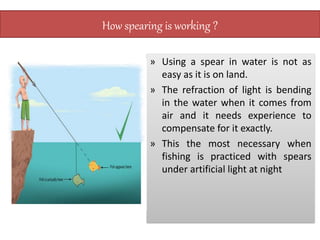
» Using a spear in water is not as
easy as it is on land.
» The refraction of light is bending
in the water when it comes from
air and it needs experience to
compensate for it exactly.
» This the most necessary when
fishing is practiced with spears
under artificial light at night
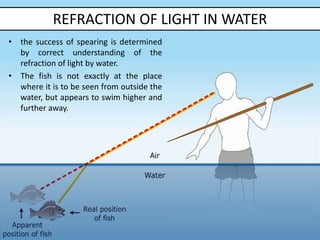
• the success of spearing is determined
by correct understanding of the
refraction of light by water.
• The fish is not exactly at the place
where it is to be seen from outside the
water, but appears to swim higher and
further away.
REFRACTION OF LIGHT IN WATER
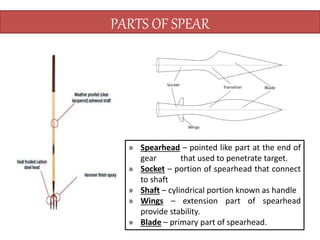
PARTS OF SPEAR
» Spearhead – pointed like part at the end of
gear that used to penetrate target.
» Socket – portion of spearhead that connect
to shaft
» Shaft – cylindrical portion known as handle
» Wings – extension part of spearhead
provide stability.
» Blade – primary part of spearhead.
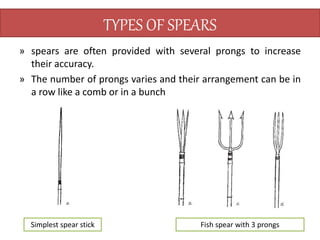
TYPES OF SPEARS
» spears are often provided with several prongs to increase
their accuracy.
» The number of prongs varies and their arrangement can be in
a row like a comb or in a bunch
Simplest spear stick Fish spear with 3 prongs
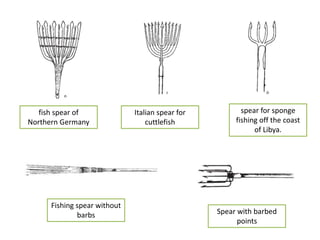
fish spear of
Northern Germany
Italian spear for
cuttlefish
spear for sponge
fishing off the coast
of Libya.
Fishing spear without
barbs Spear with barbed
points
FISH PLUMMETS
» Length of a pushed spear is limited - in deeper water by the
buoyancy of the wooden shaft.
» Moreover, several meters long spear is difficult to handle.
» It is not sufficient to catch bottom fishes. Thus other devices
are needed to bring up the prey from the bottom.
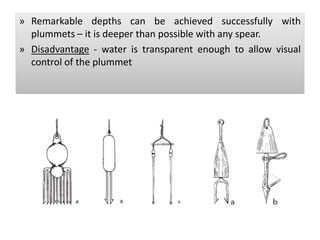
» This can be achieved with the help of fish plummets or plumb
lines.
» These are operated according to the principle of the spearing
gear, but the stick is replaced by a rope.
» With fishing plummets the depth
of the fishing water is no longer a
problem.
» A rope can be almost weightless,
is easy to store, and can be as
long as needed.
» On the end of this line, the
plummet is tied instead of having
a spearhead.
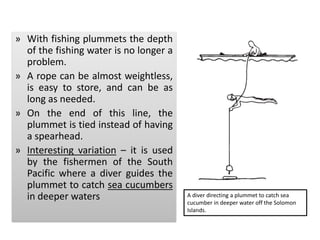
» Interesting variation – it is used
by the fishermen of the South
Pacific where a diver guides the
plummet to catch sea cucumbers
in deeper waters A diver directing a plummet to catch sea
cucumber in deeper water off the Solomon
Islands.
» Remarkable depths can be achieved successfully with
plummets – it is deeper than possible with any spear.
» Disadvantage - water is transparent enough to allow visual
control of the plummet
EEL COMBS
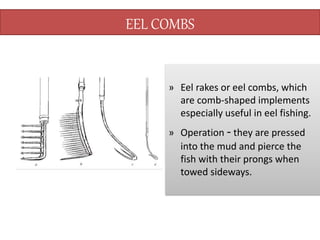
» Eel rakes or eel combs, which
are comb-shaped implements
especially useful in eel fishing.
» Operation - they are pressed
into the mud and pierce the
fish with their prongs when
towed sideways.
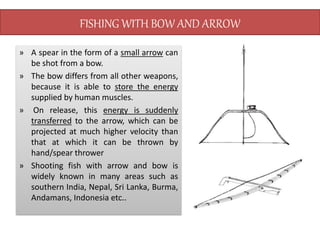
FISHING WITH BOW AND ARROW
» A spear in the form of a small arrow can
be shot from a bow.
» The bow differs from all other weapons,
because it is able to store the energy
supplied by human muscles.
» On release, this energy is suddenly
transferred to the arrow, which can be
projected at much higher velocity than
that at which it can be thrown by
hand/spear thrower
» Shooting fish with arrow and bow is
widely known in many areas such as
southern India, Nepal, Sri Lanka, Burma,
Andamans, Indonesia etc..
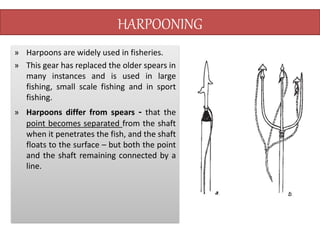
HARPOONING
» Harpoons are widely used in fisheries.
» This gear has replaced the older spears in
many instances and is used in large
fishing, small scale fishing and in sport
fishing.
» Harpoons differ from spears - that the
point becomes separated from the shaft
when it penetrates the fish, and the shaft
floats to the surface – but both the point
and the shaft remaining connected by a
line.
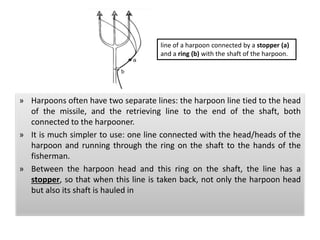
» Harpoons often have two separate lines: the harpoon line tied to the head
of the missile, and the retrieving line to the end of the shaft, both
connected to the harpooner.
» It is much simpler to use: one line connected with the head/heads of the
harpoon and running through the ring on the shaft to the hands of the
fisherman.
» Between the harpoon head and this ring on the shaft, the line has a
stopper, so that when this line is taken back, not only the harpoon head
but also its shaft is hauled in
line of a harpoon connected by a stopper (a)
and a ring (b) with the shaft of the harpoon.
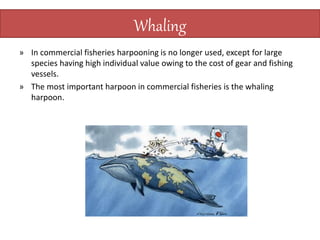
Whaling
» In commercial fisheries harpooning is no longer used, except for large
species having high individual value owing to the cost of gear and fishing
vessels.
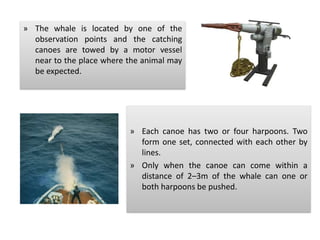
» The most important harpoon in commercial fisheries is the whaling
harpoon.
» Each canoe has two or four harpoons. Two
form one set, connected with each other by
lines.
» Only when the canoe can come within a
distance of 2–3m of the whale can one or
both harpoons be pushed.
» The whale is located by one of the
observation points and the catching
canoes are towed by a motor vessel
near to the place where the animal may
be expected.
SHOOTING FISH
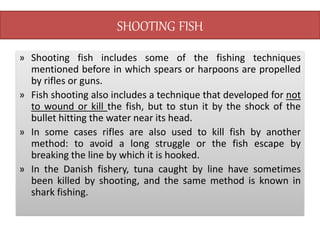
» Shooting fish includes some of the fishing techniques
mentioned before in which spears or harpoons are propelled
by rifles or guns.
» Fish shooting also includes a technique that developed for not
to wound or kill the fish, but to stun it by the shock of the
bullet hitting the water near its head.
» In some cases rifles are also used to kill fish by another
method: to avoid a long struggle or the fish escape by
breaking the line by which it is hooked.
» In the Danish fishery, tuna caught by line have sometimes
been killed by shooting, and the same method is known in
shark fishing.
REFERENCE
• Cordini, J.M. (1955) Rio Parana, sus peces mas comunes pesca commercial. Publication Miscelanea
No. 410. Ministerio de Agricultura y Ganaderia, Buenos Aires
• Duge, P., Henking, H. & Wilhelms, O. (1902) Bericht über die Internationale Fischerei-Ausstellung
in St. Petersburg 1902. Berlin
• Fiscus, C.H. & Marquette, W.M. (1975) National marine fisheries service field studies relating to the
bowhead whale harvest in Alaska, 1974. Northwest Fisheries Center Processed Report
• Helgeland, G. (ed.) (1975) Archery World’s Complete Guide to Bowhunting. Englewood Cliffs
• Kishinouge, K. (1941) Prehistoric fishing in Japan. Journal of the College of Agriculture Imperial
University Tokyo II, 327–382.
• Klunzinger, C. B. (1892) Bodenseefische, deren Pflege undv Fang. Stuttgart.
• Lane, P. (1978) Eels and their utilization. Marine Fisheries Review 40 (4), 1–20
THANK YOU

Spearing, Harpooning and Shooting fish.pptx

  • 1.
  • 2.
    » The fishingspear its simplest form and it is the fisherman’s most primitive gear. » The range and capacity of humans to seize living fish by some means from a distance, is limited by the length of his arm. » By using a stick, the fisherman who is gathering or collecting his catch can reach objects from further away and even secure them.
  • 3.
    What is spearing? » Spearing - method of fishing that involves impaling the fish with sharp pointed straight object its called spear. » It was earliest fishing techniques used by mankind. » Spearing - catching or tacking of fish by bow hunting, gigging, or any device used to capture fish by piercing the body » it was developed to satisfy the need to extend the range and reach of the human arm.
  • 4.
    How spearing isworking ? » Using a spear in water is not as easy as it is on land. » The refraction of light is bending in the water when it comes from air and it needs experience to compensate for it exactly. » This the most necessary when fishing is practiced with spears under artificial light at night
  • 5.
    • the successof spearing is determined by correct understanding of the refraction of light by water. • The fish is not exactly at the place where it is to be seen from outside the water, but appears to swim higher and further away. REFRACTION OF LIGHT IN WATER
  • 6.
    PARTS OF SPEAR »Spearhead – pointed like part at the end of gear that used to penetrate target. » Socket – portion of spearhead that connect to shaft » Shaft – cylindrical portion known as handle » Wings – extension part of spearhead provide stability. » Blade – primary part of spearhead.
  • 7.
    TYPES OF SPEARS »spears are often provided with several prongs to increase their accuracy. » The number of prongs varies and their arrangement can be in a row like a comb or in a bunch Simplest spear stick Fish spear with 3 prongs
  • 8.
    fish spear of NorthernGermany Italian spear for cuttlefish spear for sponge fishing off the coast of Libya. Fishing spear without barbs Spear with barbed points
  • 9.
    FISH PLUMMETS » Lengthof a pushed spear is limited - in deeper water by the buoyancy of the wooden shaft. » Moreover, several meters long spear is difficult to handle. » It is not sufficient to catch bottom fishes. Thus other devices are needed to bring up the prey from the bottom. » This can be achieved with the help of fish plummets or plumb lines. » These are operated according to the principle of the spearing gear, but the stick is replaced by a rope.
  • 10.
    » With fishingplummets the depth of the fishing water is no longer a problem. » A rope can be almost weightless, is easy to store, and can be as long as needed. » On the end of this line, the plummet is tied instead of having a spearhead. » Interesting variation – it is used by the fishermen of the South Pacific where a diver guides the plummet to catch sea cucumbers in deeper waters A diver directing a plummet to catch sea cucumber in deeper water off the Solomon Islands.
  • 11.
    » Remarkable depthscan be achieved successfully with plummets – it is deeper than possible with any spear. » Disadvantage - water is transparent enough to allow visual control of the plummet
  • 12.
    EEL COMBS » Eelrakes or eel combs, which are comb-shaped implements especially useful in eel fishing. » Operation - they are pressed into the mud and pierce the fish with their prongs when towed sideways.
  • 13.
    FISHING WITH BOWAND ARROW » A spear in the form of a small arrow can be shot from a bow. » The bow differs from all other weapons, because it is able to store the energy supplied by human muscles. » On release, this energy is suddenly transferred to the arrow, which can be projected at much higher velocity than that at which it can be thrown by hand/spear thrower » Shooting fish with arrow and bow is widely known in many areas such as southern India, Nepal, Sri Lanka, Burma, Andamans, Indonesia etc..
  • 14.
    HARPOONING » Harpoons arewidely used in fisheries. » This gear has replaced the older spears in many instances and is used in large fishing, small scale fishing and in sport fishing. » Harpoons differ from spears - that the point becomes separated from the shaft when it penetrates the fish, and the shaft floats to the surface – but both the point and the shaft remaining connected by a line.
  • 15.
    » Harpoons oftenhave two separate lines: the harpoon line tied to the head of the missile, and the retrieving line to the end of the shaft, both connected to the harpooner. » It is much simpler to use: one line connected with the head/heads of the harpoon and running through the ring on the shaft to the hands of the fisherman. » Between the harpoon head and this ring on the shaft, the line has a stopper, so that when this line is taken back, not only the harpoon head but also its shaft is hauled in line of a harpoon connected by a stopper (a) and a ring (b) with the shaft of the harpoon.
  • 16.
    Whaling » In commercialfisheries harpooning is no longer used, except for large species having high individual value owing to the cost of gear and fishing vessels. » The most important harpoon in commercial fisheries is the whaling harpoon.
  • 17.
    » Each canoehas two or four harpoons. Two form one set, connected with each other by lines. » Only when the canoe can come within a distance of 2–3m of the whale can one or both harpoons be pushed. » The whale is located by one of the observation points and the catching canoes are towed by a motor vessel near to the place where the animal may be expected.
  • 18.
    SHOOTING FISH » Shootingfish includes some of the fishing techniques mentioned before in which spears or harpoons are propelled by rifles or guns. » Fish shooting also includes a technique that developed for not to wound or kill the fish, but to stun it by the shock of the bullet hitting the water near its head. » In some cases rifles are also used to kill fish by another method: to avoid a long struggle or the fish escape by breaking the line by which it is hooked. » In the Danish fishery, tuna caught by line have sometimes been killed by shooting, and the same method is known in shark fishing.
  • 19.
    REFERENCE • Cordini, J.M.(1955) Rio Parana, sus peces mas comunes pesca commercial. Publication Miscelanea No. 410. Ministerio de Agricultura y Ganaderia, Buenos Aires • Duge, P., Henking, H. & Wilhelms, O. (1902) Bericht über die Internationale Fischerei-Ausstellung in St. Petersburg 1902. Berlin • Fiscus, C.H. & Marquette, W.M. (1975) National marine fisheries service field studies relating to the bowhead whale harvest in Alaska, 1974. Northwest Fisheries Center Processed Report • Helgeland, G. (ed.) (1975) Archery World’s Complete Guide to Bowhunting. Englewood Cliffs • Kishinouge, K. (1941) Prehistoric fishing in Japan. Journal of the College of Agriculture Imperial University Tokyo II, 327–382. • Klunzinger, C. B. (1892) Bodenseefische, deren Pflege undv Fang. Stuttgart. • Lane, P. (1978) Eels and their utilization. Marine Fisheries Review 40 (4), 1–20
  • 20.