Phrasal verbs arevery common in English, especially in more informal contexts. They are
made up of a verb + a particle (a preposition or an adverb). The particle often changes
the meaning of the verb.
WHAT IS A PHRASAL VERB?
I called Jen to see how she was. (call = to telephone)
They've called off the meeting. (call off = to cancel)
There are phrasal verbs that take objects (or not) and can separable or inseparable.
3.
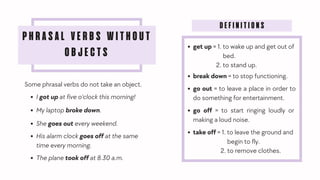
PHRASAL VERBS WITHOUT
OBJECTS
Somephrasal verbs do not take an object.
I got up at five o'clock this morning!
My laptop broke down.
She goes out every weekend.
His alarm clock goes off at the same
time every morning.
The plane took off at 8.30 a.m.
DEFINITIONS
get up = 1. to wake up and get out of
bed.
2. to stand up.
break down = to stop functioning.
go out = to leave a place in order to
do something for entertainment.
go off = to start ringing loudly or
making a loud noise.
take off = 1. to leave the ground and
begin to fly.
2. to remove clothes.
4.
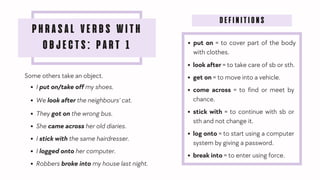
PHRASAL VERBS WITH
OBJECTS:PART 1
Some others take an object.
I put on/take off my shoes.
We look after the neighbours' cat.
They got on the wrong bus.
She came across her old diaries.
I stick with the same hairdresser.
I logged onto her computer.
Robbers broke into my house last night.
DEFINITIONS
put on = to cover part of the body
with clothes.
look after = to take care of sb or sth.
get on = to move into a vehicle.
come across = to find or meet by
chance.
stick with = to continue with sb or
sth and not change it.
log onto = to start using a computer
system by giving a password.
break into = to enter using force.
5.
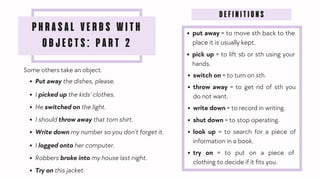
PHRASAL VERBS WITH
OBJECTS:PART 2
Some others take an object.
Put away the dishes, please.
I picked up the kids' clothes.
Write down my number so you don’t forget it.
He switched on the light.
I should throw away that torn shirt.
I logged onto her computer.
Robbers broke into my house last night.
DEFINITIONS
put away = to move sth back to the
place it is usually kept.
pick up = to lift sb or sth using your
hands.
throw away = to get rid of sth you
do not want.
switch on = to turn on sth.
try on = to put on a piece of
clothing to decide if it fits you.
write down = to record in writing.
shut down = to stop operating.
look up = to search for a piece of
information in a book.
Try on this jacket.
6.
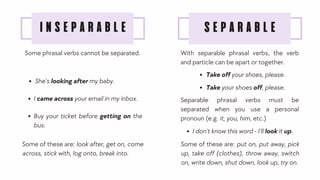
Some phrasal verbscannot be separated.
SEPARABLE
INSEPARABLE
With separable phrasal verbs, the verb
and particle can be apart or together.
Some of these are: put on, put away, pick
up, take off (clothes), throw away, switch
on, write down, shut down, look up, try on.
Some of these are: look after, get on, come
across, stick with, log onto, break into.
She’s looking after my baby.
I came across your email in my inbox.
Buy your ticket before getting on the
bus.
Take off your shoes, please.
Take your shoes off, please.
Separable phrasal verbs must be
separated when you use a personal
pronoun (e.g. it, you, him, etc.)
I don’t know this word - I’ll look it up.





![Phrasal verb[1]](https://cdn.slidesharecdn.com/ss_thumbnails/phrasalverb1-180528131447-thumbnail.jpg?width=640&height=640&fit=bounds)


![Phrasal verb 2018[1]](https://cdn.slidesharecdn.com/ss_thumbnails/phrasalverb20181-180528134645-thumbnail.jpg?width=640&height=640&fit=bounds)


