RADIPOL XT Monofilament application
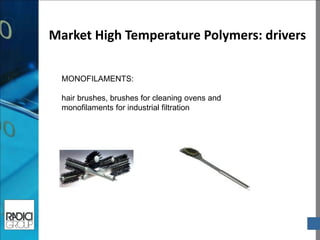
Market High Temperature Polymers: drivers 
MONOFILAMENTS: 
hair brushes, brushes for cleaning ovens and monofilaments for industrial filtration
Radipol XT Key benefits 
3 
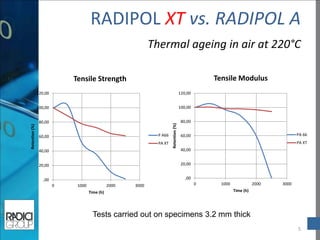
•Higher resistance to thermal oxidation. Same or even better performances vs. competitors till 230°C for 3000 h 
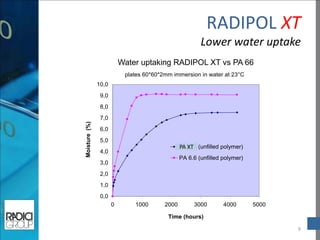
•Lower water absorption vs. PA 66 
•Lower moisture absorption vs PA 66 
To note, RADIPOL XT covers all ranges of applications (injection molding / extrusion / blow molding)
Radipol XT Key benefits 
4 
•Higher resistance to thermal oxidation. Same or even better performances vs. competitors till 230°C for 3000 h 
•Lower water absorption vs. PA 66 
•Lower moisture absorption vs PA 66
5 
,00 
20,00 
40,00 
60,00 
80,00 
100,00 
120,00 
0 
1000 
2000 
3000 
Retention (%) 
Time (h) 
Tensile Strength 
P A66 
PA XT 
,00 
20,00 
40,00 
60,00 
80,00 
100,00 
120,00 
0 
1000 
2000 
3000 
Retention (%) 
Time (h) 
Tensile Modulus 
PA 66 
PA XT 
RADIPOL XT vs. RADIPOL A Thermal ageing in air at 220°C 
Tests carried out on specimens 3.2 mm thick
6 
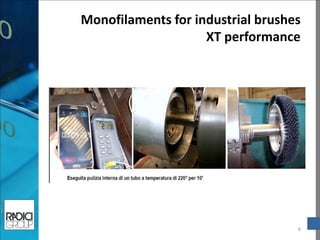
Monofilaments for industrial brushes 
XT performance
7 
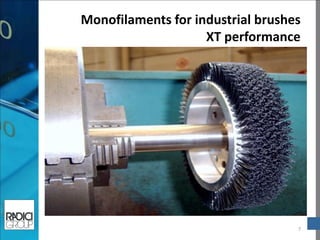
Monofilaments for industrial brushes 
XT performance
Radipol XT Key benefits 
8 
•Higher temperature resistance Vc. PA 46 and PA 66: it works weel till 220°C 
•Lower moisture uptake vs. PA 66 
•Lower water uptake vs PA 66
WATER ABSORPTION PA66/6T AND PA66 
plates 60*60*2mm immersion in water at 23°C 
0,0 
1,0 
2,0 
3,0 
4,0 
5,0 
6,0 
7,0 
8,0 
9,0 
10,0 
0 1000 2000 3000 4000 5000 
Time (hours) 
Moisture (%) 
HT-PA (unfilled polymer) 
PA 6.6 (unfilled polymer) 
9 
RADIPOL XT 
Lower water uptake 
Water uptaking RADIPOL XT vs PA 66 
PA XT
Radipol XT Key benefits 
10 
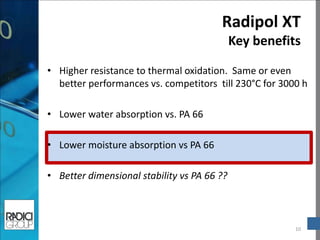
•Higher resistance to thermal oxidation. Same or even better performances vs. competitors till 230°C for 3000 h 
•Lower water absorption vs. PA 66 
•Lower moisture absorption vs PA 66 
•Better dimensional stability vs PA 66 ??
11 
RADIPOL XT Lower moisture uptake 
About 25% less moisture uptake for RADIPOL XT 
000 
001 
001 
002 
002 
003 
003 
004 
004 
005 
005 
0 
12 
24 
36 
48 
60 
72 
84 
96 
108 
120 
132 
144 
156 
168 
180 
Moisture uptake [%] 
Time [h] 
Moisture uptake 
60°C - 70% HR on plaques 2.0mm thick 
PA66 
XT
 Mechanical & physical properties 
 Product Variety 
 Summary of performances 
Radipol XT Product info 
12
13 
Properties 
Method 
Test conditions 
Units 
Radipol® XT 
Density 
ISO1183 
Kg/dm3 
1,15 
Tensile modulus 
ISO 527-2/1A 
DAM; vel. test 1mm/min 
MPa 
2900 
Yield stress 
ISO 527-2/1A 
DAM; vel. test 5mm/min 
MPa 
93 
Yield strain 
ISO 527-2/1A 
DAM; vel. test 5mm/min 
% 
6.0 
Flexural modulus 
ISO 178/1A 
DAM; vel. test 2mm/min 
MPa 
2700 
Flexural strength 
ISO 178/1A 
DAM; vel. test 2mm/min 
MPa 
124 
Charpy impact strength 
ISO 179 eU 
DAM; T=23°C 
KJ/m2 
NB 
Charpy notched impact strength 
ISO 179 eA 
DAM; T=23°C 
KJ/m2 
6.5 
Melting temperature 
ISO 11357-1-3 
Heating rate 10°C/min 
°C 
280 
RADIPOL XT Mechanical & physical properties
RADIPOL XT Product Variety 
RADIPOL XT 45 
•RV: 2,2 
•AEG: 30-40 
•Tm : 280 
•Tc : 247 
RADIPOL XT 45 H01 
14 
•RV: 2,5 
•AEG: > 60 
•Tm: 280 
•Tc: 243 
Reccomended for extruding monofilaments
Rheological behavior 
15 
10 
100 
1000 
100 
1000 
10000 
Apparent shear viscosity (Pa - s) 
Apparent shear rate (1/s) 
A45 
A75 
XT 45 
XT 45H01
16 
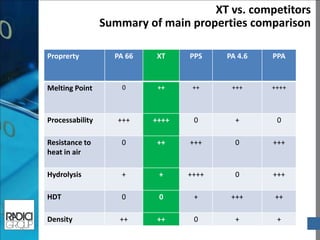
XT vs. competitors Summary of main properties comparison 
Proprerty 
PA 66 
XT 
PPS 
PA 4.6 
PPA 
Melting Point 
0 
++ 
++ 
+++ 
++++ 
Processability 
+++ 
++++ 
0 
+ 
0 
Resistance to heat in air 
0 
++ 
+++ 
0 
+++ 
Hydrolysis 
+ 
+ 
++++ 
0 
+++ 
HDT 
0 
0 
+ 
+++ 
++ 
Density 
++ 
++ 
0 
+ 
+
17 
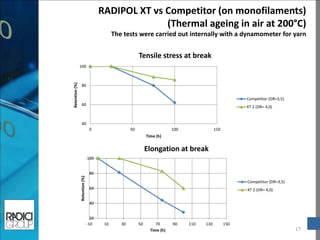
RADIPOL XT vs Competitor (on monofilaments) (Thermal ageing in air at 200°C) The tests were carried out internally with a dynamometer for yarn 
40 
60 
80 
100 
0 
50 
100 
150 
Retention (%) 
Time (h) 
Tensile stress at break 
Competitor (DR=3,5) 
XT 2 (DR= 4,0) 
20 
40 
60 
80 
100 
-10 
10 
30 
50 
70 
90 
110 
130 
150 
Retention (%) 
Time (h) 
Elongation at break 
Competitor (DR=3,5) 
XT 2 (DR= 4,0)
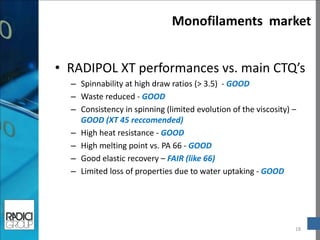
Monofilaments market 
•RADIPOL XT performances vs. main CTQ’s 
–Spinnability at high draw ratios (> 3.5) - GOOD 
–Waste reduced - GOOD 
–Consistency in spinning (limited evolution of the viscosity) – GOOD (XT 45 reccomended) 
–High heat resistance - GOOD 
–High melting point vs. PA 66 - GOOD 
–Good elastic recovery – FAIR (like 66) 
–Limited loss of properties due to water uptaking - GOOD 
18

Radipol XT for monofilament

  • 1.
  • 2.
    Market High TemperaturePolymers: drivers MONOFILAMENTS: hair brushes, brushes for cleaning ovens and monofilaments for industrial filtration
  • 3.
    Radipol XT Keybenefits 3 •Higher resistance to thermal oxidation. Same or even better performances vs. competitors till 230°C for 3000 h •Lower water absorption vs. PA 66 •Lower moisture absorption vs PA 66 To note, RADIPOL XT covers all ranges of applications (injection molding / extrusion / blow molding)
  • 4.
    Radipol XT Keybenefits 4 •Higher resistance to thermal oxidation. Same or even better performances vs. competitors till 230°C for 3000 h •Lower water absorption vs. PA 66 •Lower moisture absorption vs PA 66
  • 5.
    5 ,00 20,00 40,00 60,00 80,00 100,00 120,00 0 1000 2000 3000 Retention (%) Time (h) Tensile Strength P A66 PA XT ,00 20,00 40,00 60,00 80,00 100,00 120,00 0 1000 2000 3000 Retention (%) Time (h) Tensile Modulus PA 66 PA XT RADIPOL XT vs. RADIPOL A Thermal ageing in air at 220°C Tests carried out on specimens 3.2 mm thick
  • 6.
    6 Monofilaments forindustrial brushes XT performance
  • 7.
    7 Monofilaments forindustrial brushes XT performance
  • 8.
    Radipol XT Keybenefits 8 •Higher temperature resistance Vc. PA 46 and PA 66: it works weel till 220°C •Lower moisture uptake vs. PA 66 •Lower water uptake vs PA 66
  • 9.
    WATER ABSORPTION PA66/6TAND PA66 plates 60*60*2mm immersion in water at 23°C 0,0 1,0 2,0 3,0 4,0 5,0 6,0 7,0 8,0 9,0 10,0 0 1000 2000 3000 4000 5000 Time (hours) Moisture (%) HT-PA (unfilled polymer) PA 6.6 (unfilled polymer) 9 RADIPOL XT Lower water uptake Water uptaking RADIPOL XT vs PA 66 PA XT
  • 10.
    Radipol XT Keybenefits 10 •Higher resistance to thermal oxidation. Same or even better performances vs. competitors till 230°C for 3000 h •Lower water absorption vs. PA 66 •Lower moisture absorption vs PA 66 •Better dimensional stability vs PA 66 ??
  • 11.
    11 RADIPOL XTLower moisture uptake About 25% less moisture uptake for RADIPOL XT 000 001 001 002 002 003 003 004 004 005 005 0 12 24 36 48 60 72 84 96 108 120 132 144 156 168 180 Moisture uptake [%] Time [h] Moisture uptake 60°C - 70% HR on plaques 2.0mm thick PA66 XT
  • 12.
     Mechanical &physical properties  Product Variety  Summary of performances Radipol XT Product info 12
  • 13.
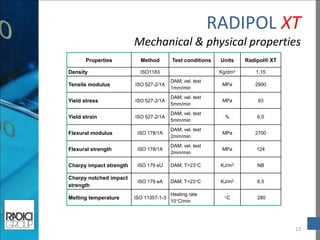
    13 Properties Method Test conditions Units Radipol® XT Density ISO1183 Kg/dm3 1,15 Tensile modulus ISO 527-2/1A DAM; vel. test 1mm/min MPa 2900 Yield stress ISO 527-2/1A DAM; vel. test 5mm/min MPa 93 Yield strain ISO 527-2/1A DAM; vel. test 5mm/min % 6.0 Flexural modulus ISO 178/1A DAM; vel. test 2mm/min MPa 2700 Flexural strength ISO 178/1A DAM; vel. test 2mm/min MPa 124 Charpy impact strength ISO 179 eU DAM; T=23°C KJ/m2 NB Charpy notched impact strength ISO 179 eA DAM; T=23°C KJ/m2 6.5 Melting temperature ISO 11357-1-3 Heating rate 10°C/min °C 280 RADIPOL XT Mechanical & physical properties
  • 14.
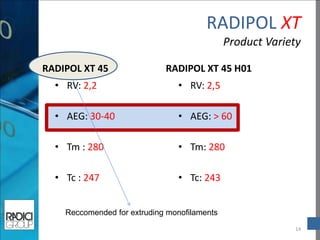
    RADIPOL XT ProductVariety RADIPOL XT 45 •RV: 2,2 •AEG: 30-40 •Tm : 280 •Tc : 247 RADIPOL XT 45 H01 14 •RV: 2,5 •AEG: > 60 •Tm: 280 •Tc: 243 Reccomended for extruding monofilaments
  • 15.
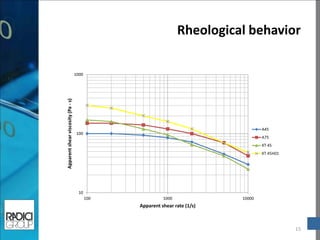
    Rheological behavior 15 10 100 1000 100 1000 10000 Apparent shear viscosity (Pa - s) Apparent shear rate (1/s) A45 A75 XT 45 XT 45H01
  • 16.
    16 XT vs.competitors Summary of main properties comparison Proprerty PA 66 XT PPS PA 4.6 PPA Melting Point 0 ++ ++ +++ ++++ Processability +++ ++++ 0 + 0 Resistance to heat in air 0 ++ +++ 0 +++ Hydrolysis + + ++++ 0 +++ HDT 0 0 + +++ ++ Density ++ ++ 0 + +
  • 17.
    17 RADIPOL XTvs Competitor (on monofilaments) (Thermal ageing in air at 200°C) The tests were carried out internally with a dynamometer for yarn 40 60 80 100 0 50 100 150 Retention (%) Time (h) Tensile stress at break Competitor (DR=3,5) XT 2 (DR= 4,0) 20 40 60 80 100 -10 10 30 50 70 90 110 130 150 Retention (%) Time (h) Elongation at break Competitor (DR=3,5) XT 2 (DR= 4,0)
  • 18.
    Monofilaments market •RADIPOLXT performances vs. main CTQ’s –Spinnability at high draw ratios (> 3.5) - GOOD –Waste reduced - GOOD –Consistency in spinning (limited evolution of the viscosity) – GOOD (XT 45 reccomended) –High heat resistance - GOOD –High melting point vs. PA 66 - GOOD –Good elastic recovery – FAIR (like 66) –Limited loss of properties due to water uptaking - GOOD 18