<Insert Picture Here>


Contexts And Dependency Injection In The Java EE 6 Ecosystem
Arun Gupta, Java EE & GlassFish Guy
blogs.sun.com/arungupta, @arungupta
The following is intended to outline our general product
direction. It is intended for information purposes only,
and may not be incorporated into any contract. It is not a
commitment to deliver any material, code, or functionality,
and should not be relied upon in making purchasing
decisions.
The development, release, and timing of any features or
functionality described for Oracle’s products remains at the
sole discretion of Oracle.


                                                               2
How we got here ?


• Java EE 5 had resource injection
  – @EJB, @PersistenceUnit, @Resource
• Motivated by Seam, Guice, and Spring
  – More typesafe than Seam
  – More stateful and less XML-centric than Spring
  – More web and enterprise-capable than Guice
• Adapts JSR 330 for Java EE environments
  – @Inject, @Qualifier, @ScopeType


                                                     3
CDI Key Concepts

• Type-safe approach to Dependency Injection
• Strong typing, Loose coupling
  – Events, Interceptors, Decorators
• Context & Scope management
• Works with Java EE modular and component architecture
  – Integration with Unified Expression Language (UEL)
• Portable extensions
• Bridge EJB (transactional tier) and JSF (presentation tier) in
  the platform

                                                                   4
What is a CDI managed bean ?


• “Beans”
  – All managed beans by other Java EE specifications
    • Except JPA
  – Meets the following conditions
    • Non-static inner class
    • Concrete class or decorated with @Decorator
    • Constructor with no parameters or a constructor annotated with @Inject
• “Contextual instances” - Instances of “beans” that belong to
  contexts

                                                                               5
How to configure ?
There is none!


• Discovers bean in all modules in which CDI is enabled
• “beans.xml”
  – WEB-INF of WAR
  – META-INF of JAR
  – META-INF of directory in the classpath
• Can enable groups of bean selectively via a descriptor


                                                           6
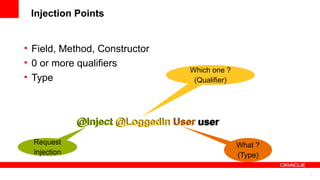
Injection Points


• Field, Method, Constructor
• 0 or more qualifiers
                                   Which one ?
• Type                              (Qualifier)


              @Inject @LoggedIn User user
  Request                                         What ?
  Injection                                       (Type)

                                                           7
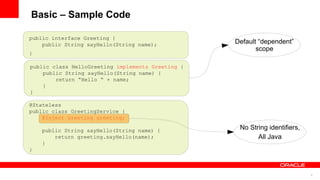
Basic – Sample Code

public interface Greeting {
    public String sayHello(String name);           Default “dependent”
                                                          scope
}

public class HelloGreeting implements Greeting {
    public String sayHello(String name) {
        return “Hello “ + name;
    }
}

@Stateless
public class GreetingService {
    @Inject Greeting greeting;

    public String sayHello(String name) {           No String identifiers,
        return greeting.sayHello(name);                   All Java
    }
}


                                                                             8
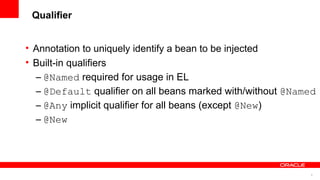
Qualifier


• Annotation to uniquely identify a bean to be injected
• Built-in qualifiers
  – @Named required for usage in EL
  – @Default qualifier on all beans marked with/without @Named
  – @Any implicit qualifier for all beans (except @New)
  – @New


                                                            9
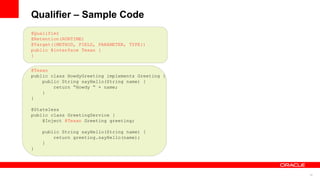
Qualifier – Sample Code
@Qualifier
@Retention(RUNTIME)
@Target({METHOD, FIELD, PARAMETER, TYPE})
public @interface Texan {
}


@Texan
public class HowdyGreeting implements Greeting {
    public String sayHello(String name) {
        return “Howdy “ + name;
    }
}

@Stateless
public class GreetingService {
    @Inject @Texan Greeting greeting;

    public String sayHello(String name) {
        return greeting.sayHello(name);
    }
}


                                                   10
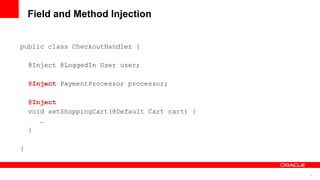
Field and Method Injection


public class CheckoutHandler {

    @Inject @LoggedIn User user;

    @Inject PaymentProcessor processor;

    @Inject
    void setShoppingCart(@Default Cart cart) {
       …
    }

}


                                                 11
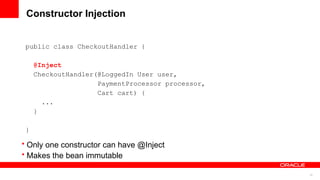
Constructor Injection


 public class CheckoutHandler {

     @Inject
     CheckoutHandler(@LoggedIn User user,
                     PaymentProcessor processor,
                     Cart cart) {
       ...
     }

 }

• Only one constructor can have @Inject
• Makes the bean immutable

                                                   12
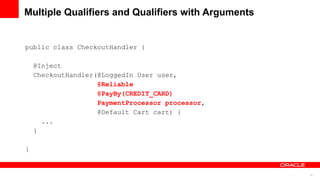
Multiple Qualifiers and Qualifiers with Arguments


public class CheckoutHandler {

    @Inject
    CheckoutHandler(@LoggedIn User user,
                    @Reliable
                    @PayBy(CREDIT_CARD)
                    PaymentProcessor processor,
                    @Default Cart cart) {
      ...
    }

}


                                                    13
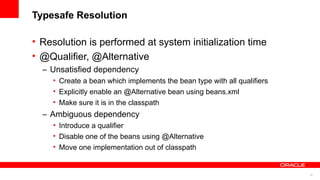
Typesafe Resolution

• Resolution is performed at system initialization time
• @Qualifier, @Alternative
  – Unsatisfied dependency
    • Create a bean which implements the bean type with all qualifiers
    • Explicitly enable an @Alternative bean using beans.xml
    • Make sure it is in the classpath
  – Ambiguous dependency
    • Introduce a qualifier
    • Disable one of the beans using @Alternative
    • Move one implementation out of classpath


                                                                         14
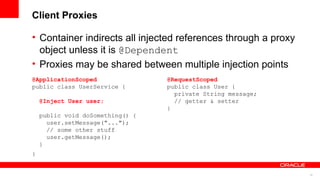
Client Proxies

• Container indirects all injected references through a proxy
  object unless it is @Dependent
• Proxies may be shared between multiple injection points
@ApplicationScoped                @RequestScoped
public class UserService {        public class User {
                                    private String message;
    @Inject User user;              // getter & setter
                                  }
    public void doSomething() {
      user.setMessage("...");
      // some other stuff
      user.getMessage();
    }
}


                                                                15
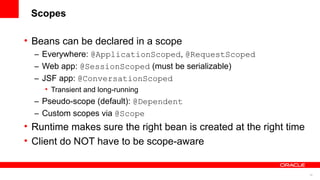
Scopes

• Beans can be declared in a scope
  – Everywhere: @ApplicationScoped, @RequestScoped
  – Web app: @SessionScoped (must be serializable)
  – JSF app: @ConversationScoped
    • Transient and long-running
  – Pseudo-scope (default): @Dependent
  – Custom scopes via @Scope
• Runtime makes sure the right bean is created at the right time
• Client do NOT have to be scope-aware


                                                                   16
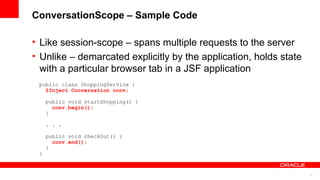
ConversationScope – Sample Code

• Like session-scope – spans multiple requests to the server
• Unlike – demarcated explicitly by the application, holds state
  with a particular browser tab in a JSF application
 public class ShoppingService {
   @Inject Conversation conv;

     public void startShopping() {
       conv.begin();
     }

     . . .

     public void checkOut() {
       conv.end();
     }
 }


                                                                   17
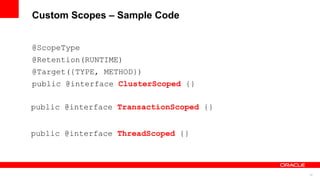
Custom Scopes – Sample Code


@ScopeType
@Retention(RUNTIME)
@Target({TYPE, METHOD})
public @interface ClusterScoped {}

public @interface TransactionScoped {}


public @interface ThreadScoped {}


                                         18
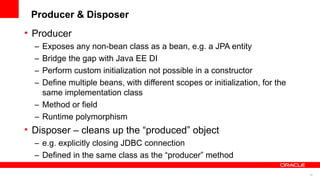
Producer & Disposer
• Producer
  – Exposes any non-bean class as a bean, e.g. a JPA entity
  – Bridge the gap with Java EE DI
  – Perform custom initialization not possible in a constructor
  – Define multiple beans, with different scopes or initialization, for the
    same implementation class
  – Method or field
  – Runtime polymorphism
• Disposer – cleans up the “produced” object
  – e.g. explicitly closing JDBC connection
  – Defined in the same class as the “producer” method

                                                                              19
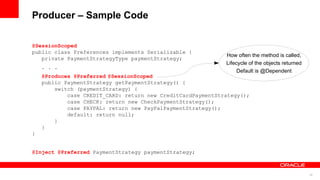
Producer – Sample Code

@SessionScoped
public class Preferences implements Serializable {
                                                             How often the method is called,
   private PaymentStrategyType paymentStrategy;
                                                             Lifecycle of the objects returned
    . . .
                                                                  Default is @Dependent
    @Produces @Preferred @SessionScoped
    public PaymentStrategy getPaymentStrategy() {
        switch (paymentStrategy) {
            case CREDIT_CARD: return new CreditCardPaymentStrategy();
            case CHECK: return new CheckPaymentStrategy();
            case PAYPAL: return new PayPalPaymentStrategy();
            default: return null;
        }
    }
}


@Inject @Preferred PaymentStrategy paymentStrategy;


                                                                                                 20
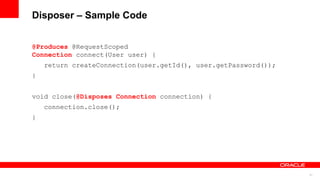
Disposer – Sample Code


@Produces @RequestScoped
Connection connect(User user) {
    return createConnection(user.getId(), user.getPassword());
}


void close(@Disposes Connection connection) {
    connection.close();
}


                                                                 21
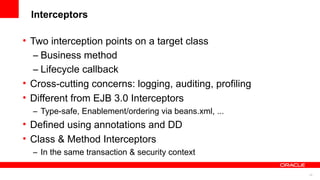
Interceptors

• Two interception points on a target class
   – Business method
   – Lifecycle callback
• Cross-cutting concerns: logging, auditing, profiling
• Different from EJB 3.0 Interceptors
    – Type-safe, Enablement/ordering via beans.xml, ...
• Defined using annotations and DD
• Class & Method Interceptors
    – In the same transaction & security context
•
                                                          22
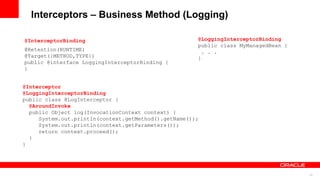
Interceptors – Business Method (Logging)

@InterceptorBinding                                   @LoggingInterceptorBinding
                                                      public class MyManagedBean {
@Retention(RUNTIME)                                     . . .
@Target({METHOD,TYPE})                                }
public @interface LoggingInterceptorBinding {
}


@Interceptor
@LoggingInterceptorBinding
public class @LogInterceptor {
  @AroundInvoke
  public Object log(InvocationContext context) {
     System.out.println(context.getMethod().getName());
     System.out.println(context.getParameters());
     return context.proceed();
  }
}


                                                                                     23
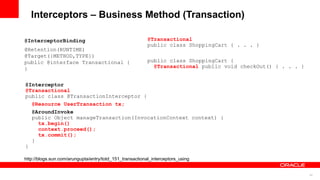
Interceptors – Business Method (Transaction)

@InterceptorBinding                                       @Transactional
                                                          public class ShoppingCart { . . . }
@Retention(RUNTIME)
@Target({METHOD,TYPE})
public @interface Transactional {                         public class ShoppingCart {
}                                                           @Transactional public void checkOut() { . . . }


@Interceptor
@Transactional
public class @TransactionInterceptor {
  @Resource UserTransaction tx;
  @AroundInvoke
  public Object manageTransaction(InvocationContext context) {
    tx.begin()
    context.proceed();
    tx.commit();
  }
}

http://blogs.sun.com/arungupta/entry/totd_151_transactional_interceptors_using


                                                                                                              24
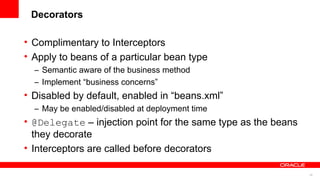
Decorators

• Complimentary to Interceptors
• Apply to beans of a particular bean type
  – Semantic aware of the business method
  – Implement “business concerns”
• Disabled by default, enabled in “beans.xml”
  – May be enabled/disabled at deployment time
• @Delegate – injection point for the same type as the beans
  they decorate
• Interceptors are called before decorators

                                                               25
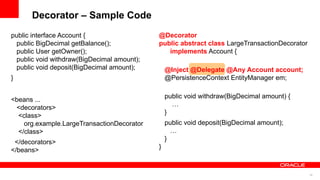
Decorator – Sample Code
public interface Account {                  @Decorator
 public BigDecimal getBalance();            public abstract class LargeTransactionDecorator
 public User getOwner();                       implements Account {
 public void withdraw(BigDecimal amount);
 public void deposit(BigDecimal amount);        @Inject @Delegate @Any Account account;
}                                               @PersistenceContext EntityManager em;

                                                public void withdraw(BigDecimal amount) {
<beans ...
                                                  …
 <decorators>
                                                }
  <class>
    org.example.LargeTransactionDecorator       public void deposit(BigDecimal amount);
  </class>                                        …
                                                }
 </decorators>
                                            }
</beans>


                                                                                              26
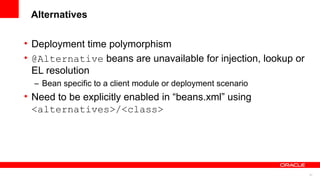
Alternatives

• Deployment time polymorphism
• @Alternative beans are unavailable for injection, lookup or
  EL resolution
  – Bean specific to a client module or deployment scenario
• Need to be explicitly enabled in “beans.xml” using
  <alternatives>/<class>


                                                                27
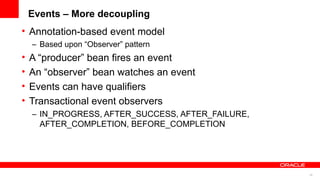
Events – More decoupling
• Annotation-based event model
    – Based upon “Observer” pattern
•   A “producer” bean fires an event
•   An “observer” bean watches an event
•   Events can have qualifiers
•   Transactional event observers
    – IN_PROGRESS, AFTER_SUCCESS, AFTER_FAILURE,
      AFTER_COMPLETION, BEFORE_COMPLETION


                                                   28
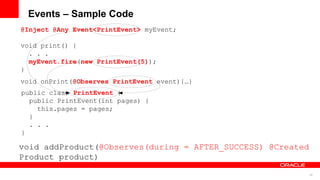
Events – Sample Code
@Inject @Any Event<PrintEvent> myEvent;

void print() {
  . . .
  myEvent.fire(new PrintEvent(5));
}
void onPrint(@Observes PrintEvent event){…}
public class PrintEvent {
  public PrintEvent(int pages) {
    this.pages = pages;
  }
  . . .
}

void addProduct(@Observes(during = AFTER_SUCCESS) @Created
Product product)
                                                             29
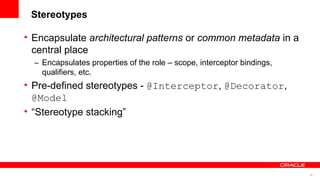
Stereotypes

• Encapsulate architectural patterns or common metadata in a
  central place
  – Encapsulates properties of the role – scope, interceptor bindings,
    qualifiers, etc.
• Pre-defined stereotypes - @Interceptor, @Decorator,
  @Model
• “Stereotype stacking”


                                                                         30
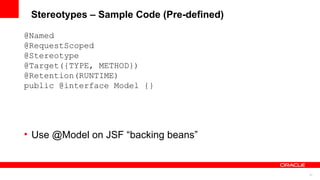
Stereotypes – Sample Code (Pre-defined)

@Named
@RequestScoped
@Stereotype
@Target({TYPE, METHOD})
@Retention(RUNTIME)
public @interface Model {}


• Use @Model on JSF “backing beans”


                                           31
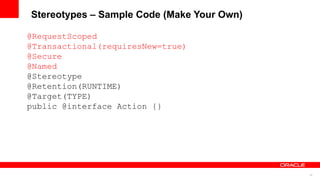
Stereotypes – Sample Code (Make Your Own)

@RequestScoped
@Transactional(requiresNew=true)
@Secure
@Named
@Stereotype
@Retention(RUNTIME)
@Target(TYPE)
public @interface Action {}


                                            32
Loose Coupling

• Alternatives – deployment time polymorphism
• Producer – runtime polymorphism
• Interceptors – decouple technical and business concerns
• Decorators – decouple business concerns
• Event notifications – decouple event producer and
  consumers
• Contextual lifecycle management decouples bean
  lifecycles


                                                            33
Strong Typing

• No String-based identifiers, only type-safe Java constructs
  – Dependencies, interceptors, decorators, event produced/consumed, ...
• IDEs can provide autocompletion, validation, and refactoring
• Lift the semantic level of code
  – Make the code more understandable
  – @Asynchronous instead of asyncPaymentProcessor
• Stereotypes


                                                                           34
CDI & EJB - Typesafety


• Java EE resources injected using String-based names (non-
typesafe)
• JDBC/JMS resources, EJB references, Persistence
Context/Unit, …
• Typesafe dependency injection
• Loose coupling, Strong typing
• Lesser errors due to typos in String-based names
• Easier and better tooling


                                                              35
CDI & EJB – Stateful Components


• Stateful components passed by client in a scope
• Explicitly destroy components when the scope is complete


• Session bean through CDI is “contextual instance”
• CDI runtime creates the instance when needed by the client
• CDI runtime destroys the instance when the context ends


                                                               36
CDI & EJB – As JSF “backing bean”


•JSF managed beans used as “glue” to connect with Java EE enterprise
services


• EJB may be used as JSF managed beans
 • No JSF backing beans “glue”
• Brings transactional support to web tier


                                                                       37
CDI & EJB – Enhanced Interceptors


• Interceptors only defined for session beans or message
listener methods of MDBs
• Enabled statically using “ejb-jar.xml” or @Interceptors

• Typesafe Interceptor bindings on any managed bean
• Can be enabled or disabled at deployment using “beans.xml”
• Order of interceptors can be controlled using “beans.xml”


                                                               38
CDI & JSF


• Brings transactional support to web tier by allowing EJB as JSF
  “backing beans”
• Built-in stereotypes for ease-of-development - @Model
• Integration with Unified Expression Language
  – <h:dataTable value=#{cart.lineItems}” var=”item”>
• Context management complements JSF's component-oriented
  model


                                                                39
CDI & JSF


• @ConversationScope holds state with a browser tab in JSF
  application
  – @Inject Conversation conv;
• Transient (default) and long-running conversations
    • Shopping Cart example
    • Transient converted to long-running: Conversation.begin/end
• @Named enables EL-friendly name


                                                                    40
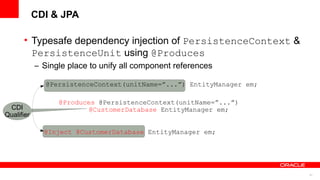
CDI & JPA

      • Typesafe dependency injection of PersistenceContext &
        PersistenceUnit using @Produces
            – Single place to unify all component references

               @PersistenceContext(unitName=”...”) EntityManager em;

                  @Produces @PersistenceContext(unitName=”...”)
 CDI                      @CustomerDatabase EntityManager em;
Qualifier

              @Inject @CustomerDatabase EntityManager em;


                                                                       41
CDI & JPA


• Create “transactional event observers”
  – Kinds
    •   IN_PROGRESS
    •   BEFORE_COMPLETION
    •   AFTER_COMPLETION
    •   AFTER_FAILURE
    •   AFTER_SUCCESS
  – Keep the cache updated


                                           42
CDI & JAX-RS


• Manage the lifecycle of JAX-RS resource by CDI
  – Annotate a JAX-RS resource with @RequestScoped
• @Path to convert class of a managed component into a
  root resource class


                                                         43
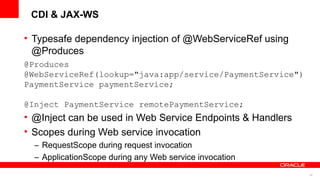
CDI & JAX-WS

• Typesafe dependency injection of @WebServiceRef using
  @Produces
@Produces
@WebServiceRef(lookup="java:app/service/PaymentService")
PaymentService paymentService;

@Inject PaymentService remotePaymentService;
• @Inject can be used in Web Service Endpoints & Handlers
• Scopes during Web service invocation
  – RequestScope during request invocation
  – ApplicationScope during any Web service invocation
                                                            44
Portable Extensions

• Key development around Java EE 6 “extensibility” theme
• Addition of beans, decorators, interceptors, contexts
  – OSGi service into Java EE components
  – Running CDI in Java SE environment
  – TX and Persistence to non-EJB managed beans
• Integration with BPM engines
• Integration with 3 -party frameworks like Spring, Seam, Wicket
                    rd


• New technology based upon the CDI programming model


                                                                   45
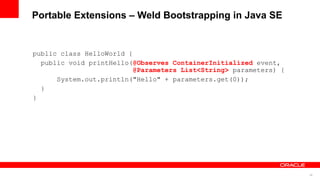
Portable Extensions – Weld Bootstrapping in Java SE


public class HelloWorld {
  public void printHello(@Observes ContainerInitialized event,
                          @Parameters List<String> parameters) {
      System.out.println("Hello" + parameters.get(0));
  }
}


                                                                   46
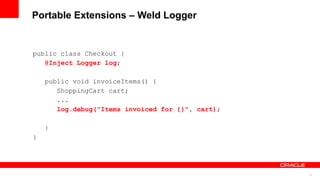
Portable Extensions – Weld Logger


public class Checkout {
   @Inject Logger log;

    public void invoiceItems() {
       ShoppingCart cart;
       ...
       log.debug("Items invoiced for {}", cart);

    }
}


                                                   47
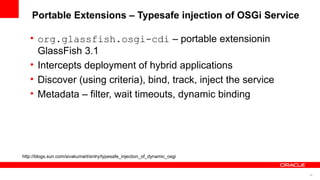
Portable Extensions – Typesafe injection of OSGi Service

   • org.glassfish.osgi-cdi – portable extensionin
     GlassFish 3.1
   • Intercepts deployment of hybrid applications
   • Discover (using criteria), bind, track, inject the service
   • Metadata – filter, wait timeouts, dynamic binding


http://blogs.sun.com/sivakumart/entry/typesafe_injection_of_dynamic_osgi


                                                                           48
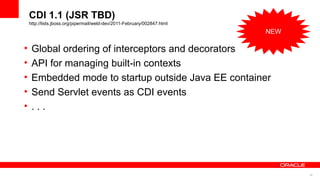
CDI 1.1 (JSR TBD)
    http://lists.jboss.org/pipermail/weld-dev/2011-February/002847.html
                                                                          NEW

•    Global ordering of interceptors and decorators
•    API for managing built-in contexts
•    Embedded mode to startup outside Java EE container
•    Send Servlet events as CDI events
•    ...


                                                                                49
CDI Implementations


                      50
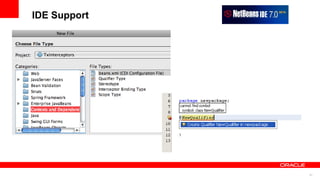
IDE Support


              51
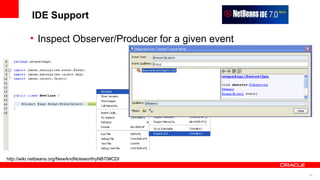
IDE Support

          • Inspect Observer/Producer for a given event


http://wiki.netbeans.org/NewAndNoteworthyNB70#CDI


                                                          52
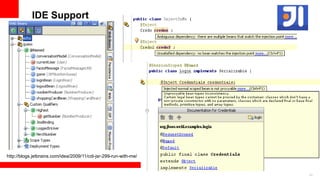
IDE Support


http://blogs.jetbrains.com/idea/2009/11/cdi-jsr-299-run-with-me/


                                                                   53
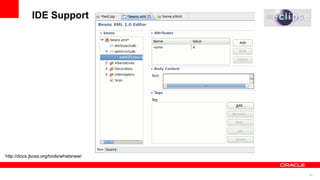
IDE Support


http://docs.jboss.org/tools/whatsnew/


                                        54
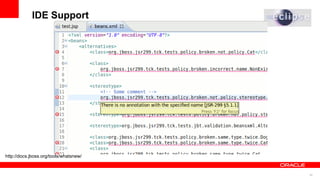
IDE Support


http://docs.jboss.org/tools/whatsnew/


                                        55
Summary


• Provides standards-based and typesafe dependency injection
  in Java EE 6
• Integrates well with other Java EE 6 technologies
• Portable Extensions facilitate richer programming model
• Weld is the Reference Implementation
   – Integrated in GlassFish and JBoss
• Improving support in IDEs


                                                               56
References


•   oracle.com/goto/glassfish
•   glassfish.org
•   blogs.sun.com/theaquarium
•   youtube.com/user/GlassFishVideos
•   http://docs.jboss.org/weld/reference/latest/en-US/html/
•   Follow @glassfish


                                                              57
<Insert Picture Here>


Contexts And Dependency Injection In The Java EE 6 Ecosystem
Arun Gupta, Java EE & GlassFish Guy
blogs.sun.com/arungupta, @arungupta

Spark IT 2011 - Context & Dependency Injection in the Java EE 6 Ecosystem

  • 1.
    <Insert Picture Here> ContextsAnd Dependency Injection In The Java EE 6 Ecosystem Arun Gupta, Java EE & GlassFish Guy blogs.sun.com/arungupta, @arungupta
  • 2.
    The following isintended to outline our general product direction. It is intended for information purposes only, and may not be incorporated into any contract. It is not a commitment to deliver any material, code, or functionality, and should not be relied upon in making purchasing decisions. The development, release, and timing of any features or functionality described for Oracle’s products remains at the sole discretion of Oracle. 2
  • 3.
    How we gothere ? • Java EE 5 had resource injection – @EJB, @PersistenceUnit, @Resource • Motivated by Seam, Guice, and Spring – More typesafe than Seam – More stateful and less XML-centric than Spring – More web and enterprise-capable than Guice • Adapts JSR 330 for Java EE environments – @Inject, @Qualifier, @ScopeType 3
  • 4.
    CDI Key Concepts •Type-safe approach to Dependency Injection • Strong typing, Loose coupling – Events, Interceptors, Decorators • Context & Scope management • Works with Java EE modular and component architecture – Integration with Unified Expression Language (UEL) • Portable extensions • Bridge EJB (transactional tier) and JSF (presentation tier) in the platform 4
  • 5.
    What is aCDI managed bean ? • “Beans” – All managed beans by other Java EE specifications • Except JPA – Meets the following conditions • Non-static inner class • Concrete class or decorated with @Decorator • Constructor with no parameters or a constructor annotated with @Inject • “Contextual instances” - Instances of “beans” that belong to contexts 5
  • 6.
    How to configure? There is none! • Discovers bean in all modules in which CDI is enabled • “beans.xml” – WEB-INF of WAR – META-INF of JAR – META-INF of directory in the classpath • Can enable groups of bean selectively via a descriptor 6
  • 7.
    Injection Points • Field,Method, Constructor • 0 or more qualifiers Which one ? • Type (Qualifier) @Inject @LoggedIn User user Request What ? Injection (Type) 7
  • 8.
    Basic – SampleCode public interface Greeting { public String sayHello(String name); Default “dependent” scope } public class HelloGreeting implements Greeting { public String sayHello(String name) { return “Hello “ + name; } } @Stateless public class GreetingService { @Inject Greeting greeting; public String sayHello(String name) { No String identifiers, return greeting.sayHello(name); All Java } } 8
  • 9.
    Qualifier • Annotation touniquely identify a bean to be injected • Built-in qualifiers – @Named required for usage in EL – @Default qualifier on all beans marked with/without @Named – @Any implicit qualifier for all beans (except @New) – @New 9
  • 10.
    Qualifier – SampleCode @Qualifier @Retention(RUNTIME) @Target({METHOD, FIELD, PARAMETER, TYPE}) public @interface Texan { } @Texan public class HowdyGreeting implements Greeting { public String sayHello(String name) { return “Howdy “ + name; } } @Stateless public class GreetingService { @Inject @Texan Greeting greeting; public String sayHello(String name) { return greeting.sayHello(name); } } 10
  • 11.
    Field and MethodInjection public class CheckoutHandler { @Inject @LoggedIn User user; @Inject PaymentProcessor processor; @Inject void setShoppingCart(@Default Cart cart) { … } } 11
  • 12.
    Constructor Injection publicclass CheckoutHandler { @Inject CheckoutHandler(@LoggedIn User user, PaymentProcessor processor, Cart cart) { ... } } • Only one constructor can have @Inject • Makes the bean immutable 12
  • 13.
    Multiple Qualifiers andQualifiers with Arguments public class CheckoutHandler { @Inject CheckoutHandler(@LoggedIn User user, @Reliable @PayBy(CREDIT_CARD) PaymentProcessor processor, @Default Cart cart) { ... } } 13
  • 14.
    Typesafe Resolution • Resolutionis performed at system initialization time • @Qualifier, @Alternative – Unsatisfied dependency • Create a bean which implements the bean type with all qualifiers • Explicitly enable an @Alternative bean using beans.xml • Make sure it is in the classpath – Ambiguous dependency • Introduce a qualifier • Disable one of the beans using @Alternative • Move one implementation out of classpath 14
  • 15.
    Client Proxies • Containerindirects all injected references through a proxy object unless it is @Dependent • Proxies may be shared between multiple injection points @ApplicationScoped @RequestScoped public class UserService { public class User { private String message; @Inject User user; // getter & setter } public void doSomething() { user.setMessage("..."); // some other stuff user.getMessage(); } } 15
  • 16.
    Scopes • Beans canbe declared in a scope – Everywhere: @ApplicationScoped, @RequestScoped – Web app: @SessionScoped (must be serializable) – JSF app: @ConversationScoped • Transient and long-running – Pseudo-scope (default): @Dependent – Custom scopes via @Scope • Runtime makes sure the right bean is created at the right time • Client do NOT have to be scope-aware 16
  • 17.
    ConversationScope – SampleCode • Like session-scope – spans multiple requests to the server • Unlike – demarcated explicitly by the application, holds state with a particular browser tab in a JSF application public class ShoppingService { @Inject Conversation conv; public void startShopping() { conv.begin(); } . . . public void checkOut() { conv.end(); } } 17
  • 18.
    Custom Scopes –Sample Code @ScopeType @Retention(RUNTIME) @Target({TYPE, METHOD}) public @interface ClusterScoped {} public @interface TransactionScoped {} public @interface ThreadScoped {} 18
  • 19.
    Producer & Disposer •Producer – Exposes any non-bean class as a bean, e.g. a JPA entity – Bridge the gap with Java EE DI – Perform custom initialization not possible in a constructor – Define multiple beans, with different scopes or initialization, for the same implementation class – Method or field – Runtime polymorphism • Disposer – cleans up the “produced” object – e.g. explicitly closing JDBC connection – Defined in the same class as the “producer” method 19
  • 20.
    Producer – SampleCode @SessionScoped public class Preferences implements Serializable { How often the method is called, private PaymentStrategyType paymentStrategy; Lifecycle of the objects returned . . . Default is @Dependent @Produces @Preferred @SessionScoped public PaymentStrategy getPaymentStrategy() { switch (paymentStrategy) { case CREDIT_CARD: return new CreditCardPaymentStrategy(); case CHECK: return new CheckPaymentStrategy(); case PAYPAL: return new PayPalPaymentStrategy(); default: return null; } } } @Inject @Preferred PaymentStrategy paymentStrategy; 20
  • 21.
    Disposer – SampleCode @Produces @RequestScoped Connection connect(User user) { return createConnection(user.getId(), user.getPassword()); } void close(@Disposes Connection connection) { connection.close(); } 21
  • 22.
    Interceptors • Two interceptionpoints on a target class – Business method – Lifecycle callback • Cross-cutting concerns: logging, auditing, profiling • Different from EJB 3.0 Interceptors – Type-safe, Enablement/ordering via beans.xml, ... • Defined using annotations and DD • Class & Method Interceptors – In the same transaction & security context • 22
  • 23.
    Interceptors – BusinessMethod (Logging) @InterceptorBinding @LoggingInterceptorBinding public class MyManagedBean { @Retention(RUNTIME) . . . @Target({METHOD,TYPE}) } public @interface LoggingInterceptorBinding { } @Interceptor @LoggingInterceptorBinding public class @LogInterceptor { @AroundInvoke public Object log(InvocationContext context) { System.out.println(context.getMethod().getName()); System.out.println(context.getParameters()); return context.proceed(); } } 23
  • 24.
    Interceptors – BusinessMethod (Transaction) @InterceptorBinding @Transactional public class ShoppingCart { . . . } @Retention(RUNTIME) @Target({METHOD,TYPE}) public @interface Transactional { public class ShoppingCart { } @Transactional public void checkOut() { . . . } @Interceptor @Transactional public class @TransactionInterceptor { @Resource UserTransaction tx; @AroundInvoke public Object manageTransaction(InvocationContext context) { tx.begin() context.proceed(); tx.commit(); } } http://blogs.sun.com/arungupta/entry/totd_151_transactional_interceptors_using 24
  • 25.
    Decorators • Complimentary toInterceptors • Apply to beans of a particular bean type – Semantic aware of the business method – Implement “business concerns” • Disabled by default, enabled in “beans.xml” – May be enabled/disabled at deployment time • @Delegate – injection point for the same type as the beans they decorate • Interceptors are called before decorators 25
  • 26.
    Decorator – SampleCode public interface Account { @Decorator public BigDecimal getBalance(); public abstract class LargeTransactionDecorator public User getOwner(); implements Account { public void withdraw(BigDecimal amount); public void deposit(BigDecimal amount); @Inject @Delegate @Any Account account; } @PersistenceContext EntityManager em; public void withdraw(BigDecimal amount) { <beans ... … <decorators> } <class> org.example.LargeTransactionDecorator public void deposit(BigDecimal amount); </class> … } </decorators> } </beans> 26
  • 27.
    Alternatives • Deployment timepolymorphism • @Alternative beans are unavailable for injection, lookup or EL resolution – Bean specific to a client module or deployment scenario • Need to be explicitly enabled in “beans.xml” using <alternatives>/<class> 27
  • 28.
    Events – Moredecoupling • Annotation-based event model – Based upon “Observer” pattern • A “producer” bean fires an event • An “observer” bean watches an event • Events can have qualifiers • Transactional event observers – IN_PROGRESS, AFTER_SUCCESS, AFTER_FAILURE, AFTER_COMPLETION, BEFORE_COMPLETION 28
  • 29.
    Events – SampleCode @Inject @Any Event<PrintEvent> myEvent; void print() { . . . myEvent.fire(new PrintEvent(5)); } void onPrint(@Observes PrintEvent event){…} public class PrintEvent { public PrintEvent(int pages) { this.pages = pages; } . . . } void addProduct(@Observes(during = AFTER_SUCCESS) @Created Product product) 29
  • 30.
    Stereotypes • Encapsulate architecturalpatterns or common metadata in a central place – Encapsulates properties of the role – scope, interceptor bindings, qualifiers, etc. • Pre-defined stereotypes - @Interceptor, @Decorator, @Model • “Stereotype stacking” 30
  • 31.
    Stereotypes – SampleCode (Pre-defined) @Named @RequestScoped @Stereotype @Target({TYPE, METHOD}) @Retention(RUNTIME) public @interface Model {} • Use @Model on JSF “backing beans” 31
  • 32.
    Stereotypes – SampleCode (Make Your Own) @RequestScoped @Transactional(requiresNew=true) @Secure @Named @Stereotype @Retention(RUNTIME) @Target(TYPE) public @interface Action {} 32
  • 33.
    Loose Coupling • Alternatives– deployment time polymorphism • Producer – runtime polymorphism • Interceptors – decouple technical and business concerns • Decorators – decouple business concerns • Event notifications – decouple event producer and consumers • Contextual lifecycle management decouples bean lifecycles 33
  • 34.
    Strong Typing • NoString-based identifiers, only type-safe Java constructs – Dependencies, interceptors, decorators, event produced/consumed, ... • IDEs can provide autocompletion, validation, and refactoring • Lift the semantic level of code – Make the code more understandable – @Asynchronous instead of asyncPaymentProcessor • Stereotypes 34
  • 35.
    CDI & EJB- Typesafety • Java EE resources injected using String-based names (non- typesafe) • JDBC/JMS resources, EJB references, Persistence Context/Unit, … • Typesafe dependency injection • Loose coupling, Strong typing • Lesser errors due to typos in String-based names • Easier and better tooling 35
  • 36.
    CDI & EJB– Stateful Components • Stateful components passed by client in a scope • Explicitly destroy components when the scope is complete • Session bean through CDI is “contextual instance” • CDI runtime creates the instance when needed by the client • CDI runtime destroys the instance when the context ends 36
  • 37.
    CDI & EJB– As JSF “backing bean” •JSF managed beans used as “glue” to connect with Java EE enterprise services • EJB may be used as JSF managed beans • No JSF backing beans “glue” • Brings transactional support to web tier 37
  • 38.
    CDI & EJB– Enhanced Interceptors • Interceptors only defined for session beans or message listener methods of MDBs • Enabled statically using “ejb-jar.xml” or @Interceptors • Typesafe Interceptor bindings on any managed bean • Can be enabled or disabled at deployment using “beans.xml” • Order of interceptors can be controlled using “beans.xml” 38
  • 39.
    CDI & JSF •Brings transactional support to web tier by allowing EJB as JSF “backing beans” • Built-in stereotypes for ease-of-development - @Model • Integration with Unified Expression Language – <h:dataTable value=#{cart.lineItems}” var=”item”> • Context management complements JSF's component-oriented model 39
  • 40.
    CDI & JSF •@ConversationScope holds state with a browser tab in JSF application – @Inject Conversation conv; • Transient (default) and long-running conversations • Shopping Cart example • Transient converted to long-running: Conversation.begin/end • @Named enables EL-friendly name 40
  • 41.
    CDI & JPA • Typesafe dependency injection of PersistenceContext & PersistenceUnit using @Produces – Single place to unify all component references @PersistenceContext(unitName=”...”) EntityManager em; @Produces @PersistenceContext(unitName=”...”) CDI @CustomerDatabase EntityManager em; Qualifier @Inject @CustomerDatabase EntityManager em; 41
  • 42.
    CDI & JPA •Create “transactional event observers” – Kinds • IN_PROGRESS • BEFORE_COMPLETION • AFTER_COMPLETION • AFTER_FAILURE • AFTER_SUCCESS – Keep the cache updated 42
  • 43.
    CDI & JAX-RS •Manage the lifecycle of JAX-RS resource by CDI – Annotate a JAX-RS resource with @RequestScoped • @Path to convert class of a managed component into a root resource class 43
  • 44.
    CDI & JAX-WS •Typesafe dependency injection of @WebServiceRef using @Produces @Produces @WebServiceRef(lookup="java:app/service/PaymentService") PaymentService paymentService; @Inject PaymentService remotePaymentService; • @Inject can be used in Web Service Endpoints & Handlers • Scopes during Web service invocation – RequestScope during request invocation – ApplicationScope during any Web service invocation 44
  • 45.
    Portable Extensions • Keydevelopment around Java EE 6 “extensibility” theme • Addition of beans, decorators, interceptors, contexts – OSGi service into Java EE components – Running CDI in Java SE environment – TX and Persistence to non-EJB managed beans • Integration with BPM engines • Integration with 3 -party frameworks like Spring, Seam, Wicket rd • New technology based upon the CDI programming model 45
  • 46.
    Portable Extensions –Weld Bootstrapping in Java SE public class HelloWorld { public void printHello(@Observes ContainerInitialized event, @Parameters List<String> parameters) { System.out.println("Hello" + parameters.get(0)); } } 46
  • 47.
    Portable Extensions –Weld Logger public class Checkout { @Inject Logger log; public void invoiceItems() { ShoppingCart cart; ... log.debug("Items invoiced for {}", cart); } } 47
  • 48.
    Portable Extensions –Typesafe injection of OSGi Service • org.glassfish.osgi-cdi – portable extensionin GlassFish 3.1 • Intercepts deployment of hybrid applications • Discover (using criteria), bind, track, inject the service • Metadata – filter, wait timeouts, dynamic binding http://blogs.sun.com/sivakumart/entry/typesafe_injection_of_dynamic_osgi 48
  • 49.
    CDI 1.1 (JSRTBD) http://lists.jboss.org/pipermail/weld-dev/2011-February/002847.html NEW • Global ordering of interceptors and decorators • API for managing built-in contexts • Embedded mode to startup outside Java EE container • Send Servlet events as CDI events • ... 49
  • 50.
  • 51.
  • 52.
    IDE Support • Inspect Observer/Producer for a given event http://wiki.netbeans.org/NewAndNoteworthyNB70#CDI 52
  • 53.
  • 54.
  • 55.
  • 56.
    Summary • Provides standards-basedand typesafe dependency injection in Java EE 6 • Integrates well with other Java EE 6 technologies • Portable Extensions facilitate richer programming model • Weld is the Reference Implementation – Integrated in GlassFish and JBoss • Improving support in IDEs 56
  • 57.
    References • oracle.com/goto/glassfish • glassfish.org • blogs.sun.com/theaquarium • youtube.com/user/GlassFishVideos • http://docs.jboss.org/weld/reference/latest/en-US/html/ • Follow @glassfish 57
  • 58.
    <Insert Picture Here> ContextsAnd Dependency Injection In The Java EE 6 Ecosystem Arun Gupta, Java EE & GlassFish Guy blogs.sun.com/arungupta, @arungupta