Contexts And Dependency Injection In The Java EE 6 Ecosystem Prasad Subramanian
Software Engineering Manager
The following is intended to outline our general product direction. It is intended for information purposes only,  and may not be incorporated into any contract. It is not a commitment to deliver any material, code, or functionality, and should not be relied upon in making purchasing decisions. The development, release, and timing of any features or functionality described for Oracle’s products remains at the sole discretion of Oracle.
How we got here ? Java EE 5 had  resource injection @EJB, @PersistenceUnit, @Resource Motivated by Seam, Guice, and Spring More typesafe than Seam
More stateful and less XML-centric than Spring
More web and enterprise-capable than Guice Adapts JSR 330 for Java EE environments @Inject, @Qualifier, @ScopeType
CDI Key Concepts Type-safe approach to Dependency Injection
Strong typing, Loose coupling Events, Interceptors, Decorators Context & Scope management
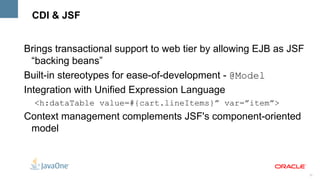
Works with Java EE modular and component architecture Integration with Unified Expression Language (UEL) Portable extensions
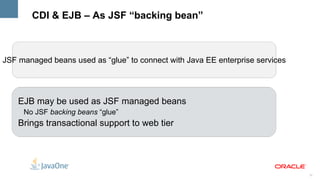
Bridge EJB (transactional tier) and JSF (presentation tier) in the platform
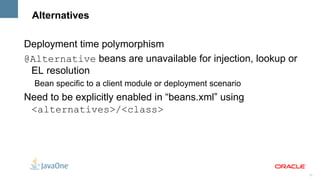
Loose Coupling Alternatives – deployment time polymorphism
Producer – runtime polymorphism
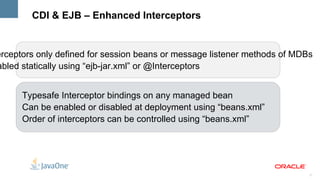
Interceptors – decouple technical and business concerns
Decorators – decouple business concerns
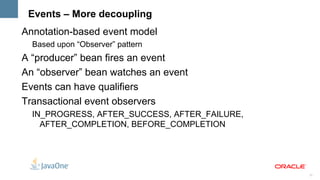
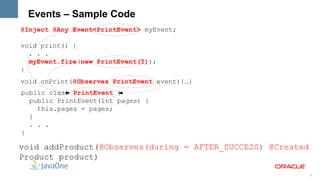
Event notifications – decouple event producer and consumers
Contextual lifecycle management decouples bean lifecycles
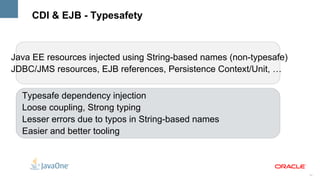
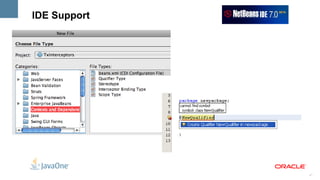
Strong Typing No String-based identifiers, only type-safe Java constructs Dependencies, interceptors, decorators, event produced/consumed, ... IDEs can provide autocompletion, validation, and refactoring
Lift the semantic level of code Make the code more understandable
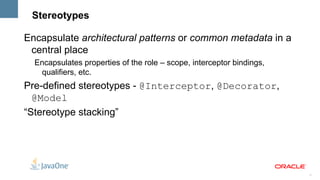
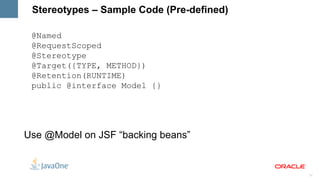
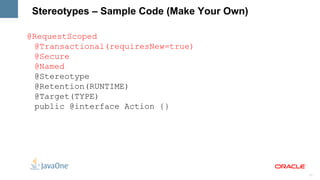
@Asynchronous  instead of  asyncPaymentProcessor Stereotypes
What is a CDI managed bean ? “ Beans” All managed beans by other Java EE specifications Except JPA Meets the following conditions Non-static inner class
Concrete class or decorated with @Decorator
Constructor with no parameters or a constructor annotated with @Inject “ Contextual instances” - Instances of “beans” that belong to contexts
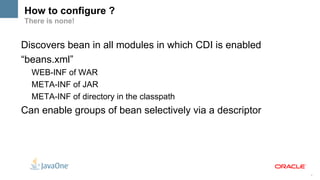
How to configure ? There is none! Discovers bean in all modules in which CDI is enabled
“ beans.xml” WEB-INF of WAR
META-INF of JAR
META-INF of directory in the classpath Can enable groups of bean selectively via a descriptor
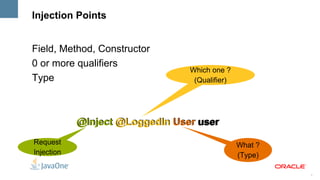
Injection Points Field, Method, Constructor
0 or more qualifiers
Type @Inject @LoggedIn User user @Inject   @LoggedIn   User  user Request Injection What ? (Type) Which one ? (Qualifier)
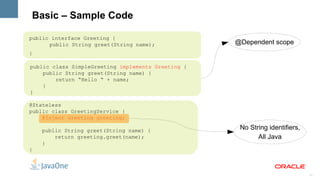
Basic – Sample Code public interface Greeting {   public String greet(String name); } @Stateless public class GreetingService {   @Inject Greeting greeting;   public String greet(String name) {   return greeting.greet(name);   } } public class SimpleGreeting  implements Greeting  {   public String greet(String name) {   return “Hello “ + name;   } }
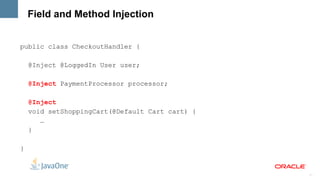
Field and Method Injection public class CheckoutHandler { @Inject @LoggedIn User user; @Inject  PaymentProcessor processor; @Inject void setShoppingCart(@Default Cart cart) { … } }
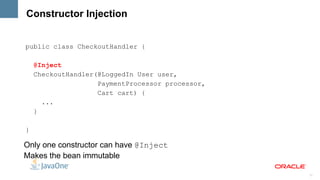
Constructor Injection public class CheckoutHandler { @Inject CheckoutHandler(@LoggedIn User user, PaymentProcessor processor, Cart cart) { ... } } Only one constructor can have  @Inject
Makes the bean immutable
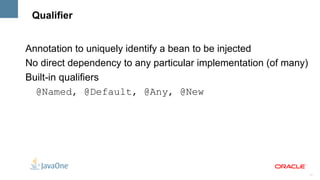
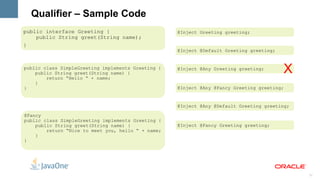
Qualifier Annotation to uniquely identify a bean to be injected
No direct dependency to any particular implementation (of many)
Built-in qualifiers @Named, @Default, @Any, @New
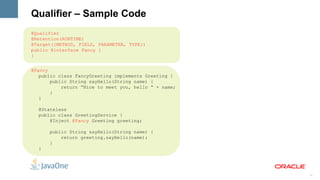
Qualifier – Sample Code @Fancy public class FancyGreeting implements Greeting {   public String sayHello(String name) {   return “Nice to meet you, hello “ + name;   } } @Stateless public class GreetingService {   @Inject  @Fancy  Greeting greeting;   public String sayHello(String name) {   return greeting.sayHello(name);   } } @Qualifier @Retention(RUNTIME) @Target({METHOD, FIELD, PARAMETER, TYPE}) public @interface Fancy { }
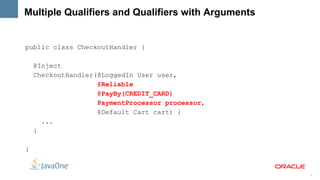
Multiple Qualifiers and Qualifiers with Arguments public class CheckoutHandler { @Inject CheckoutHandler(@LoggedIn User user, @Reliable @PayBy(CREDIT_CARD) PaymentProcessor processor , @Default Cart cart) { ... } }
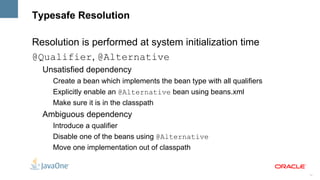
Typesafe Resolution Resolution is performed at system initialization time
@Qualifier ,  @Alternative Unsatisfied dependency Create a bean which implements the bean type with all qualifiers
Explicitly enable an  @Alternative  bean using beans.xml
Make sure it is in the classpath Ambiguous dependency Introduce a qualifier
Disable one of the beans using  @Alternative
Move one implementation out of classpath
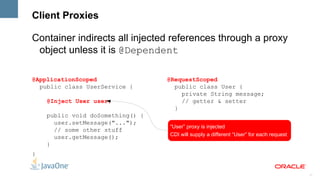
Client Proxies Container indirects all injected references through a proxy object unless it is  @Dependent @ApplicationScoped public class UserService {   @Inject User user;   public void doSomething() {   user.setMessage("...");   // some other stuff   user.getMessage();   } } @RequestScoped public class User {   private String message;   // getter & setter }  “ User” proxy is injected CDI will supply a different “User” for each request
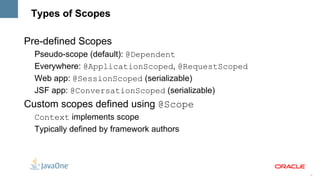
Types of Scopes Pre-defined Scopes Pseudo-scope (default):  @Dependent
Everywhere:  @ApplicationScoped ,  @RequestScoped
Web app:  @SessionScoped  (serializable)
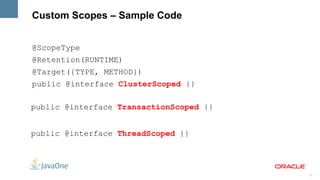
JSF app:  @ConversationScoped  (serializable) Custom scopes defined using  @Scope Context  implements scope
Typically defined by framework authors
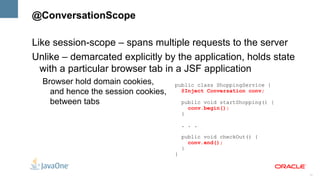
@ConversationScope Like session-scope – spans multiple requests to the server
Unlike – demarcated explicitly by the application, holds state with a particular browser tab in a JSF application Browser hold domain cookies,  and hence the session cookies,  between tabs public class ShoppingService {   @Inject Conversation conv;   public void startShopping() {   conv.begin();   }   . . .   public void checkOut() {   conv.end();   } }
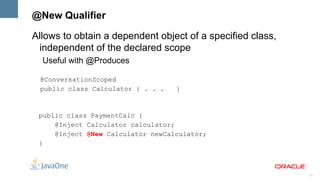
@New Qualifier Allows to obtain a dependent object of a specified class, independent of the declared scope Useful with @Produces @ConversationScoped public class Calculator { . . .   } public class PaymentCalc { @Inject Calculator calculator; @Inject  @New  Calculator newCalculator; }

CDI @javaonehyderabad

  • 1.
    Contexts And DependencyInjection In The Java EE 6 Ecosystem Prasad Subramanian
  • 2.
  • 3.
    The following isintended to outline our general product direction. It is intended for information purposes only, and may not be incorporated into any contract. It is not a commitment to deliver any material, code, or functionality, and should not be relied upon in making purchasing decisions. The development, release, and timing of any features or functionality described for Oracle’s products remains at the sole discretion of Oracle.
  • 4.
    How we gothere ? Java EE 5 had resource injection @EJB, @PersistenceUnit, @Resource Motivated by Seam, Guice, and Spring More typesafe than Seam
  • 5.
    More stateful andless XML-centric than Spring
  • 6.
    More web andenterprise-capable than Guice Adapts JSR 330 for Java EE environments @Inject, @Qualifier, @ScopeType
  • 7.
    CDI Key ConceptsType-safe approach to Dependency Injection
  • 8.
    Strong typing, Loosecoupling Events, Interceptors, Decorators Context & Scope management
  • 9.
    Works with JavaEE modular and component architecture Integration with Unified Expression Language (UEL) Portable extensions
  • 10.
    Bridge EJB (transactionaltier) and JSF (presentation tier) in the platform
  • 11.
    Loose Coupling Alternatives– deployment time polymorphism
  • 12.
  • 13.
    Interceptors – decoupletechnical and business concerns
  • 14.
    Decorators – decouplebusiness concerns
  • 15.
    Event notifications –decouple event producer and consumers
  • 16.
    Contextual lifecycle managementdecouples bean lifecycles
  • 17.
    Strong Typing NoString-based identifiers, only type-safe Java constructs Dependencies, interceptors, decorators, event produced/consumed, ... IDEs can provide autocompletion, validation, and refactoring
  • 18.
    Lift the semanticlevel of code Make the code more understandable
  • 19.
    @Asynchronous insteadof asyncPaymentProcessor Stereotypes
  • 20.
    What is aCDI managed bean ? “ Beans” All managed beans by other Java EE specifications Except JPA Meets the following conditions Non-static inner class
  • 21.
    Concrete class ordecorated with @Decorator
  • 22.
    Constructor with noparameters or a constructor annotated with @Inject “ Contextual instances” - Instances of “beans” that belong to contexts
  • 23.
    How to configure? There is none! Discovers bean in all modules in which CDI is enabled
  • 24.
  • 25.
  • 26.
    META-INF of directoryin the classpath Can enable groups of bean selectively via a descriptor
  • 27.
    Injection Points Field,Method, Constructor
  • 28.
    0 or morequalifiers
  • 29.
    Type @Inject @LoggedInUser user @Inject @LoggedIn User user Request Injection What ? (Type) Which one ? (Qualifier)
  • 30.
    Basic – SampleCode public interface Greeting { public String greet(String name); } @Stateless public class GreetingService { @Inject Greeting greeting; public String greet(String name) { return greeting.greet(name); } } public class SimpleGreeting implements Greeting { public String greet(String name) { return “Hello “ + name; } }
  • 31.
    Field and MethodInjection public class CheckoutHandler { @Inject @LoggedIn User user; @Inject PaymentProcessor processor; @Inject void setShoppingCart(@Default Cart cart) { … } }
  • 32.
    Constructor Injection publicclass CheckoutHandler { @Inject CheckoutHandler(@LoggedIn User user, PaymentProcessor processor, Cart cart) { ... } } Only one constructor can have @Inject
  • 33.
    Makes the beanimmutable
  • 34.
    Qualifier Annotation touniquely identify a bean to be injected
  • 35.
    No direct dependencyto any particular implementation (of many)
  • 36.
    Built-in qualifiers @Named,@Default, @Any, @New
  • 37.
    Qualifier – SampleCode @Fancy public class FancyGreeting implements Greeting { public String sayHello(String name) { return “Nice to meet you, hello “ + name; } } @Stateless public class GreetingService { @Inject @Fancy Greeting greeting; public String sayHello(String name) { return greeting.sayHello(name); } } @Qualifier @Retention(RUNTIME) @Target({METHOD, FIELD, PARAMETER, TYPE}) public @interface Fancy { }
  • 38.
    Multiple Qualifiers andQualifiers with Arguments public class CheckoutHandler { @Inject CheckoutHandler(@LoggedIn User user, @Reliable @PayBy(CREDIT_CARD) PaymentProcessor processor , @Default Cart cart) { ... } }
  • 39.
    Typesafe Resolution Resolutionis performed at system initialization time
  • 40.
    @Qualifier , @Alternative Unsatisfied dependency Create a bean which implements the bean type with all qualifiers
  • 41.
    Explicitly enable an @Alternative bean using beans.xml
  • 42.
    Make sure itis in the classpath Ambiguous dependency Introduce a qualifier
  • 43.
    Disable one ofthe beans using @Alternative
  • 44.
    Move one implementationout of classpath
  • 45.
    Client Proxies Containerindirects all injected references through a proxy object unless it is @Dependent @ApplicationScoped public class UserService { @Inject User user; public void doSomething() { user.setMessage("..."); // some other stuff user.getMessage(); } } @RequestScoped public class User { private String message; // getter & setter } “ User” proxy is injected CDI will supply a different “User” for each request
  • 46.
    Types of ScopesPre-defined Scopes Pseudo-scope (default): @Dependent
  • 47.
  • 48.
    Web app: @SessionScoped (serializable)
  • 49.
    JSF app: @ConversationScoped (serializable) Custom scopes defined using @Scope Context implements scope
  • 50.
    Typically defined byframework authors
  • 51.
    @ConversationScope Like session-scope– spans multiple requests to the server
  • 52.
    Unlike – demarcatedexplicitly by the application, holds state with a particular browser tab in a JSF application Browser hold domain cookies, and hence the session cookies, between tabs public class ShoppingService { @Inject Conversation conv; public void startShopping() { conv.begin(); } . . . public void checkOut() { conv.end(); } }
  • 53.
    @New Qualifier Allowsto obtain a dependent object of a specified class, independent of the declared scope Useful with @Produces @ConversationScoped public class Calculator { . . .  } public class PaymentCalc { @Inject Calculator calculator; @Inject  @New  Calculator newCalculator; }

Editor's Notes

  • #4 With Guic CDI is Java EE oriented, integrates well with EL Portable extensions that run very well with other Java EE 6 compliant containers. Spring, Guice, and Seam evolved to support corner cases, CDI has been designe to support these cases.
  • #5 Strong typing, loose coupling - A bean specifies only the type and semantics of other beans it depends upon, and that too using typing information available in the the Java object model, and no String-based identifiers. It need not be aware of the actual lifecycle, concrete implementation, threading model or other clients of any bean it interacts with. Even better, the concrete implementation, lifecycle and threading model of a bean may vary according to the deployment scenario, without affecting any client. This loose-coupling makes your code easier to maintain. Events, interceptors and decorators enhance the loose-coupling inherent in this model: • event notifications decouple event producers from event consumers, • interceptors decouple technical concerns from business logic, and • decorators allow business concerns to be compartmentalized.
  • #6 These techniques serve to enable loose coupling of client and server. The client is no longer tightly bound to an implementation of an interface, nor is it required to manage the lifecycle of the implementation. This approach lets stateful objects interact as if they were services. Loose coupling makes a system more dynamic. The system can respond to change in a well-defined manner. In the past, frameworks that attempted to provide the facilities listed above invariably did it by sacrificing type safety (most notably by using XML descriptors). CDI is the first technology, and certainly the first specification in the Java EE platform, that achieves this level of loose coupling in a typesafe way.
  • #7 These techniques serve to enable loose coupling of client and server. The client is no longer tightly bound to an implementation of an interface, nor is it required to manage the lifecycle of the implementation. This approach lets stateful objects interact as if they were services. Loose coupling makes a system more dynamic. The system can respond to change in a well-defined manner. In the past, frameworks that attempted to provide the facilities listed above invariably did it by sacrificing type safety (most notably by using XML descriptors). CDI is the first technology, and certainly the first specification in the Java EE platform, that achieves this level of loose coupling in a typesafe way.
  • #11 SimpleGreeting is created when GreetingService is created and destroyed alongwith it.
  • #22 For example, producer methods let us: expose a JPA entity as a bean, expose any JDK class as a bean, define multiple beans, with different scopes or initialization, for the same implementation class, or vary the implementation of a bean type at runtime.
  • #30 Observers and Producers are completely decoupled from each other and thus providing an additional level of loose coupling. Observers can specify a combination of “selectors” to narrow the set of event notifications they will receive.
  • #31 Observers and Producers are completely decoupled from each other and thus providing an additional level of loose coupling. Observers can specify a combination of “selectors” to narrow the set of event notifications they will receive.