Sessionization At Scale
Using Spark Streaming in production and staying sane
Marina Grechuhin & Yuval
Itzchakov
12/09/2017
YuvalItzchakov
2Confidential
• Developer @ Clicktale for the past 3 years
• Previously developer @ IDF (8200)
• @yuvalitzchakov
• https://stackoverflow.com/users/1870803/yuval-itzchakov
• http://asyncified.io
MarinaGrechuhin
3Confidential
• Team Leader @ Clicktale
• Previously co-founder and VP R&D @ SureVisit
• Previously – many more
Yes
No
Agenda
4Confidential
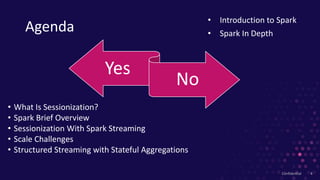
• Introduction to Spark
• Spark In Depth
• What Is Sessionization?
• Spark Brief Overview
• Sessionization With Spark Streaming
• Scale Challenges
• Structured Streaming with Stateful Aggregations
5Confidential
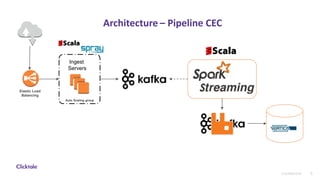
Architecture – Pipeline CEC
Elastic Load
Balancing
Auto Scaling group
Ingest
Servers
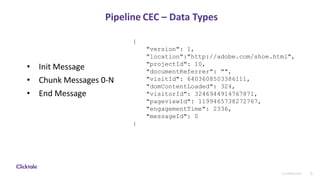
{
"version": 1,
"location":"http://adobe.com/shoe.html",
"projectId": 10,
"documentReferrer": "",
"visitId": 6403608503386111,
"domContentLoaded": 324,
"visitorId": 3246944914767871,
"pageviewId": 1199465738272767,
"engagementTime": 2336,
"messageId": 0
}
6Confidential
Pipeline CEC – Data Types
• Init Message
• Chunk Messages 0-N
• End Message
14
7Confidential
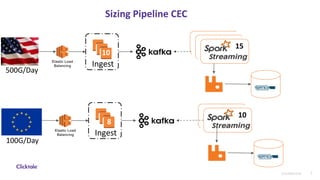
Sizing Pipeline CEC
Elastic Load
Balancing
10
500G/Day
100G/Day
Ingest
1415
Elastic Load
Balancing
8
Ingest
10
8Confidential
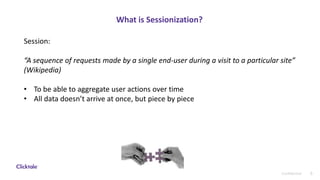
What is Sessionization?
Session:
“A sequence of requests made by a single end-user during a visit to a particular site”
(Wikipedia)
• To be able to aggregate user actions over time
• All data doesn’t arrive at once, but piece by piece
9Confidential
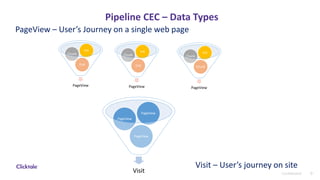
Pipeline CEC – Data Types
PageView
End
Chunk
Init
PageView
End
Chunk
Init
PageView
Chunk
Chunk
Init
Visit
PageView
PageView
PageView
PageView – User’s Journey on a single web page
Visit – User’s journey on site
10Confidential
Requirements overview
• Data size ranging between 200B – 1K (may grow over time)
• Process incoming user messages up to 100,000 messages per second
• Handle traffic peaks up to 1,000,000 messages/second (common with Fortune 500
companies)
• Scale out as needed without user intervention (hopefully linearly)
• Save user state until a session is complete, and only then send it down the pipeline
• Latency - up to 10 seconds from ingestion to processing (make data available as
soon as it’s ready)
11Confidential
12Confidential
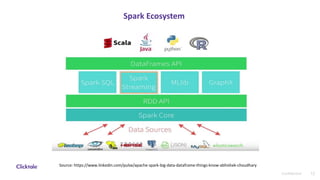
Spark Ecosystem
Source: https://www.linkedin.com/pulse/apache-spark-big-data-dataframe-things-know-abhishek-choudhary
13Confidential
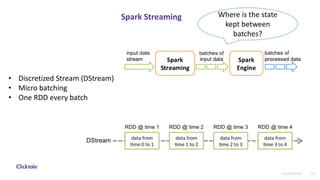
Spark Streaming
• Discretized Stream (DStream)
• Micro batching
• One RDD every batch
Where is the state
kept between
batches?
14Confidential
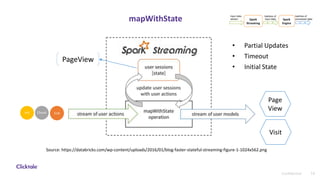
mapWithState
Source: https://databricks.com/wp-content/uploads/2016/01/blog-faster-stateful-streaming-figure-1-1024x562.png
Init Chunk End
Page
View
Visit
PageView
• Partial Updates
• Timeout
• Initial State
15Confidential
(“dardasaba”, “hello”),
(“dardasaba”,
“goodbye”),
(“hathatul”, “w00t”),
(“hathatul”, “nope”),
(“gargamel”, “muhaha”)
Executor 1
Executor 2
Executor 3
Key Value
“dardasaba” [“hello”,
“goodbye”]
Key Value
“hathatul” [“w00t”,
“nope”]
Key Value
“gargamel” [“muhaha”]
OpenHashMap[String, List[String]]
DStream[(String, String)]
Key Value
16Confidential
What Could Possibly Go Wrong?
17Confidential
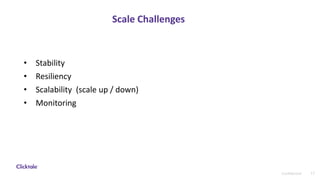
Scale Challenges
• Stability
• Resiliency
• Scalability (scale up / down)
• Monitoring
18Confidential
Spark Streaming Challenges
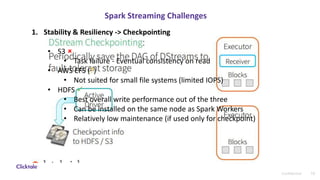
1. Stability & Resiliency -> Checkpointing
• S3 
• Task failure - Eventual consistency on read
• AWS EFS (?)
• Not suited for small file systems (limited IOPS)
• HDFS 
• Best overall write performance out of the three
• Can be installed on the same node as Spark Workers
• Relatively low maintenance (if used only for checkpoint)
19Confidential
Spark Streaming Challenges
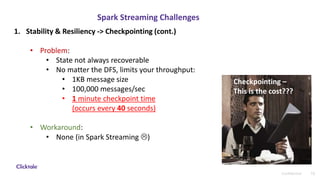
1. Stability & Resiliency -> Checkpointing (cont.)
• Problem:
• State not always recoverable
• No matter the DFS, limits your throughput:
• 1KB message size
• 100,000 messages/sec
• 1 minute checkpoint time
(occurs every 40 seconds)
• Workaround:
• None (in Spark Streaming )
Checkpointing –
This is the cost???
20Confidential
Spark Streaming Challenges
2. Resiliency -> Managing user state between application upgrades
• Problems:
• Can’t change the graph
• Can’t change your data structures
• Workaround:
• Roll your own using `stateSnapshot()`
• Provide on start up using `StateSpec.initialState()`
* Can potentially double overhead of the job time (critical with high throughput).
21Confidential
Spark Streaming Challenges
• Problem:
• Spark Streaming defaults to one job (batch) at a
time
• If a particular job is stuck, all others wait
indefinitely
• Workaround:
• Monitor job status using Sparks driver REST API
(http://<driver ip>:4040/api/v1/applications)
• Consider using Speculation (should be done
carefully)
• Enable Blacklisting if a particular node is faulty.
• If you like to live dangerously, consider modifying
“spark.streaming.concurrentJobs”
3. Stability -> Frozen Jobs
22Confidential
Spark Streaming Challenges
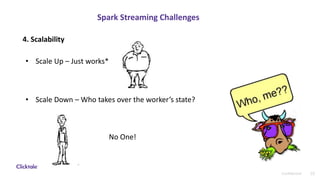
• Scale Up – Just works*
• Scale Down – Who takes over the worker’s state?
4. Scalability
No One!
23Confidential
Spark Streaming Challenges
• Logging mechanism – Log only small and random percent of
traffic
4. Monitoring
25Confidential
Is there a better alternative?
26Confidential
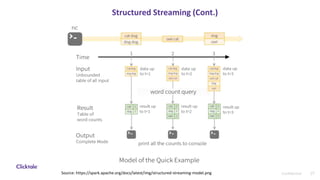
Structured Streaming
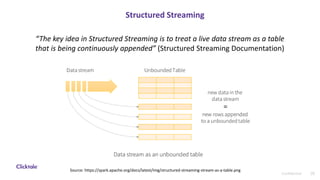
“The key idea in Structured Streaming is to treat a live data stream as a table
that is being continuously appended” (Structured Streaming Documentation)
Source: https://spark.apache.org/docs/latest/img/structured-streaming-stream-as-a-table.png
27Confidential
Structured Streaming (Cont.)
Source: https://spark.apache.org/docs/latest/img/structured-streaming-model.png
28Confidential
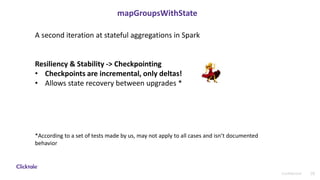
mapGroupsWithState
A second iteration at stateful aggregations in Spark
Resiliency & Stability -> Checkpointing
• Checkpoints are incremental, only deltas!
• Allows state recovery between upgrades *
*According to a set of tests made by us, may not apply to all cases and isn’t documented
behavior
29Confidential
Spark Structured Streaming
• More new features and cool stuff
• Event based timeouts (previously only processing based)​
• Watermarking (New)​
• Deduplication (New)​
• Timeout per state item (Enhancement)​
30Confidential
Our experience so far
Running ~ 1 month in production with Spark 2.2 and mapGroupsWithState:
Pros:
• Queries seem to take less time on average than Spark Streaming *
• No need to save state manually
• Deduplication out of the box is awesome
• Event based timeouts + Watermarking for late data is also awesome
* In peak hours, from ~ 3 seconds per batch to 0.6 seconds per query (x5)
31Confidential
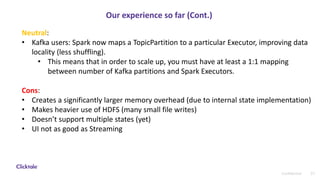
Our experience so far (Cont.)
Neutral:
• Kafka users: Spark now maps a TopicPartition to a particular Executor, improving data
locality (less shuffling).
• This means that in order to scale up, you must have at least a 1:1 mapping
between number of Kafka partitions and Spark Executors.
Cons:
• Creates a significantly larger memory overhead (due to internal state implementation)
• Makes heavier use of HDFS (many small file writes)
• Doesn’t support multiple states (yet)
• UI not as good as Streaming
32Confidential
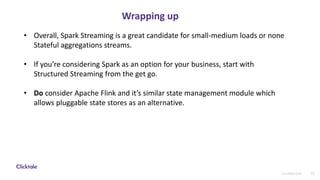
Wrapping up
• Overall, Spark Streaming is a great candidate for small-medium loads or none
Stateful aggregations streams.
• If you’re considering Spark as an option for your business, start with
Structured Streaming from the get go.
• Do consider Apache Flink and it’s similar state management module which
allows pluggable state stores as an alternative.
33Confidential
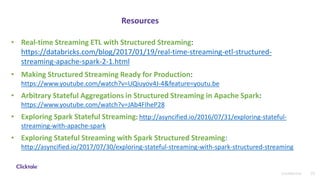
• Real-time Streaming ETL with Structured Streaming:
https://databricks.com/blog/2017/01/19/real-time-streaming-etl-structured-
streaming-apache-spark-2-1.html
• Making Structured Streaming Ready for Production:
https://www.youtube.com/watch?v=UQiuyov4J-4&feature=youtu.be
• Arbitrary Stateful Aggregations in Structured Streaming in Apache Spark:
https://www.youtube.com/watch?v=JAb4FIheP28
• Exploring Spark Stateful Streaming: http://asyncified.io/2016/07/31/exploring-stateful-
streaming-with-apache-spark
• Exploring Stateful Streaming with Spark Structured Streaming:
http://asyncified.io/2017/07/30/exploring-stateful-streaming-with-spark-structured-streaming
Resources
Thank you for listening!
Questions?

Spark Streaming @ Scale (Clicktale)

  • 1.
    Sessionization At Scale UsingSpark Streaming in production and staying sane Marina Grechuhin & Yuval Itzchakov 12/09/2017
  • 2.
    YuvalItzchakov 2Confidential • Developer @Clicktale for the past 3 years • Previously developer @ IDF (8200) • @yuvalitzchakov • https://stackoverflow.com/users/1870803/yuval-itzchakov • http://asyncified.io
  • 3.
    MarinaGrechuhin 3Confidential • Team Leader@ Clicktale • Previously co-founder and VP R&D @ SureVisit • Previously – many more
  • 4.
    Yes No Agenda 4Confidential • Introduction toSpark • Spark In Depth • What Is Sessionization? • Spark Brief Overview • Sessionization With Spark Streaming • Scale Challenges • Structured Streaming with Stateful Aggregations
  • 5.
    5Confidential Architecture – PipelineCEC Elastic Load Balancing Auto Scaling group Ingest Servers
  • 6.
    { "version": 1, "location":"http://adobe.com/shoe.html", "projectId": 10, "documentReferrer":"", "visitId": 6403608503386111, "domContentLoaded": 324, "visitorId": 3246944914767871, "pageviewId": 1199465738272767, "engagementTime": 2336, "messageId": 0 } 6Confidential Pipeline CEC – Data Types • Init Message • Chunk Messages 0-N • End Message
  • 7.
    14 7Confidential Sizing Pipeline CEC ElasticLoad Balancing 10 500G/Day 100G/Day Ingest 1415 Elastic Load Balancing 8 Ingest 10
  • 8.
    8Confidential What is Sessionization? Session: “Asequence of requests made by a single end-user during a visit to a particular site” (Wikipedia) • To be able to aggregate user actions over time • All data doesn’t arrive at once, but piece by piece
  • 9.
    9Confidential Pipeline CEC –Data Types PageView End Chunk Init PageView End Chunk Init PageView Chunk Chunk Init Visit PageView PageView PageView PageView – User’s Journey on a single web page Visit – User’s journey on site
  • 10.
    10Confidential Requirements overview • Datasize ranging between 200B – 1K (may grow over time) • Process incoming user messages up to 100,000 messages per second • Handle traffic peaks up to 1,000,000 messages/second (common with Fortune 500 companies) • Scale out as needed without user intervention (hopefully linearly) • Save user state until a session is complete, and only then send it down the pipeline • Latency - up to 10 seconds from ingestion to processing (make data available as soon as it’s ready)
  • 11.
  • 12.
  • 13.
    13Confidential Spark Streaming • DiscretizedStream (DStream) • Micro batching • One RDD every batch Where is the state kept between batches?
  • 14.
  • 15.
    15Confidential (“dardasaba”, “hello”), (“dardasaba”, “goodbye”), (“hathatul”, “w00t”), (“hathatul”,“nope”), (“gargamel”, “muhaha”) Executor 1 Executor 2 Executor 3 Key Value “dardasaba” [“hello”, “goodbye”] Key Value “hathatul” [“w00t”, “nope”] Key Value “gargamel” [“muhaha”] OpenHashMap[String, List[String]] DStream[(String, String)] Key Value
  • 16.
  • 17.
    17Confidential Scale Challenges • Stability •Resiliency • Scalability (scale up / down) • Monitoring
  • 18.
    18Confidential Spark Streaming Challenges 1.Stability & Resiliency -> Checkpointing • S3  • Task failure - Eventual consistency on read • AWS EFS (?) • Not suited for small file systems (limited IOPS) • HDFS  • Best overall write performance out of the three • Can be installed on the same node as Spark Workers • Relatively low maintenance (if used only for checkpoint)
  • 19.
    19Confidential Spark Streaming Challenges 1.Stability & Resiliency -> Checkpointing (cont.) • Problem: • State not always recoverable • No matter the DFS, limits your throughput: • 1KB message size • 100,000 messages/sec • 1 minute checkpoint time (occurs every 40 seconds) • Workaround: • None (in Spark Streaming ) Checkpointing – This is the cost???
  • 20.
    20Confidential Spark Streaming Challenges 2.Resiliency -> Managing user state between application upgrades • Problems: • Can’t change the graph • Can’t change your data structures • Workaround: • Roll your own using `stateSnapshot()` • Provide on start up using `StateSpec.initialState()` * Can potentially double overhead of the job time (critical with high throughput).
  • 21.
    21Confidential Spark Streaming Challenges •Problem: • Spark Streaming defaults to one job (batch) at a time • If a particular job is stuck, all others wait indefinitely • Workaround: • Monitor job status using Sparks driver REST API (http://<driver ip>:4040/api/v1/applications) • Consider using Speculation (should be done carefully) • Enable Blacklisting if a particular node is faulty. • If you like to live dangerously, consider modifying “spark.streaming.concurrentJobs” 3. Stability -> Frozen Jobs
  • 22.
    22Confidential Spark Streaming Challenges •Scale Up – Just works* • Scale Down – Who takes over the worker’s state? 4. Scalability No One!
  • 23.
    23Confidential Spark Streaming Challenges •Logging mechanism – Log only small and random percent of traffic 4. Monitoring
  • 24.
    25Confidential Is there abetter alternative?
  • 25.
    26Confidential Structured Streaming “The keyidea in Structured Streaming is to treat a live data stream as a table that is being continuously appended” (Structured Streaming Documentation) Source: https://spark.apache.org/docs/latest/img/structured-streaming-stream-as-a-table.png
  • 26.
    27Confidential Structured Streaming (Cont.) Source:https://spark.apache.org/docs/latest/img/structured-streaming-model.png
  • 27.
    28Confidential mapGroupsWithState A second iterationat stateful aggregations in Spark Resiliency & Stability -> Checkpointing • Checkpoints are incremental, only deltas! • Allows state recovery between upgrades * *According to a set of tests made by us, may not apply to all cases and isn’t documented behavior
  • 28.
    29Confidential Spark Structured Streaming •More new features and cool stuff • Event based timeouts (previously only processing based)​ • Watermarking (New)​ • Deduplication (New)​ • Timeout per state item (Enhancement)​
  • 29.
    30Confidential Our experience sofar Running ~ 1 month in production with Spark 2.2 and mapGroupsWithState: Pros: • Queries seem to take less time on average than Spark Streaming * • No need to save state manually • Deduplication out of the box is awesome • Event based timeouts + Watermarking for late data is also awesome * In peak hours, from ~ 3 seconds per batch to 0.6 seconds per query (x5)
  • 30.
    31Confidential Our experience sofar (Cont.) Neutral: • Kafka users: Spark now maps a TopicPartition to a particular Executor, improving data locality (less shuffling). • This means that in order to scale up, you must have at least a 1:1 mapping between number of Kafka partitions and Spark Executors. Cons: • Creates a significantly larger memory overhead (due to internal state implementation) • Makes heavier use of HDFS (many small file writes) • Doesn’t support multiple states (yet) • UI not as good as Streaming
  • 31.
    32Confidential Wrapping up • Overall,Spark Streaming is a great candidate for small-medium loads or none Stateful aggregations streams. • If you’re considering Spark as an option for your business, start with Structured Streaming from the get go. • Do consider Apache Flink and it’s similar state management module which allows pluggable state stores as an alternative.
  • 32.
    33Confidential • Real-time StreamingETL with Structured Streaming: https://databricks.com/blog/2017/01/19/real-time-streaming-etl-structured- streaming-apache-spark-2-1.html • Making Structured Streaming Ready for Production: https://www.youtube.com/watch?v=UQiuyov4J-4&feature=youtu.be • Arbitrary Stateful Aggregations in Structured Streaming in Apache Spark: https://www.youtube.com/watch?v=JAb4FIheP28 • Exploring Spark Stateful Streaming: http://asyncified.io/2016/07/31/exploring-stateful- streaming-with-apache-spark • Exploring Stateful Streaming with Spark Structured Streaming: http://asyncified.io/2017/07/30/exploring-stateful-streaming-with-spark-structured-streaming Resources
  • 33.
    Thank you forlistening! Questions?

Editor's Notes

  • #6 Monitor message sending mechanism 1 kafka topic
  • #8 Monitor message sending mechanism 1 kafka topic
  • #10 How do we aggregate user messages over time in a Streaming application??
  • #11 Do a brief overview of all points, 15-20 seconds per point. At the end of the slide do an intro to Spark and talk a little about why we chose it over alternatives
  • #13 Ask a question: How many people use Spark in production? How many people use Spark Streaming in production? How many do Sessionization?
  • #14 Spark is not real time streaming, but micro batching Where is the state held?
  • #19 Talk about each file system briefly