Spark Streaming
Much easier than Storm
Replaces Storm spouts/bolts with Akka Actors
Better API(make time part of API) and integration
Hadoop 2.3/Spark 0.9.1
Sbt setup

Create a separate sbt project; sbt run

Includes the jars and sets the class path
− Batch and Streaming,
http://spark.apache.org/docs/latest/quick-start.html
− Create a project directory
− Add dependencies; scalaized maven

libraryDependencies += "org.apache.hadoop" %
"hadoop-client" % "2.3.0"

scalaVersion:="2.10.3"
Manage the sbt/scala versions locally
Maven setup

Run the demo using maven/eclipse

Easier, maven central to find jars/artifacts

Add the external libs using maven to local repo
and mvn package in spark source distro

Eclipse: add Scala Nature, Maven project
Demo

Connect to twitter stream and process
− Test Twitter4j connection w/Java first. Print out a
twitter stream

Batch Mode: sc.stop(); RealTime Streaming
stream.awaitTermination().

Dstream/scala lazy evaluation
− Create a stream using #:: like the recursive List
operator. (#iphone,1)#:(#andriod,3)#(#apple,10).
Unlike a list head/tail behave differently. Head is a
val.
Spark Streams

StreamingContext start scheduler
− JobScheduler.scala: starts JobGenerator and runs
them in a thread pool
− JobGenerator.scala: Starts event actor, checkpoint
writer, for each thread

Storage:
− DStream appends to blockgenerator
− BlockGenerator.scala: Spark BlockGenerator w/2
threads. On termination wait for blockpush thread to
join.
Kafka Streaming Demo

KafkaUtils/Consumer connection

IOItec connection lib

Need to add more features/testing for faults

Read source how to fill out params

Start zookeeper, start a producer, define a
topic, etc...
Send data from the producer
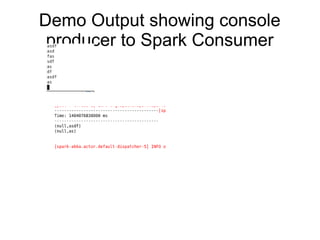
Demo Output showing console
producer to Spark Consumer
Producer/Executor
Match the broker-id in the server conf file with
groupID in the consumer call
val kafkaInputs = (1 to 5).map { _ =>
KafkaUtils.createStream(stream,"localhost:2181
", "1", Map("testtopic" -> 1))
Producer
Use awaitTermination() to get infinite loop so you
can see what you enter into the producer; Start
w/1 executor
val stream = new StreamingContext("local[2]","TestObject", Seconds(1))
val kafkaMessages=
KafkaUtils.createStream(stream,"localhost:2181","1",Map("testtopic"->1))
//create 5 executors
val kafkaInputs = (1 to 5).map { _ =>
KafkaUtils.createStream(stream,"localhost:2181", "1", Map("testtopic" -> 1))
kafkaMessages.print()
stream.start()
stream.awaitTermination()
Producer
Use awaitTermination() to get infinite loop so you
can see what you enter into the producer; Start
w/1 executor
val stream = new StreamingContext("local[2]","TestObject", Seconds(1))
val kafkaMessages=
KafkaUtils.createStream(stream,"localhost:2181","1",Map("testtopic"->1))
//create 5 executors
val kafkaInputs = (1 to 5).map { _ =>
KafkaUtils.createStream(stream,"localhost:2181", "1", Map("testtopic" -> 1))
kafkaMessages.print()
stream.start()
stream.awaitTermination()

Spark Streaming Info

  • 1.
    Spark Streaming Much easierthan Storm Replaces Storm spouts/bolts with Akka Actors Better API(make time part of API) and integration Hadoop 2.3/Spark 0.9.1
  • 2.
    Sbt setup  Create aseparate sbt project; sbt run  Includes the jars and sets the class path − Batch and Streaming, http://spark.apache.org/docs/latest/quick-start.html − Create a project directory − Add dependencies; scalaized maven  libraryDependencies += "org.apache.hadoop" % "hadoop-client" % "2.3.0"  scalaVersion:="2.10.3" Manage the sbt/scala versions locally
  • 3.
    Maven setup  Run thedemo using maven/eclipse  Easier, maven central to find jars/artifacts  Add the external libs using maven to local repo and mvn package in spark source distro  Eclipse: add Scala Nature, Maven project
  • 4.
    Demo  Connect to twitterstream and process − Test Twitter4j connection w/Java first. Print out a twitter stream  Batch Mode: sc.stop(); RealTime Streaming stream.awaitTermination().  Dstream/scala lazy evaluation − Create a stream using #:: like the recursive List operator. (#iphone,1)#:(#andriod,3)#(#apple,10). Unlike a list head/tail behave differently. Head is a val.
  • 5.
    Spark Streams  StreamingContext startscheduler − JobScheduler.scala: starts JobGenerator and runs them in a thread pool − JobGenerator.scala: Starts event actor, checkpoint writer, for each thread  Storage: − DStream appends to blockgenerator − BlockGenerator.scala: Spark BlockGenerator w/2 threads. On termination wait for blockpush thread to join.
  • 6.
    Kafka Streaming Demo  KafkaUtils/Consumerconnection  IOItec connection lib  Need to add more features/testing for faults  Read source how to fill out params  Start zookeeper, start a producer, define a topic, etc... Send data from the producer
  • 7.
    Demo Output showingconsole producer to Spark Consumer
  • 8.
    Producer/Executor Match the broker-idin the server conf file with groupID in the consumer call val kafkaInputs = (1 to 5).map { _ => KafkaUtils.createStream(stream,"localhost:2181 ", "1", Map("testtopic" -> 1))
  • 9.
    Producer Use awaitTermination() toget infinite loop so you can see what you enter into the producer; Start w/1 executor val stream = new StreamingContext("local[2]","TestObject", Seconds(1)) val kafkaMessages= KafkaUtils.createStream(stream,"localhost:2181","1",Map("testtopic"->1)) //create 5 executors val kafkaInputs = (1 to 5).map { _ => KafkaUtils.createStream(stream,"localhost:2181", "1", Map("testtopic" -> 1)) kafkaMessages.print() stream.start() stream.awaitTermination()
  • 10.
    Producer Use awaitTermination() toget infinite loop so you can see what you enter into the producer; Start w/1 executor val stream = new StreamingContext("local[2]","TestObject", Seconds(1)) val kafkaMessages= KafkaUtils.createStream(stream,"localhost:2181","1",Map("testtopic"->1)) //create 5 executors val kafkaInputs = (1 to 5).map { _ => KafkaUtils.createStream(stream,"localhost:2181", "1", Map("testtopic" -> 1)) kafkaMessages.print() stream.start() stream.awaitTermination()