Yash Shrivastava
ICTInformation Communication
Technology
- Yash Shrivastava
Ba.LLB 2nd Year
C-33
Yash Shrivastava
SPAM
-Introduction Of SPAM
-History
-Statistics
-Types
-Solution
-Law Against Spamming in INDIA
-Conclusion
Yash Shrivastava
INTRODUCTION
Def-
SPAM is defined as an unsolicited, unwanted, postings
on social network websites or suspicious emails sent to
a large number of users.
WIKI Def -
Social Spam is unwanted spam content appearing on
social network and any website with user-generated
content (comments, chat, etc.). It can be manifested in
many ways, including bulk messages, profanity, insults,
hate speech, malicious links, fraudulent reviews, fake
friends, and personally identifiable information.
Yash Shrivastava
HISTORY
- The First major commercial spam incident started on March 5,
1994.
- Within a few years, the focus of spamming (and anti-spam
efforts) moved chiefly to email, where it remains
today. Arguably, the aggressive email spamming by a number
of high-profile spammers such as Sanford Wallace of Cyber
Promotions in the mid-to-late 1990s contributed to making
spam predominantly an email phenomenon in the public
mind.
- By 2009, the majority of spam sent around the World was in
the English language spammers began using automatic
translation services to send spam in other languages
Yash Shrivastava
STATISTICS
-In 2011 the origins of
spam were analyzed
by Cisco Systems. They
provided a report that
shows spam volume
originating from countries
worldwide.
Yash Shrivastava
TYPES
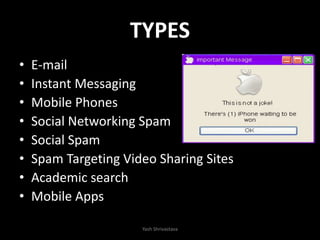
• E-mail
• Instant Messaging
• Mobile Phones
• Social Networking Spam
• Social Spam
• Spam Targeting Video Sharing Sites
• Academic search
• Mobile Apps
Yash Shrivastava
• E-Mail- Email spam, also known as unsolicited bulk email (UBE), junk mail, or
unsolicited commercial email (UCE), is the practice of sending unwanted email
messages, frequently with commercial content, in large quantities to an
indiscriminate set of recipients. Spam in email started to become a problem when
the Internet was opened up to the general public in the mid-1990s. It grew
exponentially over the following years, and today composes some 80 to 85 percent
of all the e-mail in the World, by a "conservative estimate“.
Yash Shrivastava
• Spam Targeting Video Sharing Spam.
Yash Shrivastava
• Mobile Apps Spam
• Spamming in mobile app stores include
• (i) apps that were automatically generated and as a result do not have any
specific functionality or a meaningful description.
• (ii) multiple instances of the same app being published to obtain increased
visibility in the app market.
• (iii) apps that make excessive use of unrelated keywords to attract users
through unintended searches.
Yash Shrivastava
• SOLUTION
There are different solutions to SPAM that you can use, such as:
- Self solution
- White List Solutions
- Black List Solutions
- Software Solutions
- Heuristic Filters
- Content Filters
•
•
•
Yash Shrivastava
• Self Solution
- Self solution entails the user viewing and deleting SPAM in their mailbox.
-While this may be effective, it is time consuming and frustrating.
• White List Solution
- White lists allow mail to be received from senders that are in your address
book.
- Mail from senders that are not in your address book will be stored in
the junk mail folder.
-In some cases, the mail from senders that are not in the address book will
be deleted.
• Black List Solutions
- A black list contains domain names or email addresses of companies that
are known spammers.
- Software is available that helps you to list the known SPAM domains or
email addresses; these will be placed in the junk mail or be deleted.
Yash Shrivastava
• Software Solution
- Software solutions have rules or are linked to internet black lists
- The software is usually installed on a computer or server.
- Examples of SPAM software solutions include BitDefender, Imail or
Mailwasher, ADWCleaner , ETC .
• Heuristic Filters
- A Heuristic Filter scans for characteristics, links, words and phrases that are
commonly used in SPAM.
-There are certain rules that are used in the program to indicate whether mail
is SPAM or not.
• Content Filters
-SPAM can also be indicated by the content in the email or on the webpage.
-Rules are used to decide whether the content is SPAM or not.
-The subject, attachments, headers, size and body content are viewed to help
decide whether it classifies as SPAM.
Yash Shrivastava
Law against Spamming in INDIA
Presently, the Indian Government is yet to legislate a
law that directly addresses the issue of spam. The
existing law in the form of the Information
Technology Act 2000 does not contain any provision
concerning regulation of spamming, though it does
regulate obscenity which covers publishing,
transmitting or causing to be published in electronic
form any material which is lascivious or appeals to
the prurient interest.
Yash Shrivastava
CONCULSION
SPAM is an accompaniment of the internet
that is time consuming, frustrating and
potentially threatening to your computer. Take
note of the ways to prevent SPAM from
cluttering up your mailbox. At the same time
make sure that your site is not viewed as
spam.
Yash Shrivastava
THANK
YOU
Yash Shrivastava

Spamming

  • 1.
  • 2.
    ICTInformation Communication Technology - YashShrivastava Ba.LLB 2nd Year C-33 Yash Shrivastava
  • 3.
    SPAM -Introduction Of SPAM -History -Statistics -Types -Solution -LawAgainst Spamming in INDIA -Conclusion Yash Shrivastava
  • 4.
    INTRODUCTION Def- SPAM is definedas an unsolicited, unwanted, postings on social network websites or suspicious emails sent to a large number of users. WIKI Def - Social Spam is unwanted spam content appearing on social network and any website with user-generated content (comments, chat, etc.). It can be manifested in many ways, including bulk messages, profanity, insults, hate speech, malicious links, fraudulent reviews, fake friends, and personally identifiable information. Yash Shrivastava
  • 5.
    HISTORY - The Firstmajor commercial spam incident started on March 5, 1994. - Within a few years, the focus of spamming (and anti-spam efforts) moved chiefly to email, where it remains today. Arguably, the aggressive email spamming by a number of high-profile spammers such as Sanford Wallace of Cyber Promotions in the mid-to-late 1990s contributed to making spam predominantly an email phenomenon in the public mind. - By 2009, the majority of spam sent around the World was in the English language spammers began using automatic translation services to send spam in other languages Yash Shrivastava
  • 6.
    STATISTICS -In 2011 theorigins of spam were analyzed by Cisco Systems. They provided a report that shows spam volume originating from countries worldwide. Yash Shrivastava
  • 7.
    TYPES • E-mail • InstantMessaging • Mobile Phones • Social Networking Spam • Social Spam • Spam Targeting Video Sharing Sites • Academic search • Mobile Apps Yash Shrivastava
  • 8.
    • E-Mail- Emailspam, also known as unsolicited bulk email (UBE), junk mail, or unsolicited commercial email (UCE), is the practice of sending unwanted email messages, frequently with commercial content, in large quantities to an indiscriminate set of recipients. Spam in email started to become a problem when the Internet was opened up to the general public in the mid-1990s. It grew exponentially over the following years, and today composes some 80 to 85 percent of all the e-mail in the World, by a "conservative estimate“. Yash Shrivastava
  • 9.
    • Spam TargetingVideo Sharing Spam. Yash Shrivastava
  • 10.
    • Mobile AppsSpam • Spamming in mobile app stores include • (i) apps that were automatically generated and as a result do not have any specific functionality or a meaningful description. • (ii) multiple instances of the same app being published to obtain increased visibility in the app market. • (iii) apps that make excessive use of unrelated keywords to attract users through unintended searches. Yash Shrivastava
  • 11.
    • SOLUTION There aredifferent solutions to SPAM that you can use, such as: - Self solution - White List Solutions - Black List Solutions - Software Solutions - Heuristic Filters - Content Filters • • • Yash Shrivastava
  • 12.
    • Self Solution -Self solution entails the user viewing and deleting SPAM in their mailbox. -While this may be effective, it is time consuming and frustrating. • White List Solution - White lists allow mail to be received from senders that are in your address book. - Mail from senders that are not in your address book will be stored in the junk mail folder. -In some cases, the mail from senders that are not in the address book will be deleted. • Black List Solutions - A black list contains domain names or email addresses of companies that are known spammers. - Software is available that helps you to list the known SPAM domains or email addresses; these will be placed in the junk mail or be deleted. Yash Shrivastava
  • 13.
    • Software Solution -Software solutions have rules or are linked to internet black lists - The software is usually installed on a computer or server. - Examples of SPAM software solutions include BitDefender, Imail or Mailwasher, ADWCleaner , ETC . • Heuristic Filters - A Heuristic Filter scans for characteristics, links, words and phrases that are commonly used in SPAM. -There are certain rules that are used in the program to indicate whether mail is SPAM or not. • Content Filters -SPAM can also be indicated by the content in the email or on the webpage. -Rules are used to decide whether the content is SPAM or not. -The subject, attachments, headers, size and body content are viewed to help decide whether it classifies as SPAM. Yash Shrivastava
  • 14.
    Law against Spammingin INDIA Presently, the Indian Government is yet to legislate a law that directly addresses the issue of spam. The existing law in the form of the Information Technology Act 2000 does not contain any provision concerning regulation of spamming, though it does regulate obscenity which covers publishing, transmitting or causing to be published in electronic form any material which is lascivious or appeals to the prurient interest. Yash Shrivastava
  • 15.
    CONCULSION SPAM is anaccompaniment of the internet that is time consuming, frustrating and potentially threatening to your computer. Take note of the ways to prevent SPAM from cluttering up your mailbox. At the same time make sure that your site is not viewed as spam. Yash Shrivastava
  • 16.