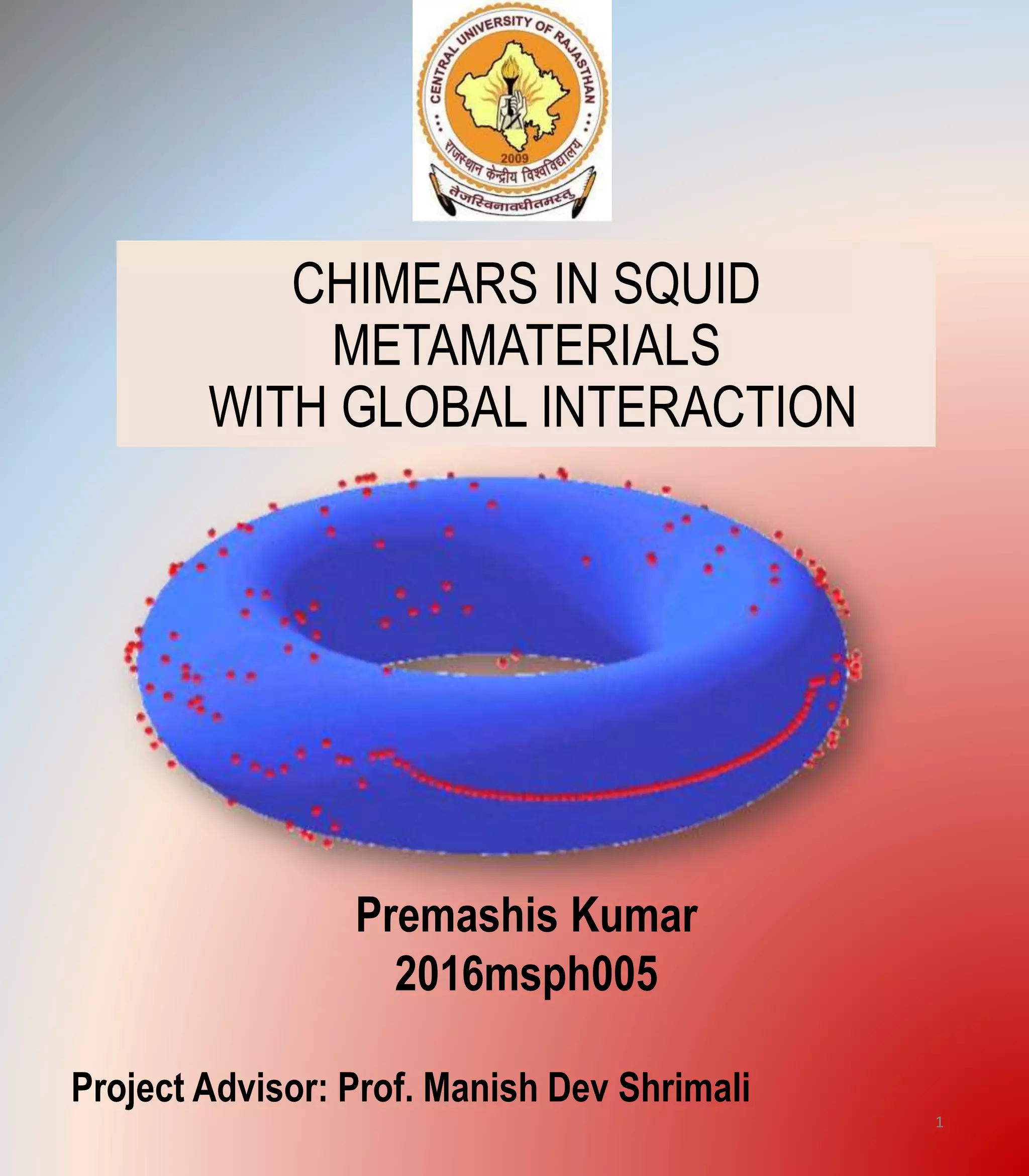
CHIMEARS IN SQUID
METAMATERIALS
WITH GLOBAL INTERACTION
Premashis Kumar
2016msph005
Project Advisor: Prof. Manish Dev Shrimali
1
CONTENTS
• Introduction
• SQUID Metamaterials
• Chimeras in SQUID
Metamaterials
• Kuramoto Model
• Future Planning
2
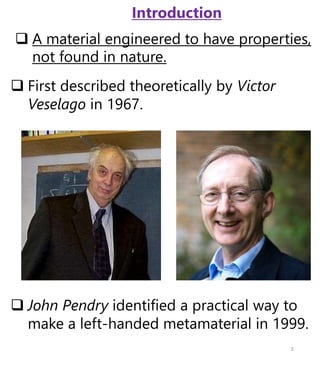
 First described theoretically by Victor
Veselago in 1967.
 John Pendry identified a practical way to
make a left-handed metamaterial in 1999.
 A material engineered to have properties,
not found in nature.
3
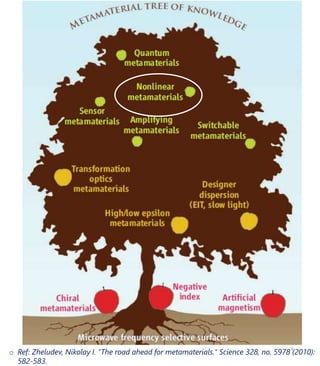
Introduction
o Ref: Zheludev, Nikolay I. "The road ahead for metamaterials." Science 328, no. 5978 (2010):
582-583.
4
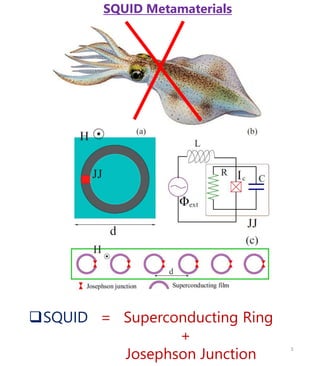
SQUID = Superconducting Ring
+
Josephson Junction
5
SQUID Metamaterials
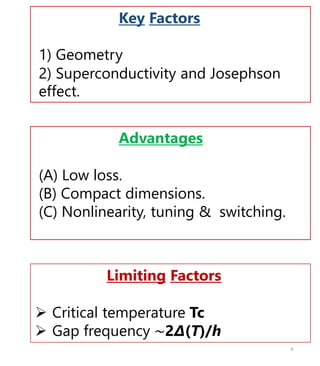
Advantages
(A) Low loss.
(B) Compact dimensions.
(C) Nonlinearity, tuning & switching.
Limiting Factors
 Critical temperature Tc
 Gap frequency ∼2Δ(T)/h
Key Factors
1) Geometry
2) Superconductivity and Josephson
effect.
6
7
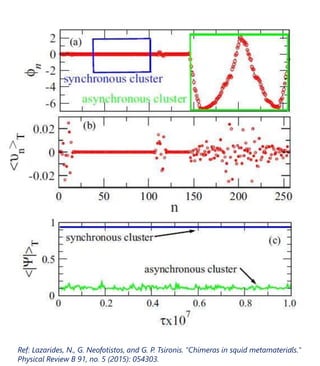
Ref: Lazarides, N., G. Neofotistos, and G. P. Tsironis. "Chimeras in squid metamaterials."
Physical Review B 91, no. 5 (2015): 054303.
8
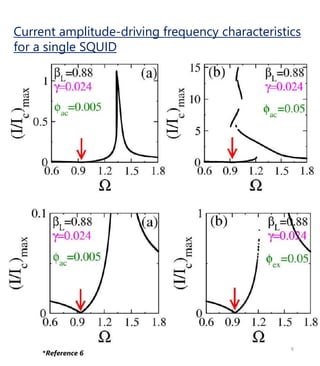
Current amplitude-driving frequency characteristics
for a single SQUID
9
*Reference 6
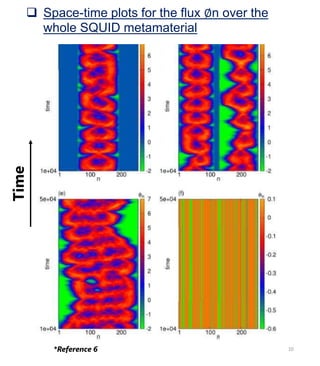
 Space-time plots for the flux ∅n over the
whole SQUID metamaterial
10*Reference 6
Time
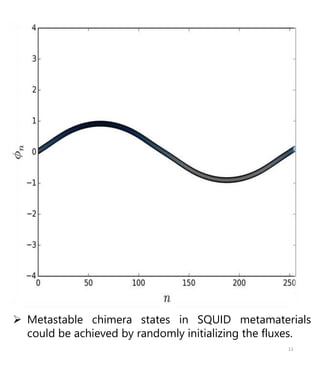
 Metastable chimera states in SQUID metamaterials
could be achieved by randomly initializing the fluxes.
11
Kuramoto Model
12
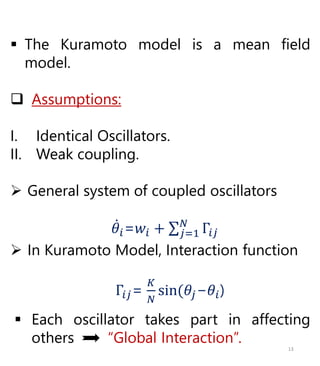
 The Kuramoto model is a mean field
model.
 Assumptions:
I. Identical Oscillators.
II. Weak coupling.
 General system of coupled oscillators
𝜃𝑖=𝑤𝑖 + 𝑗=1
𝑁
Γ𝑖𝑗
 In Kuramoto Model, Interaction function
Γ𝑖𝑗=
𝐾
𝑁
sin(𝜃𝑗−𝜃𝑖)
 Each oscillator takes part in affecting
others “Global Interaction”.
13
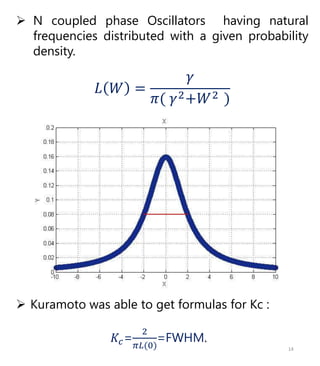
 N coupled phase Oscillators having natural
frequencies distributed with a given probability
density.
𝐿 𝑊 =
𝛾
𝜋( 𝛾2+𝑊2 )
 Kuramoto was able to get formulas for Kc :
𝐾𝑐=
2
𝜋𝐿(0)
=FWHM.
14
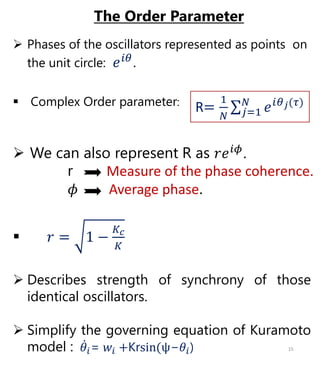
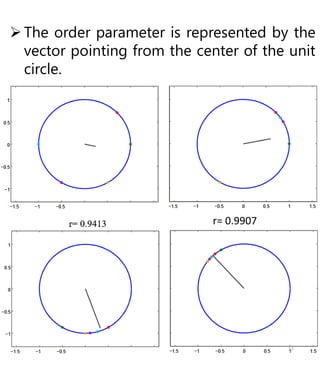
 Complex Order parameter:
R=
1
𝑁 𝑗=1
𝑁
𝑒 𝑖𝜃 𝑗(𝜏)
The Order Parameter
 Phases of the oscillators represented as points on
the unit circle: 𝑒 𝑖𝜃.
 We can also represent R as 𝑟𝑒 𝑖𝜙
.
r Measure of the phase coherence.
𝜙 Average phase.
 𝑟 = 1 −
𝐾 𝑐
𝐾
 Describes strength of synchrony of those
identical oscillators.
 Simplify the governing equation of Kuramoto
model : 𝜃𝑖= 𝑤𝑖 +Krsin(ψ−𝜃𝑖) 15
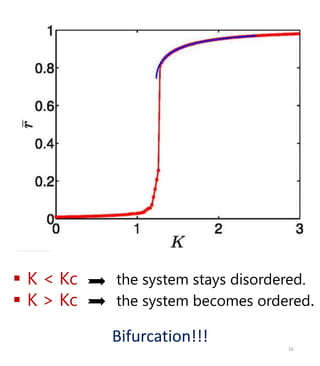
 K < Kc the system stays disordered.
 K > Kc the system becomes ordered.
Bifurcation!!!
16
The order parameter is represented by the
vector pointing from the center of the unit
circle.
17
r= 0.9907
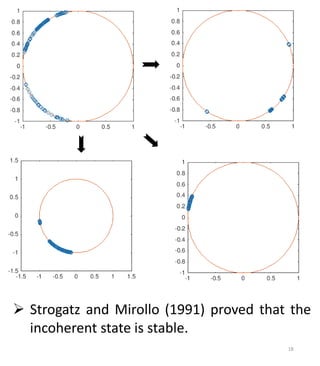
 Strogatz and Mirollo (1991) proved that the
incoherent state is stable.
18
19
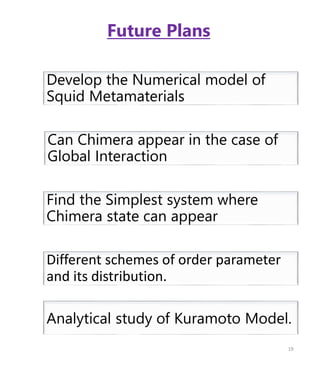
Future Plans
Different schemes of order parameter
and its distribution.
Can Chimera appear in the case of
Global Interaction
Find the Simplest system where
Chimera state can appear
Develop the Numerical model of
Squid Metamaterials
Analytical study of Kuramoto Model.
References
1. Lazarides, N., G. Neofotistos, and G. P. Tsironis. "Chimeras in
squid metamaterials." Physical Review B 91, no. 5 (2015):
054303.
2. Acebrón, Juan A., Luis L. Bonilla, Conrad J. Pérez Vicente, Félix
Ritort, and Renato Spigler. "The Kuramoto model: A simple
paradigm for synchronization phenomena." Reviews of modern
physics 77, no. 1 (2005): 137.
3. Jung, Philipp, Alexey V. Ustinov, and Steven M. Anlage.
"Progress in superconducting metamaterials." Superconductor
Science and Technology 27, no. 7 (2014): 073001.
4. Zheludev, Nikolay I. "The road ahead for metamaterials."
Science 328, no. 5978 (2010): 582-583.
5. N. Yao, Z.-G. Huang, Y.-C. Lai, and Z.-G. Zheng, Sci. Rep. 3, 3522
(2013)
6. Hizanidis, J., Lazarides, N., Neofotistos, G., & Tsironis, G. P.
(2016). Chimera states and synchronization in magnetically
driven SQUID metamaterials. The European Physical Journal
Special Topics, 225(6-7), 1231-1243.
7. Wu, H., & Kim, D. (2015). Distribution of Order Parameter for
Kuramoto Model. International Journal for Innovation Education
and Research, 3(9).
8. Gottwald, G. A. (2015). Model reduction for networks of coupled
oscillators. Chaos: An Interdisciplinary Journal of Nonlinear Science,
25(5), 053111.
20
21

SQUID metamaterials and The Kuramoto model

  • 1.
    CHIMEARS IN SQUID METAMATERIALS WITHGLOBAL INTERACTION Premashis Kumar 2016msph005 Project Advisor: Prof. Manish Dev Shrimali 1
  • 2.
    CONTENTS • Introduction • SQUIDMetamaterials • Chimeras in SQUID Metamaterials • Kuramoto Model • Future Planning 2
  • 3.
     First describedtheoretically by Victor Veselago in 1967.  John Pendry identified a practical way to make a left-handed metamaterial in 1999.  A material engineered to have properties, not found in nature. 3 Introduction
  • 4.
    o Ref: Zheludev,Nikolay I. "The road ahead for metamaterials." Science 328, no. 5978 (2010): 582-583. 4
  • 5.
    SQUID = SuperconductingRing + Josephson Junction 5 SQUID Metamaterials
  • 6.
    Advantages (A) Low loss. (B)Compact dimensions. (C) Nonlinearity, tuning & switching. Limiting Factors  Critical temperature Tc  Gap frequency ∼2Δ(T)/h Key Factors 1) Geometry 2) Superconductivity and Josephson effect. 6
  • 7.
  • 8.
    Ref: Lazarides, N.,G. Neofotistos, and G. P. Tsironis. "Chimeras in squid metamaterials." Physical Review B 91, no. 5 (2015): 054303. 8
  • 9.
    Current amplitude-driving frequencycharacteristics for a single SQUID 9 *Reference 6
  • 10.
     Space-time plotsfor the flux ∅n over the whole SQUID metamaterial 10*Reference 6 Time
  • 11.
     Metastable chimerastates in SQUID metamaterials could be achieved by randomly initializing the fluxes. 11
  • 12.
  • 13.
     The Kuramotomodel is a mean field model.  Assumptions: I. Identical Oscillators. II. Weak coupling.  General system of coupled oscillators 𝜃𝑖=𝑤𝑖 + 𝑗=1 𝑁 Γ𝑖𝑗  In Kuramoto Model, Interaction function Γ𝑖𝑗= 𝐾 𝑁 sin(𝜃𝑗−𝜃𝑖)  Each oscillator takes part in affecting others “Global Interaction”. 13
  • 14.
     N coupledphase Oscillators having natural frequencies distributed with a given probability density. 𝐿 𝑊 = 𝛾 𝜋( 𝛾2+𝑊2 )  Kuramoto was able to get formulas for Kc : 𝐾𝑐= 2 𝜋𝐿(0) =FWHM. 14
  • 15.
     Complex Orderparameter: R= 1 𝑁 𝑗=1 𝑁 𝑒 𝑖𝜃 𝑗(𝜏) The Order Parameter  Phases of the oscillators represented as points on the unit circle: 𝑒 𝑖𝜃.  We can also represent R as 𝑟𝑒 𝑖𝜙 . r Measure of the phase coherence. 𝜙 Average phase.  𝑟 = 1 − 𝐾 𝑐 𝐾  Describes strength of synchrony of those identical oscillators.  Simplify the governing equation of Kuramoto model : 𝜃𝑖= 𝑤𝑖 +Krsin(ψ−𝜃𝑖) 15
  • 16.
     K <Kc the system stays disordered.  K > Kc the system becomes ordered. Bifurcation!!! 16
  • 17.
    The order parameteris represented by the vector pointing from the center of the unit circle. 17 r= 0.9907
  • 18.
     Strogatz andMirollo (1991) proved that the incoherent state is stable. 18
  • 19.
    19 Future Plans Different schemesof order parameter and its distribution. Can Chimera appear in the case of Global Interaction Find the Simplest system where Chimera state can appear Develop the Numerical model of Squid Metamaterials Analytical study of Kuramoto Model.
  • 20.
    References 1. Lazarides, N.,G. Neofotistos, and G. P. Tsironis. "Chimeras in squid metamaterials." Physical Review B 91, no. 5 (2015): 054303. 2. Acebrón, Juan A., Luis L. Bonilla, Conrad J. Pérez Vicente, Félix Ritort, and Renato Spigler. "The Kuramoto model: A simple paradigm for synchronization phenomena." Reviews of modern physics 77, no. 1 (2005): 137. 3. Jung, Philipp, Alexey V. Ustinov, and Steven M. Anlage. "Progress in superconducting metamaterials." Superconductor Science and Technology 27, no. 7 (2014): 073001. 4. Zheludev, Nikolay I. "The road ahead for metamaterials." Science 328, no. 5978 (2010): 582-583. 5. N. Yao, Z.-G. Huang, Y.-C. Lai, and Z.-G. Zheng, Sci. Rep. 3, 3522 (2013) 6. Hizanidis, J., Lazarides, N., Neofotistos, G., & Tsironis, G. P. (2016). Chimera states and synchronization in magnetically driven SQUID metamaterials. The European Physical Journal Special Topics, 225(6-7), 1231-1243. 7. Wu, H., & Kim, D. (2015). Distribution of Order Parameter for Kuramoto Model. International Journal for Innovation Education and Research, 3(9). 8. Gottwald, G. A. (2015). Model reduction for networks of coupled oscillators. Chaos: An Interdisciplinary Journal of Nonlinear Science, 25(5), 053111. 20
  • 21.