space
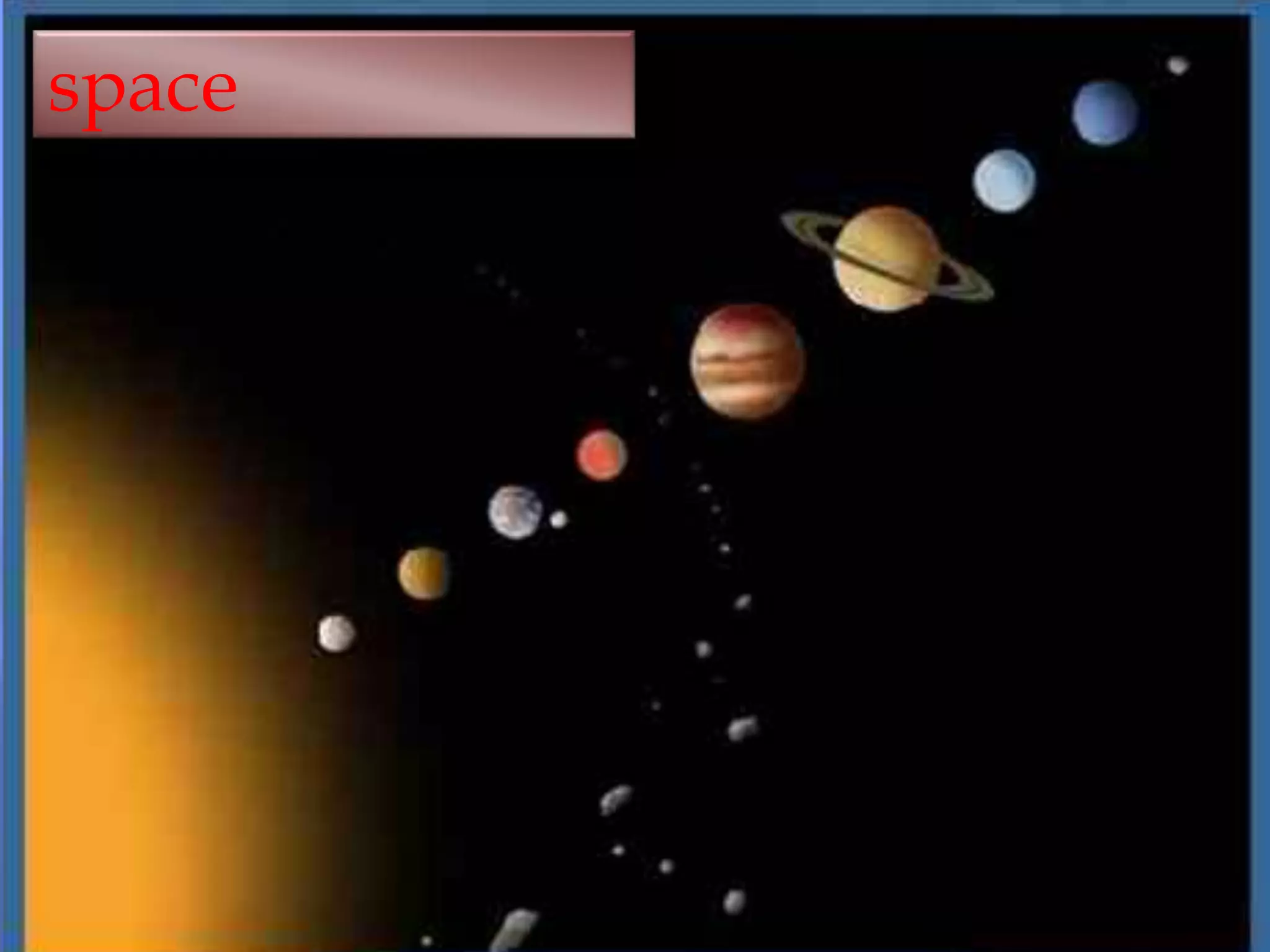
   the solar System is made up of the Sun, 9
    planets, many other small rocky, metallic and
    icy objects and a lot of empty space. The nine
    planets move around the Sun in paths called
    orbits. Moons, like our own Moon orbit most of
    the planets.
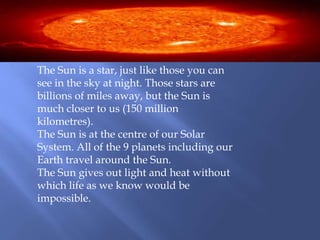
The Sun is a star, just like those you can
see in the sky at night. Those stars are
billions of miles away, but the Sun is
much closer to us (150 million
kilometres).
The Sun is at the centre of our Solar
System. All of the 9 planets including our
Earth travel around the Sun.
The Sun gives out light and heat without
which life as we know would be
impossible.
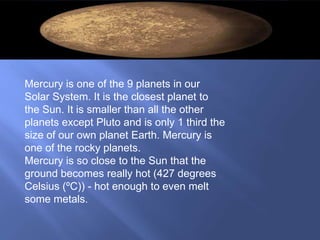
Mercury is one of the 9 planets in our
Solar System. It is the closest planet to
the Sun. It is smaller than all the other
planets except Pluto and is only 1 third the
size of our own planet Earth. Mercury is
one of the rocky planets.
Mercury is so close to the Sun that the
ground becomes really hot (427 degrees
Celsius (ºC)) - hot enough to even melt
some metals.
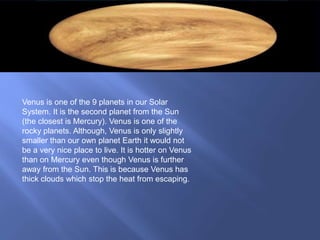
Venus is one of the 9 planets in our Solar
System. It is the second planet from the Sun
(the closest is Mercury). Venus is one of the
rocky planets. Although, Venus is only slightly
smaller than our own planet Earth it would not
be a very nice place to live. It is hotter on Venus
than on Mercury even though Venus is further
away from the Sun. This is because Venus has
thick clouds which stop the heat from escaping.
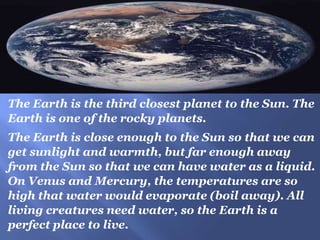
The Earth is the third closest planet to the Sun. The
Earth is one of the rocky planets.
The Earth is close enough to the Sun so that we can
get sunlight and warmth, but far enough away
from the Sun so that we can have water as a liquid.
On Venus and Mercury, the temperatures are so
high that water would evaporate (boil away). All
living creatures need water, so the Earth is a
perfect place to live.
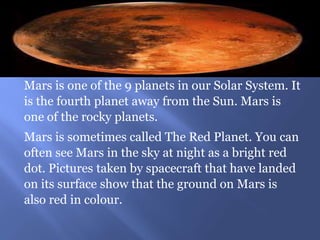
Mars is one of the 9 planets in our Solar System. It
is the fourth planet away from the Sun. Mars is
one of the rocky planets.
Mars is sometimes called The Red Planet. You can
often see Mars in the sky at night as a bright red
dot. Pictures taken by spacecraft that have landed
on its surface show that the ground on Mars is
also red in colour.
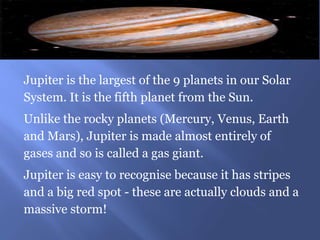
Jupiter is the largest of the 9 planets in our Solar
System. It is the fifth planet from the Sun.
Unlike the rocky planets (Mercury, Venus, Earth
and Mars), Jupiter is made almost entirely of
gases and so is called a gas giant.
Jupiter is easy to recognise because it has stripes
and a big red spot - these are actually clouds and a
massive storm!
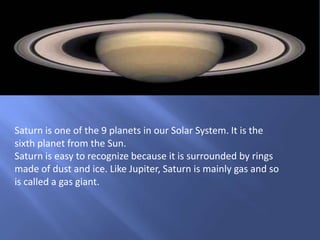
Saturn is one of the 9 planets in our Solar System. It is the
sixth planet from the Sun.
Saturn is easy to recognize because it is surrounded by rings
made of dust and ice. Like Jupiter, Saturn is mainly gas and so
is called a gas giant.
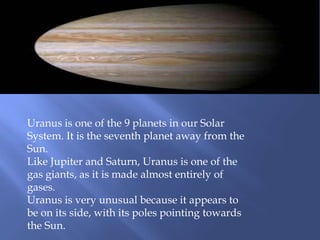
Uranus is one of the 9 planets in our Solar
System. It is the seventh planet away from the
Sun.
Like Jupiter and Saturn, Uranus is one of the
gas giants, as it is made almost entirely of
gases.
Uranus is very unusual because it appears to
be on its side, with its poles pointing towards
the Sun.
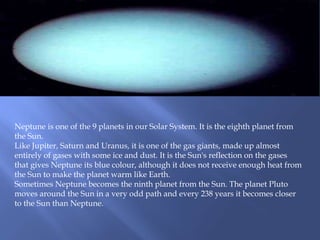
Neptune is one of the 9 planets in our Solar System. It is the eighth planet from
the Sun.
Like Jupiter, Saturn and Uranus, it is one of the gas giants, made up almost
entirely of gases with some ice and dust. It is the Sun's reflection on the gases
that gives Neptune its blue colour, although it does not receive enough heat from
the Sun to make the planet warm like Earth.
Sometimes Neptune becomes the ninth planet from the Sun. The planet Pluto
moves around the Sun in a very odd path and every 238 years it becomes closer
to the Sun than Neptune.
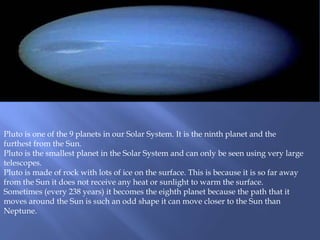
Pluto is one of the 9 planets in our Solar System. It is the ninth planet and the
furthest from the Sun.
Pluto is the smallest planet in the Solar System and can only be seen using very large
telescopes.
Pluto is made of rock with lots of ice on the surface. This is because it is so far away
from the Sun it does not receive any heat or sunlight to warm the surface.
Sometimes (every 238 years) it becomes the eighth planet because the path that it
moves around the Sun is such an odd shape it can move closer to the Sun than
Neptune.
http://www.youtube.com/watch?v=zWpZ1gIEHhY&feature=related
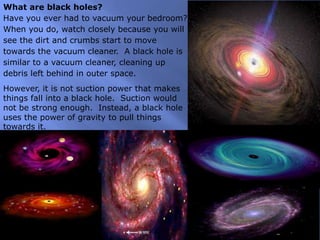
What are black holes?
Have you ever had to vacuum your bedroom?
When you do, watch closely because you will
see the dirt and crumbs start to move
towards the vacuum cleaner. A black hole is
similar to a vacuum cleaner, cleaning up
debris left behind in outer space.
However, it is not suction power that makes
things fall into a black hole. Suction would
not be strong enough. Instead, a black hole
uses the power of gravity to pull things
towards it.
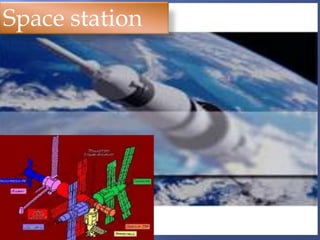
Space station
The Space Station circles
the Earth every 90
minutes, and looks down
on 85 percent of the
populated areas
When fully
constructed, the Space
Station will be visible to
more than 90 percept of
the world's population
space

space

  • 1.
  • 2.
    the solar System is made up of the Sun, 9 planets, many other small rocky, metallic and icy objects and a lot of empty space. The nine planets move around the Sun in paths called orbits. Moons, like our own Moon orbit most of the planets.
  • 3.
    The Sun isa star, just like those you can see in the sky at night. Those stars are billions of miles away, but the Sun is much closer to us (150 million kilometres). The Sun is at the centre of our Solar System. All of the 9 planets including our Earth travel around the Sun. The Sun gives out light and heat without which life as we know would be impossible.
  • 5.
    Mercury is oneof the 9 planets in our Solar System. It is the closest planet to the Sun. It is smaller than all the other planets except Pluto and is only 1 third the size of our own planet Earth. Mercury is one of the rocky planets. Mercury is so close to the Sun that the ground becomes really hot (427 degrees Celsius (ºC)) - hot enough to even melt some metals.
  • 6.
    Venus is oneof the 9 planets in our Solar System. It is the second planet from the Sun (the closest is Mercury). Venus is one of the rocky planets. Although, Venus is only slightly smaller than our own planet Earth it would not be a very nice place to live. It is hotter on Venus than on Mercury even though Venus is further away from the Sun. This is because Venus has thick clouds which stop the heat from escaping.
  • 7.
    The Earth isthe third closest planet to the Sun. The Earth is one of the rocky planets. The Earth is close enough to the Sun so that we can get sunlight and warmth, but far enough away from the Sun so that we can have water as a liquid. On Venus and Mercury, the temperatures are so high that water would evaporate (boil away). All living creatures need water, so the Earth is a perfect place to live.
  • 8.
    Mars is oneof the 9 planets in our Solar System. It is the fourth planet away from the Sun. Mars is one of the rocky planets. Mars is sometimes called The Red Planet. You can often see Mars in the sky at night as a bright red dot. Pictures taken by spacecraft that have landed on its surface show that the ground on Mars is also red in colour.
  • 9.
    Jupiter is thelargest of the 9 planets in our Solar System. It is the fifth planet from the Sun. Unlike the rocky planets (Mercury, Venus, Earth and Mars), Jupiter is made almost entirely of gases and so is called a gas giant. Jupiter is easy to recognise because it has stripes and a big red spot - these are actually clouds and a massive storm!
  • 10.
    Saturn is oneof the 9 planets in our Solar System. It is the sixth planet from the Sun. Saturn is easy to recognize because it is surrounded by rings made of dust and ice. Like Jupiter, Saturn is mainly gas and so is called a gas giant.
  • 11.
    Uranus is oneof the 9 planets in our Solar System. It is the seventh planet away from the Sun. Like Jupiter and Saturn, Uranus is one of the gas giants, as it is made almost entirely of gases. Uranus is very unusual because it appears to be on its side, with its poles pointing towards the Sun.
  • 12.
    Neptune is oneof the 9 planets in our Solar System. It is the eighth planet from the Sun. Like Jupiter, Saturn and Uranus, it is one of the gas giants, made up almost entirely of gases with some ice and dust. It is the Sun's reflection on the gases that gives Neptune its blue colour, although it does not receive enough heat from the Sun to make the planet warm like Earth. Sometimes Neptune becomes the ninth planet from the Sun. The planet Pluto moves around the Sun in a very odd path and every 238 years it becomes closer to the Sun than Neptune.
  • 13.
    Pluto is oneof the 9 planets in our Solar System. It is the ninth planet and the furthest from the Sun. Pluto is the smallest planet in the Solar System and can only be seen using very large telescopes. Pluto is made of rock with lots of ice on the surface. This is because it is so far away from the Sun it does not receive any heat or sunlight to warm the surface. Sometimes (every 238 years) it becomes the eighth planet because the path that it moves around the Sun is such an odd shape it can move closer to the Sun than Neptune.
  • 14.
  • 15.
    What are blackholes? Have you ever had to vacuum your bedroom? When you do, watch closely because you will see the dirt and crumbs start to move towards the vacuum cleaner. A black hole is similar to a vacuum cleaner, cleaning up debris left behind in outer space. However, it is not suction power that makes things fall into a black hole. Suction would not be strong enough. Instead, a black hole uses the power of gravity to pull things towards it.
  • 16.
  • 17.
    The Space Stationcircles the Earth every 90 minutes, and looks down on 85 percent of the populated areas
  • 18.
    When fully constructed, theSpace Station will be visible to more than 90 percept of the world's population