Treatment of Adolescent Bulimia Nervosa vs.
Anorexia Nervosa: Which is Ahead?
Daniel Le Grange, PhD
Benioff UCSF Professor in Children’s Health
Eating Disorders Director
Department of Psychiatry
University of California, San Francisco, CA
CAP Grand Rounds February 2016
Outline of Presentation
①  The Status of Treatment Studies
②  Evidence-Based Treatment for AN
③  Workings of Efficacious Treatments
④  Evidence-Based Treatment for BN
⑤  Discussion Points
The Status of Treatment Studies
Part 1
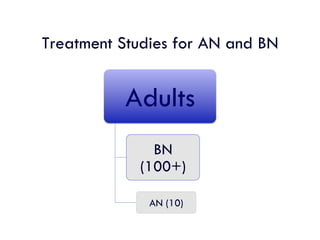
Treatment Studies for AN and BN
Adults
BN
(100+)
AN (10)
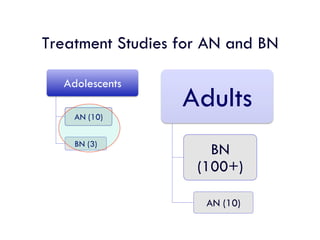
Treatment Studies for AN and BN
Adolescents
AN (10)
BN (3)
Adults
BN
(100+)
AN (10)
Treatment of Adolescent
Anorexia Nervosa
Part 2
Evidence for the Treatment of
Adolescent Eating Disorders
The predominant models for treating adolescent AN
are:
①  Inpatient treatment for weight restoration in
psychiatric setting.
②  Outpatient psychosocial treatment.
①  Inpatient Weight Restoration
The predominant models for treating adolescent AN are:
o Inpatient weight restoration in a psychiatric setting
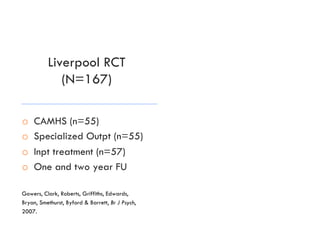
Liverpool RCT
(N=167)
o  CAMHS (n=55)
o  Specialized Outpt (n=55)
o  Inpt treatment (n=57)
o  One and two year FU
Gowers, Clark, Roberts, Griffiths, Edwards,
Bryan, Smethurst, Byford & Barrett, Br J Psych,
2007.
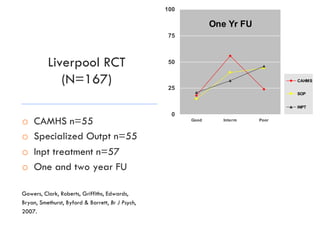
Liverpool RCT
(N=167)
o  CAMHS n=55
o  Specialized Outpt n=55
o  Inpt treatment n=57
o  One and two year FU
Gowers, Clark, Roberts, Griffiths, Edwards,
Bryan, Smethurst, Byford & Barrett, Br J Psych,
2007.
One Yr FU
0
25
50
75
100
Good Interm Poor
CAHMS
SOP
INPT
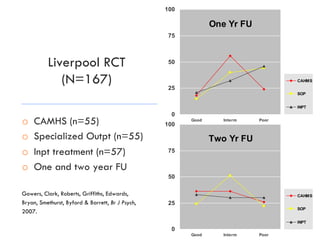
Liverpool RCT
(N=167)
o  CAMHS (n=55)
o  Specialized Outpt (n=55)
o  Inpt treatment (n=57)
o  One and two year FU
Gowers, Clark, Roberts, Griffiths, Edwards,
Bryan, Smethurst, Byford & Barrett, Br J Psych,
2007.
One Yr FU
0
25
50
75
100
Good Interm Poor
CAHMS
SOP
INPT
Two Yr FU
0
25
50
75
100
Good Interm Poor
CAHMS
SOP
INPT
Conclusions
o  First-line in-patient psychiatric treatment
does not provide advantages over out-
patient management.
o  Out-patient treatment failures do very
poorly on transfer to in-patient facilities.
Westmead RCT
(N=82)
o  MS then FBT (n=41)
o  WR then FBT (n=41)
o  One year FU
Madden, Miskovic-Wheatley, Wallis, Kohn, Lock,
Le Grange, Jo, Clarke, Rhodes, Hay & Touyz,
Psychol Med, 2014.
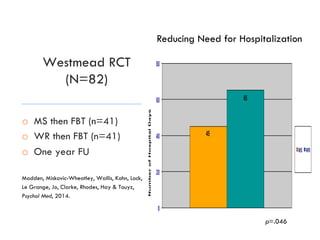
Westmead RCT
(N=82)
o  MS then FBT (n=41)
o  WR then FBT (n=41)
o  One year FU
Madden, Miskovic-Wheatley, Wallis, Kohn, Lock,
Le Grange, Jo, Clarke, Rhodes, Hay & Touyz,
Psychol Med, 2014.
Reducing Need for Hospitalization
p=.046
Conclusions
o  Outcomes were similar with either MS or WR
when inpatient treatment is combined with
outpatient FBT.
o  Significant cost savings will result from
combining brief hospitalization with FBT.
Six-Site German RCT
(N=172)
o  IP (n=85)
o  DP (n=87)
o  One year FU
Herpertz-Dahlman et al, LANCET, 2014
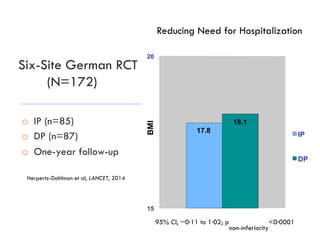
Six-Site German RCT
(N=172)
o  IP (n=85)
o  DP (n=87)
o  One-year follow-up
Herpertz-Dahlman et al, LANCET, 2014
17.8
18.1
15
20
BMI
IP
DP
Reducing Need for Hospitalization
95% CI, −0·∙11 to 1·∙02; p
non-inferiority
<0·∙0001
Conclusions
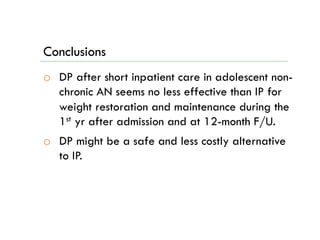
o  DP after short inpatient care in adolescent non-
chronic AN seems no less effective than IP for
weight restoration and maintenance during the
1st yr after admission and at 12-month F/U.
o  DP might be a safe and less costly alternative
to IP.
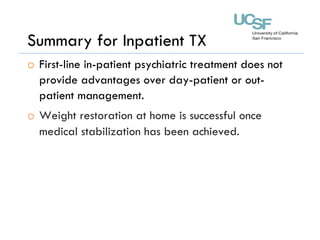
Summary for Inpatient TX
o  First-line in-patient psychiatric treatment does not
provide advantages over day-patient or out-
patient management.
o  Weight restoration at home is successful once
medical stabilization has been achieved.
②  Psychosocial Treatments for AN
The predominant models for treating adolescent AN are:
o  Inpatient weight restoration
o Outpatient psychosocial treatment
o Family-Based Treatment (FBT) is family focused and aims
at symptom management by parents early in treatment.
o Adolescent Focused Therapy (AFT) is an individual
therapy and aims to promote self-efficacy, self-esteem,
and self-management of eating problems.
o Systemic Family Therapy (SyFT) places the focus on the
family system to draw on their existing strengths.
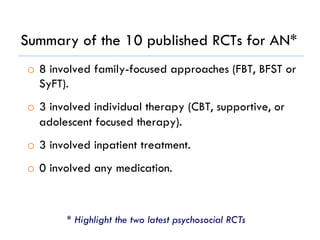
Summary of the 10 published RCTs for AN*
o  8 involved family-focused approaches (FBT, BFST or
SyFT).
o  3 involved individual therapy (CBT, supportive, or
adolescent focused therapy).
o  3 involved inpatient treatment.
o  0 involved any medication.
* Highlight the two latest psychosocial RCTs
One of Two
Family-Based Treatment vs. Adolescent
Focused Therapy for Adolescent
Anorexia Nervosa
A multisite comparison
Lock, Le Grange, Agras, Moye, Bryson & Jo, Arch Gen Psychiatry, 2010;
Le Grange, Lock, Agras, Moye, Bryson, Jo & Kraemer, Beh Res Therapy, 2012;
Le Grange, Lock, Accurso, Agras, Bryson & Jo, J Am Acad Child Adolesc Psychiatry, 2014
One of Two
Primary Outcome
Remission is 95% mBMI for height and age according
to CDC norms + EDE within 1SD of community norms
o Approximates weight needed for return to full
physical health in young adolescents and addresses
growth, bone health, and hormonal function
o EDE threshold is in the normal range for community
sample and addresses minimization common in
adolescent AN
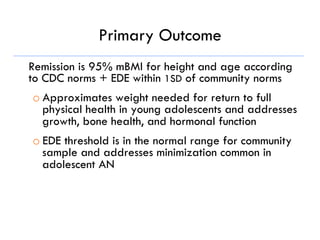
Full and Partial Remission by Treatment
EOT 6mFU 12mFU EOT 6mFU 12mFU
Percentage
AFT FBT
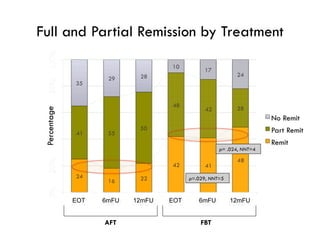
p=.029, NNT=5
p= .024, NNT=4
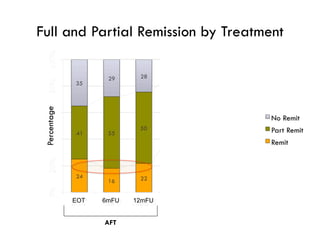
Full and Partial Remission by Treatment
EOT 6mFU 12mFU EOT 6mFU 12mFU
Percentage
AFT FBT
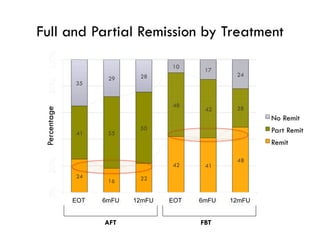
Full and Partial Remission by Treatment
EOT 6mFU 12mFU EOT 6mFU 12mFU
Percentage
AFT FBT
p=.029, NNT=5
p= .024, NNT=4
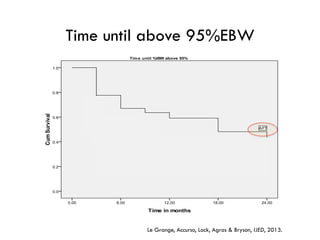
Time until above 95%EBW
Le Grange, Accurso, Lock, Agras & Bryson, IJED, 2013.
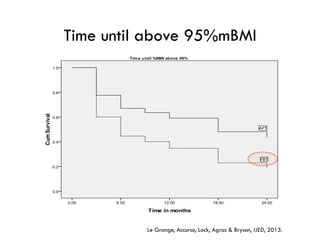
Time until above 95%mBMI
Le Grange, Accurso, Lock, Agras & Bryson, IJED, 2013.
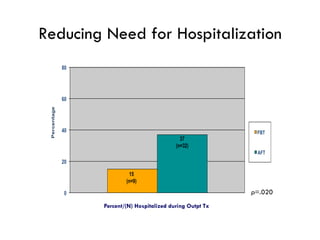
Reducing Need for Hospitalization
15
(n=9)
37
(n=32)
0
20
40
60
80
Percentage
FBT
AFT
p=.020
3/11/16 30
Percent/(N) Hospitalized during Outpt Tx
o  Only 2 participants who were remitted at
1yr FU relapsed at 4yr FU.
o  One fourth not remitted at 1yr FU achieved
remission at long-term FU.
Long-Term Follow-Up
Le Grange, Lock, Accurso, Agras, Moye, Bryson, & Jo, JAACAP, 2014.
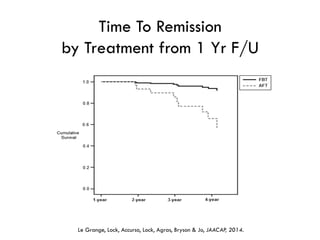
Time To Remission
by Treatment from 1 Yr F/U
Le Grange, Lock, Accurso, Lock, Agras, Bryson & Jo, JAACAP, 2014.
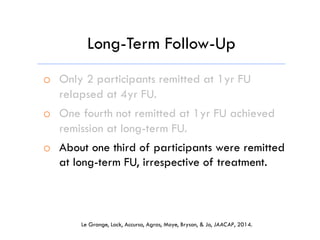
o  Only 2 participants remitted at 1yr FU
relapsed at 4yr FU.
o  One fourth not remitted at 1yr FU achieved
remission at long-term FU.
o  About one third of participants were remitted
at long-term FU, irrespective of treatment.
Long-Term Follow-Up
Le Grange, Lock, Accurso, Agras, Moye, Bryson, & Jo, JAACAP, 2014.
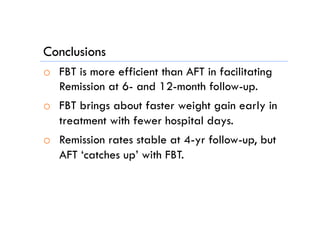
Conclusions
o  FBT is more efficient than AFT in facilitating
Remission at 6- and 12-month follow-up.
o  FBT brings about faster weight gain early in
treatment with fewer hospital days.
o  Remission rates stable at 4-yr follow-up, but
AFT ‘catches up’ with FBT.
A Comparison of Two Family Therapies
for Adolescent AN
A Six Site Comparison
Agras et al., JAMA Psychiatry, 2014
Two of Two
%IBW	
  
Agras et al., JAMA Psychiatry, 2014
o  FBT (n=82)
o  SyFT (n=82)
o  One Year Follow-up
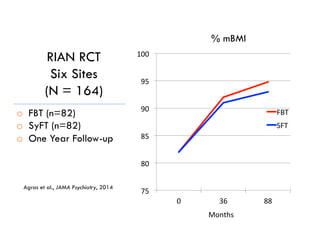
RIAN RCT
Six Sites
(N = 164)
75	
  
80	
  
85	
  
90	
  
95	
  
100	
  
0	
   36	
   88	
  
FBT	
  
SFT	
  
Months	
  
%IBW	
  
Agras et al., JAMA Psychiatry, 2014
o  FBT (n=82)
o  SyFT (n=82)
o  One Year Follow-up
RIAN RCT
Six Sites
(N = 164)
% mBMI
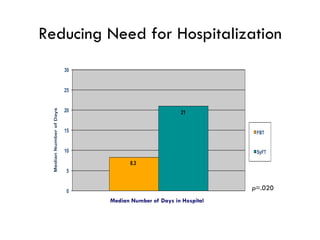
Reducing Need for Hospitalization
8.3
21
0
5
10
15
20
25
30
MedianNumberofDays
FBT
SyFT
p=.020
38
Median Number of Days in Hospital
Conclusions
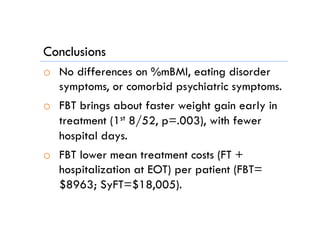
o  No differences on %mBMI, eating disorder
symptoms, or comorbid psychiatric symptoms.
o  FBT brings about faster weight gain early in
treatment (1st 8/52, p=.003), with fewer
hospital days.
o  FBT lower mean treatment costs (FT +
hospitalization at EOT) per patient (FBT=
$8963; SyFT=$18,005).
Treatment of Adolescent
Anorexia Nervosa
Part 3
Workings of Effective Treatment
①  Predictors of Outcome
②  Adapting FBT
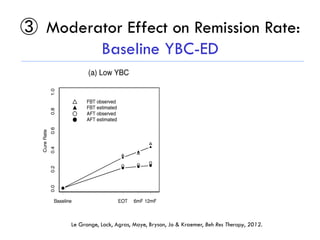
③  Moderator Effect on Outcome
④  Reducing the need for Hospitalization
Weight gain >2 kgs. by wk 4 correctly characterized:


①  Early Weight Gain and Outcome
(N>400 in FBT and AFT)
o  79% of responders [AUC = .814 (p<.001)]
o  71% of non-responders [AUC = .811 (p<.001)]
Doyle, Le Grange, Celio-Doyle, Loeb & Crosby, IJED, 2009; Le Grange, Accurso, Lock, Agras & Bryson, IJED, 2013;
Lock et al., JAACAP, 2005; Madden et al., IJED, 2015.
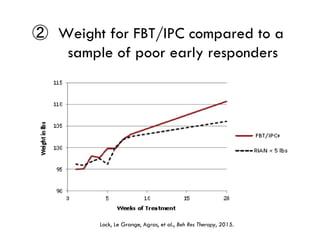
②  Weight for FBT/IPC compared to a
sample of poor early responders
Lock, Le Grange, Agras, et al., Beh Res Therapy, 2015.
③  Moderator Effect on Remission Rate:
Baseline YBC-ED
Le Grange, Lock, Agras, Moye, Bryson, Jo & Kraemer, Beh Res Therapy, 2012.
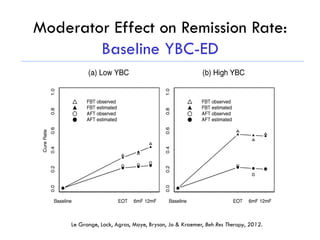
Moderator Effect on Remission Rate:
Baseline YBC-ED
Le Grange, Lock, Agras, Moye, Bryson, Jo & Kraemer, Beh Res Therapy, 2012.
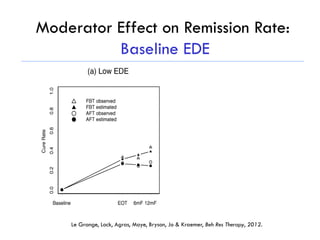
Moderator Effect on Remission Rate:
Baseline EDE
Le Grange, Lock, Agras, Moye, Bryson, Jo & Kraemer, Beh Res Therapy, 2012.
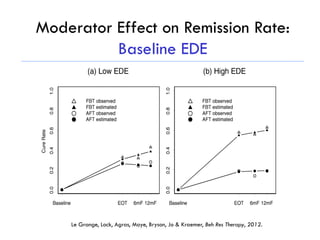
Moderator Effect on Remission Rate:
Baseline EDE
Le Grange, Lock, Agras, Moye, Bryson, Jo & Kraemer, Beh Res Therapy, 2012.
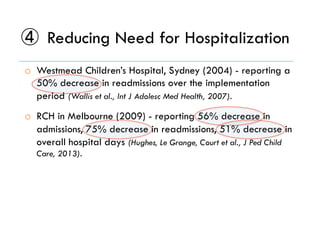
④  Reducing Need for Hospitalization
o  Westmead Children’s Hospital, Sydney (2004) - reporting a
50% decrease in readmissions over the implementation
period (Wallis et al., Int J Adolesc Med Health, 2007).
o  RCH in Melbourne (2009) - reporting 56% decrease in
admissions, 75% decrease in readmissions, 51% decrease in
overall hospital days (Hughes, Le Grange, Court et al., J Ped Child
Care, 2013).
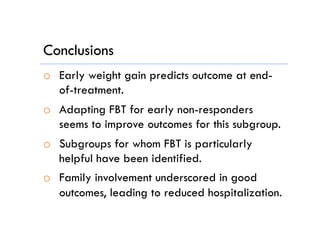
Conclusions
o  Early weight gain predicts outcome at end-
of-treatment.
o  Adapting FBT for early non-responders
seems to improve outcomes for this subgroup.
o  Subgroups for whom FBT is particularly
helpful have been identified.
o  Family involvement underscored in good
outcomes, leading to reduced hospitalization.
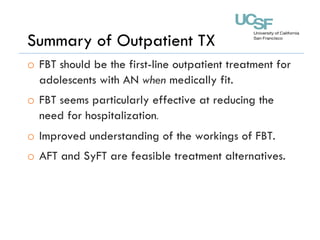
Summary of Outpatient TX
o  FBT should be the first-line outpatient treatment for
adolescents with AN when medically fit.
o  FBT seems particularly effective at reducing the
need for hospitalization.
o  Improved understanding of the workings of FBT.
o  AFT and SyFT are feasible treatment alternatives.
Treatment of Adolescent
Bulimia Nervosa
Part 4
51
Chicago RCT
FBT-BN vs SPT
(N = 80)
o FBT-BN (n=41)
o SPT (n=39)
o 6 months of therapy
o 6 month follow-up
Le Grange, Crosby, Rathuaz & Leventhal, Arch Gen
Psych, 2007.
52
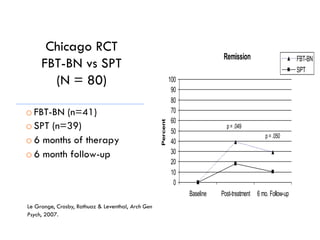
Chicago RCT
FBT-BN vs SPT
(N = 80)
o FBT-BN (n=41)
o SPT (n=39)
o 6 months of therapy
o 6 month follow-up
Le Grange, Crosby, Rathuaz & Leventhal, Arch Gen
Psych, 2007.
Remission
0
10
20
30
40
50
60
70
80
90
100
Baseline Post-treatment 6 mo. Follow-up
Percent
FBT-BN
SPT
p = .049
p = .050
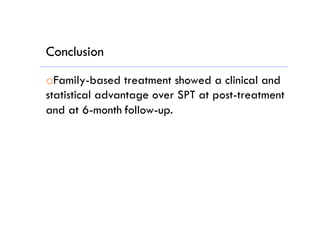
Conclusion
o Family-based treatment showed a clinical and
statistical advantage over SPT at post-treatment
and at 6-month follow-up.
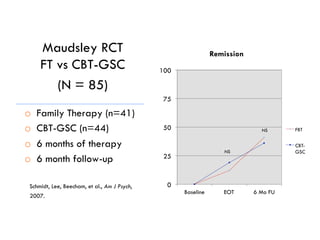
Maudsley RCT
FT vs CBT-GSC
(N = 85)
o  Family Therapy (n=41)
o  CBT-GSC (n=44)
o  6 months of therapy
o  6 month follow-up
Schmidt, Lee, Beecham, et al., Am J Psych,
2007.
Maudsley RCT
FT vs CBT-GSC
(N = 85)
o  Family Therapy (n=41)
o  CBT-GSC (n=44)
o  6 months of therapy
o  6 month follow-up
Schmidt, Lee, Beecham, et al., Am J Psych,
2007.
0
25
50
75
100
Baseline EOT 6 Mo FU
Remission
FBT
CBT-
GSCNS
NS
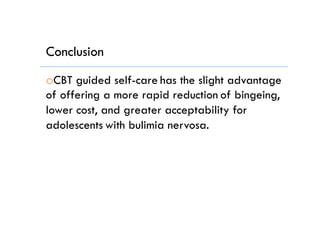
Conclusion
o CBT guided self-care has the slight advantage
of offering a more rapid reduction of bingeing,
lower cost, and greater acceptability for
adolescents with bulimia nervosa.
Chicago/Stanford RCT
FT-BN vs. CBT-A
(N = 110)
o  FBT-BN (n=52)
o  CBT-A (n=58)
o  6 months of therapy
o  6 and 12 month follow-up
Le Grange, Lock, Agras et al., J Am Acad Child
Adolesc Psychiatry, 2015.
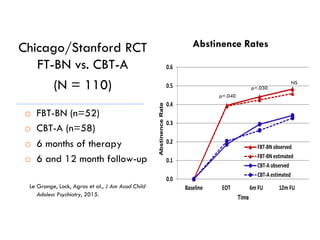
Chicago/Stanford RCT
FT-BN vs. CBT-A
(N = 110)
o  FBT-BN (n=52)
o  CBT-A (n=58)
o  6 months of therapy
o  6 and 12 month follow-up
Le Grange, Lock, Agras et al., J Am Acad Child
Adolesc Psychiatry, 2015.
0.0
0.1
0.2
0.3
0.4
0.5
0.6
Baseline EOT 6m	
  FU 12m	
  FU
AbstinenceRate
Time
FBT-­‐BN	
  observed
FBT-­‐BN	
  estimated
CBT-­‐A	
  observed
CBT-­‐A	
  estimated
Abstinence Rates
p=.040
p=.030
NS
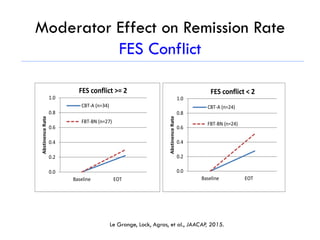
Moderator Effect on Remission Rate
FES Conflict
Le Grange, Lock, Agras, et al., JAACAP, 2015.
0.0
0.2
0.4
0.6
0.8
1.0
Baseline EOT
Abstinence	
  Rate
FES	
  conflict	
  >=	
  2
CBT-­‐A	
  (n=34)
FBT-­‐BN	
  (n=27)
0.0
0.2
0.4
0.6
0.8
1.0
Baseline EOT
Abstinence	
  Rate
FES	
  conflict	
  <	
  2
CBT-­‐A	
  (n=24)
FBT-­‐BN	
  (n=24)
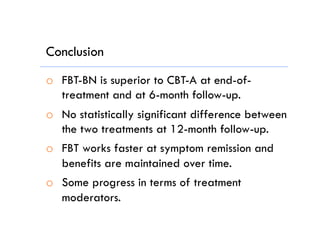
Conclusion
o  FBT-BN is superior to CBT-A at end-of-
treatment and at 6-month follow-up.
o  No statistically significant difference between
the two treatments at 12-month follow-up.
o  FBT works faster at symptom remission and
benefits are maintained over time.
o  Some progress in terms of treatment
moderators.
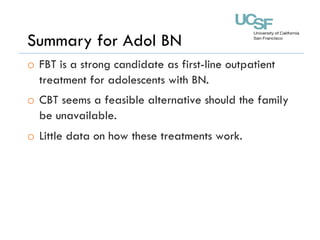
Summary for Adol BN
o  FBT is a strong candidate as first-line outpatient
treatment for adolescents with BN.
o  CBT seems a feasible alternative should the family
be unavailable.
o  Little data on how these treatments work.
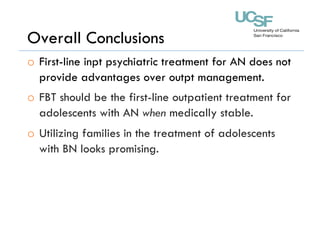
Overall Conclusions
o  First-line inpt psychiatric treatment for AN does not
provide advantages over outpt management.
o  FBT should be the first-line outpatient treatment for
adolescents with AN when medically stable.
o  Utilizing families in the treatment of adolescents
with BN looks promising.
①  Parent Focused Treatment vs. FBT – Melbourne/
UCSF.
②  Dissemination Study – Stanford/UCSF.
③  Effectiveness Study – Minnesota/UCSF.
④  Telemedicine – Chicago/UCSF.
⑤  FBT vs. FBT/IPC+ Pending.
Looking Ahead
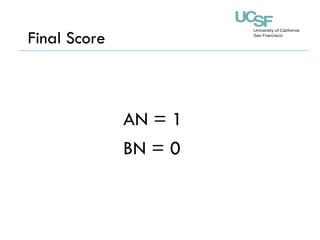
Final Score
AN = 1
BN = 0
Acknowledgements
o  National Institutes of Health
o  Baker Foundation of Australia
o  National Eating Disorders Association
o  Children’s Hospitals and Clinics of Minnesota
o  Collaborators at Kings College, London, Mt Sinai School of
Medicine, NY, University of Minnesota, MN, NRI Fargo,
ND, University of Melbourne, University of Sydney,
Australia, and Stanford University.

Le grange cap gr 2.9.16

  • 1.
    Treatment of AdolescentBulimia Nervosa vs. Anorexia Nervosa: Which is Ahead? Daniel Le Grange, PhD Benioff UCSF Professor in Children’s Health Eating Disorders Director Department of Psychiatry University of California, San Francisco, CA CAP Grand Rounds February 2016
  • 2.
    Outline of Presentation ① The Status of Treatment Studies ②  Evidence-Based Treatment for AN ③  Workings of Efficacious Treatments ④  Evidence-Based Treatment for BN ⑤  Discussion Points
  • 3.
    The Status ofTreatment Studies Part 1
  • 4.
    Treatment Studies forAN and BN Adults BN (100+) AN (10)
  • 5.
    Treatment Studies forAN and BN Adolescents AN (10) BN (3) Adults BN (100+) AN (10)
  • 6.
  • 7.
    Evidence for theTreatment of Adolescent Eating Disorders The predominant models for treating adolescent AN are: ①  Inpatient treatment for weight restoration in psychiatric setting. ②  Outpatient psychosocial treatment.
  • 8.
    ①  Inpatient WeightRestoration The predominant models for treating adolescent AN are: o Inpatient weight restoration in a psychiatric setting
  • 9.
    Liverpool RCT (N=167) o  CAMHS(n=55) o  Specialized Outpt (n=55) o  Inpt treatment (n=57) o  One and two year FU Gowers, Clark, Roberts, Griffiths, Edwards, Bryan, Smethurst, Byford & Barrett, Br J Psych, 2007.
  • 10.
    Liverpool RCT (N=167) o  CAMHSn=55 o  Specialized Outpt n=55 o  Inpt treatment n=57 o  One and two year FU Gowers, Clark, Roberts, Griffiths, Edwards, Bryan, Smethurst, Byford & Barrett, Br J Psych, 2007. One Yr FU 0 25 50 75 100 Good Interm Poor CAHMS SOP INPT
  • 11.
    Liverpool RCT (N=167) o  CAMHS(n=55) o  Specialized Outpt (n=55) o  Inpt treatment (n=57) o  One and two year FU Gowers, Clark, Roberts, Griffiths, Edwards, Bryan, Smethurst, Byford & Barrett, Br J Psych, 2007. One Yr FU 0 25 50 75 100 Good Interm Poor CAHMS SOP INPT Two Yr FU 0 25 50 75 100 Good Interm Poor CAHMS SOP INPT
  • 12.
    Conclusions o  First-line in-patientpsychiatric treatment does not provide advantages over out- patient management. o  Out-patient treatment failures do very poorly on transfer to in-patient facilities.
  • 13.
    Westmead RCT (N=82) o  MSthen FBT (n=41) o  WR then FBT (n=41) o  One year FU Madden, Miskovic-Wheatley, Wallis, Kohn, Lock, Le Grange, Jo, Clarke, Rhodes, Hay & Touyz, Psychol Med, 2014.
  • 14.
    Westmead RCT (N=82) o  MSthen FBT (n=41) o  WR then FBT (n=41) o  One year FU Madden, Miskovic-Wheatley, Wallis, Kohn, Lock, Le Grange, Jo, Clarke, Rhodes, Hay & Touyz, Psychol Med, 2014. Reducing Need for Hospitalization p=.046
  • 15.
    Conclusions o  Outcomes weresimilar with either MS or WR when inpatient treatment is combined with outpatient FBT. o  Significant cost savings will result from combining brief hospitalization with FBT.
  • 16.
    Six-Site German RCT (N=172) o IP (n=85) o  DP (n=87) o  One year FU Herpertz-Dahlman et al, LANCET, 2014
  • 17.
    Six-Site German RCT (N=172) o IP (n=85) o  DP (n=87) o  One-year follow-up Herpertz-Dahlman et al, LANCET, 2014 17.8 18.1 15 20 BMI IP DP Reducing Need for Hospitalization 95% CI, −0·∙11 to 1·∙02; p non-inferiority <0·∙0001
  • 18.
    Conclusions o  DP aftershort inpatient care in adolescent non- chronic AN seems no less effective than IP for weight restoration and maintenance during the 1st yr after admission and at 12-month F/U. o  DP might be a safe and less costly alternative to IP.
  • 19.
    Summary for InpatientTX o  First-line in-patient psychiatric treatment does not provide advantages over day-patient or out- patient management. o  Weight restoration at home is successful once medical stabilization has been achieved.
  • 20.
    ②  Psychosocial Treatmentsfor AN The predominant models for treating adolescent AN are: o  Inpatient weight restoration o Outpatient psychosocial treatment o Family-Based Treatment (FBT) is family focused and aims at symptom management by parents early in treatment. o Adolescent Focused Therapy (AFT) is an individual therapy and aims to promote self-efficacy, self-esteem, and self-management of eating problems. o Systemic Family Therapy (SyFT) places the focus on the family system to draw on their existing strengths.
  • 21.
    Summary of the10 published RCTs for AN* o  8 involved family-focused approaches (FBT, BFST or SyFT). o  3 involved individual therapy (CBT, supportive, or adolescent focused therapy). o  3 involved inpatient treatment. o  0 involved any medication. * Highlight the two latest psychosocial RCTs
  • 22.
  • 23.
    Family-Based Treatment vs.Adolescent Focused Therapy for Adolescent Anorexia Nervosa A multisite comparison Lock, Le Grange, Agras, Moye, Bryson & Jo, Arch Gen Psychiatry, 2010; Le Grange, Lock, Agras, Moye, Bryson, Jo & Kraemer, Beh Res Therapy, 2012; Le Grange, Lock, Accurso, Agras, Bryson & Jo, J Am Acad Child Adolesc Psychiatry, 2014 One of Two
  • 24.
    Primary Outcome Remission is95% mBMI for height and age according to CDC norms + EDE within 1SD of community norms o Approximates weight needed for return to full physical health in young adolescents and addresses growth, bone health, and hormonal function o EDE threshold is in the normal range for community sample and addresses minimization common in adolescent AN
  • 25.
    Full and PartialRemission by Treatment EOT 6mFU 12mFU EOT 6mFU 12mFU Percentage AFT FBT p=.029, NNT=5 p= .024, NNT=4
  • 26.
    Full and PartialRemission by Treatment EOT 6mFU 12mFU EOT 6mFU 12mFU Percentage AFT FBT
  • 27.
    Full and PartialRemission by Treatment EOT 6mFU 12mFU EOT 6mFU 12mFU Percentage AFT FBT p=.029, NNT=5 p= .024, NNT=4
  • 28.
    Time until above95%EBW Le Grange, Accurso, Lock, Agras & Bryson, IJED, 2013.
  • 29.
    Time until above95%mBMI Le Grange, Accurso, Lock, Agras & Bryson, IJED, 2013.
  • 30.
    Reducing Need forHospitalization 15 (n=9) 37 (n=32) 0 20 40 60 80 Percentage FBT AFT p=.020 3/11/16 30 Percent/(N) Hospitalized during Outpt Tx
  • 31.
    o  Only 2participants who were remitted at 1yr FU relapsed at 4yr FU. o  One fourth not remitted at 1yr FU achieved remission at long-term FU. Long-Term Follow-Up Le Grange, Lock, Accurso, Agras, Moye, Bryson, & Jo, JAACAP, 2014.
  • 32.
    Time To Remission byTreatment from 1 Yr F/U Le Grange, Lock, Accurso, Lock, Agras, Bryson & Jo, JAACAP, 2014.
  • 33.
    o  Only 2participants remitted at 1yr FU relapsed at 4yr FU. o  One fourth not remitted at 1yr FU achieved remission at long-term FU. o  About one third of participants were remitted at long-term FU, irrespective of treatment. Long-Term Follow-Up Le Grange, Lock, Accurso, Agras, Moye, Bryson, & Jo, JAACAP, 2014.
  • 34.
    Conclusions o  FBT ismore efficient than AFT in facilitating Remission at 6- and 12-month follow-up. o  FBT brings about faster weight gain early in treatment with fewer hospital days. o  Remission rates stable at 4-yr follow-up, but AFT ‘catches up’ with FBT.
  • 35.
    A Comparison ofTwo Family Therapies for Adolescent AN A Six Site Comparison Agras et al., JAMA Psychiatry, 2014 Two of Two
  • 36.
    %IBW   Agras etal., JAMA Psychiatry, 2014 o  FBT (n=82) o  SyFT (n=82) o  One Year Follow-up RIAN RCT Six Sites (N = 164)
  • 37.
    75   80   85   90   95   100   0   36   88   FBT   SFT   Months   %IBW   Agras et al., JAMA Psychiatry, 2014 o  FBT (n=82) o  SyFT (n=82) o  One Year Follow-up RIAN RCT Six Sites (N = 164) % mBMI
  • 38.
    Reducing Need forHospitalization 8.3 21 0 5 10 15 20 25 30 MedianNumberofDays FBT SyFT p=.020 38 Median Number of Days in Hospital
  • 39.
    Conclusions o  No differenceson %mBMI, eating disorder symptoms, or comorbid psychiatric symptoms. o  FBT brings about faster weight gain early in treatment (1st 8/52, p=.003), with fewer hospital days. o  FBT lower mean treatment costs (FT + hospitalization at EOT) per patient (FBT= $8963; SyFT=$18,005).
  • 40.
    Treatment of Adolescent AnorexiaNervosa Part 3 Workings of Effective Treatment ①  Predictors of Outcome ②  Adapting FBT ③  Moderator Effect on Outcome ④  Reducing the need for Hospitalization
  • 41.
    Weight gain >2kgs. by wk 4 correctly characterized:       ①  Early Weight Gain and Outcome (N>400 in FBT and AFT) o  79% of responders [AUC = .814 (p<.001)] o  71% of non-responders [AUC = .811 (p<.001)] Doyle, Le Grange, Celio-Doyle, Loeb & Crosby, IJED, 2009; Le Grange, Accurso, Lock, Agras & Bryson, IJED, 2013; Lock et al., JAACAP, 2005; Madden et al., IJED, 2015.
  • 42.
    ②  Weight forFBT/IPC compared to a sample of poor early responders Lock, Le Grange, Agras, et al., Beh Res Therapy, 2015.
  • 43.
    ③  Moderator Effecton Remission Rate: Baseline YBC-ED Le Grange, Lock, Agras, Moye, Bryson, Jo & Kraemer, Beh Res Therapy, 2012.
  • 44.
    Moderator Effect onRemission Rate: Baseline YBC-ED Le Grange, Lock, Agras, Moye, Bryson, Jo & Kraemer, Beh Res Therapy, 2012.
  • 45.
    Moderator Effect onRemission Rate: Baseline EDE Le Grange, Lock, Agras, Moye, Bryson, Jo & Kraemer, Beh Res Therapy, 2012.
  • 46.
    Moderator Effect onRemission Rate: Baseline EDE Le Grange, Lock, Agras, Moye, Bryson, Jo & Kraemer, Beh Res Therapy, 2012.
  • 47.
    ④  Reducing Needfor Hospitalization o  Westmead Children’s Hospital, Sydney (2004) - reporting a 50% decrease in readmissions over the implementation period (Wallis et al., Int J Adolesc Med Health, 2007). o  RCH in Melbourne (2009) - reporting 56% decrease in admissions, 75% decrease in readmissions, 51% decrease in overall hospital days (Hughes, Le Grange, Court et al., J Ped Child Care, 2013).
  • 48.
    Conclusions o  Early weightgain predicts outcome at end- of-treatment. o  Adapting FBT for early non-responders seems to improve outcomes for this subgroup. o  Subgroups for whom FBT is particularly helpful have been identified. o  Family involvement underscored in good outcomes, leading to reduced hospitalization.
  • 49.
    Summary of OutpatientTX o  FBT should be the first-line outpatient treatment for adolescents with AN when medically fit. o  FBT seems particularly effective at reducing the need for hospitalization. o  Improved understanding of the workings of FBT. o  AFT and SyFT are feasible treatment alternatives.
  • 50.
  • 51.
    51 Chicago RCT FBT-BN vsSPT (N = 80) o FBT-BN (n=41) o SPT (n=39) o 6 months of therapy o 6 month follow-up Le Grange, Crosby, Rathuaz & Leventhal, Arch Gen Psych, 2007.
  • 52.
    52 Chicago RCT FBT-BN vsSPT (N = 80) o FBT-BN (n=41) o SPT (n=39) o 6 months of therapy o 6 month follow-up Le Grange, Crosby, Rathuaz & Leventhal, Arch Gen Psych, 2007. Remission 0 10 20 30 40 50 60 70 80 90 100 Baseline Post-treatment 6 mo. Follow-up Percent FBT-BN SPT p = .049 p = .050
  • 53.
    Conclusion o Family-based treatment showeda clinical and statistical advantage over SPT at post-treatment and at 6-month follow-up.
  • 54.
    Maudsley RCT FT vsCBT-GSC (N = 85) o  Family Therapy (n=41) o  CBT-GSC (n=44) o  6 months of therapy o  6 month follow-up Schmidt, Lee, Beecham, et al., Am J Psych, 2007.
  • 55.
    Maudsley RCT FT vsCBT-GSC (N = 85) o  Family Therapy (n=41) o  CBT-GSC (n=44) o  6 months of therapy o  6 month follow-up Schmidt, Lee, Beecham, et al., Am J Psych, 2007. 0 25 50 75 100 Baseline EOT 6 Mo FU Remission FBT CBT- GSCNS NS
  • 56.
    Conclusion o CBT guided self-carehas the slight advantage of offering a more rapid reduction of bingeing, lower cost, and greater acceptability for adolescents with bulimia nervosa.
  • 57.
    Chicago/Stanford RCT FT-BN vs.CBT-A (N = 110) o  FBT-BN (n=52) o  CBT-A (n=58) o  6 months of therapy o  6 and 12 month follow-up Le Grange, Lock, Agras et al., J Am Acad Child Adolesc Psychiatry, 2015.
  • 58.
    Chicago/Stanford RCT FT-BN vs.CBT-A (N = 110) o  FBT-BN (n=52) o  CBT-A (n=58) o  6 months of therapy o  6 and 12 month follow-up Le Grange, Lock, Agras et al., J Am Acad Child Adolesc Psychiatry, 2015. 0.0 0.1 0.2 0.3 0.4 0.5 0.6 Baseline EOT 6m  FU 12m  FU AbstinenceRate Time FBT-­‐BN  observed FBT-­‐BN  estimated CBT-­‐A  observed CBT-­‐A  estimated Abstinence Rates p=.040 p=.030 NS
  • 59.
    Moderator Effect onRemission Rate FES Conflict Le Grange, Lock, Agras, et al., JAACAP, 2015. 0.0 0.2 0.4 0.6 0.8 1.0 Baseline EOT Abstinence  Rate FES  conflict  >=  2 CBT-­‐A  (n=34) FBT-­‐BN  (n=27) 0.0 0.2 0.4 0.6 0.8 1.0 Baseline EOT Abstinence  Rate FES  conflict  <  2 CBT-­‐A  (n=24) FBT-­‐BN  (n=24)
  • 60.
    Conclusion o  FBT-BN issuperior to CBT-A at end-of- treatment and at 6-month follow-up. o  No statistically significant difference between the two treatments at 12-month follow-up. o  FBT works faster at symptom remission and benefits are maintained over time. o  Some progress in terms of treatment moderators.
  • 61.
    Summary for AdolBN o  FBT is a strong candidate as first-line outpatient treatment for adolescents with BN. o  CBT seems a feasible alternative should the family be unavailable. o  Little data on how these treatments work.
  • 62.
    Overall Conclusions o  First-lineinpt psychiatric treatment for AN does not provide advantages over outpt management. o  FBT should be the first-line outpatient treatment for adolescents with AN when medically stable. o  Utilizing families in the treatment of adolescents with BN looks promising.
  • 63.
    ①  Parent FocusedTreatment vs. FBT – Melbourne/ UCSF. ②  Dissemination Study – Stanford/UCSF. ③  Effectiveness Study – Minnesota/UCSF. ④  Telemedicine – Chicago/UCSF. ⑤  FBT vs. FBT/IPC+ Pending. Looking Ahead
  • 64.
  • 65.
    Acknowledgements o  National Institutesof Health o  Baker Foundation of Australia o  National Eating Disorders Association o  Children’s Hospitals and Clinics of Minnesota o  Collaborators at Kings College, London, Mt Sinai School of Medicine, NY, University of Minnesota, MN, NRI Fargo, ND, University of Melbourne, University of Sydney, Australia, and Stanford University.