National 5 History - Source
Comparison questions
Today’s lesson
We are developing our knowledge and understanding of
how to answer National 5 type Source Comparison
questions.
By the end of today’s lesson I will be able to…
1) Identify similarities between historical sources.
2) Identify differences between historical sources.
3) Contribute to creating a National 5 style ‘Model Answer’.
Today’s lesson involves:
1) Note taking
2) Source task
3) Creating a model answer.
Source Comparison Questions
Source Comparison questions are one of many question types that you
will get at National 5 level.
They are always worth 4 marks.
In these questions you are given two sources and asked to compare
what the sources asked about a certain topic. For example, you might
get asked about whether two sources agree on conditions in the
trenches.
You need no background knowledge.
The Source will either all agree or all disagree.
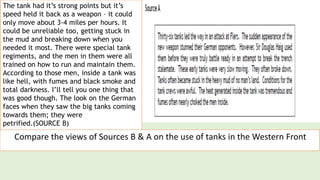
The tank had it’s strong points but it’s
speed held it back as a weapon – it could
only move about 3-4 miles per hours. It
could be unreliable too, getting stuck in
the mud and breaking down when you
needed it most. There were special tank
regiments, and the men in them were all
trained on how to run and maintain them.
According to those men, inside a tank was
like hell, with fumes and black smoke and
total darkness. I’ll tell you one thing that
was good though. The look on the German
faces when they saw the big tanks coming
towards them; they were
petrified.(SOURCE B)
Compare the views of Sources B & A on the use of tanks in the Western Front
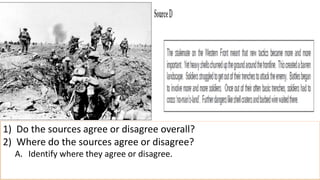
1) Do the sources agree or disagree overall?
2) Where do the sources agree or disagree?
A. Identify where they agree or disagree.
Exam style
Now we can identify similarities and differences between sources we are now going to look
at how to write up these questions.
As previously mentioned these questions are worth 4 marks but you can get up to 5 marks
available.
You get 1 mark for an overall comparison.
For example: ‘Overall, Sources A and B mostly agree about conditions in the trenches.’
You can get a 1 mark for a simple comparison.
For example: ‘Sources A & B agree that there were rats causing havoc in the trenches.’
You can get 2 marks for a developed comparison.
For example: ‘Sources A & B agree that there were rats causing havoc in the trenches.
Source A states: ‘(Insert quote from Source A). This is backed up by Source B which states:
‘(Insert quote from Source B)’.
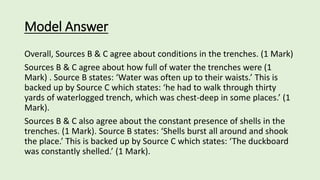
Model Answer
Every pair has a past paper question in front of them, read the sources
and complete the following instructions. You have 5 minutes.
1) Highlight where the sources agree/disagree
2) Write down an overall comparison in your jotter about the source
using the structure below:
Sources B & C agree/disagree about (Insert topic of the question).
Model Answer
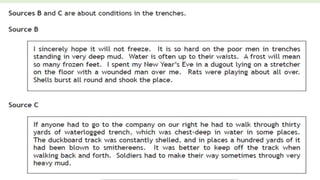
Overall, Sources B & C agree about conditions in the trenches. (1 Mark)
Sources B & C agree about how full of water the trenches were (1
Mark) . Source B states: ‘Water was often up to their waists.’ This is
backed up by Source C which states: ‘he had to walk through thirty
yards of waterlogged trench, which was chest-deep in some places.’ (1
Mark).
Sources B & C also agree about the constant presence of shells in the
trenches. (1 Mark). Source B states: ‘Shells burst all around and shook
the place.’ This is backed up by Source C which states: ‘The duckboard
was constantly shelled.’ (1 Mark).
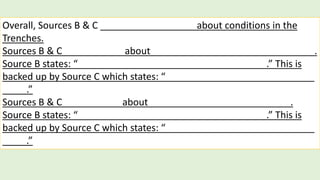
Overall, Sources B & C about conditions in the
Trenches.
Sources B & C about .
Source B states: “ .” This is
backed up by Source C which states: “
.”
Sources B & C about .
Source B states: “ .” This is
backed up by Source C which states: “
.”

Source comparison questions

  • 1.
    National 5 History- Source Comparison questions
  • 2.
    Today’s lesson We aredeveloping our knowledge and understanding of how to answer National 5 type Source Comparison questions. By the end of today’s lesson I will be able to… 1) Identify similarities between historical sources. 2) Identify differences between historical sources. 3) Contribute to creating a National 5 style ‘Model Answer’. Today’s lesson involves: 1) Note taking 2) Source task 3) Creating a model answer.
  • 3.
    Source Comparison Questions SourceComparison questions are one of many question types that you will get at National 5 level. They are always worth 4 marks. In these questions you are given two sources and asked to compare what the sources asked about a certain topic. For example, you might get asked about whether two sources agree on conditions in the trenches. You need no background knowledge. The Source will either all agree or all disagree.
  • 4.
    The tank hadit’s strong points but it’s speed held it back as a weapon – it could only move about 3-4 miles per hours. It could be unreliable too, getting stuck in the mud and breaking down when you needed it most. There were special tank regiments, and the men in them were all trained on how to run and maintain them. According to those men, inside a tank was like hell, with fumes and black smoke and total darkness. I’ll tell you one thing that was good though. The look on the German faces when they saw the big tanks coming towards them; they were petrified.(SOURCE B) Compare the views of Sources B & A on the use of tanks in the Western Front
  • 5.
    1) Do thesources agree or disagree overall? 2) Where do the sources agree or disagree? A. Identify where they agree or disagree.
  • 6.
    Exam style Now wecan identify similarities and differences between sources we are now going to look at how to write up these questions. As previously mentioned these questions are worth 4 marks but you can get up to 5 marks available. You get 1 mark for an overall comparison. For example: ‘Overall, Sources A and B mostly agree about conditions in the trenches.’ You can get a 1 mark for a simple comparison. For example: ‘Sources A & B agree that there were rats causing havoc in the trenches.’ You can get 2 marks for a developed comparison. For example: ‘Sources A & B agree that there were rats causing havoc in the trenches. Source A states: ‘(Insert quote from Source A). This is backed up by Source B which states: ‘(Insert quote from Source B)’.
  • 7.
    Model Answer Every pairhas a past paper question in front of them, read the sources and complete the following instructions. You have 5 minutes. 1) Highlight where the sources agree/disagree 2) Write down an overall comparison in your jotter about the source using the structure below: Sources B & C agree/disagree about (Insert topic of the question).
  • 9.
    Model Answer Overall, SourcesB & C agree about conditions in the trenches. (1 Mark) Sources B & C agree about how full of water the trenches were (1 Mark) . Source B states: ‘Water was often up to their waists.’ This is backed up by Source C which states: ‘he had to walk through thirty yards of waterlogged trench, which was chest-deep in some places.’ (1 Mark). Sources B & C also agree about the constant presence of shells in the trenches. (1 Mark). Source B states: ‘Shells burst all around and shook the place.’ This is backed up by Source C which states: ‘The duckboard was constantly shelled.’ (1 Mark).
  • 10.
    Overall, Sources B& C about conditions in the Trenches. Sources B & C about . Source B states: “ .” This is backed up by Source C which states: “ .” Sources B & C about . Source B states: “ .” This is backed up by Source C which states: “ .”