SOUND + IMAGE
THE RELATIONSHIP BETWEEN SOUND AND
IMAGE
 The sound and the image of a film can be recorded
  separately.
 This enables filmmakers to manipulate the sound to
  find the perfect balance between dialogue, music,
  and sound effects.
 Whichever element is emphasized helps the viewer
  understand what is important to the scene or the
  message the director is trying to convey.
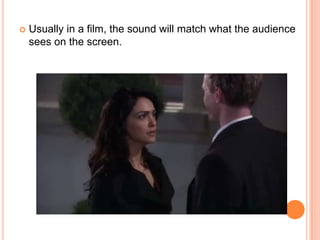
   Usually in a film, the sound will match what the audience
    sees on the screen.
THE RELATIONSHIP BETWEEN SOUND AND
IMAGE
   By having the sound and image match, the
    filmmaker reinforces the reality of the movie world
    and shapes the viewer’s perception of the film.

   However, there are times when a filmmaker will
    purposely choose to have the sound differ from
    what is being shown onscreen.
THE RELATIONSHIP BETWEEN SOUND AND IMAGE
   There are five ways that sound may differ from the
    image:
       Onscreen space and offscreen space
       Objective images and subjective sound
       Diegetic details and non-diegetic sound
       Image time and sound time
       Image mood and sound mood
ONSCREEN SPACE AND OFFSCREEN SPACE
   Because the image is confined to the frame of the
    screen, filmmakers often try to find ways to make it
    seem as though the world of the film extends past
    the frame.

   One method of accomplishing this is to have sound
    come from offscreen – the area beyond the frame.

   A sound coming from offscreen means that it can
    be heard, but there is no image that shows us
    where the sound is coming from.
OBJECTIVE IMAGES AND SUBJECTIVE
SOUNDS
   While the image is often limited to showing a
    character’s actions, through the use of subjective
    sound, a filmmaker can reveal to the viewer what a
    character is thinking.

   Although the audience can hear the sounds, they
    do not actually exist in the world of the movie.
DIEGETIC DETAILS AND NON-DIEGETIC
SOUND
 Diegetic - Any sound, voice or piece of music that
  comes from within the world of the narrative
 Non-diegetic - Sounds, such as music or a
  narrator’s voices that come from outside the space
  of the narrative.
 When a filmmaker uses non-diegetic sound with an
  image from the world of the movie, it generally
  indicates a form of direct address to the audience.
       Examples: background music playing to shape the
        emotions of the audience, a voice-over narration
IMAGE TIME AND SOUND TIME
   Combining sound and image allows filmmakers to
    present two different points in time simultaneously.
       Example: when a voice-over narration describes past
        events.


   Sometimes discrepancies in image time and sound
    time occur during transitions, where the sound at
    the end of one scene will carry over into the other.
    This is called a sound bridge.
IMAGE MOOD AND SOUND MOOD
   Often, a film’s soundtrack corresponds to what is
    happening on the screen and serves to emphasize
    the mood of the image.

   By creating a contrast between the mood of the
    image and the mood of the sound, however, a
    filmmaker can highlight the tension of a scene and
    draw the audience’s attention to a particular aspect
    of the movie.
Sound unit   day two

Sound unit day two

  • 1.
  • 2.
    THE RELATIONSHIP BETWEENSOUND AND IMAGE  The sound and the image of a film can be recorded separately.  This enables filmmakers to manipulate the sound to find the perfect balance between dialogue, music, and sound effects.  Whichever element is emphasized helps the viewer understand what is important to the scene or the message the director is trying to convey.
  • 4.
    Usually in a film, the sound will match what the audience sees on the screen.
  • 5.
    THE RELATIONSHIP BETWEENSOUND AND IMAGE  By having the sound and image match, the filmmaker reinforces the reality of the movie world and shapes the viewer’s perception of the film.  However, there are times when a filmmaker will purposely choose to have the sound differ from what is being shown onscreen.
  • 6.
    THE RELATIONSHIP BETWEENSOUND AND IMAGE  There are five ways that sound may differ from the image:  Onscreen space and offscreen space  Objective images and subjective sound  Diegetic details and non-diegetic sound  Image time and sound time  Image mood and sound mood
  • 7.
    ONSCREEN SPACE ANDOFFSCREEN SPACE  Because the image is confined to the frame of the screen, filmmakers often try to find ways to make it seem as though the world of the film extends past the frame.  One method of accomplishing this is to have sound come from offscreen – the area beyond the frame.  A sound coming from offscreen means that it can be heard, but there is no image that shows us where the sound is coming from.
  • 9.
    OBJECTIVE IMAGES ANDSUBJECTIVE SOUNDS  While the image is often limited to showing a character’s actions, through the use of subjective sound, a filmmaker can reveal to the viewer what a character is thinking.  Although the audience can hear the sounds, they do not actually exist in the world of the movie.
  • 11.
    DIEGETIC DETAILS ANDNON-DIEGETIC SOUND  Diegetic - Any sound, voice or piece of music that comes from within the world of the narrative  Non-diegetic - Sounds, such as music or a narrator’s voices that come from outside the space of the narrative.  When a filmmaker uses non-diegetic sound with an image from the world of the movie, it generally indicates a form of direct address to the audience.  Examples: background music playing to shape the emotions of the audience, a voice-over narration
  • 14.
    IMAGE TIME ANDSOUND TIME  Combining sound and image allows filmmakers to present two different points in time simultaneously.  Example: when a voice-over narration describes past events.  Sometimes discrepancies in image time and sound time occur during transitions, where the sound at the end of one scene will carry over into the other. This is called a sound bridge.
  • 16.
    IMAGE MOOD ANDSOUND MOOD  Often, a film’s soundtrack corresponds to what is happening on the screen and serves to emphasize the mood of the image.  By creating a contrast between the mood of the image and the mood of the sound, however, a filmmaker can highlight the tension of a scene and draw the audience’s attention to a particular aspect of the movie.