Sound Devices
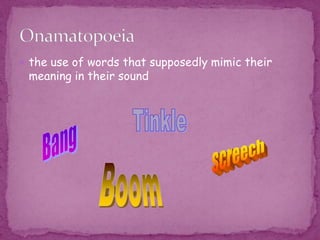
the use of words that supposedly mimic their meaning in their sound OnamatopoeiaTinkleBangscreechBoom
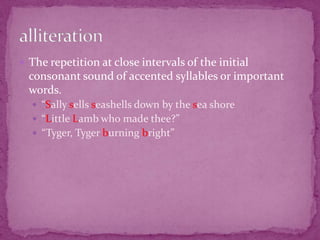
The repetition at close intervals of the initial consonant sound of accented syllables or important words.“Sally sells seashells down by the sea shore“Little Lamb who made thee?”“Tyger, Tyger burning bright”alliteration
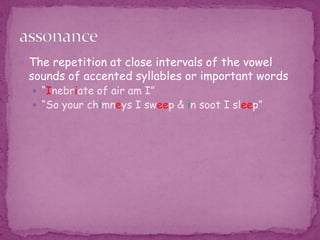
The repetition at close intervals of the vowel sounds of accented syllables or important words “Inebriate of air am I”“So your chimneys I sweep & in soot I sleep”assonance
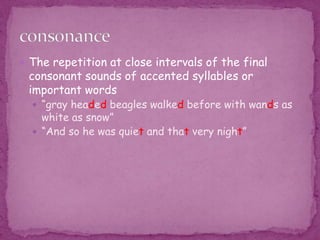
The repetition at close intervals of the final consonant sounds of accented syllables or important words “gray headed beagles walked before with wands as white as snow”“And so he was quiet and that very night”consonance
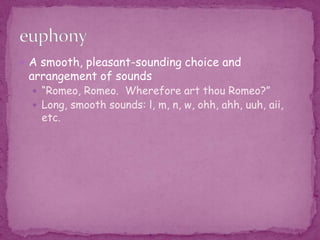
A smooth, pleasant-sounding choice and arrangement of sounds “Romeo, Romeo.  Wherefore art thou Romeo?”Long, smooth sounds: l, m, n, w, ohh, ahh, uuh, aii, etc.euphony
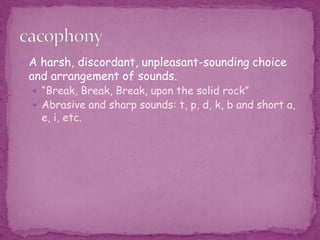
A harsh, discordant, unpleasant-sounding choice and arrangement of sounds. “Break, Break, Break, upon the solid rock”Abrasive and sharp sounds: t, p, d, k, b and short a, e, i, etc.cacophony
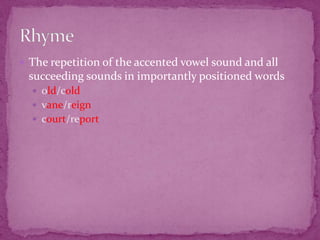
The repetition of the accented vowel sound and all succeeding sounds in importantly positioned wordsold/coldvane/reigncourt/reportRhyme
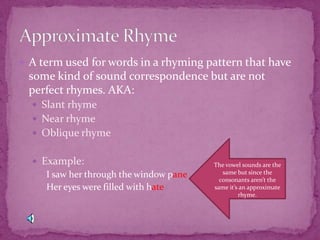
A term used for words in a rhyming pattern that have some kind of sound correspondence but are not perfect rhymes. AKA:Slant rhymeNear rhymeOblique rhymeExample: I saw her through the window paneHer eyes were filled with hateApproximate RhymeThe vowel sounds are the same but since the consonants aren’t the same it’s an approximate rhyme.
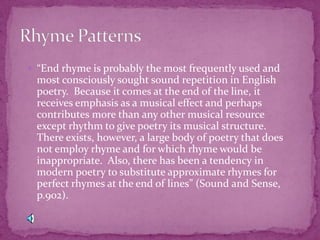
“End rhyme is probably the most frequently used and most consciously sought sound repetition in English poetry.  Because it comes at the end of the line, it receives emphasis as a musical effect and perhaps contributes more than any other musical resource except rhythm to give poetry its musical structure.  There exists, however, a large body of poetry that does not employ rhyme and for which rhyme would be inappropriate.  Also, there has been a tendency in modern poetry to substitute approximate rhymes for perfect rhymes at the end of lines” (Sound and Sense, p.902).Rhyme Patterns
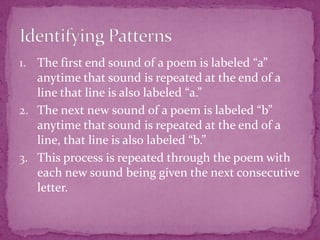
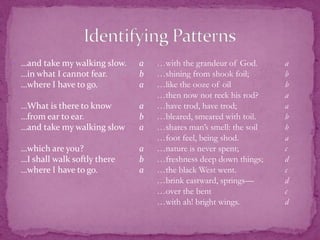
The first end sound of a poem is labeled “a” anytime that sound is repeated at the end of a line that line is also labeled “a.”The next new sound of a poem is labeled “b” anytime that sound is repeated at the end of a line, that line is also labeled “b.”This process is repeated through the poem with each new sound being given the next consecutive letter.Identifying Patterns
…and take my walking slow.   	a…in what I cannot fear.	b…where I have to go.		a…What is there to know	a…from ear to ear.		b…and take my walking slow	a…which are you?		a…I shall walk softly there	b…where I have to go.		a		Identifying Patterns…with the grandeur of God.	a…shining from shook foil;		b…like the ooze of oil		b…then now not reck his rod?	a…have trod, have trod;		a…bleared, smeared with toil.	b…shares man’s smell: the soil	b…foot feel, being shod.		a…nature is never spent;		c…freshness deep down things;	d…the black West went.		c…brink eastward, springs—	d…over the bent			c…with ah! bright wings.		d
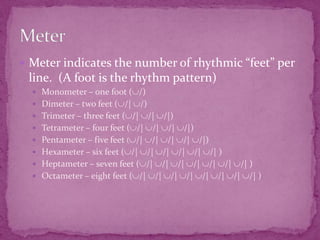
Rhythm refers to any wavelike recurrence of motion of sound.  In speech it is the natural rise and fall of language.Meter is the identifying characteristic of language that we can tap our feet to.  When verse is metrical, the accents of language are so arranged as to occur at apparently equal intervals of time, and it is this interval that we mark off with the tap of a foot.Rhythm & Meter
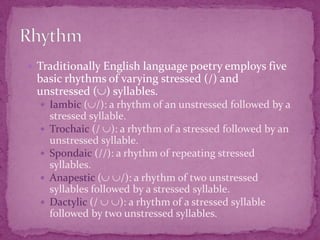
Traditionally English language poetry employs five basic rhythms of varying stressed (/) and unstressed () syllables.
Iambic (/): a rhythm of an unstressed followed by a stressed syllable.
Trochaic (/ ): a rhythm of a stressed followed by an unstressed syllable.
Spondaic (//): a rhythm of repeating stressed syllables.
Anapestic ( /): a rhythm of two unstressed syllables followed by a stressed syllable.
Dactylic (/  ): a rhythm of a stressed syllable followed by two unstressed syllables.Rhythm
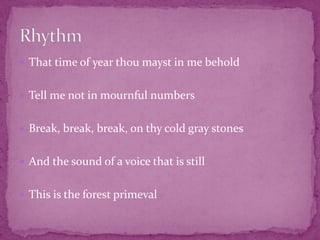
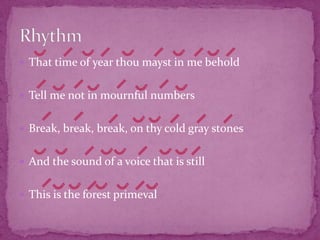
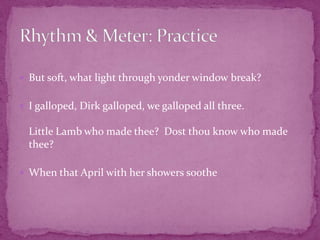
That time of year thou mayst in me beholdTell me not in mournful numbersBreak, break, break, on thy cold gray stonesAnd the sound of a voice that is stillThis is the forest primevalRhythm

Sound Devices Final

  • 1.
  • 2.
    the use ofwords that supposedly mimic their meaning in their sound OnamatopoeiaTinkleBangscreechBoom
  • 3.
    The repetition atclose intervals of the initial consonant sound of accented syllables or important words.“Sally sells seashells down by the sea shore“Little Lamb who made thee?”“Tyger, Tyger burning bright”alliteration
  • 4.
    The repetition atclose intervals of the initial consonant sound of accented syllables or important words.“Sally sells seashells down by the sea shore“Little Lamb who made thee?”“Tyger, Tyger burning bright”alliteration
  • 5.
    The repetition atclose intervals of the vowel sounds of accented syllables or important words “Inebriate of air am I”“So your chimneys I sweep & in soot I sleep”assonance
  • 6.
    The repetition atclose intervals of the vowel sounds of accented syllables or important words “Inebriate of air am I”“So your chimneys I sweep & in soot I sleep”assonance
  • 7.
    The repetition atclose intervals of the final consonant sounds of accented syllables or important words “gray headed beagles walked before with wands as white as snow”“And so he was quiet and that very night”consonance
  • 8.
    The repetition atclose intervals of the final consonant sounds of accented syllables or important words “gray headed beagles walked before with wands as white as snow”“And so he was quiet and that very night”consonance
  • 9.
    A smooth, pleasant-soundingchoice and arrangement of sounds “Romeo, Romeo. Wherefore art thou Romeo?”Long, smooth sounds: l, m, n, w, ohh, ahh, uuh, aii, etc.euphony
  • 10.
    A harsh, discordant,unpleasant-sounding choice and arrangement of sounds. “Break, Break, Break, upon the solid rock”Abrasive and sharp sounds: t, p, d, k, b and short a, e, i, etc.cacophony
  • 11.
    The repetition ofthe accented vowel sound and all succeeding sounds in importantly positioned wordsold/coldvane/reigncourt/reportRhyme
  • 12.
    A term usedfor words in a rhyming pattern that have some kind of sound correspondence but are not perfect rhymes. AKA:Slant rhymeNear rhymeOblique rhymeExample: I saw her through the window paneHer eyes were filled with hateApproximate RhymeThe vowel sounds are the same but since the consonants aren’t the same it’s an approximate rhyme.
  • 13.
    “End rhyme isprobably the most frequently used and most consciously sought sound repetition in English poetry. Because it comes at the end of the line, it receives emphasis as a musical effect and perhaps contributes more than any other musical resource except rhythm to give poetry its musical structure. There exists, however, a large body of poetry that does not employ rhyme and for which rhyme would be inappropriate. Also, there has been a tendency in modern poetry to substitute approximate rhymes for perfect rhymes at the end of lines” (Sound and Sense, p.902).Rhyme Patterns
  • 14.
    The first endsound of a poem is labeled “a” anytime that sound is repeated at the end of a line that line is also labeled “a.”The next new sound of a poem is labeled “b” anytime that sound is repeated at the end of a line, that line is also labeled “b.”This process is repeated through the poem with each new sound being given the next consecutive letter.Identifying Patterns
  • 15.
    …and take mywalking slow. a…in what I cannot fear. b…where I have to go. a…What is there to know a…from ear to ear. b…and take my walking slow a…which are you? a…I shall walk softly there b…where I have to go. a Identifying Patterns…with the grandeur of God. a…shining from shook foil; b…like the ooze of oil b…then now not reck his rod? a…have trod, have trod; a…bleared, smeared with toil. b…shares man’s smell: the soil b…foot feel, being shod. a…nature is never spent; c…freshness deep down things; d…the black West went. c…brink eastward, springs— d…over the bent c…with ah! bright wings. d
  • 16.
    Rhythm refers toany wavelike recurrence of motion of sound. In speech it is the natural rise and fall of language.Meter is the identifying characteristic of language that we can tap our feet to. When verse is metrical, the accents of language are so arranged as to occur at apparently equal intervals of time, and it is this interval that we mark off with the tap of a foot.Rhythm & Meter
  • 17.
    Traditionally English languagepoetry employs five basic rhythms of varying stressed (/) and unstressed () syllables.
  • 18.
    Iambic (/): arhythm of an unstressed followed by a stressed syllable.
  • 19.
    Trochaic (/ ):a rhythm of a stressed followed by an unstressed syllable.
  • 20.
    Spondaic (//): arhythm of repeating stressed syllables.
  • 21.
    Anapestic ( /):a rhythm of two unstressed syllables followed by a stressed syllable.
  • 22.
    Dactylic (/ ): a rhythm of a stressed syllable followed by two unstressed syllables.Rhythm
  • 23.
    That time ofyear thou mayst in me beholdTell me not in mournful numbersBreak, break, break, on thy cold gray stonesAnd the sound of a voice that is stillThis is the forest primevalRhythm