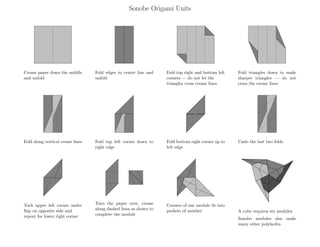
Sonobe Origami Units
Crease paper down the middle
and unfold
Fold edges to center line and
unfold
Fold top right and bottom left
corners — do not let the
triangles cross crease lines
Fold triangles down to make
sharper triangles — do not
cross the crease lines
Fold along vertical crease lines Fold top left corner down to
right edge
Fold bottom right corner up to
left edge
Undo the last two folds
Tuck upper left corner under
flap on opposite side and
repeat for lower right corner
Turn the paper over, crease
along dashed lines as shown to
complete the module
Corners of one module fit into
pockets of another A cube requires six modules
Sonobe modules also make
many other polyhedra
Where’s the Math in Origami?
Origami may not seem like it involves very much mathematics. Yes, origami involves symmetry. If we
build a polyhedron then, sure, we encounter a shape from geometry. Is that as far as it goes? Do any
interesting mathematical questions arise from the process of folding paper? Is there any deep mathematics
in origami? Is the mathematics behind origami useful for anything other than making pretty decorations?
People who spend time folding paper often ask themselves questions that are ultimately mathematical in
nature. Is there a simpler procedure for folding a certain figure? Where on the original square paper do
the wings of a crane come from? What size paper should I use to make a chair to sit at the origami table
I already made? Is it possible to make an origami beetle that has six legs and two antennae from a single
square sheet of paper? Is there a precise procedure for folding a paper into five equal strips?
In the last few decades, folders inspired by questions like these have revolutionized origami by bringing
mathematical techniques to their art. In the early 1990s, Robert Lang proved that for any number of
appendages there is an origami base that can produce the desired effect from a single square sheet of
paper. Robert has created a computer program that can design a somewhat optimized base for any stick
figure outline. This has enabled many folders to create origami animals that were considered impossible
years ago.
Recently, mathematical origami theory has been applied to produce an amazing range of practical appli-
cations. New technologies being developed include: paper product designs involving no adhesives, better
ways of folding maps, unfolding space telescopes and solar sails, software systems that test the safety of
airbag packings for car manufacturers, and self-organizing artificial intelligence systems.
Challenge Problems For Sonobe Modules
• Using two colors, is it possible to construct a cube so that both colors appear on each face?
• Using three colors, is it possible to construct a cube so that only two of the three colors appear on
each face?
• Using three colors, is it possible to construct a cube so that all three colors appear on each face?
• Using Sonobe units, can you build a stellated octahedron? A stellated icosahedron?
• Can you use Sonobe units to design your own unusual polyhedron?
• What is the smallest number of Sonobe units you need to make a polyhedron?
• How many different polyhedra can you make using six or fewer Sonobe units? Seven?
• A Sonobe polyhedron is three-colorable if there is a way to construct it using only three colors so
that no module inserts into a module of the same color. Can you find a three-coloring for a stellated
octahedron? What about for a stellated icosahedron? Can you find any polyhedra that are not
three-colorable?

Sonobe origami polyhedra

  • 1.
    Sonobe Origami Units Creasepaper down the middle and unfold Fold edges to center line and unfold Fold top right and bottom left corners — do not let the triangles cross crease lines Fold triangles down to make sharper triangles — do not cross the crease lines Fold along vertical crease lines Fold top left corner down to right edge Fold bottom right corner up to left edge Undo the last two folds Tuck upper left corner under flap on opposite side and repeat for lower right corner Turn the paper over, crease along dashed lines as shown to complete the module Corners of one module fit into pockets of another A cube requires six modules Sonobe modules also make many other polyhedra
  • 2.
    Where’s the Mathin Origami? Origami may not seem like it involves very much mathematics. Yes, origami involves symmetry. If we build a polyhedron then, sure, we encounter a shape from geometry. Is that as far as it goes? Do any interesting mathematical questions arise from the process of folding paper? Is there any deep mathematics in origami? Is the mathematics behind origami useful for anything other than making pretty decorations? People who spend time folding paper often ask themselves questions that are ultimately mathematical in nature. Is there a simpler procedure for folding a certain figure? Where on the original square paper do the wings of a crane come from? What size paper should I use to make a chair to sit at the origami table I already made? Is it possible to make an origami beetle that has six legs and two antennae from a single square sheet of paper? Is there a precise procedure for folding a paper into five equal strips? In the last few decades, folders inspired by questions like these have revolutionized origami by bringing mathematical techniques to their art. In the early 1990s, Robert Lang proved that for any number of appendages there is an origami base that can produce the desired effect from a single square sheet of paper. Robert has created a computer program that can design a somewhat optimized base for any stick figure outline. This has enabled many folders to create origami animals that were considered impossible years ago. Recently, mathematical origami theory has been applied to produce an amazing range of practical appli- cations. New technologies being developed include: paper product designs involving no adhesives, better ways of folding maps, unfolding space telescopes and solar sails, software systems that test the safety of airbag packings for car manufacturers, and self-organizing artificial intelligence systems. Challenge Problems For Sonobe Modules • Using two colors, is it possible to construct a cube so that both colors appear on each face? • Using three colors, is it possible to construct a cube so that only two of the three colors appear on each face? • Using three colors, is it possible to construct a cube so that all three colors appear on each face? • Using Sonobe units, can you build a stellated octahedron? A stellated icosahedron? • Can you use Sonobe units to design your own unusual polyhedron? • What is the smallest number of Sonobe units you need to make a polyhedron? • How many different polyhedra can you make using six or fewer Sonobe units? Seven? • A Sonobe polyhedron is three-colorable if there is a way to construct it using only three colors so that no module inserts into a module of the same color. Can you find a three-coloring for a stellated octahedron? What about for a stellated icosahedron? Can you find any polyhedra that are not three-colorable?