Sonnet 43Elizabeth barret browningPowerpoint Created by Sachin Budhrani and Harsh Shah
What is a sonnet? A sonnet  is a fourteen line poem that is based on love. All sonnets follow a specific rhyme scheme.Sonnet 43 follows a rhyme scheme of ABBA-ABBA-CD-CD-CD. Sonnet 43 follows the Iambic pentameter. An iambic pentameter follows the rules of 10 beats per line, where unstressed and stressed syllables alternate.A sonnet is broken down into 4 sections. These are called quatrains .Each quatrain contains a rhyme scheme.
POEMHow do I love thee? Let me count the ways. I love thee to the depth and breadth and height My soul can reach, when feeling out of sight For the ends of Being and ideal Grace. I love thee to the level of everyday's Most quiet need, by sun and candle-light. I love thee freely, as men strive for Right; I love thee purely, as they turn from Praise. I love thee with the passion put to use In my old griefs, and with my childhood's faith. I love thee with a love I seemed to lose With my lost saints!---I love thee with the breath, Smiles, tears, of all my life!---and, if God choose, I shall but love thee better after death.
Subject Matter	Sonnet 43 expresses the poet’s intense love for her future husband, Robert Browning. She claims her love is so intense for him that it even rises to spiritual levels. She loves him freely and purely, without any selfish mindset or expectation of self-gain. She loves him so much, at the level of intense suffering. So intense it even resembles Christ on the cross. She also says she loves him the way she loved her ‘lost’ saints as a child.  In the end, she even says their bonds and love wont end if death set them apart.
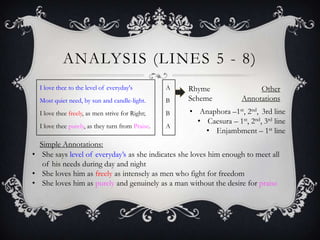
Analysis (lines 1 - 4)Rhyme SchemeHow do I love thee? Let me count the ways. I love thee to the depth and breadth and height My soul can reach, when feeling out of sight For the ends of Being and ideal Grace. ABBAOther AnnotationsAnaphora – 1st, 2nd line
Caesura – 3rd line
Enjambment – 2nd, 3rd line
Rhetorical Q’s– 1st  line Simple Annotations:Elizabeth uses thee to the poet's husband, Robert Browning

Sonnet 43 (1)

  • 1.
    Sonnet 43Elizabeth barretbrowningPowerpoint Created by Sachin Budhrani and Harsh Shah
  • 2.
    What is asonnet? A sonnet is a fourteen line poem that is based on love. All sonnets follow a specific rhyme scheme.Sonnet 43 follows a rhyme scheme of ABBA-ABBA-CD-CD-CD. Sonnet 43 follows the Iambic pentameter. An iambic pentameter follows the rules of 10 beats per line, where unstressed and stressed syllables alternate.A sonnet is broken down into 4 sections. These are called quatrains .Each quatrain contains a rhyme scheme.
  • 3.
    POEMHow do Ilove thee? Let me count the ways. I love thee to the depth and breadth and height My soul can reach, when feeling out of sight For the ends of Being and ideal Grace. I love thee to the level of everyday's Most quiet need, by sun and candle-light. I love thee freely, as men strive for Right; I love thee purely, as they turn from Praise. I love thee with the passion put to use In my old griefs, and with my childhood's faith. I love thee with a love I seemed to lose With my lost saints!---I love thee with the breath, Smiles, tears, of all my life!---and, if God choose, I shall but love thee better after death.
  • 4.
    Subject Matter Sonnet 43expresses the poet’s intense love for her future husband, Robert Browning. She claims her love is so intense for him that it even rises to spiritual levels. She loves him freely and purely, without any selfish mindset or expectation of self-gain. She loves him so much, at the level of intense suffering. So intense it even resembles Christ on the cross. She also says she loves him the way she loved her ‘lost’ saints as a child. In the end, she even says their bonds and love wont end if death set them apart.
  • 5.
    Analysis (lines 1- 4)Rhyme SchemeHow do I love thee? Let me count the ways. I love thee to the depth and breadth and height My soul can reach, when feeling out of sight For the ends of Being and ideal Grace. ABBAOther AnnotationsAnaphora – 1st, 2nd line
  • 6.
  • 7.
  • 8.
    Rhetorical Q’s– 1st line Simple Annotations:Elizabeth uses thee to the poet's husband, Robert Browning