Sonnets from thePortuguese
Elizabeth Barrett Browning
A collection of love sonnets written
to her husband, Robert Browning
2.
About Elizabeth BarrettBrowning
• • Born in 1806, died 1861
• • One of the most respected poets of the
Victorian era
• • Known for her passionate poetry and strong
voice on social issues
• • Married fellow poet Robert Browning in
1846
• 👉 Her personal life deeply influenced her
poetry.
3.
About the Collection
•• Written between 1845–1846
• • Published in 1850
• • Contains 44 sonnets
• • Initially disguised as translations, but
actually original poems
• 👉 The poems express her deep love for
Robert Browning.
4.
Themes of theSonnets
• • Love and Devotion – sincere affection for
Robert
• • Struggle and Doubt – fear of unworthiness
and vulnerability
• • Faith and Spirituality – love as divine and
eternal
• • Transformation – love as a force that
changes life
• 👉 A journey from hesitation to complete
5.
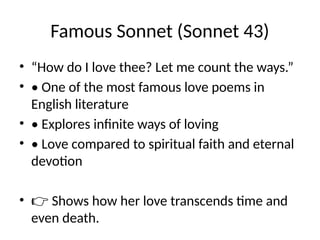
Famous Sonnet (Sonnet43)
• “How do I love thee? Let me count the ways.”
• • One of the most famous love poems in
English literature
• • Explores infinite ways of loving
• • Love compared to spiritual faith and eternal
devotion
• 👉 Shows how her love transcends time and
even death.
6.
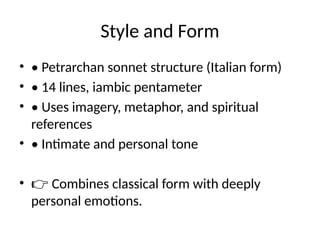
Style and Form
•• Petrarchan sonnet structure (Italian form)
• • 14 lines, iambic pentameter
• • Uses imagery, metaphor, and spiritual
references
• • Intimate and personal tone
• 👉 Combines classical form with deeply
personal emotions.
7.
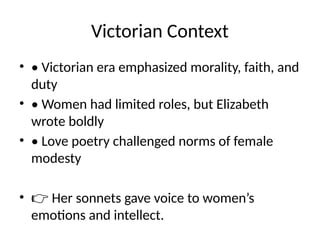
Victorian Context
• •Victorian era emphasized morality, faith, and
duty
• • Women had limited roles, but Elizabeth
wrote boldly
• • Love poetry challenged norms of female
modesty
• 👉 Her sonnets gave voice to women’s
emotions and intellect.
8.
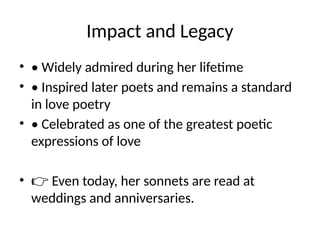
Impact and Legacy
•• Widely admired during her lifetime
• • Inspired later poets and remains a standard
in love poetry
• • Celebrated as one of the greatest poetic
expressions of love
• 👉 Even today, her sonnets are read at
weddings and anniversaries.
9.
Conclusion
• • Sonnetsfrom the Portuguese reveal
Elizabeth’s journey of love
• • Blend of passion, vulnerability, and faith
• • Timeless exploration of devotion between
two poets
• 👉 Proof that true love can be immortalized in
poetry.