What are Generative AI Tools?
¬ Generative artificial intelligence (AI) tools use machine-learning algorithms to create “new” digital content (text, images, audio, 		
		 multimedia, computer code, etc.).
¬ They are not currently capable of evaluating, critically combining or verifying information—instead, they predict and rearrange the
		 most likely outcome based on the requested output, feedback and patterns in the data models they are trained on.
¬ Natural language processing (NLP) is the subset of generative AI tools, such as ChatGPT, that allows computers to analyze and 		
		 then mimic human language. Paired with a user-friendly interface, these tools are commonly called “chatbots” and allow users 		
		 of all skill levels to place requests and interact with the language models in a conversational manner.
Example
A chatbot for a course could answer student questions related to the course subject matter, offer definitions, summarize or identify
main ideas in documents or materials, generate review questions, or identify support resources. For the model to learn, it needs to be
exposed to relevant data. The chatbots learn what the best answers are and how to deal with questions that don’t fit the framework of
the questions asked.
Different Tools for Text and Image Generation
¬ Chatbots such as ChatGPT, ChatSonic, LaMDA, BERT, Jasper, Jasper Art, Midjourney, Stable Diffusion and Bing use NLP and are 		
		 trained to understand language and respond in a meaningful way.
¬ Some apps such as ChatGPT are trained on large amounts of text data from various sources and then the model uses the 		
		 prompt given, analyzes the data into components, processes the meaning of each part generated and then produces a 		
		 response. This process is called “transfer training,” which involves the model being trained on new tasks and data to improve its
		 performance and accuracy (Sanchez, 2023).
¬ The tools differ in the data models they are trained on and the way in which they were designed for the user to interact with 		
		 them; for example, the original version of ChatGPT is based on data up to September 2021 and uses a conversational format, 		
		 ChatSonic is powered by Google Search and utilizes voice commands, Jasper remembers conversations, LaMDA is trained on 		
		 dialogue and Replika is oriented to personal use. Other AI apps are conversation-focused and may use rule-based systems that
		 rely on predetermined responses. Additional apps are image-based and provide visual explanation such as Socratic or DALL-E 2,
		 which can create realistic images from a given description.
AN INTRODUCTION TO
GENERATIVE AI TOOLS
®
Examples
¬ Bard (Google): Powered by LaMDA (Language Model for Dialogue Applications); natural language input; can follow up on 		
		 conversations; can generate responses to open-ended prompts
¬ Bing: Uses a conversational UI; delivers a summarized answer; provides sources to each data provided
¬ Grammarly: Suggests improvements to spelling, grammar, fluency, style and tone
¬ ChatSonic: Conversational AI tool provides updates and factual information aided by Google’s information network; accesses the
		 internet to generate accurate data on current events and remembers conversations; has a built-in image generator
¬ Jasper: AI writing tools for companies that want to generate high-quality content, templates for blogs and social media; great for
		 short sentences and ad copy
¬ Replika: AI chatbot or companionship; can hold meaningful conversations; has video call options and avatars
Enhancing Teaching and Learning
Generative AI tools can be used to support the work of teachers, transform students’ learning experiences and create innovations in
learning assessment. Here are some ideas of how these tools can be integrated in teaching and learning, aligned with good teaching
practice.
Teaching Practice—supporting the work of teachers
Examples of Good Practice
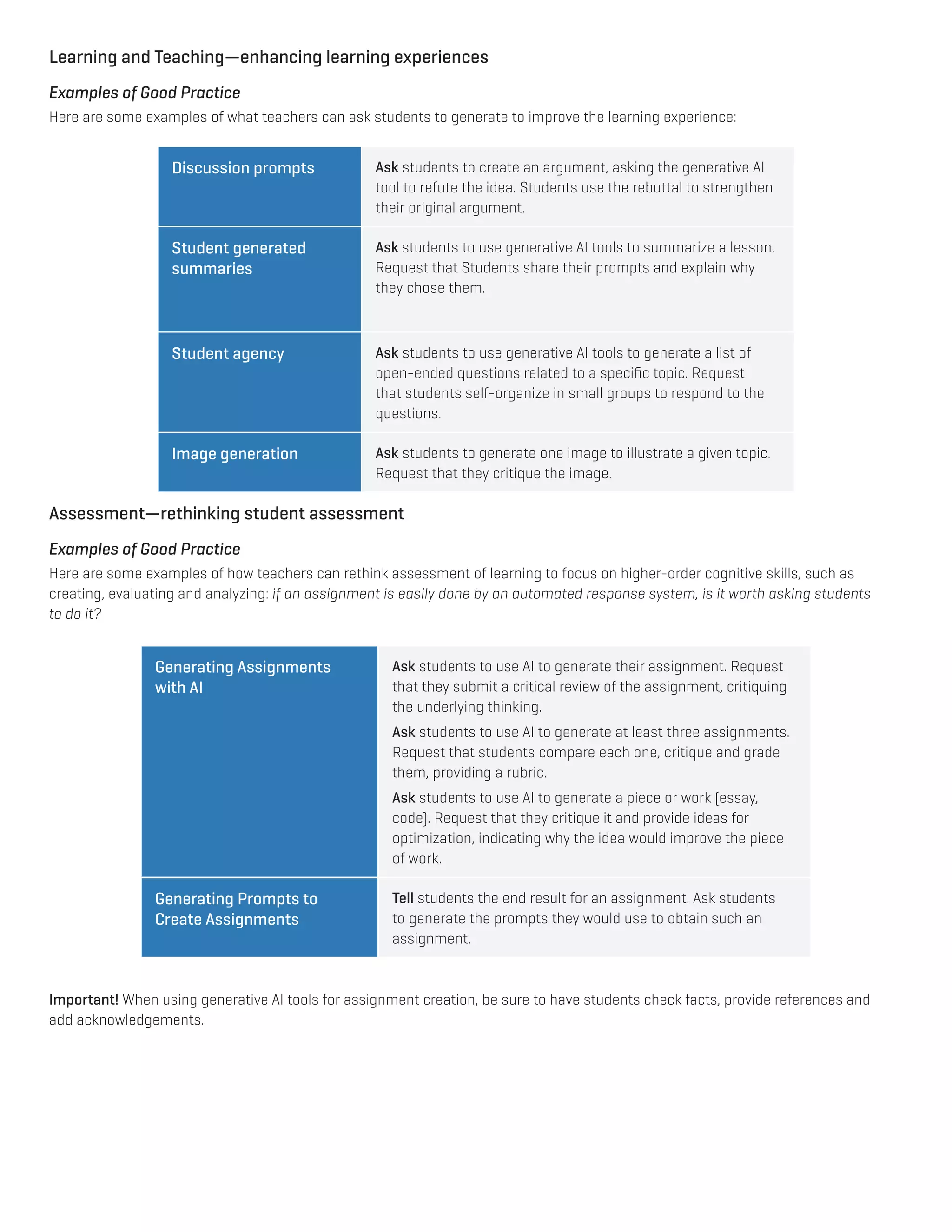
Here are some examples of what teachers can generate to support their teaching practice. Although the output may not be 100%
correct, it can be a starting point that will save time.
Course Schedules Prompt learning outcomes, delivery mode, course duration
Ask to produce a weekly course schedule
Lesson Plans Prompt learning outcomes, main student characteristics,
preferred pedagogical strategies, lesson duration
Ask to produce a lesson plan
Lesson Summaries Prompt learning outcomes, lesson main themes, lecture notes
Ask to produce a summary highlighting key topics
Learning Outcomes Prompt lesson topic, duration and level of lesson (introductory,
advanced)
Ask what learning outcomes should be covered
Feedback & Guidance Prompt the subject or the task students need to improve on
Ask for generation of specific steps/action students can do to
improve
Quiz Questions Prompt learning outcomes
Ask to generate different types of closed questions, such as
multiple choice and true/false
Images Prompt key aspects of what needs to be illustrated, using a
detailed description
Ask for the creation of the image
Learning and Teaching—enhancing learning experiences
Examples of Good Practice
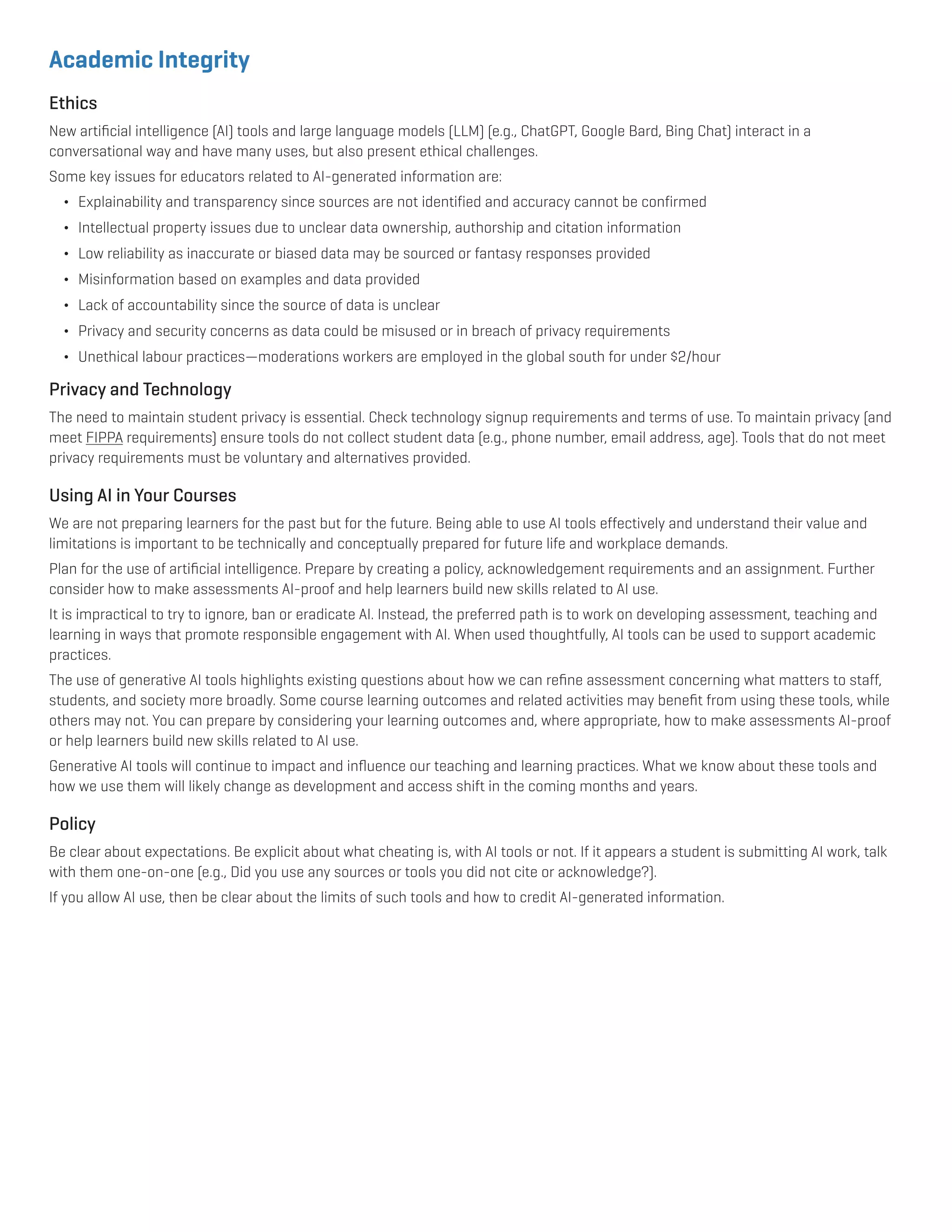
Here are some examples of what teachers can ask students to generate to improve the learning experience:
Discussion prompts Ask students to create an argument, asking the generative AI
tool to refute the idea. Students use the rebuttal to strengthen
their original argument.
Student generated
summaries
Ask students to use generative AI tools to summarize a lesson.
Request that Students share their prompts and explain why
they chose them.
Student agency Ask students to use generative AI tools to generate a list of
open-ended questions related to a specific topic. Request
that students self-organize in small groups to respond to the
questions.
Image generation Ask students to generate one image to illustrate a given topic.
Request that they critique the image.
Assessment—rethinking student assessment
Examples of Good Practice
Here are some examples of how teachers can rethink assessment of learning to focus on higher-order cognitive skills, such as
creating, evaluating and analyzing: if an assignment is easily done by an automated response system, is it worth asking students
to do it?
Generating Assignments
with AI
Ask students to use AI to generate their assignment. Request
that they submit a critical review of the assignment, critiquing
the underlying thinking.
Ask students to use AI to generate at least three assignments.
Request that students compare each one, critique and grade
them, providing a rubric.
Ask students to use AI to generate a piece or work (essay,
code). Request that they critique it and provide ideas for
optimization, indicating why the idea would improve the piece
of work.
Generating Prompts to
Create Assignments
Tell students the end result for an assignment. Ask students
to generate the prompts they would use to obtain such an
assignment.
Important! When using generative AI tools for assignment creation, be sure to have students check facts, provide references and
add acknowledgements.
Academic Integrity
Ethics
New artificial intelligence (AI) tools and large language models (LLM) (e.g., ChatGPT, Google Bard, Bing Chat) interact in a
conversational way and have many uses, but also present ethical challenges.
Some key issues for educators related to AI-generated information are:
¬ Explainability and transparency since sources are not identified and accuracy cannot be confirmed
¬ Intellectual property issues due to unclear data ownership, authorship and citation information
¬ Low reliability as inaccurate or biased data may be sourced or fantasy responses provided
¬ Misinformation based on examples and data provided
¬ Lack of accountability since the source of data is unclear
¬ Privacy and security concerns as data could be misused or in breach of privacy requirements
¬ Unethical labour practices—moderations workers are employed in the global south for under $2/hour
Privacy and Technology
The need to maintain student privacy is essential. Check technology signup requirements and terms of use. To maintain privacy (and
meet FIPPA requirements) ensure tools do not collect student data (e.g., phone number, email address, age). Tools that do not meet
privacy requirements must be voluntary and alternatives provided.
Using AI in Your Courses
We are not preparing learners for the past but for the future. Being able to use AI tools effectively and understand their value and
limitations is important to be technically and conceptually prepared for future life and workplace demands.
Plan for the use of artificial intelligence. Prepare by creating a policy, acknowledgement requirements and an assignment. Further
consider how to make assessments AI-proof and help learners build new skills related to AI use.
It is impractical to try to ignore, ban or eradicate AI. Instead, the preferred path is to work on developing assessment, teaching and
learning in ways that promote responsible engagement with AI. When used thoughtfully, AI tools can be used to support academic
practices.
The use of generative AI tools highlights existing questions about how we can refine assessment concerning what matters to staff,
students, and society more broadly. Some course learning outcomes and related activities may benefit from using these tools, while
others may not. You can prepare by considering your learning outcomes and, where appropriate, how to make assessments AI-proof
or help learners build new skills related to AI use.
Generative AI tools will continue to impact and influence our teaching and learning practices. What we know about these tools and
how we use them will likely change as development and access shift in the coming months and years.
Policy
Be clear about expectations. Be explicit about what cheating is, with AI tools or not. If it appears a student is submitting AI work, talk
with them one-on-one (e.g., Did you use any sources or tools you did not cite or acknowledge?).
If you allow AI use, then be clear about the limits of such tools and how to credit AI-generated information.
Sample course policy
Within this class, you are welcome to use generative AI tools (ChatGPT, GPT, DALL-E and others) in a totally
unrestricted fashion, for any purpose, at no penalty.
However, you should note that all large language models still have a tendency to make up incorrect facts and fake
citations and inaccurate outputs, and image-generation models can occasionally come up with highly offensive
products. You are responsible for any inaccurate, biased, offensive, or otherwise unethical content you submit
regardless of whether it originally comes from you or a foundation model.
If you use generative AI tools, you must acknowledge use. Undeclared use of the tool/technology are considered a
violation of the academic integrity policy. You must document use and the prompts used to generate the results. You
must also evaluate the output for accuracy, make the necessary corrections and add citations as required.
Having said all this, the use of generative AI tools is encouraged, as it may make it possible for you to submit
assignments with higher quality, in less time.
BCIT’s policy on plagiarism still applies to any uncited or improperly cited work by technologies or other human beings,
or submission of work by other tools or people as your own.
(Baker, 2023; SFU, 2023)
Sample citation and acknowledgement
An APA style citation might look like this:
¬ Reference page:
		 OpenAI. (2023, January 17). [ChatGPT response to a prompt about three prominent themes in BCorp businesses].
		https://chat.openai.com
¬ In text citation:
		 (ChatGPT, personal communication, February 11, 2023)
Acknowledgements might look like this:
¬ I acknowledge the use of ChatGPT for generation of three key ideas that I then researched to ensure accuracy and
		further developed.
¬ Prompts used:
			 1) What are the advantages of...
			 2) How can we improve cost effectiveness when...
			 3) What ethical challenges relate to ...
Sample assignment
Consider an assignment in which AI (e.g., ChatGPT) acts as a starting point and the student critiques and improves it. Ask learners 		
to complete an assignment using an AI tool (e.g., ChatGPT). Next steps:
¬ Critique the assignment and explain reasoning (e.g., well done because..., poor because...)
¬ Optimize the assignment (e.g., fact check, references, add content, improve writing and format)
¬ Grade the work and explain the grade
(Mollick and Mollick, 2023)
For additional ideas on using an AI tool like ChatGPT in a variety of subjects, see Trust and Maloy 2023.
Sustainability
Please note that, as with any technology, sustainability, ethical practices and use of resources are issues to be aware of. See the
resources provided for more information.
References and Resources
Generative AI Tools
Bisen, V. S. (2019, July 19). What AI techniques are used in chatbots: Explained with examples. Medium.
https://medium.com/vsinghbisen/what-ai-techniques-are-used-in-chatbots-explained-with-examples-7956ab8a74ec
Lund, B. D., & and Ting, W. (2023, February 14). Chatting about ChatGPT: How may AI and GPT impact academia and libraries?
Pre-print of a manuscript that has been accepted for publication by Library Hi Tech News. Retrieved from:
Chatting about ChatGPT: How May AI and GPT Impact Academia and Libraries? | Semantic Scholar
Montessi, C. (2023, February 1). 20 ChatGPT alternatives for your business. Invgate. Retrieved from
https://blog.invgate.com/chatgpt-alternatives
Sanchez, V.(2023, Feb 24). The origin and evolution of Chat GPT: The natural language model that is changing the game.
Retrieved from https://blog.routinehub.co/origin-and-evolution-of-chat-gpt/
Enhancing Teaching and Learning
Ferlazzo, L. (2023, January 18). 19 ways to use ChatGPT in your classroom. Education Week.
https://www.edweek.org/teaching-learning/opinion-19-ways-to-use-chatgpt-in-your-classroom/2023/01
Wiley, D. (2023, January 23). AI, Instructional Design, and OER – improving learning. Opencontent.org.
https://opencontent.org/blog/archives/7129
Herfteducator. (n.d.). A teacher’s prompt guide to ChatGPT aligned with “what works best” [Google Docs].
https://drive.google.com/file/d/15qAxnUzOwAPwHzoaKBJd8FAgiOZYcIxq/view
Academic Integrity
Baker, R. (2023). Foundation model class policy, v1.0.
https://learninganalytics.upenn.edu/ryanbaker/foundation-model-class-policy-v1.pdf CC BY-SA 3.0
Mollick, E., & Mollick, L. (2023, February 8). Why all our classes suddenly became AI classes. Harvard Business Publishing Education.
Hbsp.harvard.edu. https://hbsp.harvard.edu/inspiring-minds/why-all-our-classes-suddenly-became-ai-classes
Simon Fraser University (SFU). (2023). Syllabus statements.
www.sfu.ca. https://www.sfu.ca/students/academicintegrity/faculty/prevention/syllabus.html
Trust, T., & Maloy, R. (2023, February 24). Guide to teaching and learning critical analysis with ChatGPT. SmartBrief.
https://corp.smartbrief.com/original/2023/02/critical-analysis-with-chatgpt?utm_term=2E6F54AD-8AB5-4E94-9BA0-		
2F3DBC2ECBD3
Trust, T., & Maloy, R. (n.d.). Critical media literacy guides. Critical Media Literacy and Civic Learning. https://edtechbooks.org/			
mediaandciviclearning/cmlguides#h2_xqej.
Ethics, Principles and Responsible Use of Artificial Intelligence (AI)
OECD. (2023). The OECD artificial intelligence (AI) principles. OECD.ai. https://oecd.ai/en/ai-principles
Treasury Board of Canada. (2018, November 22). Responsible use of artificial intelligence (AI). www.canada.ca.
https://www.canada.ca/en/government/system/digital-government/digital-government-innovations/responsible-use-ai.		
html#toc1
UNESCO. (2022). Recommendation on the ethics of artificial intelligence.
Unesco.org. https://unesdoc.unesco.org/ark:/48223/pf0000381137 CC BY-NC-SA
Sustainability
Crawford, K. (2021). Atlas of AI. Yale University Press.
Nast, C. (2023, October 2). The generative AI race has a dirty secret. Wired UK.
https://www.wired.co.uk/article/the-generative-ai-search-race-has-a-dirty-secret
Perrigo, B. (2023, January 18). Exclusive: The $2 per hour workers who made ChatGPT safer. Time.
https://time.com/6247678/openai-chatgpt-kenya-workers/
This work was created by BCIT / Education Support and Innovation and is licensed under a Creative Commons Attribution 4.0
International License (CC BY 4.0).

intro_to_gen_ai_tools.pdf

  • 1.
    What are GenerativeAI Tools? ¬ Generative artificial intelligence (AI) tools use machine-learning algorithms to create “new” digital content (text, images, audio, multimedia, computer code, etc.). ¬ They are not currently capable of evaluating, critically combining or verifying information—instead, they predict and rearrange the most likely outcome based on the requested output, feedback and patterns in the data models they are trained on. ¬ Natural language processing (NLP) is the subset of generative AI tools, such as ChatGPT, that allows computers to analyze and then mimic human language. Paired with a user-friendly interface, these tools are commonly called “chatbots” and allow users of all skill levels to place requests and interact with the language models in a conversational manner. Example A chatbot for a course could answer student questions related to the course subject matter, offer definitions, summarize or identify main ideas in documents or materials, generate review questions, or identify support resources. For the model to learn, it needs to be exposed to relevant data. The chatbots learn what the best answers are and how to deal with questions that don’t fit the framework of the questions asked. Different Tools for Text and Image Generation ¬ Chatbots such as ChatGPT, ChatSonic, LaMDA, BERT, Jasper, Jasper Art, Midjourney, Stable Diffusion and Bing use NLP and are trained to understand language and respond in a meaningful way. ¬ Some apps such as ChatGPT are trained on large amounts of text data from various sources and then the model uses the prompt given, analyzes the data into components, processes the meaning of each part generated and then produces a response. This process is called “transfer training,” which involves the model being trained on new tasks and data to improve its performance and accuracy (Sanchez, 2023). ¬ The tools differ in the data models they are trained on and the way in which they were designed for the user to interact with them; for example, the original version of ChatGPT is based on data up to September 2021 and uses a conversational format, ChatSonic is powered by Google Search and utilizes voice commands, Jasper remembers conversations, LaMDA is trained on dialogue and Replika is oriented to personal use. Other AI apps are conversation-focused and may use rule-based systems that rely on predetermined responses. Additional apps are image-based and provide visual explanation such as Socratic or DALL-E 2, which can create realistic images from a given description. AN INTRODUCTION TO GENERATIVE AI TOOLS ®
  • 2.
    Examples ¬ Bard (Google):Powered by LaMDA (Language Model for Dialogue Applications); natural language input; can follow up on conversations; can generate responses to open-ended prompts ¬ Bing: Uses a conversational UI; delivers a summarized answer; provides sources to each data provided ¬ Grammarly: Suggests improvements to spelling, grammar, fluency, style and tone ¬ ChatSonic: Conversational AI tool provides updates and factual information aided by Google’s information network; accesses the internet to generate accurate data on current events and remembers conversations; has a built-in image generator ¬ Jasper: AI writing tools for companies that want to generate high-quality content, templates for blogs and social media; great for short sentences and ad copy ¬ Replika: AI chatbot or companionship; can hold meaningful conversations; has video call options and avatars Enhancing Teaching and Learning Generative AI tools can be used to support the work of teachers, transform students’ learning experiences and create innovations in learning assessment. Here are some ideas of how these tools can be integrated in teaching and learning, aligned with good teaching practice. Teaching Practice—supporting the work of teachers Examples of Good Practice Here are some examples of what teachers can generate to support their teaching practice. Although the output may not be 100% correct, it can be a starting point that will save time. Course Schedules Prompt learning outcomes, delivery mode, course duration Ask to produce a weekly course schedule Lesson Plans Prompt learning outcomes, main student characteristics, preferred pedagogical strategies, lesson duration Ask to produce a lesson plan Lesson Summaries Prompt learning outcomes, lesson main themes, lecture notes Ask to produce a summary highlighting key topics Learning Outcomes Prompt lesson topic, duration and level of lesson (introductory, advanced) Ask what learning outcomes should be covered Feedback & Guidance Prompt the subject or the task students need to improve on Ask for generation of specific steps/action students can do to improve Quiz Questions Prompt learning outcomes Ask to generate different types of closed questions, such as multiple choice and true/false Images Prompt key aspects of what needs to be illustrated, using a detailed description Ask for the creation of the image
  • 3.
    Learning and Teaching—enhancinglearning experiences Examples of Good Practice Here are some examples of what teachers can ask students to generate to improve the learning experience: Discussion prompts Ask students to create an argument, asking the generative AI tool to refute the idea. Students use the rebuttal to strengthen their original argument. Student generated summaries Ask students to use generative AI tools to summarize a lesson. Request that Students share their prompts and explain why they chose them. Student agency Ask students to use generative AI tools to generate a list of open-ended questions related to a specific topic. Request that students self-organize in small groups to respond to the questions. Image generation Ask students to generate one image to illustrate a given topic. Request that they critique the image. Assessment—rethinking student assessment Examples of Good Practice Here are some examples of how teachers can rethink assessment of learning to focus on higher-order cognitive skills, such as creating, evaluating and analyzing: if an assignment is easily done by an automated response system, is it worth asking students to do it? Generating Assignments with AI Ask students to use AI to generate their assignment. Request that they submit a critical review of the assignment, critiquing the underlying thinking. Ask students to use AI to generate at least three assignments. Request that students compare each one, critique and grade them, providing a rubric. Ask students to use AI to generate a piece or work (essay, code). Request that they critique it and provide ideas for optimization, indicating why the idea would improve the piece of work. Generating Prompts to Create Assignments Tell students the end result for an assignment. Ask students to generate the prompts they would use to obtain such an assignment. Important! When using generative AI tools for assignment creation, be sure to have students check facts, provide references and add acknowledgements.
  • 4.
    Academic Integrity Ethics New artificialintelligence (AI) tools and large language models (LLM) (e.g., ChatGPT, Google Bard, Bing Chat) interact in a conversational way and have many uses, but also present ethical challenges. Some key issues for educators related to AI-generated information are: ¬ Explainability and transparency since sources are not identified and accuracy cannot be confirmed ¬ Intellectual property issues due to unclear data ownership, authorship and citation information ¬ Low reliability as inaccurate or biased data may be sourced or fantasy responses provided ¬ Misinformation based on examples and data provided ¬ Lack of accountability since the source of data is unclear ¬ Privacy and security concerns as data could be misused or in breach of privacy requirements ¬ Unethical labour practices—moderations workers are employed in the global south for under $2/hour Privacy and Technology The need to maintain student privacy is essential. Check technology signup requirements and terms of use. To maintain privacy (and meet FIPPA requirements) ensure tools do not collect student data (e.g., phone number, email address, age). Tools that do not meet privacy requirements must be voluntary and alternatives provided. Using AI in Your Courses We are not preparing learners for the past but for the future. Being able to use AI tools effectively and understand their value and limitations is important to be technically and conceptually prepared for future life and workplace demands. Plan for the use of artificial intelligence. Prepare by creating a policy, acknowledgement requirements and an assignment. Further consider how to make assessments AI-proof and help learners build new skills related to AI use. It is impractical to try to ignore, ban or eradicate AI. Instead, the preferred path is to work on developing assessment, teaching and learning in ways that promote responsible engagement with AI. When used thoughtfully, AI tools can be used to support academic practices. The use of generative AI tools highlights existing questions about how we can refine assessment concerning what matters to staff, students, and society more broadly. Some course learning outcomes and related activities may benefit from using these tools, while others may not. You can prepare by considering your learning outcomes and, where appropriate, how to make assessments AI-proof or help learners build new skills related to AI use. Generative AI tools will continue to impact and influence our teaching and learning practices. What we know about these tools and how we use them will likely change as development and access shift in the coming months and years. Policy Be clear about expectations. Be explicit about what cheating is, with AI tools or not. If it appears a student is submitting AI work, talk with them one-on-one (e.g., Did you use any sources or tools you did not cite or acknowledge?). If you allow AI use, then be clear about the limits of such tools and how to credit AI-generated information.
  • 5.
    Sample course policy Withinthis class, you are welcome to use generative AI tools (ChatGPT, GPT, DALL-E and others) in a totally unrestricted fashion, for any purpose, at no penalty. However, you should note that all large language models still have a tendency to make up incorrect facts and fake citations and inaccurate outputs, and image-generation models can occasionally come up with highly offensive products. You are responsible for any inaccurate, biased, offensive, or otherwise unethical content you submit regardless of whether it originally comes from you or a foundation model. If you use generative AI tools, you must acknowledge use. Undeclared use of the tool/technology are considered a violation of the academic integrity policy. You must document use and the prompts used to generate the results. You must also evaluate the output for accuracy, make the necessary corrections and add citations as required. Having said all this, the use of generative AI tools is encouraged, as it may make it possible for you to submit assignments with higher quality, in less time. BCIT’s policy on plagiarism still applies to any uncited or improperly cited work by technologies or other human beings, or submission of work by other tools or people as your own. (Baker, 2023; SFU, 2023) Sample citation and acknowledgement An APA style citation might look like this: ¬ Reference page: OpenAI. (2023, January 17). [ChatGPT response to a prompt about three prominent themes in BCorp businesses]. https://chat.openai.com ¬ In text citation: (ChatGPT, personal communication, February 11, 2023) Acknowledgements might look like this: ¬ I acknowledge the use of ChatGPT for generation of three key ideas that I then researched to ensure accuracy and further developed. ¬ Prompts used: 1) What are the advantages of... 2) How can we improve cost effectiveness when... 3) What ethical challenges relate to ... Sample assignment Consider an assignment in which AI (e.g., ChatGPT) acts as a starting point and the student critiques and improves it. Ask learners to complete an assignment using an AI tool (e.g., ChatGPT). Next steps: ¬ Critique the assignment and explain reasoning (e.g., well done because..., poor because...) ¬ Optimize the assignment (e.g., fact check, references, add content, improve writing and format) ¬ Grade the work and explain the grade (Mollick and Mollick, 2023) For additional ideas on using an AI tool like ChatGPT in a variety of subjects, see Trust and Maloy 2023. Sustainability Please note that, as with any technology, sustainability, ethical practices and use of resources are issues to be aware of. See the resources provided for more information.
  • 6.
    References and Resources GenerativeAI Tools Bisen, V. S. (2019, July 19). What AI techniques are used in chatbots: Explained with examples. Medium. https://medium.com/vsinghbisen/what-ai-techniques-are-used-in-chatbots-explained-with-examples-7956ab8a74ec Lund, B. D., & and Ting, W. (2023, February 14). Chatting about ChatGPT: How may AI and GPT impact academia and libraries? Pre-print of a manuscript that has been accepted for publication by Library Hi Tech News. Retrieved from: Chatting about ChatGPT: How May AI and GPT Impact Academia and Libraries? | Semantic Scholar Montessi, C. (2023, February 1). 20 ChatGPT alternatives for your business. Invgate. Retrieved from https://blog.invgate.com/chatgpt-alternatives Sanchez, V.(2023, Feb 24). The origin and evolution of Chat GPT: The natural language model that is changing the game. Retrieved from https://blog.routinehub.co/origin-and-evolution-of-chat-gpt/ Enhancing Teaching and Learning Ferlazzo, L. (2023, January 18). 19 ways to use ChatGPT in your classroom. Education Week. https://www.edweek.org/teaching-learning/opinion-19-ways-to-use-chatgpt-in-your-classroom/2023/01 Wiley, D. (2023, January 23). AI, Instructional Design, and OER – improving learning. Opencontent.org. https://opencontent.org/blog/archives/7129 Herfteducator. (n.d.). A teacher’s prompt guide to ChatGPT aligned with “what works best” [Google Docs]. https://drive.google.com/file/d/15qAxnUzOwAPwHzoaKBJd8FAgiOZYcIxq/view Academic Integrity Baker, R. (2023). Foundation model class policy, v1.0. https://learninganalytics.upenn.edu/ryanbaker/foundation-model-class-policy-v1.pdf CC BY-SA 3.0 Mollick, E., & Mollick, L. (2023, February 8). Why all our classes suddenly became AI classes. Harvard Business Publishing Education. Hbsp.harvard.edu. https://hbsp.harvard.edu/inspiring-minds/why-all-our-classes-suddenly-became-ai-classes Simon Fraser University (SFU). (2023). Syllabus statements. www.sfu.ca. https://www.sfu.ca/students/academicintegrity/faculty/prevention/syllabus.html Trust, T., & Maloy, R. (2023, February 24). Guide to teaching and learning critical analysis with ChatGPT. SmartBrief. https://corp.smartbrief.com/original/2023/02/critical-analysis-with-chatgpt?utm_term=2E6F54AD-8AB5-4E94-9BA0- 2F3DBC2ECBD3 Trust, T., & Maloy, R. (n.d.). Critical media literacy guides. Critical Media Literacy and Civic Learning. https://edtechbooks.org/ mediaandciviclearning/cmlguides#h2_xqej. Ethics, Principles and Responsible Use of Artificial Intelligence (AI) OECD. (2023). The OECD artificial intelligence (AI) principles. OECD.ai. https://oecd.ai/en/ai-principles Treasury Board of Canada. (2018, November 22). Responsible use of artificial intelligence (AI). www.canada.ca. https://www.canada.ca/en/government/system/digital-government/digital-government-innovations/responsible-use-ai. html#toc1 UNESCO. (2022). Recommendation on the ethics of artificial intelligence. Unesco.org. https://unesdoc.unesco.org/ark:/48223/pf0000381137 CC BY-NC-SA Sustainability Crawford, K. (2021). Atlas of AI. Yale University Press. Nast, C. (2023, October 2). The generative AI race has a dirty secret. Wired UK. https://www.wired.co.uk/article/the-generative-ai-search-race-has-a-dirty-secret Perrigo, B. (2023, January 18). Exclusive: The $2 per hour workers who made ChatGPT safer. Time. https://time.com/6247678/openai-chatgpt-kenya-workers/ This work was created by BCIT / Education Support and Innovation and is licensed under a Creative Commons Attribution 4.0 International License (CC BY 4.0).