Improve Customer Loyalty and Reduce Churn
Mekko Graphics Solutions
Improve Customer Loyalty and Reduce
Churn
Research has repeatedly shown that existing customers spend more,
purchase higher margin products and services, and are more likely to
refer additional customers.1
So, how do you avoid the high price of constantly replacing existing
customers with new ones? Knowing the reasons why your customers
are leaving you or spending less with you can help you to respond to
issues and retain more customers.
Using Mekko Graphics you can examine revenue churn and determine
the cause for controllable churn. Here is how…
1. Gartner, 2004: “Replace Customer Churn Predictions With Retention Analysis”
Improve Customer Loyalty and Reduce
Churn
Begin with Analysis
Draw Conclusions
Identify Areas for Improvement
Customer Churn
Revenue Churn Analysis (2009-10)
-200
-100
0
100
200
$300MM
New Customers
Increasers
Decreasers
Lost Customers
$255MM
-$127MM
2009-10RevenueChange($MM)
0
200
400
600
800
$1,000MM
2009
$853MM
2010
$981MM
TotalRevenue($MM)
15%
Growth
Total Company Revenue (2009-10)
2009-10 Revenue Churn
Churn = 15%
Net = $128MM
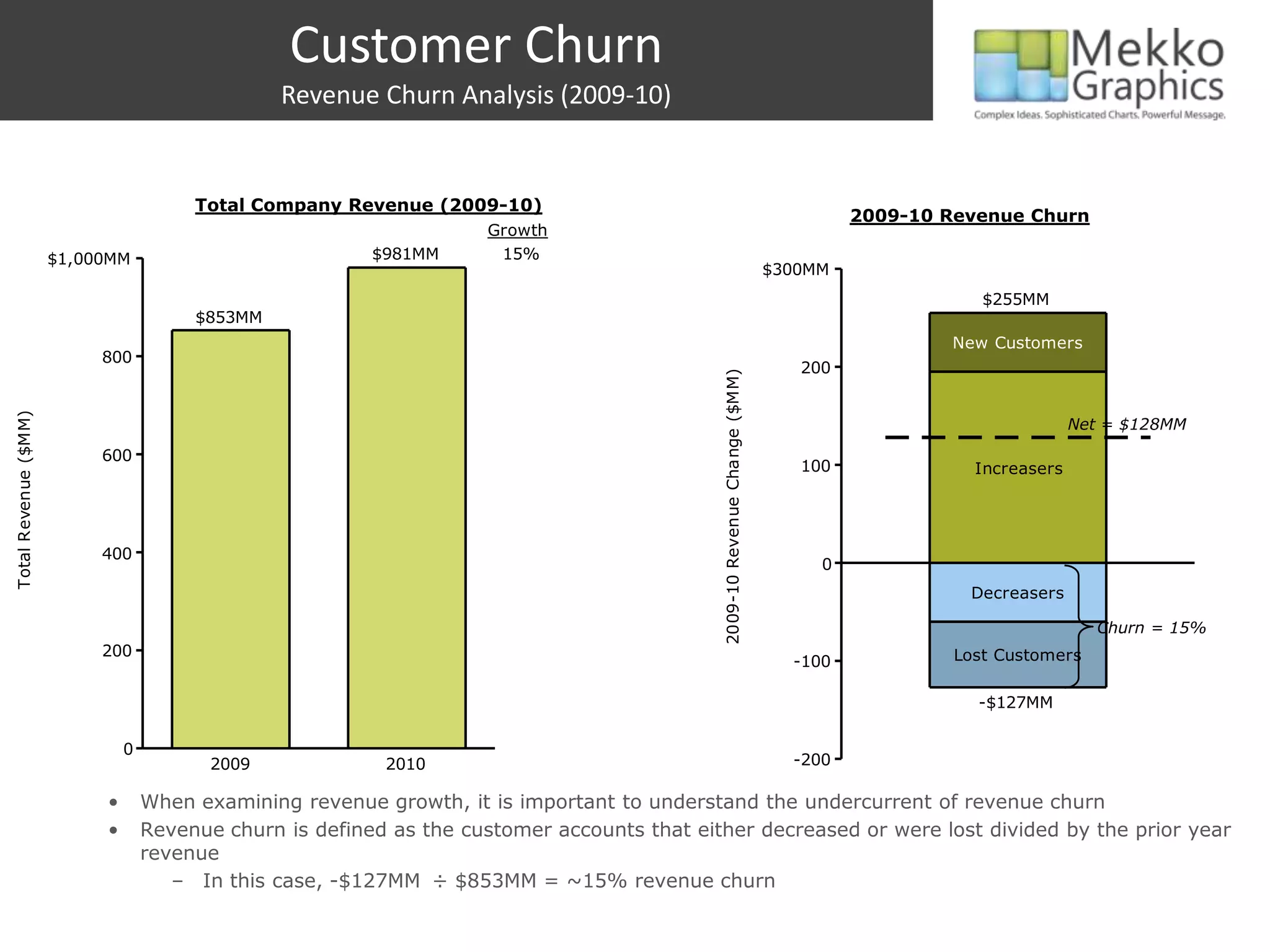
• When examining revenue growth, it is important to understand the undercurrent of revenue churn
• Revenue churn is defined as the customer accounts that either decreased or were lost divided by the prior year
revenue
– In this case, -$127MM ÷ $853MM = ~15% revenue churn
Customer Churn
Controllable vs. Uncontrollable Behavior Drivers
0
20
40
60
80
100%
Behavior Drivers
Uncontrollable
Controllable
PercentofTotalChurn
-200
-100
0
100
200
$300MM
New Customers
Increasers
Decreasers
Lost Customers
$255MM
-$127MM
2009-10RevenueChange($MM)
Controllable vs. Uncontrollable Churn2009-10 Revenue Churn
Net =
$128MM
Total Churn = 15%
“True”
Controllable
Churn = 11%
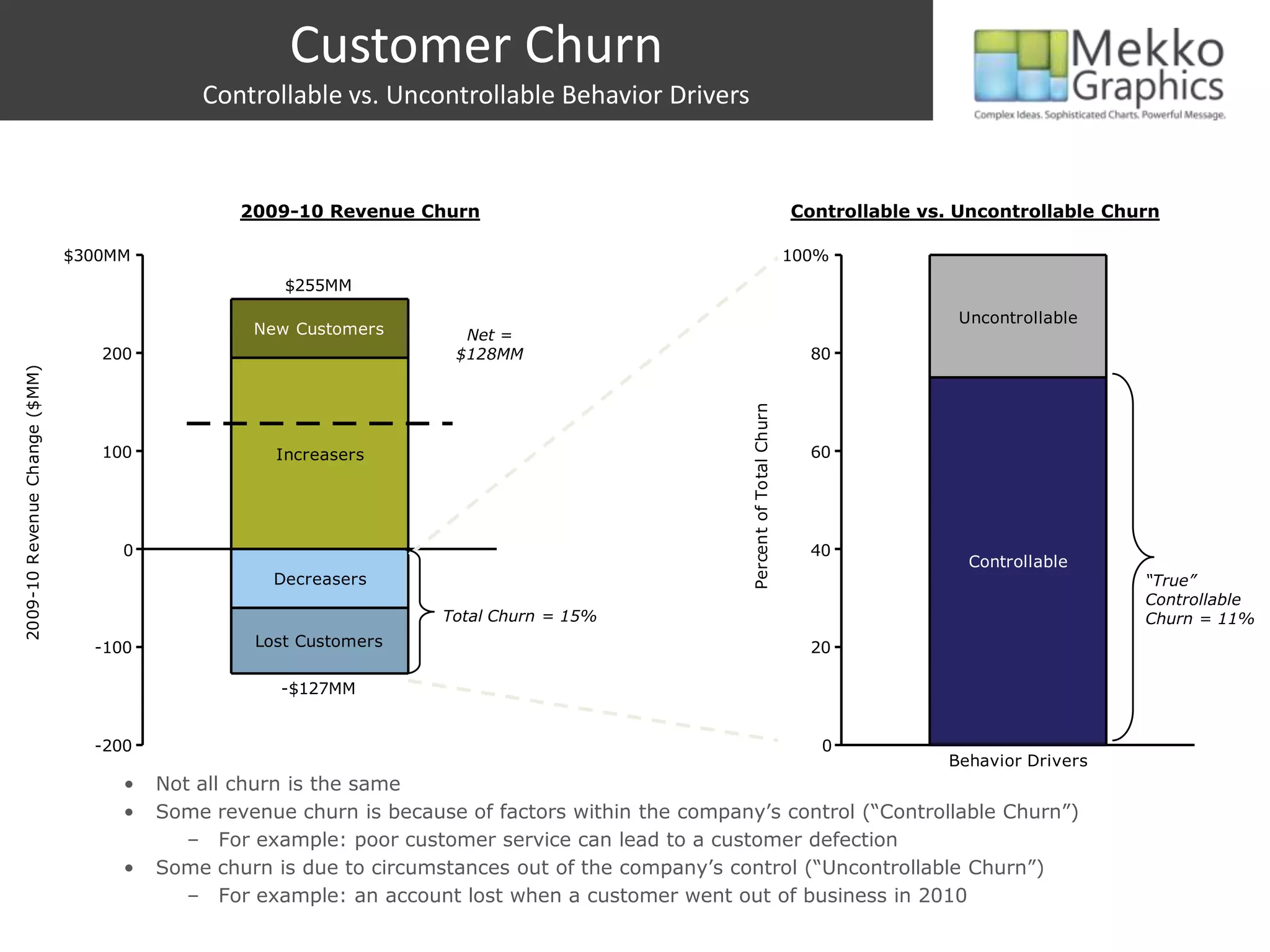
• Not all churn is the same
• Some revenue churn is because of factors within the company’s control (“Controllable Churn”)
– For example: poor customer service can lead to a customer defection
• Some churn is due to circumstances out of the company’s control (“Uncontrollable Churn”)
– For example: an account lost when a customer went out of business in 2010
Customer Behavior Drivers
Behavior Driver Detail
0
20
40
60
80
100%
Controllable Reasons
Delivery
Sales
Price
Product Issues
Customer Service
Uncontrollable Reasons
Other
Customer's Business
Conditions
Customer's Ordering
Habits
PercentofTotalChurn
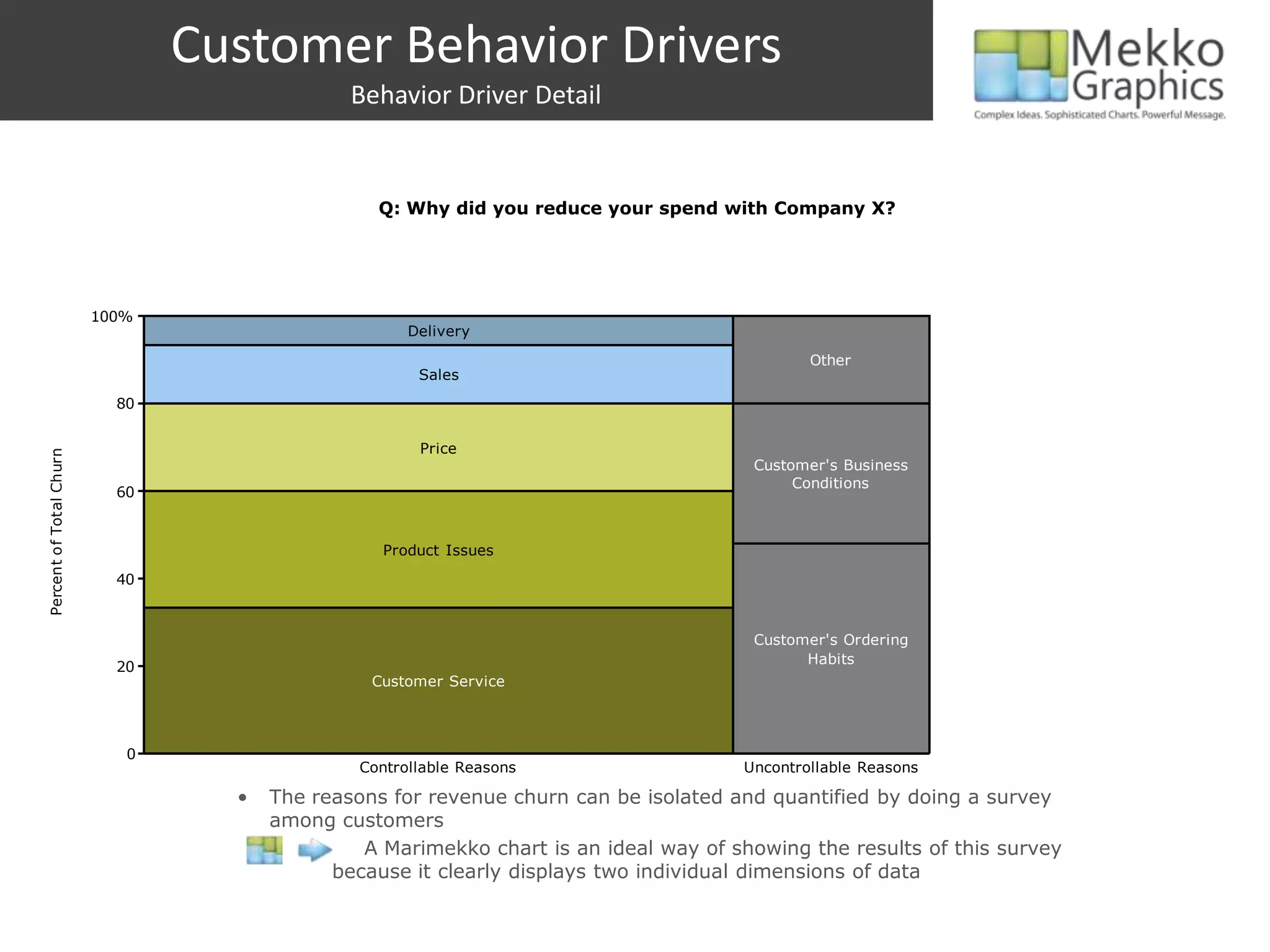
Q: Why did you reduce your spend with Company X?
• The reasons for revenue churn can be isolated and quantified by doing a survey
among customers
– A Marimekko chart is an ideal way of showing the results of this survey
because it clearly displays two individual dimensions of data
Improve Customer Loyalty and Reduce
Churn
Begin with Analysis
Draw Conclusions
Identify Areas for Improvement
What does it mean?
Using Mekko Graphics to drill down into
their data, this business was able to get to
the root of its customer churn. In this
case, the marimekko chart in the previous
slide illustrates the following:
• 75% of revenue churn was due to
controllable causes
• Of that, 60% was due to customer
service or product issues
Supported by this data this business would
be wise to investigate ways they might
improve both their product and processes
to provide better customer service and a
more fulfilling product experience.
Using this type of analysis
you can zero in on the causes
of controllable churn in your
business.
Improve Customer Loyalty and Reduce
Churn
Begin with Analysis
Draw Conclusions
Identify Areas for Improvement
So Now What?
Ask the right questions:
In this example a reasonable search for
improvement areas could begin with
questions such as:
• Are employees properly trained to
address customer issues?
• How could feedback from customers
be collected earlier in the cycle so
that issues could be resolved and
defection prevented?
• Do employees have the necessary
skills to produce the best possible
products and services?
• Is emphasis placed on ensuring a
positive off the shelf experience with
the product?
Asking the right questions
based on your analysis can
help you identify key areas
for improvement to increase
customer loyalty and reduce
controllable churn.

Reduce Churn and Improve Customer Loyalty

  • 1.
    Improve Customer Loyaltyand Reduce Churn Mekko Graphics Solutions
  • 2.
    Improve Customer Loyaltyand Reduce Churn Research has repeatedly shown that existing customers spend more, purchase higher margin products and services, and are more likely to refer additional customers.1 So, how do you avoid the high price of constantly replacing existing customers with new ones? Knowing the reasons why your customers are leaving you or spending less with you can help you to respond to issues and retain more customers. Using Mekko Graphics you can examine revenue churn and determine the cause for controllable churn. Here is how… 1. Gartner, 2004: “Replace Customer Churn Predictions With Retention Analysis”
  • 3.
    Improve Customer Loyaltyand Reduce Churn Begin with Analysis Draw Conclusions Identify Areas for Improvement
  • 4.
    Customer Churn Revenue ChurnAnalysis (2009-10) -200 -100 0 100 200 $300MM New Customers Increasers Decreasers Lost Customers $255MM -$127MM 2009-10RevenueChange($MM) 0 200 400 600 800 $1,000MM 2009 $853MM 2010 $981MM TotalRevenue($MM) 15% Growth Total Company Revenue (2009-10) 2009-10 Revenue Churn Churn = 15% Net = $128MM • When examining revenue growth, it is important to understand the undercurrent of revenue churn • Revenue churn is defined as the customer accounts that either decreased or were lost divided by the prior year revenue – In this case, -$127MM ÷ $853MM = ~15% revenue churn
  • 5.
    Customer Churn Controllable vs.Uncontrollable Behavior Drivers 0 20 40 60 80 100% Behavior Drivers Uncontrollable Controllable PercentofTotalChurn -200 -100 0 100 200 $300MM New Customers Increasers Decreasers Lost Customers $255MM -$127MM 2009-10RevenueChange($MM) Controllable vs. Uncontrollable Churn2009-10 Revenue Churn Net = $128MM Total Churn = 15% “True” Controllable Churn = 11% • Not all churn is the same • Some revenue churn is because of factors within the company’s control (“Controllable Churn”) – For example: poor customer service can lead to a customer defection • Some churn is due to circumstances out of the company’s control (“Uncontrollable Churn”) – For example: an account lost when a customer went out of business in 2010
  • 6.
    Customer Behavior Drivers BehaviorDriver Detail 0 20 40 60 80 100% Controllable Reasons Delivery Sales Price Product Issues Customer Service Uncontrollable Reasons Other Customer's Business Conditions Customer's Ordering Habits PercentofTotalChurn Q: Why did you reduce your spend with Company X? • The reasons for revenue churn can be isolated and quantified by doing a survey among customers – A Marimekko chart is an ideal way of showing the results of this survey because it clearly displays two individual dimensions of data
  • 7.
    Improve Customer Loyaltyand Reduce Churn Begin with Analysis Draw Conclusions Identify Areas for Improvement
  • 8.
    What does itmean? Using Mekko Graphics to drill down into their data, this business was able to get to the root of its customer churn. In this case, the marimekko chart in the previous slide illustrates the following: • 75% of revenue churn was due to controllable causes • Of that, 60% was due to customer service or product issues Supported by this data this business would be wise to investigate ways they might improve both their product and processes to provide better customer service and a more fulfilling product experience. Using this type of analysis you can zero in on the causes of controllable churn in your business.
  • 9.
    Improve Customer Loyaltyand Reduce Churn Begin with Analysis Draw Conclusions Identify Areas for Improvement
  • 10.
    So Now What? Askthe right questions: In this example a reasonable search for improvement areas could begin with questions such as: • Are employees properly trained to address customer issues? • How could feedback from customers be collected earlier in the cycle so that issues could be resolved and defection prevented? • Do employees have the necessary skills to produce the best possible products and services? • Is emphasis placed on ensuring a positive off the shelf experience with the product? Asking the right questions based on your analysis can help you identify key areas for improvement to increase customer loyalty and reduce controllable churn.