

Outline  Introduction Content of last Seminar Block Diagram of stand-alone PV System Solar Home Lighting System in Electrical Engg. Dept. of VNIT Campus Digital Solar Radiation Pyranometer in VNIT Energy Analysis  of the Solar Home Lighting System using Solar Radiation Data of Nagpur on December 18 and 19,2010. Optimum Design of Solar Home Lighting System using Yearly Average PSH(Peak Solar Hours) of Nagpur Results of Optimum Design of Solar Home Lighting System Improved Results on Tilted Solar Panel Publications References
AIMS AND OBJECTIVES To do the deep energy analysis of the Solar Home Lighting System considering the Solar Radiation pattern of Nagpur on December 18 and 19,2010 To verify the Specifications of the Solar Home Lighting System for Battery Size and Solar Panel Size To verify the Simulated Output using hardware design  Future work is aimed at design of a MPP Battery Charger for the Solar Home Lighting System for accelerated charging of the battery
Motivation Emerging Renewable energy Technology. Jawaharlal Nehru National Solar mission of MNRE. Keeping in view power losses in India everyone is keen to adopt it. Immediate return and cost saving Technology.
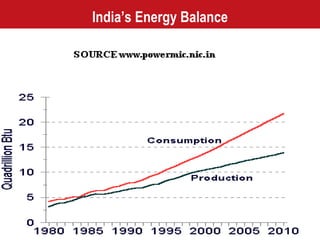
India’s Energy Balance
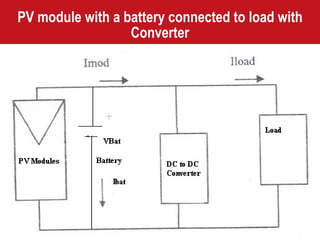
PV module with a battery connected to load with Converter
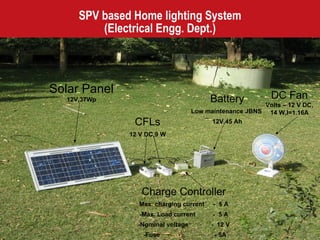
SPV based Home lighting System (Electrical Engg. Dept.) Solar Panel 12V,37Wp CFLs 12 V DC,9 W Charge Controller Max. charging current  -  5 A -Max. Load current  -  5 A -Nominal voltage  -  12 V -Fuse  - 5A Battery Low maintenance JBNS  12V,45 Ah DC Fan Volts – 12 V DC, 14 W,I=1.16A
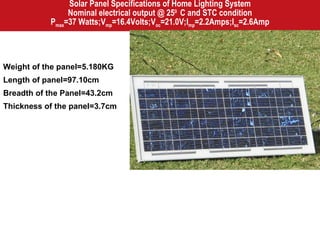
Solar Panel Specifications of Home Lighting System Nominal electrical output @ 25 0  C and STC condition P max =37 Watts;V mp =16.4Volts;V oc =21.0V;I mp =2.2Amps;I sc =2.6Amp Weight of the panel=5.180KG Length of panel=97.10cm Breadth of the Panel=43.2cm Thickness of the panel=3.7cm
DIGITAL PYRANOMETER AT ELECTRICAL DEPARTMENT, VNIT IT IS A MICROCONTROLLER BASED DIGITAL SOLAR RADIATION RECORDER. IT WILL COLLECT ALL REAL TIME DATA AUTOMATICALLY . OPERATOR IS NOT SUPPOSED TO STAND IN SUN LIGHT FOR MEASURING  SOLAR RADIATIONS.
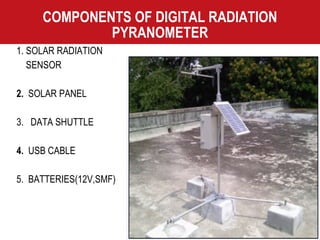
COMPONENTS OF DIGITAL RADIATION PYRANOMETER 1. SOLAR RADIATION  SENSOR 2.  SOLAR PANEL 3.  DATA SHUTTLE 4.  USB CABLE 5.  BATTERIES(12V,SMF)
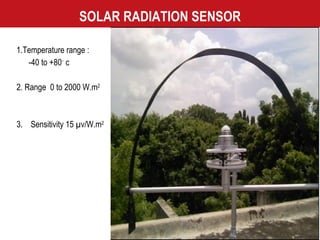
SOLAR RADIATION SENSOR 1.Temperature range :  -40 to +80 ◦  c 2. Range  0 to 2000 W.m 2 3.  Sensitivity 15 µv/W.m 2
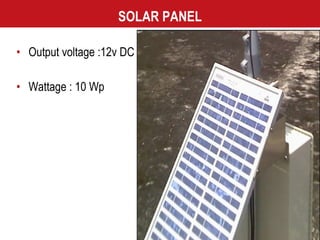
SOLAR PANEL Output voltage :12v DC Wattage : 10 Wp
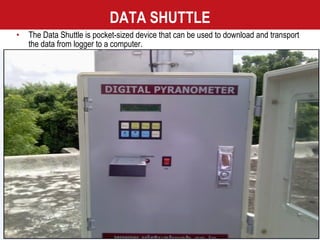
DATA SHUTTLE The Data Shuttle is pocket-sized device that can be used to download and transport the data from logger to a computer.
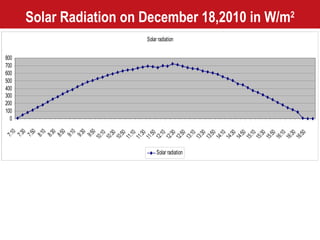
Solar Radiation on December 18,2010 in W/m 2
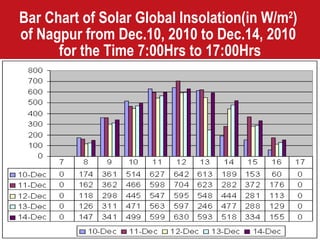
Bar Chart of Solar Global Insolation(in W/m 2 )  of Nagpur from Dec.10, 2010 to Dec.14, 2010  for the Time 7:00Hrs to 17:00Hrs
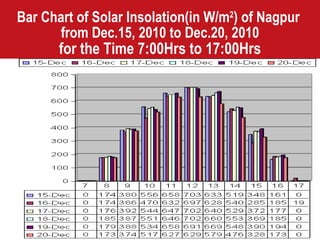
Bar Chart of Solar Insolation(in W/m 2 ) of Nagpur  from Dec.15, 2010 to Dec.20, 2010   for the Time 7:00Hrs to 17:00Hrs
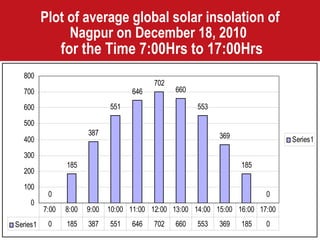
Plot of average global solar insolation of  Nagpur on December 18, 2010    for the Time 7:00Hrs to 17:00Hrs
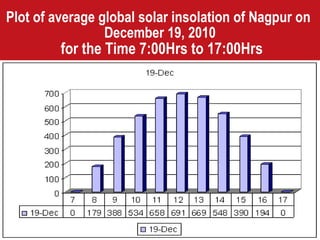
Plot of average global solar insolation of Nagpur on  December 19, 2010   for the Time 7:00Hrs to 17:00Hrs
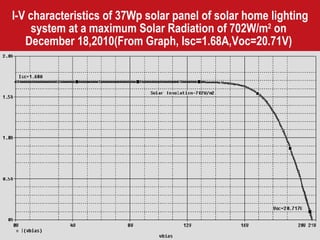
I-V characteristics of 37Wp solar panel of solar home lighting system at a maximum Solar Radiation of 702W/m 2  on  December 18,2010(From Graph, Isc=1.68A,Voc=20.71V)
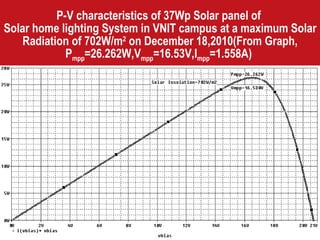
P-V characteristics of 37Wp Solar panel of  Solar home lighting System in VNIT campus at a maximum Solar Radiation of 702W/m 2  on December 18,2010(From Graph, P mpp =26.262W,V mpp =16.53V,I mpp =1.558A)
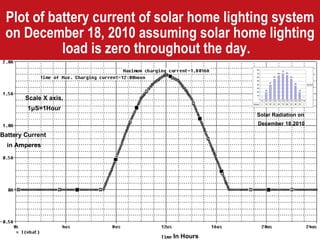
Plot of battery current of solar home lighting system on December 18, 2010 assuming solar home lighting load is zero throughout the day.   Solar Radiation on  December 18,2010 Scale X axis, 1 μ S=1Hour In Hours Battery Current  in Amperes
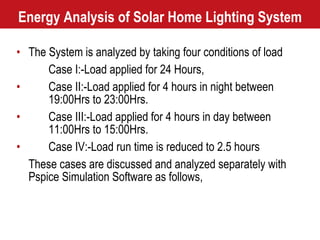
Energy Analysis of Solar Home Lighting System The System is analyzed by taking four conditions of load Case I:-Load applied for 24 Hours, Case II:-Load applied for 4 hours in night between  19:00Hrs to 23:00Hrs. Case III:-Load applied for 4 hours in day between  11:00Hrs to 15:00Hrs. Case IV:-Load run time is reduced to 2.5 hours These cases are discussed and analyzed separately with Pspice Simulation Software as follows,
Energy Analysis of Solar Home Lighting System CASE I Load applied for 24 Hours
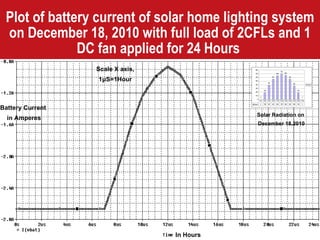
Plot of battery current of solar home lighting system on December 18, 2010 with full load of 2CFLs and 1 DC fan applied for 24 Hours  Solar Radiation on  December 18,2010 Scale X axis, 1 μ S=1Hour In Hours Battery Current  in Amperes
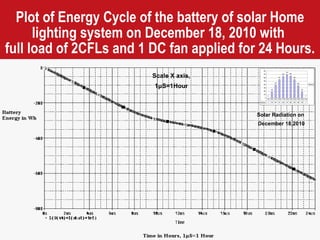
Plot of Energy Cycle of the battery of solar Home lighting system on December 18, 2010 with  full load of 2CFLs and 1 DC fan applied for 24 Hours. Solar Radiation on  December 18,2010 Scale X axis, 1 μ S=1Hour
CASE II LOAD APPLIED FOR 4 HOURS IN NIGHT BETWEEN 19:00HRS TO 23:00HRS
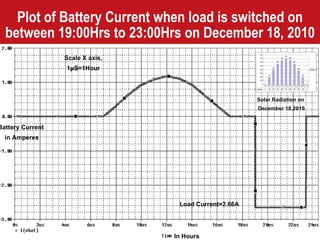
Plot of Battery Current when load is switched on between 19:00Hrs to 23:00Hrs on December 18, 2010 Load Current=2.66A Solar Radiation on  December 18,2010 Scale X axis, 1 μ S=1Hour In Hours Battery Current  in Amperes
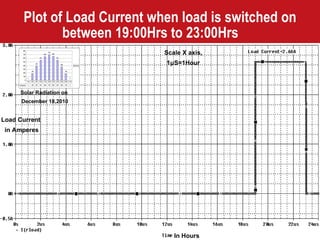
Plot of Load Current when load is switched on between 19:00Hrs to 23:00Hrs   Solar Radiation on  December 18,2010 Scale X axis, 1 μ S=1Hour In Hours Load Current  in Amperes
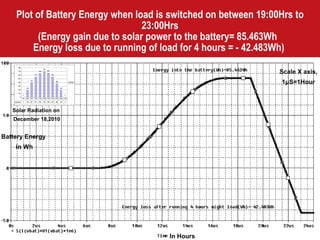
Plot of Battery Energy when load is switched on between 19:00Hrs to 23:00Hrs (Energy gain due to solar power to the battery= 85.463Wh  Energy loss due to running of load for 4 hours = - 42.483Wh)  Solar Radiation on  December 18,2010 Scale X axis, 1 μ S=1Hour In Hours Battery Energy  in Wh
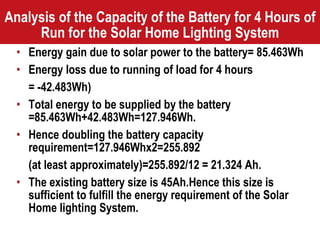
Analysis of the Capacity of the Battery for 4 Hours of Run for the Solar Home Lighting System Energy gain due to solar power to the battery= 85.463Wh Energy loss due to running of load for 4 hours  = -42.483Wh) Total energy to be supplied by the battery =85.463Wh+42.483Wh=127.946Wh. Hence doubling the battery capacity requirement=127.946Whx2=255.892 (at least approximately)=255.892/12 = 21.324 Ah. The existing battery size is 45Ah.Hence this size is sufficient to fulfill the energy requirement of the Solar Home lighting System.
ENERGY ANALYSIS OF SOLAR HOME LIGHTING SYSTEM CASE III LOAD APPLIED FOR 4 HOURS IN DAY BETWEEN 11:00HRS TO 15:00HRS
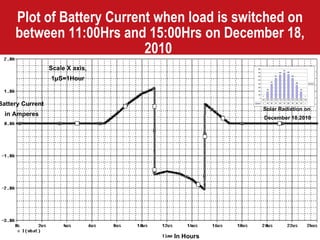
Plot of Battery Current when load is switched on between 11:00Hrs and 15:00Hrs on December 18, 2010  Solar Radiation on  December 18,2010 Scale X axis, 1 μ S=1Hour In Hours Battery Current  in Amperes
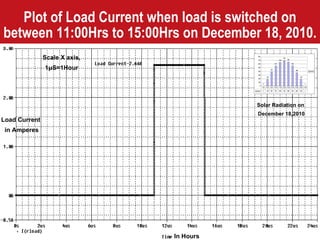
Plot of Load Current when load is switched on between 11:00Hrs to 15:00Hrs on December 18, 2010. Solar Radiation on  December 18,2010 Scale X axis, 1 μ S=1Hour In Hours Load Current  in Amperes
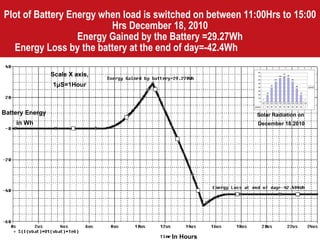
Plot of Battery Energy when load is switched on between 11:00Hrs to 15:00 Hrs December 18, 2010 Energy Gained by the Battery =29.27Wh Energy Loss by the battery at the end of day=-42.4Wh      Solar Radiation on  December 18,2010 Scale X axis, 1 μ S=1Hour In Hours Battery Energy  in Wh
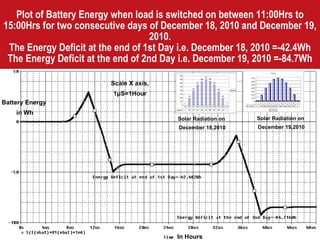
Plot of Battery Energy when load is switched on between 11:00Hrs to 15:00Hrs for two consecutive days of December 18, 2010 and December 19, 2010. The Energy Deficit at the end of 1st Day i.e. December 18, 2010 =-42.4Wh The Energy Deficit at the end of 2nd Day i.e. December 19, 2010 =-84.7Wh Solar Radiation on  December 18,2010 Solar Radiation on  December 19,2010 Scale X axis, 1 μ S=1Hour In Hours Battery Energy  in Wh
Energy Analysis of Solar Home Lighting System CASE IV LOAD RUN TIME IS REDUCED TO 2 and 1/2 HOURS IN DAY BETWEEN 11:00HRS TO 13:30HRS
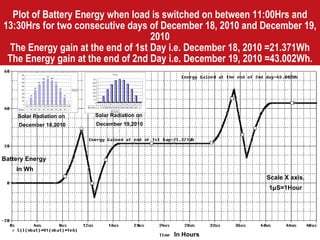
Plot of Battery Energy when load is switched on between 11:00Hrs and 13:30Hrs for two consecutive days of December 18, 2010 and December 19, 2010 The Energy gain at the end of 1st Day i.e. December 18, 2010 =21.371Wh The Energy gain at the end of 2nd Day i.e. December 19, 2010 =43.002Wh. Solar Radiation on  December 18,2010 Solar Radiation on  December 19,2010 Scale X axis, 1 μ S=1Hour In Hours Battery Energy  in Wh
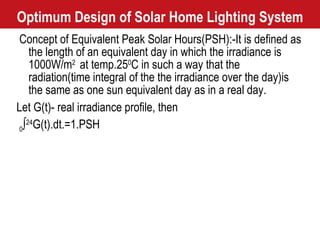
Optimum Design of Solar Home Lighting System Concept of Equivalent Peak Solar Hours(PSH):-It is defined as the length of an equivalent day in which the irradiance is 1000W/m 2  at temp.25 0 C in such a way that the radiation(time integral of the the irradiance over the day)is the same as one sun equivalent day as in a real day. Let G(t)- real irradiance profile, then  0 ∫ 24 G(t).dt.=1.PSH
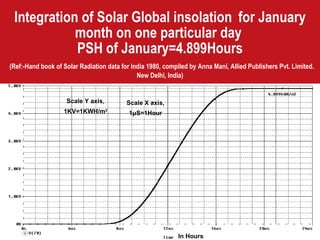
Integration of Solar Global insolation  for January month on one particular day  PSH of January=4.899Hours   (Ref:-Hand book of Solar Radiation data for India 1980, compiled by Anna Mani, Allied Publishers Pvt. Limited. New Delhi, India) In Hours Scale X axis, 1 μ S=1Hour Scale Y axis, 1KV =1KWH/m 2
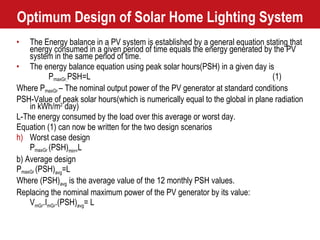
Optimum Design of Solar Home Lighting System The Energy balance in a PV system is established by a general equation stating that energy consumed in a given period of time equals the energy generated by the PV system in the same period of time. The energy balance equation using peak solar hours(PSH) in a given day is P maxGr . PSH=L (1) Where P maxGr  – The nominal output power of the PV generator at standard conditions PSH-Value of peak solar hours(which is numerically equal to the global in plane radiation in kWh/m 2  day) L-The energy consumed by the load over this average or worst day. Equation (1) can now be written for the two design scenarios Worst case design P maxGr  (PSH) min= L b) Average design P maxGr  (PSH) avg =L Where (PSH) avg  is the average value of the 12 monthly PSH values. Replacing the nominal maximum power of the PV generator by its value: V mGr .I mGr .(PSH) avg = L
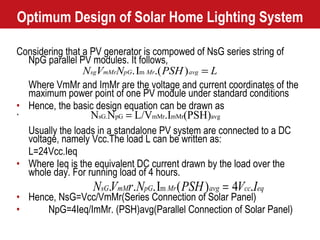
Optimum Design of Solar Home Lighting System Considering that a PV generator is compowed of NsG series string of NpG parallel PV modules. It follows, Where VmMr and ImMr are the voltage and current coordinates of the maximum power point of one PV module under standard conditions Hence, the basic design equation can be drawn as ` Usually the loads in a standalone PV system are connected to a DC voltage, namely Vcc.The load L can be written as: L=24Vcc.Ieq Where Ieq is the equivalent DC current drawn by the load over the whole day. For running load of 4 hours. Hence, NsG=Vcc/VmMr(Series Connection of Solar Panel) NpG=4Ieq/ImMr. (PSH)avg(Parallel Connection of Solar Panel)
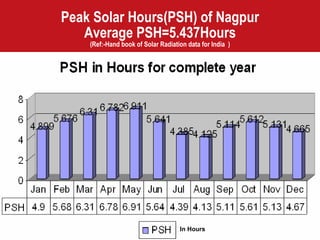
Peak Solar Hours(PSH) of Nagpur Average PSH=5.437Hours (Ref:-Hand book of Solar Radiation data for India  ) In Hours
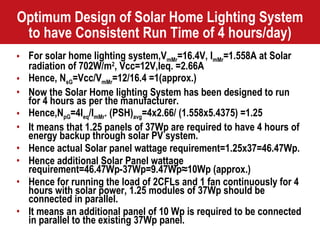
Optimum Design of Solar Home Lighting System to have Consistent Run Time of 4 hours/day) For solar home lighting system,V mMr =16.4V, I mMr =1.558A at Solar radiation of 702W/m 2 , Vcc=12V,Ieq. =2.66A Hence, N sG =Vcc/V mMr =12/16.4 =1(approx.) Now the Solar Home lighting System has been designed to run for 4 hours as per the manufacturer. Hence,N pG =4I eq /I mMr . (PSH) avg =4x2.66/ (1.558x5.4375) =1.25 It means that 1.25 panels of 37Wp are required to have 4 hours of energy backup through solar PV system. Hence actual Solar panel wattage requirement=1.25x37=46.47Wp. Hence additional Solar Panel wattage requirement=46.47Wp-37Wp=9.47Wp≈10Wp (approx.) Hence for running the load of 2CFLs and 1 fan continuously for 4 hours with solar power, 1.25 modules of 37Wp should be connected in parallel. It means an additional panel of 10 Wp is required to be connected in parallel to the existing 37Wp panel.
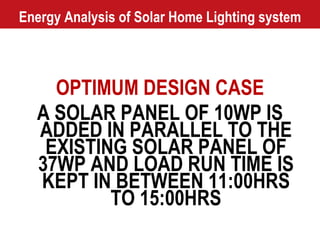
Energy Analysis of Solar Home Lighting system OPTIMUM DESIGN CASE A SOLAR PANEL OF 10WP IS ADDED IN PARALLEL TO THE EXISTING SOLAR PANEL OF 37WP AND LOAD RUN TIME IS KEPT IN BETWEEN 11:00HRS TO 15:00HRS
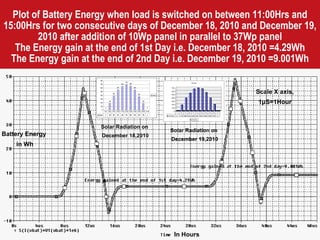
Plot of Battery Energy when load is switched on between 11:00Hrs and 15:00Hrs for two consecutive days of December 18, 2010 and December 19, 2010 after addition of 10Wp panel in parallel to 37Wp panel The Energy gain at the end of 1st Day i.e. December 18, 2010 =4.29Wh The Energy gain at the end of 2nd Day i.e. December 19, 2010 =9.001Wh Solar Radiation on  December 18,2010 Solar Radiation on  December 19,2010 In Hours Scale X axis, 1 μ S=1Hour Battery Energy  in Wh
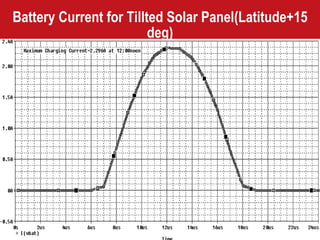
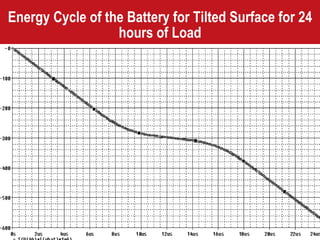
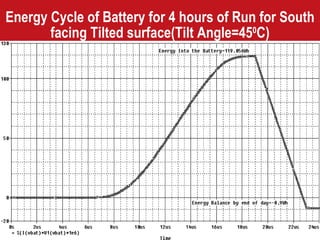
Results for Solar Radiation at South facing Tilted Solar Panel at an angle of 45 degrees.
Battery Current for Tillted Solar Panel(Latitude+15 deg)
Energy Cycle of the Battery for Tilted Surface for 24 hours of Load
Energy Cycle of Battery for 4 hours of Run for South facing Tilted surface(Tilt Angle=45 0 C)
Conclusion From the above ,it is concluded that for running the Solar Home lighting System satisfactorily with continuous energy gain with full load throughout the year, following changes should be incorporated in the system 1. With existing panel of 37Wp, the home lighting system is not suitable to run for 4 hours with continuous energy gain. In stead, it is suitable to run for 2.5 hours with continuous energy gain 2. One panel of 10Wp is to be added in parallel to 37Wp panel to run the system for 4 hours as specified by the manufacturer. This will ensure continuous energy gain in the system.  3. The existing 45 AH battery capacity is sufficient to provide required amount of energy storage to run the system for 4 hours with continuous energy gain. 4. The future work is aimed at hardware design of the system and to verify simulated results generated in this paper
References [1]Gilbert M.Masters, Stanford University” Renewable and Efficient Electric power System”. John Wiley and Sons Ltd., 3rd Edition, 2004. [2]Roger Messenger and Jerry Ventre “Photovoltaic Systems Engineering” CRC Press, 1999.  [3]Luis Castaner and SantiagoSilvestre, “Modeling of Photovoltaic Systems using Pspice”.John Willey and Sons, Ltd., 2002. [4] Hand book of Solar Radiation data for India 1980, compiled by Anna Mani, Allied Publishers Pvt. Limited. New Delhi, India. [5] Muhammad H.Rashid “Introduction to PSpice using Orcad for Circuits and Electronics” Third Edition.2003  [6] Mohan Kolhe “Techno-Economic Optimum sizing of a stand-alone solar photovoltaic system”; IEEE transactions on energy conversion, Vol.4 No.2, June 2009, pp 511-519. [7]Mohammad A.S.Masoum, Seyed Mahdi Mousavi Badejani and Ewald F.Fuchs, Fellow, IEEE,”Microprocessor Controlled new class of optimal battery chargers for photovoltaic applications. IEEE transactions on energy conversion, Vol.19. No.3, September 2004, pp 599-606. [8]Florent Boico and Brad Lehman, Member IEEE and Khalil Shujaee “Solar Battery Chargers for NiMH Batteries” IEEE transactions on Power Electronics, Vol.22 No.5, September 2007, pp 1600-1609. [9]R. M. Moharil and P. S. Kulkarni, “A case study of Solar Photovoltaic Power System at Sagardeep Island, India”, International Journal Renewable and Sustainable Energy Reviews (Elsevier Publication), Vol. 13, 2009, pp. 673-681. [10 ]  http://mnre.gov.in/
  Querries/Suggessions are most welcome [email_address]
Thankyou

Solargy energy analysis

  • 1.
  • 2.
    Outline IntroductionContent of last Seminar Block Diagram of stand-alone PV System Solar Home Lighting System in Electrical Engg. Dept. of VNIT Campus Digital Solar Radiation Pyranometer in VNIT Energy Analysis of the Solar Home Lighting System using Solar Radiation Data of Nagpur on December 18 and 19,2010. Optimum Design of Solar Home Lighting System using Yearly Average PSH(Peak Solar Hours) of Nagpur Results of Optimum Design of Solar Home Lighting System Improved Results on Tilted Solar Panel Publications References
  • 3.
    AIMS AND OBJECTIVESTo do the deep energy analysis of the Solar Home Lighting System considering the Solar Radiation pattern of Nagpur on December 18 and 19,2010 To verify the Specifications of the Solar Home Lighting System for Battery Size and Solar Panel Size To verify the Simulated Output using hardware design Future work is aimed at design of a MPP Battery Charger for the Solar Home Lighting System for accelerated charging of the battery
  • 4.
    Motivation Emerging Renewableenergy Technology. Jawaharlal Nehru National Solar mission of MNRE. Keeping in view power losses in India everyone is keen to adopt it. Immediate return and cost saving Technology.
  • 5.
  • 6.
    PV module witha battery connected to load with Converter
  • 7.
    SPV based Homelighting System (Electrical Engg. Dept.) Solar Panel 12V,37Wp CFLs 12 V DC,9 W Charge Controller Max. charging current - 5 A -Max. Load current - 5 A -Nominal voltage - 12 V -Fuse - 5A Battery Low maintenance JBNS 12V,45 Ah DC Fan Volts – 12 V DC, 14 W,I=1.16A
  • 8.
    Solar Panel Specificationsof Home Lighting System Nominal electrical output @ 25 0 C and STC condition P max =37 Watts;V mp =16.4Volts;V oc =21.0V;I mp =2.2Amps;I sc =2.6Amp Weight of the panel=5.180KG Length of panel=97.10cm Breadth of the Panel=43.2cm Thickness of the panel=3.7cm
  • 9.
    DIGITAL PYRANOMETER ATELECTRICAL DEPARTMENT, VNIT IT IS A MICROCONTROLLER BASED DIGITAL SOLAR RADIATION RECORDER. IT WILL COLLECT ALL REAL TIME DATA AUTOMATICALLY . OPERATOR IS NOT SUPPOSED TO STAND IN SUN LIGHT FOR MEASURING SOLAR RADIATIONS.
  • 10.
    COMPONENTS OF DIGITALRADIATION PYRANOMETER 1. SOLAR RADIATION SENSOR 2. SOLAR PANEL 3. DATA SHUTTLE 4. USB CABLE 5. BATTERIES(12V,SMF)
  • 11.
    SOLAR RADIATION SENSOR1.Temperature range : -40 to +80 ◦ c 2. Range 0 to 2000 W.m 2 3. Sensitivity 15 µv/W.m 2
  • 12.
    SOLAR PANEL Outputvoltage :12v DC Wattage : 10 Wp
  • 13.
    DATA SHUTTLE TheData Shuttle is pocket-sized device that can be used to download and transport the data from logger to a computer.
  • 14.
    Solar Radiation onDecember 18,2010 in W/m 2
  • 15.
    Bar Chart ofSolar Global Insolation(in W/m 2 ) of Nagpur from Dec.10, 2010 to Dec.14, 2010 for the Time 7:00Hrs to 17:00Hrs
  • 16.
    Bar Chart ofSolar Insolation(in W/m 2 ) of Nagpur from Dec.15, 2010 to Dec.20, 2010 for the Time 7:00Hrs to 17:00Hrs
  • 17.
    Plot of averageglobal solar insolation of Nagpur on December 18, 2010 for the Time 7:00Hrs to 17:00Hrs
  • 18.
    Plot of averageglobal solar insolation of Nagpur on December 19, 2010 for the Time 7:00Hrs to 17:00Hrs
  • 19.
    I-V characteristics of37Wp solar panel of solar home lighting system at a maximum Solar Radiation of 702W/m 2 on December 18,2010(From Graph, Isc=1.68A,Voc=20.71V)
  • 20.
    P-V characteristics of37Wp Solar panel of Solar home lighting System in VNIT campus at a maximum Solar Radiation of 702W/m 2 on December 18,2010(From Graph, P mpp =26.262W,V mpp =16.53V,I mpp =1.558A)
  • 21.
    Plot of batterycurrent of solar home lighting system on December 18, 2010 assuming solar home lighting load is zero throughout the day. Solar Radiation on December 18,2010 Scale X axis, 1 μ S=1Hour In Hours Battery Current in Amperes
  • 22.
    Energy Analysis ofSolar Home Lighting System The System is analyzed by taking four conditions of load Case I:-Load applied for 24 Hours, Case II:-Load applied for 4 hours in night between 19:00Hrs to 23:00Hrs. Case III:-Load applied for 4 hours in day between 11:00Hrs to 15:00Hrs. Case IV:-Load run time is reduced to 2.5 hours These cases are discussed and analyzed separately with Pspice Simulation Software as follows,
  • 23.
    Energy Analysis ofSolar Home Lighting System CASE I Load applied for 24 Hours
  • 24.
    Plot of batterycurrent of solar home lighting system on December 18, 2010 with full load of 2CFLs and 1 DC fan applied for 24 Hours Solar Radiation on December 18,2010 Scale X axis, 1 μ S=1Hour In Hours Battery Current in Amperes
  • 25.
    Plot of EnergyCycle of the battery of solar Home lighting system on December 18, 2010 with full load of 2CFLs and 1 DC fan applied for 24 Hours. Solar Radiation on December 18,2010 Scale X axis, 1 μ S=1Hour
  • 26.
    CASE II LOADAPPLIED FOR 4 HOURS IN NIGHT BETWEEN 19:00HRS TO 23:00HRS
  • 27.
    Plot of BatteryCurrent when load is switched on between 19:00Hrs to 23:00Hrs on December 18, 2010 Load Current=2.66A Solar Radiation on December 18,2010 Scale X axis, 1 μ S=1Hour In Hours Battery Current in Amperes
  • 28.
    Plot of LoadCurrent when load is switched on between 19:00Hrs to 23:00Hrs Solar Radiation on December 18,2010 Scale X axis, 1 μ S=1Hour In Hours Load Current in Amperes
  • 29.
    Plot of BatteryEnergy when load is switched on between 19:00Hrs to 23:00Hrs (Energy gain due to solar power to the battery= 85.463Wh Energy loss due to running of load for 4 hours = - 42.483Wh) Solar Radiation on December 18,2010 Scale X axis, 1 μ S=1Hour In Hours Battery Energy in Wh
  • 30.
    Analysis of theCapacity of the Battery for 4 Hours of Run for the Solar Home Lighting System Energy gain due to solar power to the battery= 85.463Wh Energy loss due to running of load for 4 hours = -42.483Wh) Total energy to be supplied by the battery =85.463Wh+42.483Wh=127.946Wh. Hence doubling the battery capacity requirement=127.946Whx2=255.892 (at least approximately)=255.892/12 = 21.324 Ah. The existing battery size is 45Ah.Hence this size is sufficient to fulfill the energy requirement of the Solar Home lighting System.
  • 31.
    ENERGY ANALYSIS OFSOLAR HOME LIGHTING SYSTEM CASE III LOAD APPLIED FOR 4 HOURS IN DAY BETWEEN 11:00HRS TO 15:00HRS
  • 32.
    Plot of BatteryCurrent when load is switched on between 11:00Hrs and 15:00Hrs on December 18, 2010 Solar Radiation on December 18,2010 Scale X axis, 1 μ S=1Hour In Hours Battery Current in Amperes
  • 33.
    Plot of LoadCurrent when load is switched on between 11:00Hrs to 15:00Hrs on December 18, 2010. Solar Radiation on December 18,2010 Scale X axis, 1 μ S=1Hour In Hours Load Current in Amperes
  • 34.
    Plot of BatteryEnergy when load is switched on between 11:00Hrs to 15:00 Hrs December 18, 2010 Energy Gained by the Battery =29.27Wh Energy Loss by the battery at the end of day=-42.4Wh Solar Radiation on December 18,2010 Scale X axis, 1 μ S=1Hour In Hours Battery Energy in Wh
  • 35.
    Plot of BatteryEnergy when load is switched on between 11:00Hrs to 15:00Hrs for two consecutive days of December 18, 2010 and December 19, 2010. The Energy Deficit at the end of 1st Day i.e. December 18, 2010 =-42.4Wh The Energy Deficit at the end of 2nd Day i.e. December 19, 2010 =-84.7Wh Solar Radiation on December 18,2010 Solar Radiation on December 19,2010 Scale X axis, 1 μ S=1Hour In Hours Battery Energy in Wh
  • 36.
    Energy Analysis ofSolar Home Lighting System CASE IV LOAD RUN TIME IS REDUCED TO 2 and 1/2 HOURS IN DAY BETWEEN 11:00HRS TO 13:30HRS
  • 37.
    Plot of BatteryEnergy when load is switched on between 11:00Hrs and 13:30Hrs for two consecutive days of December 18, 2010 and December 19, 2010 The Energy gain at the end of 1st Day i.e. December 18, 2010 =21.371Wh The Energy gain at the end of 2nd Day i.e. December 19, 2010 =43.002Wh. Solar Radiation on December 18,2010 Solar Radiation on December 19,2010 Scale X axis, 1 μ S=1Hour In Hours Battery Energy in Wh
  • 38.
    Optimum Design ofSolar Home Lighting System Concept of Equivalent Peak Solar Hours(PSH):-It is defined as the length of an equivalent day in which the irradiance is 1000W/m 2 at temp.25 0 C in such a way that the radiation(time integral of the the irradiance over the day)is the same as one sun equivalent day as in a real day. Let G(t)- real irradiance profile, then 0 ∫ 24 G(t).dt.=1.PSH
  • 39.
    Integration of SolarGlobal insolation for January month on one particular day PSH of January=4.899Hours (Ref:-Hand book of Solar Radiation data for India 1980, compiled by Anna Mani, Allied Publishers Pvt. Limited. New Delhi, India) In Hours Scale X axis, 1 μ S=1Hour Scale Y axis, 1KV =1KWH/m 2
  • 40.
    Optimum Design ofSolar Home Lighting System The Energy balance in a PV system is established by a general equation stating that energy consumed in a given period of time equals the energy generated by the PV system in the same period of time. The energy balance equation using peak solar hours(PSH) in a given day is P maxGr . PSH=L (1) Where P maxGr – The nominal output power of the PV generator at standard conditions PSH-Value of peak solar hours(which is numerically equal to the global in plane radiation in kWh/m 2 day) L-The energy consumed by the load over this average or worst day. Equation (1) can now be written for the two design scenarios Worst case design P maxGr (PSH) min= L b) Average design P maxGr (PSH) avg =L Where (PSH) avg is the average value of the 12 monthly PSH values. Replacing the nominal maximum power of the PV generator by its value: V mGr .I mGr .(PSH) avg = L
  • 41.
    Optimum Design ofSolar Home Lighting System Considering that a PV generator is compowed of NsG series string of NpG parallel PV modules. It follows, Where VmMr and ImMr are the voltage and current coordinates of the maximum power point of one PV module under standard conditions Hence, the basic design equation can be drawn as ` Usually the loads in a standalone PV system are connected to a DC voltage, namely Vcc.The load L can be written as: L=24Vcc.Ieq Where Ieq is the equivalent DC current drawn by the load over the whole day. For running load of 4 hours. Hence, NsG=Vcc/VmMr(Series Connection of Solar Panel) NpG=4Ieq/ImMr. (PSH)avg(Parallel Connection of Solar Panel)
  • 42.
    Peak Solar Hours(PSH)of Nagpur Average PSH=5.437Hours (Ref:-Hand book of Solar Radiation data for India ) In Hours
  • 43.
    Optimum Design ofSolar Home Lighting System to have Consistent Run Time of 4 hours/day) For solar home lighting system,V mMr =16.4V, I mMr =1.558A at Solar radiation of 702W/m 2 , Vcc=12V,Ieq. =2.66A Hence, N sG =Vcc/V mMr =12/16.4 =1(approx.) Now the Solar Home lighting System has been designed to run for 4 hours as per the manufacturer. Hence,N pG =4I eq /I mMr . (PSH) avg =4x2.66/ (1.558x5.4375) =1.25 It means that 1.25 panels of 37Wp are required to have 4 hours of energy backup through solar PV system. Hence actual Solar panel wattage requirement=1.25x37=46.47Wp. Hence additional Solar Panel wattage requirement=46.47Wp-37Wp=9.47Wp≈10Wp (approx.) Hence for running the load of 2CFLs and 1 fan continuously for 4 hours with solar power, 1.25 modules of 37Wp should be connected in parallel. It means an additional panel of 10 Wp is required to be connected in parallel to the existing 37Wp panel.
  • 44.
    Energy Analysis ofSolar Home Lighting system OPTIMUM DESIGN CASE A SOLAR PANEL OF 10WP IS ADDED IN PARALLEL TO THE EXISTING SOLAR PANEL OF 37WP AND LOAD RUN TIME IS KEPT IN BETWEEN 11:00HRS TO 15:00HRS
  • 45.
    Plot of BatteryEnergy when load is switched on between 11:00Hrs and 15:00Hrs for two consecutive days of December 18, 2010 and December 19, 2010 after addition of 10Wp panel in parallel to 37Wp panel The Energy gain at the end of 1st Day i.e. December 18, 2010 =4.29Wh The Energy gain at the end of 2nd Day i.e. December 19, 2010 =9.001Wh Solar Radiation on December 18,2010 Solar Radiation on December 19,2010 In Hours Scale X axis, 1 μ S=1Hour Battery Energy in Wh
  • 46.
    Results for SolarRadiation at South facing Tilted Solar Panel at an angle of 45 degrees.
  • 47.
    Battery Current forTillted Solar Panel(Latitude+15 deg)
  • 48.
    Energy Cycle ofthe Battery for Tilted Surface for 24 hours of Load
  • 49.
    Energy Cycle ofBattery for 4 hours of Run for South facing Tilted surface(Tilt Angle=45 0 C)
  • 50.
    Conclusion From theabove ,it is concluded that for running the Solar Home lighting System satisfactorily with continuous energy gain with full load throughout the year, following changes should be incorporated in the system 1. With existing panel of 37Wp, the home lighting system is not suitable to run for 4 hours with continuous energy gain. In stead, it is suitable to run for 2.5 hours with continuous energy gain 2. One panel of 10Wp is to be added in parallel to 37Wp panel to run the system for 4 hours as specified by the manufacturer. This will ensure continuous energy gain in the system. 3. The existing 45 AH battery capacity is sufficient to provide required amount of energy storage to run the system for 4 hours with continuous energy gain. 4. The future work is aimed at hardware design of the system and to verify simulated results generated in this paper
  • 51.
    References [1]Gilbert M.Masters,Stanford University” Renewable and Efficient Electric power System”. John Wiley and Sons Ltd., 3rd Edition, 2004. [2]Roger Messenger and Jerry Ventre “Photovoltaic Systems Engineering” CRC Press, 1999. [3]Luis Castaner and SantiagoSilvestre, “Modeling of Photovoltaic Systems using Pspice”.John Willey and Sons, Ltd., 2002. [4] Hand book of Solar Radiation data for India 1980, compiled by Anna Mani, Allied Publishers Pvt. Limited. New Delhi, India. [5] Muhammad H.Rashid “Introduction to PSpice using Orcad for Circuits and Electronics” Third Edition.2003 [6] Mohan Kolhe “Techno-Economic Optimum sizing of a stand-alone solar photovoltaic system”; IEEE transactions on energy conversion, Vol.4 No.2, June 2009, pp 511-519. [7]Mohammad A.S.Masoum, Seyed Mahdi Mousavi Badejani and Ewald F.Fuchs, Fellow, IEEE,”Microprocessor Controlled new class of optimal battery chargers for photovoltaic applications. IEEE transactions on energy conversion, Vol.19. No.3, September 2004, pp 599-606. [8]Florent Boico and Brad Lehman, Member IEEE and Khalil Shujaee “Solar Battery Chargers for NiMH Batteries” IEEE transactions on Power Electronics, Vol.22 No.5, September 2007, pp 1600-1609. [9]R. M. Moharil and P. S. Kulkarni, “A case study of Solar Photovoltaic Power System at Sagardeep Island, India”, International Journal Renewable and Sustainable Energy Reviews (Elsevier Publication), Vol. 13, 2009, pp. 673-681. [10 ] http://mnre.gov.in/
  • 52.
    Querries/Suggessionsare most welcome [email_address]
  • 53.

Editor's Notes

  • #2 Friday, August 12, 2011 Logixmasterrev.ppt
  • #3 Friday, August 12, 2011 Logixmasterrev.ppt
  • #4 Friday, August 12, 2011 Logixmasterrev.ppt
  • #5 Friday, August 12, 2011 Logixmasterrev.ppt
  • #6 Friday, August 12, 2011 Logixmasterrev.ppt
  • #7 Friday, August 12, 2011 Logixmasterrev.ppt
  • #8 Friday, August 12, 2011 Logixmasterrev.ppt
  • #9 Friday, August 12, 2011 Logixmasterrev.ppt
  • #10 Friday, August 12, 2011 Logixmasterrev.ppt
  • #11 Friday, August 12, 2011 Logixmasterrev.ppt
  • #12 Friday, August 12, 2011 Logixmasterrev.ppt
  • #13 Friday, August 12, 2011 Logixmasterrev.ppt
  • #14 Friday, August 12, 2011 Logixmasterrev.ppt
  • #15 Friday, August 12, 2011 Logixmasterrev.ppt
  • #16 Friday, August 12, 2011 Logixmasterrev.ppt
  • #17 Friday, August 12, 2011 Logixmasterrev.ppt
  • #18 Friday, August 12, 2011 Logixmasterrev.ppt
  • #19 Friday, August 12, 2011 Logixmasterrev.ppt
  • #20 Friday, August 12, 2011 Logixmasterrev.ppt
  • #21 Friday, August 12, 2011 Logixmasterrev.ppt
  • #22 Friday, August 12, 2011 Logixmasterrev.ppt
  • #23 Friday, August 12, 2011 Logixmasterrev.ppt
  • #24 Friday, August 12, 2011 Logixmasterrev.ppt
  • #25 Friday, August 12, 2011 Logixmasterrev.ppt
  • #26 Friday, August 12, 2011 Logixmasterrev.ppt
  • #27 Friday, August 12, 2011 Logixmasterrev.ppt
  • #28 Friday, August 12, 2011 Logixmasterrev.ppt
  • #29 Friday, August 12, 2011 Logixmasterrev.ppt
  • #30 Friday, August 12, 2011 Logixmasterrev.ppt
  • #31 Friday, August 12, 2011 Logixmasterrev.ppt
  • #32 Friday, August 12, 2011 Logixmasterrev.ppt
  • #33 Friday, August 12, 2011 Logixmasterrev.ppt
  • #34 Friday, August 12, 2011 Logixmasterrev.ppt
  • #35 Friday, August 12, 2011 Logixmasterrev.ppt
  • #36 Friday, August 12, 2011 Logixmasterrev.ppt
  • #37 Friday, August 12, 2011 Logixmasterrev.ppt
  • #38 Friday, August 12, 2011 Logixmasterrev.ppt
  • #39 Friday, August 12, 2011 Logixmasterrev.ppt
  • #40 Friday, August 12, 2011 Logixmasterrev.ppt
  • #41 Friday, August 12, 2011 Logixmasterrev.ppt
  • #42 Friday, August 12, 2011 Logixmasterrev.ppt
  • #43 Friday, August 12, 2011 Logixmasterrev.ppt
  • #44 Friday, August 12, 2011 Logixmasterrev.ppt
  • #45 Friday, August 12, 2011 Logixmasterrev.ppt
  • #46 Friday, August 12, 2011 Logixmasterrev.ppt
  • #47 Friday, August 12, 2011 Logixmasterrev.ppt
  • #48 Friday, August 12, 2011 Logixmasterrev.ppt
  • #49 Friday, August 12, 2011 Logixmasterrev.ppt
  • #50 Friday, August 12, 2011 Logixmasterrev.ppt
  • #51 Friday, August 12, 2011 Logixmasterrev.ppt
  • #52 Friday, August 12, 2011 Logixmasterrev.ppt
  • #53 Friday, August 12, 2011 Logixmasterrev.ppt
  • #54 Friday, August 12, 2011 Logixmasterrev.ppt