2.6 SOLAR CONSTANT, CLARITY INDEX, S O L A R
I N S O L A T I O N
(a)Solar constant :
It is observed that the solar energy flux outside the
earth's atmosphere is not affected by atmospheric gases,
dust, clouds, etc. Further, they are not scattered, hence
it is beam radiation only (no diffused radiation).
Therefore, the solar energy flux received outside the
earth's atmosphere is essentially constant. This radiation
is called extraterrestrial radiation.
Solar constant is the solar energy received per unit time
per unit area normal to the direction of sun rays at the
mean distance of the earth from the sun (1.5 x 10⁸
km).
The value of solar constant is 1353 W/m2
as per
measurements upto 1970. However, subsequent
measurements revised this value to 1367 W/m2
. The
difference between the two values is only one per cent.
As solar constant is obtained from radiation outside
the earth's atmosphere, it is unaffected by the
atmospheric conditions and hence it is called an universal
constant.
(b)Solar insolation :
It is the measure of solar radiation received on flat
horizontal earth surface. It is defined as the total solar
energy received on a flat horizontal earth surface at a
given place and time. As against solar constant, solar
insolation is dependent on atmospheric conditions
(clouds, winter, etc.) and time (morning, noon, evening,
night, etc.)
Clarityindex (Ki ) :
It is the ratio of solar radiation received on earth's
horizontal surface per unit time to the radiation received
on equal surface area beyond the earth's atmosphere in
the direction perpendicular to the sun rays over the %nine
period. It is also expressed as the ratio of solar insolation
to solar (instant. That is
𝑲𝒊 =
Solar insolation per unit time per unit area
Solar constant
𝑲𝒊 =
Solar power per unit area (W/m2)
Solar constant (W/m2)
---------2
As numerator and denominator in equation (2) have
same unit, the ilarity index K1 has no unit. Further, similar
to solar insolation, clarity index Ile sensitive to
atmospheric conditions. It varies from 0.1 for cloudy day
to maximum of 0.7 for clear day during noon time. It also
varies during hours of a day.
2.7 SOLAR ENERGY FROM SATELLITE STATION THROUGH
MICROWAVE TO EARTH STATION :
The extraterrestrial radiation (solar energy) is
much more concentrated (0.15 MWh/m2
per year) than
total or global radiation received on the earth surface
(0.05 MWh/m2
per year). This is an average value for
radiation received on the earth surface which again can
vary due to atmospheric and seasonal variations. Thus, on
an average, only 30% of the solar energy reaches the
earth surface and 70% is lost in the atmosphere. Hence,
if solar energy is collected outside the earth's
atmosphere, then it is available 100% and for 24 hours
by means of geo- stationary satellite without influence of
clarity index of the earth's atmosphere. This solar
satellite power plan is proposed by UNESCO in 1974 and
is ambitious and has capability to cater the energy
demands infuture.
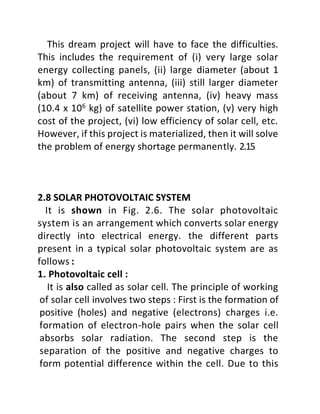
The solar satellite microwave power plant
arrangement is shown in Fig. 2.7. It consists of geo-
stationary satellite revolving outside the earth's
atmosphere. On this satellite is mounted solar
photovoltaic or solar thermal collector system which
converts abundantly and continuously available solar
energy into electrical or thermal energy respectively.
This electrical or thermal energy can be stored on
unit present in revolving satellite energy plant. But as
the satellite is geo-stationary and rotates around the
earth round the clock, the sun is available all the time.
Therefore, no storage unit is required. The solar satellite
power plant will convert electrical or thermal energy
generated from photovoltaic system or thermal
collector respectively to microwave. Because
microwaves (MHz frequency range) being long
wavelengths are not absorbed in the earth's
atmosphere and can reach the earth surface easily.
Thus, the microwaves given to transmitting antenna on
solar satellite power plant reach the earth station
without much absorption in the atmosphere.
Fig. 2.7.Solar satellite microwave power plant
The receiving antenna at the earth station power plant
receives these microwaves and converted back to
electrical or thermal energy form by converters. Thus,
solar energy is received in full amount and in continuous
way on the earth without any loss. The converter will
convert the electrical or thermal energy to electrical
power of 50 or 60 Hz.
This dream project will have to face the difficulties.
This includes the requirement of (i) very large solar
energy collecting panels, (ii) large diameter (about 1
km) of transmitting antenna, (iii) still larger diameter
(about 7 km) of receiving antenna, (iv) heavy mass
(10.4 x 10⁶ kg) of satellite power station, (v) very high
cost of the project, (vi) low efficiency of solar cell, etc.
However, if this project is materialized, then it will solve
the problem of energy shortage permanently. 2.15
2.8 SOLAR PHOTOVOLTAIC SYSTEM
It is shown in Fig. 2.6. The solar photovoltaic
system is an arrangement which converts solar energy
directly into electrical energy. the different parts
present in a typical solar photovoltaic system are as
follows :
1. Photovoltaic cell :
It is also called as solar cell. The principle of working
of solar cell involves two steps : First is the formation of
positive (holes) and negative (electrons) charges i.e.
formation of electron-hole pairs when the solar cell
absorbs solar radiation. The second step is the
separation of the positive and negative charges to
form potential difference within the cell. Due to this
potential difference, the electric current can flow
through the external circuit.
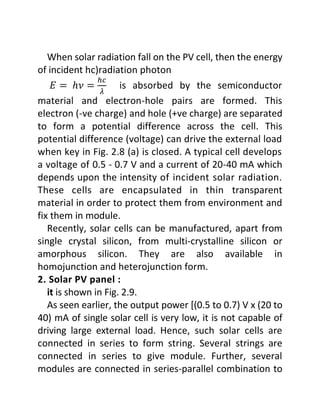
The structure or construction of photovoltaic cell
is shown in fig. 2.8 (a) and its notation is shown in Fig. 2.5
(b).
Fig. 2.8 : Construction of photovoltaic cell
It consists of thin wafer of about 250 u.m in thickness
of single crystal silicon P-type semiconductor material.
On one side of this wafer is diffused N-type impurity
to form shallow P-N junction with N-type material
forming front side and P-type material forming back
side of photovoltaic cell. The ohmic contacts are made
to N-type (front) and P-type (back) material to make
external circuit connections possible as shown in Fig.
2.8 (a). This structure of P-N junction of photovoltaic
cell (PV cell) for simplicity can be shown as given in Fig.
2.8 (b).
When solar radiation fall on the PV cell, then the energy
of incident hc)radiation photon
𝐸 = ℎ𝜈 =
ℎ𝑐
𝜆
is absorbed by the semiconductor
material and electron-hole pairs are formed. This
electron (-ve charge) and hole (+ve charge) are separated
to form a potential difference across the cell. This
potential difference (voltage) can drive the external load
when key in Fig. 2.8 (a) is closed. A typical cell develops
a voltage of 0.5 - 0.7 V and a current of 20-40 mA which
depends upon the intensity of incident solar radiation.
These cells are encapsulated in thin transparent
material in order to protect them from environment and
fix them in module.
Recently, solar cells can be manufactured, apart from
single crystal silicon, from multi-crystalline silicon or
amorphous silicon. They are also available in
homojunction and heterojunction form.
2. Solar PV panel :
it is shown in Fig. 2.9.
As seen earlier, the output power [(0.5 to 0.7) V x (20 to
40) mA of single solar cell is very low, it is not capable of
driving large external load. Hence, such solar cells are
connected in series to form string. Several strings are
connected in series to give module. Further, several
modules are connected in series-parallel combination to
form array or panel. This solar array or panel works as
solar photovoltaic collector. The solar panel is mounted
on a large plane non-conducting board and is installed on
the terrace or open ground in order to have maximum
solar energy available. The solar panel can be of fixed
type or tracking type arid can also have focusing system
using mirrors or lenses to make it concentrated
collector. However, solar panel of fixed type are cheap and
commonly used for domestic purpose though they have
comparatively lower output power.
The PV cells in the panel convert solar energy to
electrical (D.C.) energy of sufficient output for driving load
as against the single cell.
Fig. 2.9 : Solar photovoltaic system
3. Storage batteries :
As already discussed, the energy of incident solar
radiation fluctuates with time, season, atmospheric
conditions, place etc., the output D.C. power from the
solar PV panel is not continuous and constant. This
makes it difficult to drive the load which requires energy at
constant rate. Hence storage batteries are used in solar PV
system which can store the I-
1C output power from PV
panel when it is in excess and add up when the output of
PV panel is inadequate. The storage batteries along with
PV panel account for the major cost of solar PV system.
4, Inverter :
It is a device which converts unidirectional direct current
(D.C.) into alternating current (A.C.). For most of the
electrical applications, the electrical energy required is in
A.C. form. But the output from solar PV panel and so also
from storage batteries is undirectional D.C. Therefore,
this output needs to be converted into useful A.C. This is
done by the Inverter, The output A.C. of required
voltage, current, power and frequency is formed by the
inverter.
2.9 MERITS OF SOLAR PV SYSTEM
The merits of solar PV system are as follows :
• It is cheap and clean source of energy. PV system do not
use fuel and do not release harmful gases or other
pollutants.
• The solar power is available free of cost, but PV
system costs.
• The photovoltaic systems are quiet (no sound
pollution) and visually unobstructive.
• Small scale solar PV system can be installed on
rooftops of buildings, the space which is unused.
• Solar PV system is the most effective system for
providing power to space appliances including
satellites. Originally, PV system was used for space
applications.
• Solar PV system works over long period of time.
• It has no or little maintenance. Further it has no
movable parts in solar PV cells.
• Solar energy is locally available renewable energy
source, i.e. it is not required tobe imported from other
countries.
• Unlike fuels which are mined and harvested and cause
depletion or alteration of resource, the solar PV system
produces electricity without any depletion in source.
• The solar PV systems are very effective in remote areas,
where a stand alone unit can work.
• Solar PV system can avoid transportation of electricity
from one place to other and hence avoids loss during
transmission.
• A PV system output power capacity can be changed
easily by changing modules in the PV panel. This
makes it energy requirement adjustable.
• It can work for mobile applications like car, radio,
calculators, etc.
2.10.LIMITATION OF SOLAR PV SYSTEM :
• Some toxic chemicals, like cadmium and arsenic, are
used in the PV cell production which causes minor
environmental impacts.
• Solar energy is not continuous in time and space.
Hence output power from PV system is not constant.
• Storage batteries are required to store excess
production from PV panel and to supply when the
output from the PV panel is insufficient or absent.
Sometimes standby diesel generator unit is required.
The construction cost of the PV system is high due to
high cost of solar cell.
• Efficiency of solar cell is very low (14% - 25%) which
makes the electrical energy available at high cost
compared to conventional source of energy.
• Large space is required for solar PV panels.
• It cannot be used for large power requirement
applications such as power station.
• Solar PV system requires additional equipment viz
inverter which converts D.C. to A.C. required for many
applications.
2.11 PROSPECTS OF SOLAR PV SYSTEM
In section 2.9, we have seen the advantages or merits of PV
system And in section 2.10 the limitations or drawbacks of
the same. From this it Is seen that the solar PV system has
more advantages than disadvantages. this means the solar
PV system has bright future or better prospects. The
prospects can be summarised as follows. At the outset it is
clear that solar PV system can cater the futureenergy needs.
• Solar energy is free, clean, abundant, renewable
everlasting source of energy. It can have better
prospects if solar cells with low cost and high efficiency
are produced. In recent years, efforts are going on to
construct PV cell, apart from single crystal silicon, from
multicrystalline silicon or amorphous silicon. Further
cadmium, arsenic, telluride etc. are used for PV
cell manufacturing. This gave rise to lower cost and
more efficiency. Hence, fruits of high efficiency, low
cost and large scale production of PV cells is within
reach in near future.
• For remote, hilly, desert and difficult areas
electrification the solar PV system has most promising
option.
• Solar PV system is very good option for portable and
mobile units such as cars, automobiles, satellites etc.
• Small solar PV systems with power output in the
range kW to MW are having very wider prospects.
These systems can be installed on the top of building
without any interference to day-to-day work. Also it
is low cost system. This has very large scope in India as
well as in world.
• India is country of villages. It is possible to electrify
these villages and small towns by small or low power
PV system.
• Solar PV system can work in conjunction with the
diesel generator system which is called solar-diesel
hybrid power plant. This makes the PV system
compatible with the other which enhances its use in
future.
Thus, with the help of research on solar PV cell system,
it can be possible to get power from solar energy at
comparatively lower cost than conventional coal, oil, fuel,
natural gas sources. Hence better prospects are seen for
solar energy in the years to come.
,2.112 POWER OF A SOLAR CELL AND SOLAR PV PANEL
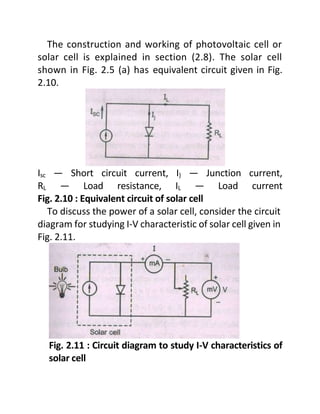
The construction and working of photovoltaic cell or
solar cell is explained in section (2.8). The solar cell
shown in Fig. 2.5 (a) has equivalent circuit given in Fig.
2.10.
Isc — Short circuit current, I) — Junction current,
RL — Load resistance, IL — Load current
Fig. 2.10 : Equivalent circuit of solar cell
To discuss the power of a solar cell, consider the circuit
diagram for studying I-V characteristic of solar cell given in
Fig. 2.11.
Fig. 2.11 : Circuit diagram to study I-V characteristics of
solar cell
From this circuit it is also possible to study the power-
voltage of the solarcell.
The solar cell is exposed to constant illumination from
the bulb. The load resistance Rl is varied in steps from
zero to infinity and for each value of RL the
corresponding values of current I and voltage V are
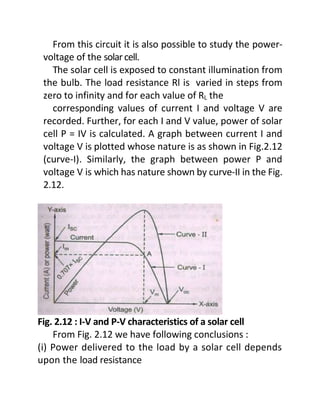
recorded. Further, for each I and V value, power of solar
cell P = IV is calculated. A graph between current I and
voltage V is plotted whose nature is as shown in Fig.2.12
(curve-I). Similarly, the graph between power P and
voltage V is which has nature shown by curve-II in the Fig.
2.12.
Fig. 2.12 : I-V and P-V characteristics of a solar cell
From Fig. 2.12 we have following conclusions :
(i) Power delivered to the load by a solar cell depends
upon the load resistance
𝑅𝑙 =
𝑑𝑣𝑐
𝑑𝐼𝑐
• When RL = 0, then current I = Isc. This is short circuit
current (Isc) which is maximum current delivered by
the solar cell. It is shown on Y-axis in Fig. 2.12. Here
voltage across load V = 0. Hence power delivered by
solar cell P = V x I.
P = 0xI= 0
• Multiply by 0.707 to the value of short circuit current
so that we get current Im, = 0.707 x Isc. From this value
of Im, draw a horizontal line parallel to X-axis. It
intersects the I-V characteristics [curve-I] at point A.
From this point, draw perpendicular on X-axis to get
corresponding value of voltage Vm. Then product of Im
andVm, gives maximum power point. Power Pmpp = Im
X Vm. At this value of load i.e. for these values of Im,
and Vm, the solar cell delivers maximum power to the
load. This maximum power is also shown by curve-H.
Thus adjust the load to get value of current Im, and
voltage Vm, so that one can have maximum power. This
point A is also called as knee point.
• When load RL = ∞ then I = 0 and V = Voc. This is the
maximum voltage across the load shown on X-axis
called open circuit voltage (Voc). At this value of load,
though voltage is maximum (Voc), the current
becomes zero. Hence power P = I x V = 0.
• The variation of power delivered by solar cell from
zero at Isc, then maximum at Im, and Vm and again zero
at Voc is shown by curve-II in Fig. 2.12.
• The fill factor is a measure of photo junction inside the
solar cell which is effectively contributing to the photo
current. Not all junctions participate in giving
photocurrent because some are inactive or
defective. The fill factor is also a measure of
perfectness of I-V characteristics. If it is perfect
square (I-V characteristic), then FF = 1. In practice, fill
factor (FF) is less than 1. It is given as
Fill Factor =
Pmpp
Voc x Isc
Power of a solar PV panel:
If there are n solar cells in a module and there are m
modules in a panel, then power of a solar panel
(or array) Pp is written as
Pp = n x m x P
where P = V x I is power of single solar cell.
If RL is external load connected, Vp is D.C. output voltage of
the panel and Ip is D.C. output current of the panel, then Pp
becomes
Pp = Vp .Ip
𝑃𝑝 =
𝑉𝑃
2
𝑅𝐿
[sinceV=IR]
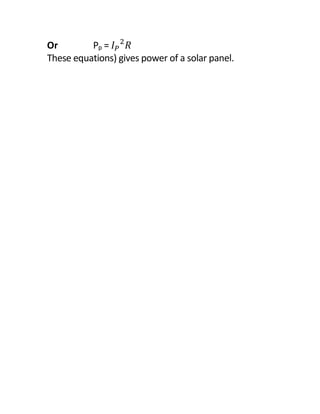
Or Pp = 𝐼𝑃
2
𝑅
These equations) gives power of a solar panel.

Solar-Energy-3.docx

  • 1.
    2.6 SOLAR CONSTANT,CLARITY INDEX, S O L A R I N S O L A T I O N (a)Solar constant : It is observed that the solar energy flux outside the earth's atmosphere is not affected by atmospheric gases, dust, clouds, etc. Further, they are not scattered, hence it is beam radiation only (no diffused radiation). Therefore, the solar energy flux received outside the earth's atmosphere is essentially constant. This radiation is called extraterrestrial radiation. Solar constant is the solar energy received per unit time per unit area normal to the direction of sun rays at the mean distance of the earth from the sun (1.5 x 10⁸ km). The value of solar constant is 1353 W/m2 as per measurements upto 1970. However, subsequent measurements revised this value to 1367 W/m2 . The difference between the two values is only one per cent. As solar constant is obtained from radiation outside the earth's atmosphere, it is unaffected by the atmospheric conditions and hence it is called an universal constant. (b)Solar insolation : It is the measure of solar radiation received on flat horizontal earth surface. It is defined as the total solar energy received on a flat horizontal earth surface at a given place and time. As against solar constant, solar
  • 2.
    insolation is dependenton atmospheric conditions (clouds, winter, etc.) and time (morning, noon, evening, night, etc.) Clarityindex (Ki ) : It is the ratio of solar radiation received on earth's horizontal surface per unit time to the radiation received on equal surface area beyond the earth's atmosphere in the direction perpendicular to the sun rays over the %nine period. It is also expressed as the ratio of solar insolation to solar (instant. That is 𝑲𝒊 = Solar insolation per unit time per unit area Solar constant 𝑲𝒊 = Solar power per unit area (W/m2) Solar constant (W/m2) ---------2 As numerator and denominator in equation (2) have same unit, the ilarity index K1 has no unit. Further, similar to solar insolation, clarity index Ile sensitive to atmospheric conditions. It varies from 0.1 for cloudy day to maximum of 0.7 for clear day during noon time. It also varies during hours of a day. 2.7 SOLAR ENERGY FROM SATELLITE STATION THROUGH MICROWAVE TO EARTH STATION : The extraterrestrial radiation (solar energy) is much more concentrated (0.15 MWh/m2 per year) than total or global radiation received on the earth surface (0.05 MWh/m2 per year). This is an average value for
  • 3.
    radiation received onthe earth surface which again can vary due to atmospheric and seasonal variations. Thus, on an average, only 30% of the solar energy reaches the earth surface and 70% is lost in the atmosphere. Hence, if solar energy is collected outside the earth's atmosphere, then it is available 100% and for 24 hours by means of geo- stationary satellite without influence of clarity index of the earth's atmosphere. This solar satellite power plan is proposed by UNESCO in 1974 and is ambitious and has capability to cater the energy demands infuture. The solar satellite microwave power plant arrangement is shown in Fig. 2.7. It consists of geo- stationary satellite revolving outside the earth's atmosphere. On this satellite is mounted solar photovoltaic or solar thermal collector system which converts abundantly and continuously available solar energy into electrical or thermal energy respectively. This electrical or thermal energy can be stored on unit present in revolving satellite energy plant. But as the satellite is geo-stationary and rotates around the earth round the clock, the sun is available all the time. Therefore, no storage unit is required. The solar satellite power plant will convert electrical or thermal energy generated from photovoltaic system or thermal
  • 4.
    collector respectively tomicrowave. Because microwaves (MHz frequency range) being long wavelengths are not absorbed in the earth's atmosphere and can reach the earth surface easily. Thus, the microwaves given to transmitting antenna on solar satellite power plant reach the earth station without much absorption in the atmosphere. Fig. 2.7.Solar satellite microwave power plant The receiving antenna at the earth station power plant receives these microwaves and converted back to electrical or thermal energy form by converters. Thus, solar energy is received in full amount and in continuous way on the earth without any loss. The converter will convert the electrical or thermal energy to electrical power of 50 or 60 Hz.
  • 5.
    This dream projectwill have to face the difficulties. This includes the requirement of (i) very large solar energy collecting panels, (ii) large diameter (about 1 km) of transmitting antenna, (iii) still larger diameter (about 7 km) of receiving antenna, (iv) heavy mass (10.4 x 10⁶ kg) of satellite power station, (v) very high cost of the project, (vi) low efficiency of solar cell, etc. However, if this project is materialized, then it will solve the problem of energy shortage permanently. 2.15 2.8 SOLAR PHOTOVOLTAIC SYSTEM It is shown in Fig. 2.6. The solar photovoltaic system is an arrangement which converts solar energy directly into electrical energy. the different parts present in a typical solar photovoltaic system are as follows : 1. Photovoltaic cell : It is also called as solar cell. The principle of working of solar cell involves two steps : First is the formation of positive (holes) and negative (electrons) charges i.e. formation of electron-hole pairs when the solar cell absorbs solar radiation. The second step is the separation of the positive and negative charges to form potential difference within the cell. Due to this
  • 6.
    potential difference, theelectric current can flow through the external circuit. The structure or construction of photovoltaic cell is shown in fig. 2.8 (a) and its notation is shown in Fig. 2.5 (b). Fig. 2.8 : Construction of photovoltaic cell It consists of thin wafer of about 250 u.m in thickness of single crystal silicon P-type semiconductor material. On one side of this wafer is diffused N-type impurity to form shallow P-N junction with N-type material forming front side and P-type material forming back side of photovoltaic cell. The ohmic contacts are made to N-type (front) and P-type (back) material to make external circuit connections possible as shown in Fig. 2.8 (a). This structure of P-N junction of photovoltaic cell (PV cell) for simplicity can be shown as given in Fig. 2.8 (b).
  • 7.
    When solar radiationfall on the PV cell, then the energy of incident hc)radiation photon 𝐸 = ℎ𝜈 = ℎ𝑐 𝜆 is absorbed by the semiconductor material and electron-hole pairs are formed. This electron (-ve charge) and hole (+ve charge) are separated to form a potential difference across the cell. This potential difference (voltage) can drive the external load when key in Fig. 2.8 (a) is closed. A typical cell develops a voltage of 0.5 - 0.7 V and a current of 20-40 mA which depends upon the intensity of incident solar radiation. These cells are encapsulated in thin transparent material in order to protect them from environment and fix them in module. Recently, solar cells can be manufactured, apart from single crystal silicon, from multi-crystalline silicon or amorphous silicon. They are also available in homojunction and heterojunction form. 2. Solar PV panel : it is shown in Fig. 2.9. As seen earlier, the output power [(0.5 to 0.7) V x (20 to 40) mA of single solar cell is very low, it is not capable of driving large external load. Hence, such solar cells are connected in series to form string. Several strings are connected in series to give module. Further, several modules are connected in series-parallel combination to
  • 8.
    form array orpanel. This solar array or panel works as solar photovoltaic collector. The solar panel is mounted on a large plane non-conducting board and is installed on the terrace or open ground in order to have maximum solar energy available. The solar panel can be of fixed type or tracking type arid can also have focusing system using mirrors or lenses to make it concentrated collector. However, solar panel of fixed type are cheap and commonly used for domestic purpose though they have comparatively lower output power. The PV cells in the panel convert solar energy to electrical (D.C.) energy of sufficient output for driving load as against the single cell. Fig. 2.9 : Solar photovoltaic system 3. Storage batteries : As already discussed, the energy of incident solar radiation fluctuates with time, season, atmospheric
  • 9.
    conditions, place etc.,the output D.C. power from the solar PV panel is not continuous and constant. This makes it difficult to drive the load which requires energy at constant rate. Hence storage batteries are used in solar PV system which can store the I- 1C output power from PV panel when it is in excess and add up when the output of PV panel is inadequate. The storage batteries along with PV panel account for the major cost of solar PV system. 4, Inverter : It is a device which converts unidirectional direct current (D.C.) into alternating current (A.C.). For most of the electrical applications, the electrical energy required is in A.C. form. But the output from solar PV panel and so also from storage batteries is undirectional D.C. Therefore, this output needs to be converted into useful A.C. This is done by the Inverter, The output A.C. of required voltage, current, power and frequency is formed by the inverter. 2.9 MERITS OF SOLAR PV SYSTEM The merits of solar PV system are as follows : • It is cheap and clean source of energy. PV system do not use fuel and do not release harmful gases or other pollutants. • The solar power is available free of cost, but PV system costs.
  • 10.
    • The photovoltaicsystems are quiet (no sound pollution) and visually unobstructive. • Small scale solar PV system can be installed on rooftops of buildings, the space which is unused. • Solar PV system is the most effective system for providing power to space appliances including satellites. Originally, PV system was used for space applications. • Solar PV system works over long period of time. • It has no or little maintenance. Further it has no movable parts in solar PV cells. • Solar energy is locally available renewable energy source, i.e. it is not required tobe imported from other countries. • Unlike fuels which are mined and harvested and cause depletion or alteration of resource, the solar PV system produces electricity without any depletion in source. • The solar PV systems are very effective in remote areas, where a stand alone unit can work. • Solar PV system can avoid transportation of electricity from one place to other and hence avoids loss during transmission. • A PV system output power capacity can be changed easily by changing modules in the PV panel. This makes it energy requirement adjustable.
  • 11.
    • It canwork for mobile applications like car, radio, calculators, etc. 2.10.LIMITATION OF SOLAR PV SYSTEM : • Some toxic chemicals, like cadmium and arsenic, are used in the PV cell production which causes minor environmental impacts. • Solar energy is not continuous in time and space. Hence output power from PV system is not constant. • Storage batteries are required to store excess production from PV panel and to supply when the output from the PV panel is insufficient or absent. Sometimes standby diesel generator unit is required. The construction cost of the PV system is high due to high cost of solar cell. • Efficiency of solar cell is very low (14% - 25%) which makes the electrical energy available at high cost compared to conventional source of energy. • Large space is required for solar PV panels. • It cannot be used for large power requirement applications such as power station. • Solar PV system requires additional equipment viz inverter which converts D.C. to A.C. required for many applications. 2.11 PROSPECTS OF SOLAR PV SYSTEM
  • 12.
    In section 2.9,we have seen the advantages or merits of PV system And in section 2.10 the limitations or drawbacks of the same. From this it Is seen that the solar PV system has more advantages than disadvantages. this means the solar PV system has bright future or better prospects. The prospects can be summarised as follows. At the outset it is clear that solar PV system can cater the futureenergy needs. • Solar energy is free, clean, abundant, renewable everlasting source of energy. It can have better prospects if solar cells with low cost and high efficiency are produced. In recent years, efforts are going on to construct PV cell, apart from single crystal silicon, from multicrystalline silicon or amorphous silicon. Further cadmium, arsenic, telluride etc. are used for PV cell manufacturing. This gave rise to lower cost and more efficiency. Hence, fruits of high efficiency, low cost and large scale production of PV cells is within reach in near future. • For remote, hilly, desert and difficult areas electrification the solar PV system has most promising option. • Solar PV system is very good option for portable and mobile units such as cars, automobiles, satellites etc. • Small solar PV systems with power output in the range kW to MW are having very wider prospects. These systems can be installed on the top of building
  • 13.
    without any interferenceto day-to-day work. Also it is low cost system. This has very large scope in India as well as in world. • India is country of villages. It is possible to electrify these villages and small towns by small or low power PV system. • Solar PV system can work in conjunction with the diesel generator system which is called solar-diesel hybrid power plant. This makes the PV system compatible with the other which enhances its use in future. Thus, with the help of research on solar PV cell system, it can be possible to get power from solar energy at comparatively lower cost than conventional coal, oil, fuel, natural gas sources. Hence better prospects are seen for solar energy in the years to come. ,2.112 POWER OF A SOLAR CELL AND SOLAR PV PANEL
  • 14.
    The construction andworking of photovoltaic cell or solar cell is explained in section (2.8). The solar cell shown in Fig. 2.5 (a) has equivalent circuit given in Fig. 2.10. Isc — Short circuit current, I) — Junction current, RL — Load resistance, IL — Load current Fig. 2.10 : Equivalent circuit of solar cell To discuss the power of a solar cell, consider the circuit diagram for studying I-V characteristic of solar cell given in Fig. 2.11. Fig. 2.11 : Circuit diagram to study I-V characteristics of solar cell
  • 15.
    From this circuitit is also possible to study the power- voltage of the solarcell. The solar cell is exposed to constant illumination from the bulb. The load resistance Rl is varied in steps from zero to infinity and for each value of RL the corresponding values of current I and voltage V are recorded. Further, for each I and V value, power of solar cell P = IV is calculated. A graph between current I and voltage V is plotted whose nature is as shown in Fig.2.12 (curve-I). Similarly, the graph between power P and voltage V is which has nature shown by curve-II in the Fig. 2.12. Fig. 2.12 : I-V and P-V characteristics of a solar cell From Fig. 2.12 we have following conclusions : (i) Power delivered to the load by a solar cell depends upon the load resistance
  • 16.
    𝑅𝑙 = 𝑑𝑣𝑐 𝑑𝐼𝑐 • WhenRL = 0, then current I = Isc. This is short circuit current (Isc) which is maximum current delivered by the solar cell. It is shown on Y-axis in Fig. 2.12. Here voltage across load V = 0. Hence power delivered by solar cell P = V x I. P = 0xI= 0 • Multiply by 0.707 to the value of short circuit current so that we get current Im, = 0.707 x Isc. From this value of Im, draw a horizontal line parallel to X-axis. It intersects the I-V characteristics [curve-I] at point A. From this point, draw perpendicular on X-axis to get corresponding value of voltage Vm. Then product of Im andVm, gives maximum power point. Power Pmpp = Im X Vm. At this value of load i.e. for these values of Im, and Vm, the solar cell delivers maximum power to the load. This maximum power is also shown by curve-H. Thus adjust the load to get value of current Im, and voltage Vm, so that one can have maximum power. This point A is also called as knee point. • When load RL = ∞ then I = 0 and V = Voc. This is the maximum voltage across the load shown on X-axis called open circuit voltage (Voc). At this value of load, though voltage is maximum (Voc), the current becomes zero. Hence power P = I x V = 0.
  • 17.
    • The variationof power delivered by solar cell from zero at Isc, then maximum at Im, and Vm and again zero at Voc is shown by curve-II in Fig. 2.12. • The fill factor is a measure of photo junction inside the solar cell which is effectively contributing to the photo current. Not all junctions participate in giving photocurrent because some are inactive or defective. The fill factor is also a measure of perfectness of I-V characteristics. If it is perfect square (I-V characteristic), then FF = 1. In practice, fill factor (FF) is less than 1. It is given as Fill Factor = Pmpp Voc x Isc Power of a solar PV panel: If there are n solar cells in a module and there are m modules in a panel, then power of a solar panel (or array) Pp is written as Pp = n x m x P where P = V x I is power of single solar cell. If RL is external load connected, Vp is D.C. output voltage of the panel and Ip is D.C. output current of the panel, then Pp becomes Pp = Vp .Ip 𝑃𝑝 = 𝑉𝑃 2 𝑅𝐿 [sinceV=IR]
  • 18.
    Or Pp =𝐼𝑃 2 𝑅 These equations) gives power of a solar panel.