Introduction:-
1)Magnets are solid objects of stone, metal, or other
material, which has the property of attracting iron-
containing materials.
2)This attracting property is either natural, as in the case of
lodestone or induced (formed unnatural means).
3)All materials are made up of tiny particles called atoms.
4) Atoms are composed of negatively charged electrons
that rotate around the nucleus of atom.
5)The electrons in the atoms of magnetic materials are
spinning in the same direction around the nucleus. This
causes the material to be magnetic, or attracted to
magnets.
6)In each magnetic material there are many different
groups of atoms, each forming its own tiny magnet, but
these groups are in opposing directions to each other.
7)In a magnet, these groups of atoms are aligned so
that all the tiny magnets are pointing in the same
direction. This alignment of the groups of atoms is
makes the material magnetic.
8)The physicist Danish Hans, Christian Oersted in 1820,
discovered that, a wire carrying current causes a deflection
of a magnetic needle placed near the wire.
9)He found that when electric current is passed through a
conductor, magnetic field is produced around it. The
direction of magnetic field is given by right hand rule.
10) The strength of the magnetic field depends upon the
current flowing through the conductor. in this chapter we will
discuss the magnetic effects of electric current.
Biot-Savart's law states that the magnetic field at a point
due to a small element of current carrying conductor is
(i) directly proportional to the length of the element
(ii) directly proportional to current flowing through it
(iii) directly proportional to the sine of the angle between
the element and the line joining the centre of the element
to the point and
(iv)inversely proportional to the to the square of the
distance of the point from centre of the element.
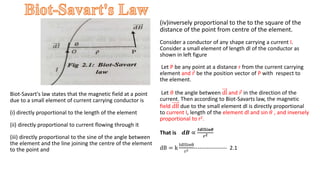
Consider a conductor of any shape carrying a current I.
Consider a small element of length dl of the conductor as
shown in left figure
Let P be any point at a distance r from the current carrying
element and 𝑟 be the position vector of P with respect to
the element.
Let 𝜃 the angle between dl and 𝑟 in the direction of the
current. Then according to Biot-Savarts law, the magnetic
field dB due to the small element dl is directly proportional
to current I, length of the element dl and sin 𝜃 , and inversely
proportional to r2.
That is 𝒅𝑩 ∝
𝑰𝒅𝒍𝑺𝒊𝒏𝜽
𝒓𝟐
dB = k
IdlSinθ
r2 ------------------ 2.1
That is 𝒅𝑩 ∝
𝑰𝒅𝒍𝑺𝒊𝒏𝜽
𝒓𝟐
dB = k
IdlSinθ
r2 ------------------ 2.1
where k is constant of proportionality and its value
depends upon system of units and the medium in which
the conductor is situated. The value of k in S.I. system for
vacuum or air is given as
𝝁𝟎
𝟒𝝅
.
𝜇0 is called the permeability of vacuum or free space.
Using value of k, equation (2.1) becomes
dB =
𝜇0
4𝜋
IdlSinθ
r2
4𝜋 × 10−7𝑊𝑏/𝐴𝑚 𝑜𝑟
𝜇0
4𝜋
= 10−7𝑊𝑏/𝐴𝑚
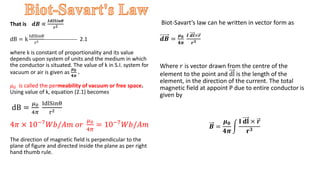
The direction of magnetic field is perpendicular to the
plane of figure and directed inside the plane as per right
hand thumb rule.
Biot-Savart’s law can he written in vector form as
𝒅𝑩 =
𝝁𝟎
𝟒𝝅
𝑰 𝒅𝒍×𝒓
𝒓𝟑
Where 𝑟 is vector drawn from the centre of the
element to the point and dl is the length of the
element, in the direction of the current. The total
magnetic field at appoint P due to entire conductor is
given by
𝑩 =
𝝁𝟎
𝟒𝝅
𝐈 𝐝𝐥 × 𝒓
𝐫𝟑
2.3.1 Magnetic field due to straight current carrying
conductor –
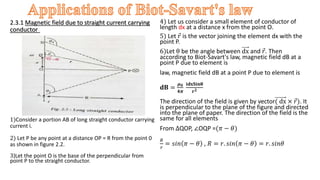
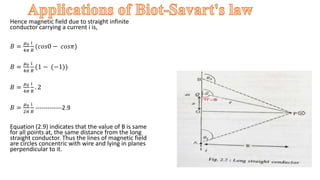
1)Consider a portion AB of long straight conductor carrying
current i.
2) Let P be any point at a distance OP = R from the point 0
as shown in figure 2.2.
3)Let the point O is the base of the perpendicular from
point P to the straight conductor.
4) Let us consider a small element of conductor of
length dx at a distance x from the point O.
5) Let 𝑟 is the vector joining the element dx with the
point P.
6)Let θ be the angle between dx and 𝑟. Then
according to Biot-Savart's law, magnetic field dB at a
point P due to element is
law, magnetic field dB at a point P due to element is
𝐝𝐁 =
𝝁𝟎
𝟒𝝅
𝐢𝐝𝐱𝐒𝐢𝐧𝛉
𝐫𝟐
The direction of the field is given by vector( dx × 𝑟). It
is perpendicular to the plane of the figure and directed
into the plane of paper. The direction of the field is the
same for all elements.
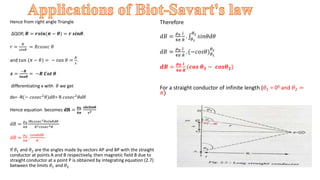
From ∆QOP, ∠OQP =(𝜋 − 𝜃)
𝑅
𝑟
= 𝑠𝑖𝑛 𝜋 − 𝜃 , 𝑅 = 𝑟. 𝑠𝑖𝑛 𝜋 − 𝜃 = 𝑟. 𝑠𝑖𝑛𝜃
Hence from right angle Triangle
∆QOP, 𝑹 = 𝒓𝒔𝒊𝒏(𝝅 − 𝜽) = 𝒓 𝒔𝒊𝒏𝜽.
𝑟 =
𝑅
𝑠𝑖𝑛𝜃
= 𝑅𝑐𝑜𝑠𝑒𝑐 𝜃
and 𝑡𝑎𝑛 (𝜋 − 𝜃) = − 𝑡𝑎𝑛 𝜃 =
𝑅
𝑥
.
𝒙 =
−𝑹
𝒕𝒂𝒏𝜽
= −𝑹 𝑪𝒐𝒕 𝜽
differentiating x with 𝜃 we get
dx= -R(− 𝑐𝑜𝑠𝑒𝑐2
𝜃)𝑑𝜃= R 𝑐𝑜𝑠𝑒𝑐2
𝜃𝑑𝜃
Hence equation becomes 𝐝𝐁 =
𝝁𝟎
𝟒𝝅
𝐢𝐝𝐱𝐒𝐢𝐧𝛉
𝐫𝟐
𝑑𝐵 =
𝜇0
4𝜋
iR𝑐𝑜𝑠𝑒𝑐2𝜃𝑠𝑖𝑛𝜃𝑑𝜃
𝑅2𝑐𝑜𝑠𝑒𝑐2𝜃
𝑑𝐵 =
𝜇0
4𝜋
.
i𝑠𝑖𝑛𝜃𝑑𝜃
𝑅
If 𝜃1 and 𝜃2 are the angles made by vectors AP and BP with the straight
conductor at points A and B respectively, then magnetic field B due to
straight conductor at a point P is obtained by integrating equation (2.7)
between the limits 𝜃1 and 𝜃2
Therefore
𝑑𝐵 =
𝜇0
4𝜋
i
𝑅
. 𝜃1
𝜃2
𝑠𝑖𝑛𝜃𝑑𝜃
𝑑𝐵 =
𝜇0
4𝜋
i
𝑅
. (−𝑐𝑜𝑠𝜃)𝜃1
𝜃2
𝒅𝑩 =
𝝁𝟎
𝟒𝝅
𝐢
𝑹
(𝒄𝒐𝒔 𝜽𝟏 − 𝒄𝒐𝒔𝜽𝟐)
For a straight conductor of infinite length (𝜃1 = 00 and 𝜃2 =
𝜋) .
Hence magnetic field due to straight infinite
conductor carrying a current i is,
𝐵 =
𝜇0
4𝜋
i
𝑅
(𝑐𝑜𝑠0 − 𝑐𝑜𝑠𝜋)
𝐵 =
𝜇0
4𝜋
i
𝑅
(1 − (−1))
𝐵 =
𝜇0
4𝜋
i
𝑅
. 2
𝐵 =
𝜇0
2𝜋
i
𝑅
-------------2.9
Equation (2.9) indicates that the value of B is same
for all points at, the same distance from the long
straight conductor. Thus the lines of magnetic field
are circles concentric with wire and lying in planes
perpendicular to it.
.
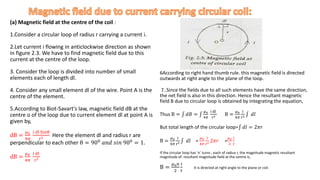
(a) Magnetic field at the centre of the coil :
1.Consider a circular loop of radius r carrying a current i.
2.Let current i flowing in anticlockwise direction as shown
in figure 2.3. We have to find magnetic field due to this
current at the centre of the loop.
3. Consider the loop is divided into number of small
elements each of length dl.
4. Consider any small element dl of the wire. Point A is the
centre of the element.
5.According to Biot-Savart's law, magnetic field dB at the
centre o of the loop due to current element dl at point A is
given by,
dB =
𝜇0
4𝜋
i dl Sinθ
r2 Here the element dl and radius r are
perpendicular to each other θ = 900 𝑎𝑛𝑑 𝑠𝑖𝑛 900 = 1.
dB =
𝜇0
4𝜋
i dl
r2
6According to right hand thumb rule. this magnetic field is directed
outwards at right angle to the plane of the loop.
7..Since the fields due to all such elements have the same direction,
the net field is also in this direction. Hence the resultant magnetic
field B due to circular loop is obtained by integrating the equation,
Thus B = 𝑑𝐵 =
𝜇0
4𝜋
i dl
r2 B =
𝜇0
4𝜋
i
r2 𝑑𝑙
But total length of the circular loop= 𝑑𝑙 = 2𝜋𝑟
B =
𝜇0
4𝜋
i
r2 𝑑𝑙 =
𝜇0
4𝜋
i
r2 2𝜋𝑟 =
𝜇0
2
i
r
If the circular loop has ‘n’ turns , each of radius r, the magnitude magnetic resultant
magnitude of resultant magnitude field at the centre is,
B =
𝜇0𝑛
2
i
r
It is directed at right angle to the plane or coil.
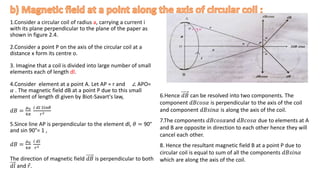
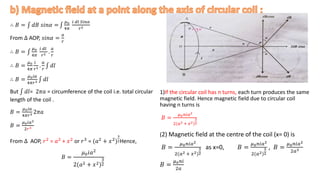
1.Consider a circular coil of radius a, carrying a current i
with its plane perpendicular to the plane of the paper as
shown in figure 2.4.
2.Consider a point P on the axis of the circular coil at a
distance x form its centre o.
3. Imagine that a coil is divided into large number of small
elements each of length dl.
4.Consider element at a point A. Let AP = r and ∠ APO=
𝛼 . The magnetic field dB at a point P due to this small
element of length dl given by Biot-Savart's law,
𝑑𝐵 =
𝜇0
4𝜋
𝑖 𝑑𝑙 𝑆𝑖𝑛𝜃
𝑟2
5.Since line AP is perpendicular to the element dl, 𝜃 = 90°
and sin 90°= 1 ,
𝑑𝐵 =
𝜇0
4𝜋
𝑖 𝑑𝑙
𝑟2
The direction of magnetic field 𝑑𝐵 is perpendicular to both
𝑑𝑙 and 𝑟.
6.Hence 𝑑𝐵 can be resolved into two components. The
component 𝑑𝐵𝑐𝑜𝑠𝛼 is perpendicular to the axis of the coil
and component 𝑑𝐵𝑠𝑖𝑛𝛼 is along the axis of the coil.
7.The components 𝑑𝐵𝑐𝑜𝑠𝛼and 𝑑𝐵𝑐𝑜𝑠𝛼 due to elements at A
and B are opposite in direction to each other hence they will
cancel each other.
8. Hence the resultant magnetic field B at a point P due to
circular coil is equal to sum of all the components 𝑑𝐵𝑠𝑖𝑛𝛼
which are along the axis of the coil.
.
∴ 𝐵 = 𝑑𝐵 𝑠𝑖𝑛𝛼 =
𝜇0
4𝜋
𝑖 𝑑𝑙 𝑆𝑖𝑛𝛼
𝑟2
From ∆ AOP, 𝑠𝑖𝑛𝛼 =
𝑎
𝑟
∴ 𝐵 =
𝜇0
4𝜋
𝑖 𝑑𝑙
𝑟2 .
𝑎
𝑟
∴ 𝐵 =
𝜇0
4𝜋
𝑖
𝑟2 .
𝑎
𝑟
𝑑𝑙
∴ 𝐵 =
𝜇0𝑖𝑎
4𝜋𝑟3 𝑑𝑙
But 𝑑𝑙= 2𝜋𝑎 = circumference of the coil i.e. total circular
length of the coil .
𝐵 =
𝜇0𝑖𝑎
4𝜋𝑟3 2𝜋𝑎
𝐵 =
𝜇0𝑖𝑎2
2𝑟3
From ∆ AOP, 𝑟2
= 𝑎2
+ 𝑥2
or 𝑟3
= (𝑎2
+ 𝑥2
)
3
2Hence,
𝐵 =
𝜇0𝑖𝑎2
2(𝑎2 + 𝑥2)
3
2
1)If the circular coil has n turns, each turn produces the same
magnetic field. Hence magnetic field due to circular coil
having n turns is
𝐵 =
𝜇0𝑛𝑖𝑎2
2(𝑎2 + 𝑥2)
3
2
(2) Magnetic field at the centre of the coil (x= 0) is
𝐵 =
𝜇0𝑛𝑖𝑎2
2(𝑎2 + 𝑥2)
3
2
as x=0, 𝐵 =
𝜇0𝑛𝑖𝑎2
2(𝑎2)
3
2
, 𝐵 =
𝜇0𝑛𝑖𝑎2
2𝑎3
𝐵 =
𝜇0𝑛𝑖
2𝑎
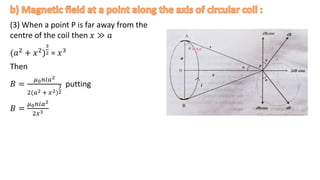
(3) When a point P is far away from the
centre of the coil then 𝑥 ≫ 𝑎
(𝑎2 + 𝑥2)
3
2 = 𝑥3
Then
𝐵 =
𝜇0𝑛𝑖𝑎2
2(𝑎2 + 𝑥2)
3
2
putting
𝐵 =
𝜇0𝑛𝑖𝑎2
2𝑥3 .
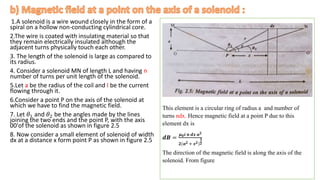
1.A solenoid is a wire wound closely in the form of a
spiral on a hollow non-conducting cylindrical core.
2.The wire is coated with insulating material so that
they remain electrically insulated although the
adjacent turns physically touch each other.
3. The length of the solenoid is large as compared to
its radius.
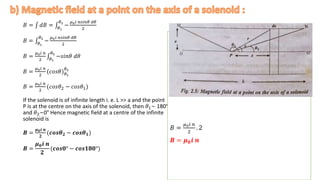
4. Consider a solenoid MN of length L and having n
number of turns per unit length of the solenoid.
5.Let a be the radius of the coil and I be the current
flowing through it.
6.Consider a point P on the axis of the solenoid at
which we have to find the magnetic field.
7. Let 𝜃1 and 𝜃2 be the angles made by the lines
joining the two ends and the point P, with the axis
00'of the solenoid as shown in figure 2.5
8. Now consider a small element of solenoid of width
dx at a distance x form point P as shown in figure 2.5
.
This element is a circular ring of radius a and number of
turns ndx. Hence magnetic field at a point P due to this
element dx is
𝒅𝑩 =
𝝁𝟎𝒊 𝒏 𝒅𝒙 𝒂𝟐
𝟐(𝒂𝟐 + 𝒙𝟐)
𝟑
𝟐
The direction of the magnetic field is along the axis of the
solenoid. From figure
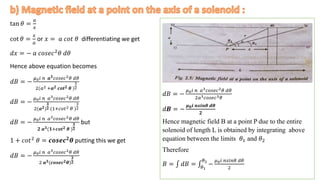
tan 𝜃 =
𝑎
𝑥
cot 𝜃 =
𝑥
𝑎
or 𝑥 = 𝑎 𝑐𝑜𝑡 𝜃 differentiating we get
𝑑𝑥 = − 𝑎 𝑐𝑜𝑠𝑒𝑐2𝜃 𝑑𝜃
Hence above equation becomes
𝑑𝐵 = −
𝜇0𝑖 𝑛 𝒂𝟑𝑐𝑜𝑠𝑒𝑐2𝜃 𝑑𝜃
2(𝑎2 +𝒂𝟐 𝒄𝒐𝒕𝟐 𝜽 )
3
2
𝑑𝐵 = −
𝜇0𝑖 𝑛 𝑎3𝑐𝑜𝑠𝑒𝑐2𝜃 𝑑𝜃
2(𝒂𝟐)
𝟑
𝟐 (1+𝑐𝑜𝑡2 𝜃 )
3
2
𝑑𝐵 = −
𝜇0𝑖 𝑛 𝑎3𝑐𝑜𝑠𝑒𝑐2𝜃 𝑑𝜃
𝟐 𝒂𝟑(𝟏+𝒄𝒐𝒕𝟐 𝜽 )
𝟑
𝟐
but
1 + 𝑐𝑜𝑡2 𝜃 = 𝒄𝒐𝒔𝒆𝒄𝟐𝜽 putting this we get
𝑑𝐵 = −
𝜇0𝑖 𝑛 𝑎3𝑐𝑜𝑠𝑒𝑐2𝜃 𝑑𝜃
2 𝒂𝟑(𝒄𝒐𝒔𝒆𝒄𝟐𝜽)
𝟑
𝟐
.
𝑑𝐵 = −
𝜇0𝑖 𝑛 𝑎3𝑐𝑜𝑠𝑒𝑐2𝜃 𝑑𝜃
2𝑎3𝑐𝑜𝑠𝑒𝑐3𝜃
𝑑𝑩 = −
𝝁𝟎𝒊 𝒏𝒔𝒊𝒏𝜽 𝒅𝜽
𝟐
Hence magnetic field B at a point P due to the entire
solenoid of length L is obtained by integrating above
equation between the limits 𝜃1 and 𝜃2
Therefore
𝐵 = 𝑑𝐵 = 𝜃1
𝜃2
−
𝜇0𝑖 𝑛𝑠𝑖𝑛𝜃 𝑑𝜃
2
𝐵 = 𝑑𝐵 = 𝜃1
𝜃2
−
𝜇0𝑖 𝑛𝑠𝑖𝑛𝜃 𝑑𝜃
2
𝐵 = 𝜃1
𝜃2
−
𝜇0𝑖 𝑛𝑠𝑖𝑛𝜃 𝑑𝜃
2
𝐵 =
𝜇0𝑖 𝑛
2 𝜃1
𝜃2
−𝑠𝑖𝑛𝜃 𝑑𝜃
𝐵 =
𝜇0𝑖 𝑛
2
(𝑐𝑜𝑠𝜃)𝜃1
𝜃2
𝐵 =
𝜇0𝑖 𝑛
2
(𝑐𝑜𝑠𝜃2 − 𝑐𝑜𝑠𝜃1)
If the solenoid is of infinite length i. e. L >> a and the point
P is at the centre on the axis of the solenoid, then 𝜃1~ 180°
and 𝜃2~0° Hence magnetic field at a centre of the infinite
solenoid is
𝑩 =
𝝁𝟎𝒊 𝒏
𝟐
(𝒄𝒐𝒔𝜽𝟐 − 𝒄𝒐𝒔𝜽𝟏)
𝑩 =
𝝁𝟎𝒊 𝒏
𝟐
(𝒄𝒐𝒔𝟎° − 𝒄𝒐𝒔𝟏𝟖𝟎°)
.
𝐵 =
𝜇0𝑖 𝑛
2
. 2
𝑩 = 𝝁𝟎𝒊 𝒏
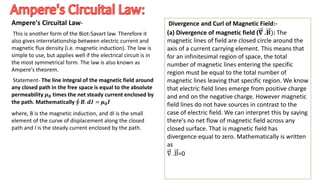
Ampere's Circuital Law-
This is another form of the Biot-Savart law. Therefore it
also gives interrelationship between electric current and
magnetic flux density (i.e. magnetic induction). The law is
simple to use, but applies well if the electrical circuit is in
the most symmetrical form. The law is also known as
Ampere's theorem.
Statement- The line integral of the magnetic field around
any closed path in the free space is equal to the absolute
permeability 𝝁𝟎 times the net steady current enclosed by
the path. Mathematically 𝑩. 𝒅𝑰 = 𝝁𝟎𝑰
where, B is the magnetic induction, and dI is the small
element of the curve of displacement along the closed
path and I is the steady current enclosed by the path.
.
Divergence and Curl of Magnetic Field:-
(a) Divergence of magnetic field (𝛁 .𝐁): The
magnetic lines of field are closed circle around the
axis of a current carrying element. This means that
for an infinitesimal region of space, the total
number of magnetic lines entering the specific
region must be equal to the total number of
magnetic lines leaving that specific region. We know
that electric field lines emerge from positive charge
and end on the negative charge. However magnetic
field lines do not have sources in contrast to the
case of electric field. We can interpret this by saying
there's no net flow of magnetic field across any
closed surface. That is magnetic field has
divergence equal to zero. Mathematically is written
as
∇ .B=0
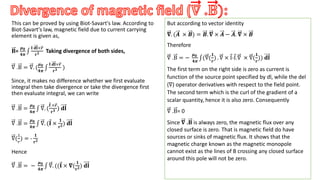
This can be proved by using Biot-Savart's law. According to
Biot-Savart's law, magnetic field due to current carrying
element is given as,
𝐁=
𝝁𝟎
𝟒𝝅
𝐈 𝐝𝐥×𝒓
𝐫𝟑 Taking divergence of both sides,
∇ .B = ∇. (
𝝁𝟎
𝟒𝝅
𝐈 𝐝𝐥×𝒓
𝐫𝟑 )
Since, it makes no difference whether we first evaluate
integral then take divergence or take the divergence first
then evaluate integral, we can write
∇ .B =
𝝁𝟎
𝟒𝝅
∇. (
𝐈 ×𝒓
𝐫𝟑 ) 𝐝𝐥
∇ .B =
𝝁𝟎
𝟒𝝅
∇. (𝐈 ×
𝟏
𝐫𝟐) 𝐝𝐥
∇(
1
𝑟
) = -
𝟏
𝐫𝟐
Hence
∇ .B = −
𝝁𝟎
𝟒𝝅
∇. ((𝐈 × 𝛁(
𝟏
𝐫𝟐) 𝐝𝐥
.
But according to vector identity
𝛁. (𝑨 × 𝑩) = 𝑩. 𝛁 × 𝑨 − 𝑨. 𝛁 × 𝑩
Therefore
∇ .B = −
𝝁𝟎
𝟒𝝅
(∇(
𝟏
𝒓
) . ∇ × I-I.∇ × ∇(
𝟏
𝒓
)) 𝐝𝐥
The first term on the right side is zero as current is
function of the source point specified by dl, while the del
(∇) operator derivatives with respect to the field point.
The second term which is the curl of the gradient of a
scalar quantity, hence it is also zero. Consequently
∇ .B= 0
Since 𝛁 .𝐁 is always zero, the magnetic flux over any
closed surface is zero. That is magnetic field do have
sources or sinks of magnetic flux. It shows that the
magnetic charge known as the magnetic monopole
cannot exist as the lines of B crossing any closed surface
around this pole will not be zero.
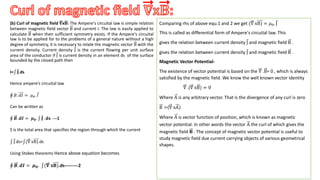
(b) Curl of magnetic field 𝛁x𝐁: The Ampere's circuital law is simple relation
between magnetic field vector B and current I. The law is easily applied to
calculate B when their sufficient symmetry exists. If the Ampere's circuital
law is to be applied for to the problems of a general nature without a high
degree of symmetry, it is necessary to relate the magnetic vector B with the
current density. Current density J is the current flowing per unit surface
area of the conductor if J is current density in an element ds of the surface
bounded by the closed path then
I= 𝐉.ds
Hence ampere’s circuital law
𝐵. 𝑑𝐼 = 𝜇0. 𝐼
Can be written as
𝑩. 𝒅𝑰 = 𝝁𝟎. 𝐉 . 𝐝𝐬 ---1
S is the total area that specifies the region through which the current
J.ds= (∇ xB).ds
Using Stokes theorems Hence above equation becomes
𝑩. 𝒅𝑰 = 𝝁𝟎. (𝛁 𝐱𝐁).ds---------2
.
Comparing rhs of above equ.1 and 2 we get (∇ xB) = 𝜇0. J
This is called as differential form of Ampere's circuital law. This
gives the relation between current density J and magnetic field B .
Magnetic Vector Potential-
The existence of vector potential is based on the ∇ .B= 0 , which is always
satisfied by the magnetic field. We know the well known vector identity
∇ .(∇ xB) = 0
Where A is any arbitrary vector. That is the divergence of any curl is zero
B =(∇ xA)
Where A is vector function of position, which is known as magnetic
vector potential. In other words the vector A the curl of which gives the
magnetic field 𝐁 . The concept of magnetic vector potential is useful to
study magnetic field due current carrying objects of various geometrical
shapes.
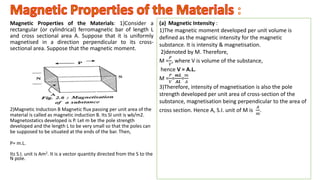
Magnetic Properties of the Materials: 1)Consider a
rectangular (or cylindrical) ferromagnetic bar of length L
and cross sectional area A. Suppose that it is uniformly
magnetised in a direction perpendicular to its cross-
sectional area. Suppose that the magnetic moment.
2)Magnetic Induction B Magnetic flux passing per unit area of the
material is called as magnetic induction B. Its SI unit is wb/m2.
Magnetostatics developed is P. Let m be the pole strength
developed and the length L to be very small so that the poles can
be supposed to be situated at the ends of the bar. Then,
P= m.L.
Its S.I. unit is Am2. It is a vector quantity directed from the S to the
N pole.
.
(a) Magnetic Intensity :
1)The magnetic moment developed per unit volume is
defined as the magnetic intensity for the magnetic
substance. It is intensity & magnetisation.
2)denoted by M. Therefore,
M =
𝑃
𝑉
, where V is volume of the substance,
hence V = A.L.
M =
𝑃
𝑉
=
𝒎𝑳
𝑨𝑳
=
𝑚
𝐴
3)Therefore, intensity of magnetisation is also the pole
strength developed per unit area of cross-section of the
substance, magnetisation being perpendicular to the area of
cross section. Hence A, S.I. unit of M is
𝐴
𝑚
.
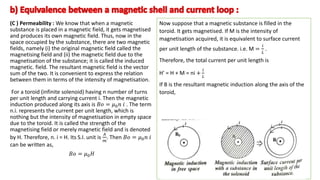
b) Equivalence between a magnetic shell and current loop
:A magnetic shell is a thin magnet of very small length. If
such a magnetic shell of dipole moment Pm and area of
cross section A is placed in a uniform magnetic field of
induction B, with its cross sectional area parallel to the
field, it is acted upon by a torque T = PmB [Fig. 2.7 (a)].
When a conducting loop of area A is carrying current i and
is held in a uniform magnetic field of induction B with its
plane parallel to the field it is acted upon by a torque T' =
B.A.i. [Fig. 2.7 (b)].
If T = T', then Pm=A.i
.
It gives the equivalence between a current loop and a
magnetic shell. A current loop of area A and carrying current
i is equivalent to a magnetic shell of dipole moment Pm = Ai,
directed perpendicular to the plane of the loop and vice-
versa. Hence, the S.I. unit of magnetic dipole moment is
Amt. Extending this analogy, for a magnet, the dipole
moment (Pm) can be equivalently considered to be due to a
coil wound round the magnet with length as the axis and
carrying current it, called the surface current, Hence Pm = A.i,
by equivalence.
M =
𝑃𝑚
𝑉
=
𝐴.𝑖
𝐴.𝐿
=
𝑖
𝐿
Hence, the intensity of magnetisation is also the surface
current per unit length of the magnet, Hence S.I. unit of M
is
𝐴
𝑚
(C ) Permeability : We know that when a magnetic
substance is placed in a magnetic field, it gets magnetised
and produces its own magnetic field. Thus, now in the
space occupied by the substance, there are two magnetic
fields, namely (i) the original magnetic field called the
magnetising field and (ii) the magnetic field due to the
magnetisation of the substance; it is called the induced
magnetic. field. The resultant magnetic field is the vector
sum of the two. It is convenient to express the relation
between them in terms of the intensity of magnetisation.
For a toroid (infinite solenoid) having n number of turns
per unit length and carrying current i. Then the magnetic
induction produced along its axis is 𝐵𝑜 = 𝜇0𝑛 𝑖 . The term
n.i. represents the current per unit length, which is
nothing but the intensity of magnetisation in empty space
due to the toroid. It is called the strength of the
magnetising field or merely magnetic field and is denoted
by H. Therefore, n. i = H. Its S.I. unit is
𝐴
𝑚
. Then 𝐵𝑜 = 𝜇0𝑛 𝑖
can be written as,
𝐵𝑜 = 𝜇0𝐻
.
Now suppose that a magnetic substance is filled in the
toroid. It gets magnetised. If M is the intensity of
magnetisation acquired, it is equivalent to surface current
per unit length of the substance. i.e. M =
𝑖
𝐿
.
Therefore, the total current per unit length is
H' = H + M = ni +
𝑖
𝐿
If B is the resultant magnetic induction along the axis of the
toroid,
B =𝜇0𝐻∙ = 𝜇0 𝐻 + 𝑀
B =𝜇0 𝑛𝑖 + 𝑀
as𝑩0 = 𝜇0𝐻 we write B = 𝜇H , by analogy. 𝜇 is called
the permeability of the magnetic material.
𝜇 =
B
𝐻
Therefore, the permeability of a magnetic material is
the ratio of the magnetic induction produced per
unit magnetising field intensity. Its S.1 unit is
weber/Am.
.
Now,
B
𝐵0
=
𝜇𝐻
𝜇0𝐻
=
𝜇
𝜇0
This ratio is called the relative permeability of the material; it
is denoted by 𝜇 or k. Thus, k =
𝜇
𝜇0
Therefore, the relative
permeability of a magnetic substance is defined as the ratio
of the permeability of the substance to the permeability of
free space. It is characteristic of the material.
B =𝜇0 [ni + M] can be written as,
𝝁 H =𝝁𝟎 (H + M)
(d) Magnetic Susceptibility :
(d) Magnetic Susceptibility : It is defined as the
ratio of the intensity of magnetisation induced in the
magnetic substance to the intensity of the magnetic
field. It is denoted by Magnetic susceptibility = X =
𝑴
𝑯
It is also characteristic of the material. For a given
material it also depends upon the temperature (of the
material). Now, from the Eq. (2.42)
𝜇 H=𝜇0(H+M )
𝜇
𝜇0
H=H+M
KH=H+M
K=1+
𝑀
𝐻
K=1+x
.
is characteristic of the material.
B =𝜇0 [ni + M] can be written as,
𝝁 H =𝝁𝟎 (H + M)

B.Sc.I- Magnetism.pptx

  • 1.
    Introduction:- 1)Magnets are solidobjects of stone, metal, or other material, which has the property of attracting iron- containing materials. 2)This attracting property is either natural, as in the case of lodestone or induced (formed unnatural means). 3)All materials are made up of tiny particles called atoms. 4) Atoms are composed of negatively charged electrons that rotate around the nucleus of atom. 5)The electrons in the atoms of magnetic materials are spinning in the same direction around the nucleus. This causes the material to be magnetic, or attracted to magnets. 6)In each magnetic material there are many different groups of atoms, each forming its own tiny magnet, but these groups are in opposing directions to each other. 7)In a magnet, these groups of atoms are aligned so that all the tiny magnets are pointing in the same direction. This alignment of the groups of atoms is makes the material magnetic. 8)The physicist Danish Hans, Christian Oersted in 1820, discovered that, a wire carrying current causes a deflection of a magnetic needle placed near the wire. 9)He found that when electric current is passed through a conductor, magnetic field is produced around it. The direction of magnetic field is given by right hand rule. 10) The strength of the magnetic field depends upon the current flowing through the conductor. in this chapter we will discuss the magnetic effects of electric current.
  • 2.
    Biot-Savart's law statesthat the magnetic field at a point due to a small element of current carrying conductor is (i) directly proportional to the length of the element (ii) directly proportional to current flowing through it (iii) directly proportional to the sine of the angle between the element and the line joining the centre of the element to the point and (iv)inversely proportional to the to the square of the distance of the point from centre of the element. Consider a conductor of any shape carrying a current I. Consider a small element of length dl of the conductor as shown in left figure Let P be any point at a distance r from the current carrying element and 𝑟 be the position vector of P with respect to the element. Let 𝜃 the angle between dl and 𝑟 in the direction of the current. Then according to Biot-Savarts law, the magnetic field dB due to the small element dl is directly proportional to current I, length of the element dl and sin 𝜃 , and inversely proportional to r2. That is 𝒅𝑩 ∝ 𝑰𝒅𝒍𝑺𝒊𝒏𝜽 𝒓𝟐 dB = k IdlSinθ r2 ------------------ 2.1
  • 3.
    That is 𝒅𝑩∝ 𝑰𝒅𝒍𝑺𝒊𝒏𝜽 𝒓𝟐 dB = k IdlSinθ r2 ------------------ 2.1 where k is constant of proportionality and its value depends upon system of units and the medium in which the conductor is situated. The value of k in S.I. system for vacuum or air is given as 𝝁𝟎 𝟒𝝅 . 𝜇0 is called the permeability of vacuum or free space. Using value of k, equation (2.1) becomes dB = 𝜇0 4𝜋 IdlSinθ r2 4𝜋 × 10−7𝑊𝑏/𝐴𝑚 𝑜𝑟 𝜇0 4𝜋 = 10−7𝑊𝑏/𝐴𝑚 The direction of magnetic field is perpendicular to the plane of figure and directed inside the plane as per right hand thumb rule. Biot-Savart’s law can he written in vector form as 𝒅𝑩 = 𝝁𝟎 𝟒𝝅 𝑰 𝒅𝒍×𝒓 𝒓𝟑 Where 𝑟 is vector drawn from the centre of the element to the point and dl is the length of the element, in the direction of the current. The total magnetic field at appoint P due to entire conductor is given by 𝑩 = 𝝁𝟎 𝟒𝝅 𝐈 𝐝𝐥 × 𝒓 𝐫𝟑
  • 4.
    2.3.1 Magnetic fielddue to straight current carrying conductor – 1)Consider a portion AB of long straight conductor carrying current i. 2) Let P be any point at a distance OP = R from the point 0 as shown in figure 2.2. 3)Let the point O is the base of the perpendicular from point P to the straight conductor. 4) Let us consider a small element of conductor of length dx at a distance x from the point O. 5) Let 𝑟 is the vector joining the element dx with the point P. 6)Let θ be the angle between dx and 𝑟. Then according to Biot-Savart's law, magnetic field dB at a point P due to element is law, magnetic field dB at a point P due to element is 𝐝𝐁 = 𝝁𝟎 𝟒𝝅 𝐢𝐝𝐱𝐒𝐢𝐧𝛉 𝐫𝟐 The direction of the field is given by vector( dx × 𝑟). It is perpendicular to the plane of the figure and directed into the plane of paper. The direction of the field is the same for all elements. From ∆QOP, ∠OQP =(𝜋 − 𝜃) 𝑅 𝑟 = 𝑠𝑖𝑛 𝜋 − 𝜃 , 𝑅 = 𝑟. 𝑠𝑖𝑛 𝜋 − 𝜃 = 𝑟. 𝑠𝑖𝑛𝜃
  • 5.
    Hence from rightangle Triangle ∆QOP, 𝑹 = 𝒓𝒔𝒊𝒏(𝝅 − 𝜽) = 𝒓 𝒔𝒊𝒏𝜽. 𝑟 = 𝑅 𝑠𝑖𝑛𝜃 = 𝑅𝑐𝑜𝑠𝑒𝑐 𝜃 and 𝑡𝑎𝑛 (𝜋 − 𝜃) = − 𝑡𝑎𝑛 𝜃 = 𝑅 𝑥 . 𝒙 = −𝑹 𝒕𝒂𝒏𝜽 = −𝑹 𝑪𝒐𝒕 𝜽 differentiating x with 𝜃 we get dx= -R(− 𝑐𝑜𝑠𝑒𝑐2 𝜃)𝑑𝜃= R 𝑐𝑜𝑠𝑒𝑐2 𝜃𝑑𝜃 Hence equation becomes 𝐝𝐁 = 𝝁𝟎 𝟒𝝅 𝐢𝐝𝐱𝐒𝐢𝐧𝛉 𝐫𝟐 𝑑𝐵 = 𝜇0 4𝜋 iR𝑐𝑜𝑠𝑒𝑐2𝜃𝑠𝑖𝑛𝜃𝑑𝜃 𝑅2𝑐𝑜𝑠𝑒𝑐2𝜃 𝑑𝐵 = 𝜇0 4𝜋 . i𝑠𝑖𝑛𝜃𝑑𝜃 𝑅 If 𝜃1 and 𝜃2 are the angles made by vectors AP and BP with the straight conductor at points A and B respectively, then magnetic field B due to straight conductor at a point P is obtained by integrating equation (2.7) between the limits 𝜃1 and 𝜃2 Therefore 𝑑𝐵 = 𝜇0 4𝜋 i 𝑅 . 𝜃1 𝜃2 𝑠𝑖𝑛𝜃𝑑𝜃 𝑑𝐵 = 𝜇0 4𝜋 i 𝑅 . (−𝑐𝑜𝑠𝜃)𝜃1 𝜃2 𝒅𝑩 = 𝝁𝟎 𝟒𝝅 𝐢 𝑹 (𝒄𝒐𝒔 𝜽𝟏 − 𝒄𝒐𝒔𝜽𝟐) For a straight conductor of infinite length (𝜃1 = 00 and 𝜃2 = 𝜋) .
  • 6.
    Hence magnetic fielddue to straight infinite conductor carrying a current i is, 𝐵 = 𝜇0 4𝜋 i 𝑅 (𝑐𝑜𝑠0 − 𝑐𝑜𝑠𝜋) 𝐵 = 𝜇0 4𝜋 i 𝑅 (1 − (−1)) 𝐵 = 𝜇0 4𝜋 i 𝑅 . 2 𝐵 = 𝜇0 2𝜋 i 𝑅 -------------2.9 Equation (2.9) indicates that the value of B is same for all points at, the same distance from the long straight conductor. Thus the lines of magnetic field are circles concentric with wire and lying in planes perpendicular to it. .
  • 7.
    (a) Magnetic fieldat the centre of the coil : 1.Consider a circular loop of radius r carrying a current i. 2.Let current i flowing in anticlockwise direction as shown in figure 2.3. We have to find magnetic field due to this current at the centre of the loop. 3. Consider the loop is divided into number of small elements each of length dl. 4. Consider any small element dl of the wire. Point A is the centre of the element. 5.According to Biot-Savart's law, magnetic field dB at the centre o of the loop due to current element dl at point A is given by, dB = 𝜇0 4𝜋 i dl Sinθ r2 Here the element dl and radius r are perpendicular to each other θ = 900 𝑎𝑛𝑑 𝑠𝑖𝑛 900 = 1. dB = 𝜇0 4𝜋 i dl r2 6According to right hand thumb rule. this magnetic field is directed outwards at right angle to the plane of the loop. 7..Since the fields due to all such elements have the same direction, the net field is also in this direction. Hence the resultant magnetic field B due to circular loop is obtained by integrating the equation, Thus B = 𝑑𝐵 = 𝜇0 4𝜋 i dl r2 B = 𝜇0 4𝜋 i r2 𝑑𝑙 But total length of the circular loop= 𝑑𝑙 = 2𝜋𝑟 B = 𝜇0 4𝜋 i r2 𝑑𝑙 = 𝜇0 4𝜋 i r2 2𝜋𝑟 = 𝜇0 2 i r If the circular loop has ‘n’ turns , each of radius r, the magnitude magnetic resultant magnitude of resultant magnitude field at the centre is, B = 𝜇0𝑛 2 i r It is directed at right angle to the plane or coil.
  • 8.
    1.Consider a circularcoil of radius a, carrying a current i with its plane perpendicular to the plane of the paper as shown in figure 2.4. 2.Consider a point P on the axis of the circular coil at a distance x form its centre o. 3. Imagine that a coil is divided into large number of small elements each of length dl. 4.Consider element at a point A. Let AP = r and ∠ APO= 𝛼 . The magnetic field dB at a point P due to this small element of length dl given by Biot-Savart's law, 𝑑𝐵 = 𝜇0 4𝜋 𝑖 𝑑𝑙 𝑆𝑖𝑛𝜃 𝑟2 5.Since line AP is perpendicular to the element dl, 𝜃 = 90° and sin 90°= 1 , 𝑑𝐵 = 𝜇0 4𝜋 𝑖 𝑑𝑙 𝑟2 The direction of magnetic field 𝑑𝐵 is perpendicular to both 𝑑𝑙 and 𝑟. 6.Hence 𝑑𝐵 can be resolved into two components. The component 𝑑𝐵𝑐𝑜𝑠𝛼 is perpendicular to the axis of the coil and component 𝑑𝐵𝑠𝑖𝑛𝛼 is along the axis of the coil. 7.The components 𝑑𝐵𝑐𝑜𝑠𝛼and 𝑑𝐵𝑐𝑜𝑠𝛼 due to elements at A and B are opposite in direction to each other hence they will cancel each other. 8. Hence the resultant magnetic field B at a point P due to circular coil is equal to sum of all the components 𝑑𝐵𝑠𝑖𝑛𝛼 which are along the axis of the coil. .
  • 9.
    ∴ 𝐵 =𝑑𝐵 𝑠𝑖𝑛𝛼 = 𝜇0 4𝜋 𝑖 𝑑𝑙 𝑆𝑖𝑛𝛼 𝑟2 From ∆ AOP, 𝑠𝑖𝑛𝛼 = 𝑎 𝑟 ∴ 𝐵 = 𝜇0 4𝜋 𝑖 𝑑𝑙 𝑟2 . 𝑎 𝑟 ∴ 𝐵 = 𝜇0 4𝜋 𝑖 𝑟2 . 𝑎 𝑟 𝑑𝑙 ∴ 𝐵 = 𝜇0𝑖𝑎 4𝜋𝑟3 𝑑𝑙 But 𝑑𝑙= 2𝜋𝑎 = circumference of the coil i.e. total circular length of the coil . 𝐵 = 𝜇0𝑖𝑎 4𝜋𝑟3 2𝜋𝑎 𝐵 = 𝜇0𝑖𝑎2 2𝑟3 From ∆ AOP, 𝑟2 = 𝑎2 + 𝑥2 or 𝑟3 = (𝑎2 + 𝑥2 ) 3 2Hence, 𝐵 = 𝜇0𝑖𝑎2 2(𝑎2 + 𝑥2) 3 2 1)If the circular coil has n turns, each turn produces the same magnetic field. Hence magnetic field due to circular coil having n turns is 𝐵 = 𝜇0𝑛𝑖𝑎2 2(𝑎2 + 𝑥2) 3 2 (2) Magnetic field at the centre of the coil (x= 0) is 𝐵 = 𝜇0𝑛𝑖𝑎2 2(𝑎2 + 𝑥2) 3 2 as x=0, 𝐵 = 𝜇0𝑛𝑖𝑎2 2(𝑎2) 3 2 , 𝐵 = 𝜇0𝑛𝑖𝑎2 2𝑎3 𝐵 = 𝜇0𝑛𝑖 2𝑎
  • 10.
    (3) When apoint P is far away from the centre of the coil then 𝑥 ≫ 𝑎 (𝑎2 + 𝑥2) 3 2 = 𝑥3 Then 𝐵 = 𝜇0𝑛𝑖𝑎2 2(𝑎2 + 𝑥2) 3 2 putting 𝐵 = 𝜇0𝑛𝑖𝑎2 2𝑥3 .
  • 11.
    1.A solenoid isa wire wound closely in the form of a spiral on a hollow non-conducting cylindrical core. 2.The wire is coated with insulating material so that they remain electrically insulated although the adjacent turns physically touch each other. 3. The length of the solenoid is large as compared to its radius. 4. Consider a solenoid MN of length L and having n number of turns per unit length of the solenoid. 5.Let a be the radius of the coil and I be the current flowing through it. 6.Consider a point P on the axis of the solenoid at which we have to find the magnetic field. 7. Let 𝜃1 and 𝜃2 be the angles made by the lines joining the two ends and the point P, with the axis 00'of the solenoid as shown in figure 2.5 8. Now consider a small element of solenoid of width dx at a distance x form point P as shown in figure 2.5 . This element is a circular ring of radius a and number of turns ndx. Hence magnetic field at a point P due to this element dx is 𝒅𝑩 = 𝝁𝟎𝒊 𝒏 𝒅𝒙 𝒂𝟐 𝟐(𝒂𝟐 + 𝒙𝟐) 𝟑 𝟐 The direction of the magnetic field is along the axis of the solenoid. From figure
  • 12.
    tan 𝜃 = 𝑎 𝑥 cot𝜃 = 𝑥 𝑎 or 𝑥 = 𝑎 𝑐𝑜𝑡 𝜃 differentiating we get 𝑑𝑥 = − 𝑎 𝑐𝑜𝑠𝑒𝑐2𝜃 𝑑𝜃 Hence above equation becomes 𝑑𝐵 = − 𝜇0𝑖 𝑛 𝒂𝟑𝑐𝑜𝑠𝑒𝑐2𝜃 𝑑𝜃 2(𝑎2 +𝒂𝟐 𝒄𝒐𝒕𝟐 𝜽 ) 3 2 𝑑𝐵 = − 𝜇0𝑖 𝑛 𝑎3𝑐𝑜𝑠𝑒𝑐2𝜃 𝑑𝜃 2(𝒂𝟐) 𝟑 𝟐 (1+𝑐𝑜𝑡2 𝜃 ) 3 2 𝑑𝐵 = − 𝜇0𝑖 𝑛 𝑎3𝑐𝑜𝑠𝑒𝑐2𝜃 𝑑𝜃 𝟐 𝒂𝟑(𝟏+𝒄𝒐𝒕𝟐 𝜽 ) 𝟑 𝟐 but 1 + 𝑐𝑜𝑡2 𝜃 = 𝒄𝒐𝒔𝒆𝒄𝟐𝜽 putting this we get 𝑑𝐵 = − 𝜇0𝑖 𝑛 𝑎3𝑐𝑜𝑠𝑒𝑐2𝜃 𝑑𝜃 2 𝒂𝟑(𝒄𝒐𝒔𝒆𝒄𝟐𝜽) 𝟑 𝟐 . 𝑑𝐵 = − 𝜇0𝑖 𝑛 𝑎3𝑐𝑜𝑠𝑒𝑐2𝜃 𝑑𝜃 2𝑎3𝑐𝑜𝑠𝑒𝑐3𝜃 𝑑𝑩 = − 𝝁𝟎𝒊 𝒏𝒔𝒊𝒏𝜽 𝒅𝜽 𝟐 Hence magnetic field B at a point P due to the entire solenoid of length L is obtained by integrating above equation between the limits 𝜃1 and 𝜃2 Therefore 𝐵 = 𝑑𝐵 = 𝜃1 𝜃2 − 𝜇0𝑖 𝑛𝑠𝑖𝑛𝜃 𝑑𝜃 2
  • 13.
    𝐵 = 𝑑𝐵= 𝜃1 𝜃2 − 𝜇0𝑖 𝑛𝑠𝑖𝑛𝜃 𝑑𝜃 2 𝐵 = 𝜃1 𝜃2 − 𝜇0𝑖 𝑛𝑠𝑖𝑛𝜃 𝑑𝜃 2 𝐵 = 𝜇0𝑖 𝑛 2 𝜃1 𝜃2 −𝑠𝑖𝑛𝜃 𝑑𝜃 𝐵 = 𝜇0𝑖 𝑛 2 (𝑐𝑜𝑠𝜃)𝜃1 𝜃2 𝐵 = 𝜇0𝑖 𝑛 2 (𝑐𝑜𝑠𝜃2 − 𝑐𝑜𝑠𝜃1) If the solenoid is of infinite length i. e. L >> a and the point P is at the centre on the axis of the solenoid, then 𝜃1~ 180° and 𝜃2~0° Hence magnetic field at a centre of the infinite solenoid is 𝑩 = 𝝁𝟎𝒊 𝒏 𝟐 (𝒄𝒐𝒔𝜽𝟐 − 𝒄𝒐𝒔𝜽𝟏) 𝑩 = 𝝁𝟎𝒊 𝒏 𝟐 (𝒄𝒐𝒔𝟎° − 𝒄𝒐𝒔𝟏𝟖𝟎°) . 𝐵 = 𝜇0𝑖 𝑛 2 . 2 𝑩 = 𝝁𝟎𝒊 𝒏
  • 14.
    Ampere's Circuital Law- Thisis another form of the Biot-Savart law. Therefore it also gives interrelationship between electric current and magnetic flux density (i.e. magnetic induction). The law is simple to use, but applies well if the electrical circuit is in the most symmetrical form. The law is also known as Ampere's theorem. Statement- The line integral of the magnetic field around any closed path in the free space is equal to the absolute permeability 𝝁𝟎 times the net steady current enclosed by the path. Mathematically 𝑩. 𝒅𝑰 = 𝝁𝟎𝑰 where, B is the magnetic induction, and dI is the small element of the curve of displacement along the closed path and I is the steady current enclosed by the path. . Divergence and Curl of Magnetic Field:- (a) Divergence of magnetic field (𝛁 .𝐁): The magnetic lines of field are closed circle around the axis of a current carrying element. This means that for an infinitesimal region of space, the total number of magnetic lines entering the specific region must be equal to the total number of magnetic lines leaving that specific region. We know that electric field lines emerge from positive charge and end on the negative charge. However magnetic field lines do not have sources in contrast to the case of electric field. We can interpret this by saying there's no net flow of magnetic field across any closed surface. That is magnetic field has divergence equal to zero. Mathematically is written as ∇ .B=0
  • 15.
    This can beproved by using Biot-Savart's law. According to Biot-Savart's law, magnetic field due to current carrying element is given as, 𝐁= 𝝁𝟎 𝟒𝝅 𝐈 𝐝𝐥×𝒓 𝐫𝟑 Taking divergence of both sides, ∇ .B = ∇. ( 𝝁𝟎 𝟒𝝅 𝐈 𝐝𝐥×𝒓 𝐫𝟑 ) Since, it makes no difference whether we first evaluate integral then take divergence or take the divergence first then evaluate integral, we can write ∇ .B = 𝝁𝟎 𝟒𝝅 ∇. ( 𝐈 ×𝒓 𝐫𝟑 ) 𝐝𝐥 ∇ .B = 𝝁𝟎 𝟒𝝅 ∇. (𝐈 × 𝟏 𝐫𝟐) 𝐝𝐥 ∇( 1 𝑟 ) = - 𝟏 𝐫𝟐 Hence ∇ .B = − 𝝁𝟎 𝟒𝝅 ∇. ((𝐈 × 𝛁( 𝟏 𝐫𝟐) 𝐝𝐥 . But according to vector identity 𝛁. (𝑨 × 𝑩) = 𝑩. 𝛁 × 𝑨 − 𝑨. 𝛁 × 𝑩 Therefore ∇ .B = − 𝝁𝟎 𝟒𝝅 (∇( 𝟏 𝒓 ) . ∇ × I-I.∇ × ∇( 𝟏 𝒓 )) 𝐝𝐥 The first term on the right side is zero as current is function of the source point specified by dl, while the del (∇) operator derivatives with respect to the field point. The second term which is the curl of the gradient of a scalar quantity, hence it is also zero. Consequently ∇ .B= 0 Since 𝛁 .𝐁 is always zero, the magnetic flux over any closed surface is zero. That is magnetic field do have sources or sinks of magnetic flux. It shows that the magnetic charge known as the magnetic monopole cannot exist as the lines of B crossing any closed surface around this pole will not be zero.
  • 16.
    (b) Curl ofmagnetic field 𝛁x𝐁: The Ampere's circuital law is simple relation between magnetic field vector B and current I. The law is easily applied to calculate B when their sufficient symmetry exists. If the Ampere's circuital law is to be applied for to the problems of a general nature without a high degree of symmetry, it is necessary to relate the magnetic vector B with the current density. Current density J is the current flowing per unit surface area of the conductor if J is current density in an element ds of the surface bounded by the closed path then I= 𝐉.ds Hence ampere’s circuital law 𝐵. 𝑑𝐼 = 𝜇0. 𝐼 Can be written as 𝑩. 𝒅𝑰 = 𝝁𝟎. 𝐉 . 𝐝𝐬 ---1 S is the total area that specifies the region through which the current J.ds= (∇ xB).ds Using Stokes theorems Hence above equation becomes 𝑩. 𝒅𝑰 = 𝝁𝟎. (𝛁 𝐱𝐁).ds---------2 . Comparing rhs of above equ.1 and 2 we get (∇ xB) = 𝜇0. J This is called as differential form of Ampere's circuital law. This gives the relation between current density J and magnetic field B . gives the relation between current density J and magnetic field B . Magnetic Vector Potential- The existence of vector potential is based on the ∇ .B= 0 , which is always satisfied by the magnetic field. We know the well known vector identity ∇ .(∇ xB) = 0 Where A is any arbitrary vector. That is the divergence of any curl is zero B =(∇ xA) Where A is vector function of position, which is known as magnetic vector potential. In other words the vector A the curl of which gives the magnetic field 𝐁 . The concept of magnetic vector potential is useful to study magnetic field due current carrying objects of various geometrical shapes.
  • 17.
    Magnetic Properties ofthe Materials: 1)Consider a rectangular (or cylindrical) ferromagnetic bar of length L and cross sectional area A. Suppose that it is uniformly magnetised in a direction perpendicular to its cross- sectional area. Suppose that the magnetic moment. 2)Magnetic Induction B Magnetic flux passing per unit area of the material is called as magnetic induction B. Its SI unit is wb/m2. Magnetostatics developed is P. Let m be the pole strength developed and the length L to be very small so that the poles can be supposed to be situated at the ends of the bar. Then, P= m.L. Its S.I. unit is Am2. It is a vector quantity directed from the S to the N pole. . (a) Magnetic Intensity : 1)The magnetic moment developed per unit volume is defined as the magnetic intensity for the magnetic substance. It is intensity & magnetisation. 2)denoted by M. Therefore, M = 𝑃 𝑉 , where V is volume of the substance, hence V = A.L. M = 𝑃 𝑉 = 𝒎𝑳 𝑨𝑳 = 𝑚 𝐴 3)Therefore, intensity of magnetisation is also the pole strength developed per unit area of cross-section of the substance, magnetisation being perpendicular to the area of cross section. Hence A, S.I. unit of M is 𝐴 𝑚 .
  • 18.
    b) Equivalence betweena magnetic shell and current loop :A magnetic shell is a thin magnet of very small length. If such a magnetic shell of dipole moment Pm and area of cross section A is placed in a uniform magnetic field of induction B, with its cross sectional area parallel to the field, it is acted upon by a torque T = PmB [Fig. 2.7 (a)]. When a conducting loop of area A is carrying current i and is held in a uniform magnetic field of induction B with its plane parallel to the field it is acted upon by a torque T' = B.A.i. [Fig. 2.7 (b)]. If T = T', then Pm=A.i . It gives the equivalence between a current loop and a magnetic shell. A current loop of area A and carrying current i is equivalent to a magnetic shell of dipole moment Pm = Ai, directed perpendicular to the plane of the loop and vice- versa. Hence, the S.I. unit of magnetic dipole moment is Amt. Extending this analogy, for a magnet, the dipole moment (Pm) can be equivalently considered to be due to a coil wound round the magnet with length as the axis and carrying current it, called the surface current, Hence Pm = A.i, by equivalence. M = 𝑃𝑚 𝑉 = 𝐴.𝑖 𝐴.𝐿 = 𝑖 𝐿 Hence, the intensity of magnetisation is also the surface current per unit length of the magnet, Hence S.I. unit of M is 𝐴 𝑚
  • 19.
    (C ) Permeability: We know that when a magnetic substance is placed in a magnetic field, it gets magnetised and produces its own magnetic field. Thus, now in the space occupied by the substance, there are two magnetic fields, namely (i) the original magnetic field called the magnetising field and (ii) the magnetic field due to the magnetisation of the substance; it is called the induced magnetic. field. The resultant magnetic field is the vector sum of the two. It is convenient to express the relation between them in terms of the intensity of magnetisation. For a toroid (infinite solenoid) having n number of turns per unit length and carrying current i. Then the magnetic induction produced along its axis is 𝐵𝑜 = 𝜇0𝑛 𝑖 . The term n.i. represents the current per unit length, which is nothing but the intensity of magnetisation in empty space due to the toroid. It is called the strength of the magnetising field or merely magnetic field and is denoted by H. Therefore, n. i = H. Its S.I. unit is 𝐴 𝑚 . Then 𝐵𝑜 = 𝜇0𝑛 𝑖 can be written as, 𝐵𝑜 = 𝜇0𝐻 . Now suppose that a magnetic substance is filled in the toroid. It gets magnetised. If M is the intensity of magnetisation acquired, it is equivalent to surface current per unit length of the substance. i.e. M = 𝑖 𝐿 . Therefore, the total current per unit length is H' = H + M = ni + 𝑖 𝐿 If B is the resultant magnetic induction along the axis of the toroid,
  • 20.
    B =𝜇0𝐻∙ =𝜇0 𝐻 + 𝑀 B =𝜇0 𝑛𝑖 + 𝑀 as𝑩0 = 𝜇0𝐻 we write B = 𝜇H , by analogy. 𝜇 is called the permeability of the magnetic material. 𝜇 = B 𝐻 Therefore, the permeability of a magnetic material is the ratio of the magnetic induction produced per unit magnetising field intensity. Its S.1 unit is weber/Am. . Now, B 𝐵0 = 𝜇𝐻 𝜇0𝐻 = 𝜇 𝜇0 This ratio is called the relative permeability of the material; it is denoted by 𝜇 or k. Thus, k = 𝜇 𝜇0 Therefore, the relative permeability of a magnetic substance is defined as the ratio of the permeability of the substance to the permeability of free space. It is characteristic of the material. B =𝜇0 [ni + M] can be written as, 𝝁 H =𝝁𝟎 (H + M)
  • 21.
    (d) Magnetic Susceptibility: (d) Magnetic Susceptibility : It is defined as the ratio of the intensity of magnetisation induced in the magnetic substance to the intensity of the magnetic field. It is denoted by Magnetic susceptibility = X = 𝑴 𝑯 It is also characteristic of the material. For a given material it also depends upon the temperature (of the material). Now, from the Eq. (2.42) 𝜇 H=𝜇0(H+M ) 𝜇 𝜇0 H=H+M KH=H+M K=1+ 𝑀 𝐻 K=1+x . is characteristic of the material. B =𝜇0 [ni + M] can be written as, 𝝁 H =𝝁𝟎 (H + M)