International Research Journal of Engineering and Technology (IRJET) e-ISSN: 2395-0056
Volume: 09 Issue: 05 | May 2022 www.irjet.net p-ISSN: 2395-0072
© 2022, IRJET | Impact Factor value: 7.529 | ISO 9001:2008 Certified Journal | Page 1239
INSOLATION GARNER USING IoT
Ms. R. Poorani1, Ms. P.R. Malavika Thankachy2, Ms. N. Kavipriyamvadha3, Ms. G.
Manochitra4, Mrs. R. Vanitha5
1,2,3,4 UG Scholar, Department of ECE, Hindusthan College of Engineering and Technology, Coimbatore.
5Assistant Professor, Department of ECE, Hindusthan College of Engineering and Technology, Coimbatore,
Tamil Nadu, India.
--------------------------------------------------------------------***-------------------------------------------------------------------
Abstract - Solar insolation is sun radiation converted to
power and injected into the utility network using grid-
connected energy plants. Insolation garner is used to
convert radiation into current and stored in an exceeding
battery. The approach to this idea involves the right solution
to the issues and constraints that other surveillance
technologies have. The goal of this project is to manage the
position of an device to match the movements of the sun.
Because the value of fossil fuels varies, renewable energy is
fast gaining relevance as a source of energy. It's
consequently vital for engineering and technology students
to know and appreciate the technologies related to
renewable energy at the tutorial level. the foremost aim of
this proposed project is to style a low-cost monitoring
system for max electric outlet tracking in photovoltaic (PV)
systems. The designed monitoring board consists of an
embedded board (Arduino UNO based upon Atmega328),
LDR Sensors, etc. The sensor EHS is supposed and fabricated
in CMOS 90 nm technology. The monitored real-time data
are sent to the concerned person's mobile app through IoT.
Here LDR is used to hunt out the sunshine intensity of the
sun and makes the cell communicate the respected side.
Supported the monitored data the users can check easily if
the system works well or not. As a result, we will get a high
amount of current from energy.
Key Words: Internet-of-Things (IoT), Photovoltaic
Systems (PV), Light Dependent Resistor (LDR),
NODEMCU Microcontroller, Solar Panel.
1. INTRODUCTION
Solar energy is renewable energy that's clean in nature
and available in abundance. It's radiant light and warmth
from the Sun that's harnessed by employing a range of
technologies like solar energy to come up with electricity,
solar thermal energy including solar water heating, and
solar architecture. Insolation is the amount of radiation
that's received by a planet. A number of this energy is
absorbed or reflected by the atmosphere if there's one,
and a few reach the surface. When solar radiation hits an
object, a number of the energy will be absorbed while the
remainder is reflected. Generally, the absorbed radiation is
converted to thermal energy, which causes the thing to
heat up. However, in some cases, the incident energy is
often absorbed and converted into another style of energy.
This can be the case in photovoltaic cells used on solar
panels. To maximize output, factors like the geographic
location of solar panels and orientation can be determined
by understanding insolation values. Solar insolation is
wont to provide heat, light, and power for domestic still as
industrial applications. Sun radiations will be converted
into current using differing types of solar cells. Thanks to
the straight forward installation of all necessary
equipment in an exceedingly competitive market,
photovoltaic power is the best and least expensive option
today in remote and rural areas. These are being
employed together with the traditional system in many
developed and developing countries. Now, nowadays,
every soul needs power for his or her quality of life. The
consumption of power is increasing in everyday lives, and
at the identical time, other energy sources are
depreciating day by day. Therefore, to satisfy the ability
demand, other sources of power are required. For the
generation of electricity, there are often two ways first one
is from non-renewable sources, and another one is
renewable sources. Though, solar energy generation
becomes cheaper with advances in conversion technology.
Radiation is also converted directly into electricity by solar
cells (photovoltaic cells). In such cells, a tiny low electric
voltage is generated when light strikes the junction
between a metal and a semiconductor (such as silicon) or
the junction between two different semiconductors. A
solar panel, or solar module, is one component of a
photovoltaic system. They're constructed out of a series of
photovoltaic cells arranged into a panel. They are available
in an exceedingly kind of rectangular shape and are
installed together to generate electricity. Sometimes solar
panels also called photovoltaically, collect energy from the
sun in the shape of sunlight and convert it into electricity
that is often won't to power homes or businesses. These
panels are accustomed to supplement a building's
electricity or provide power at remote locations. To form
the scheme accessible monitoring at the customer level is
that the need of the current. More suitable sources of
energy and in a very few upcoming years may overcome
non-renewable energy sources completely. Solar
technologies convert sunlight into electricity either
through photovoltaic (PV) panels or through mirrors that
concentrate radiation. This energy will be accustomed to
generate electricity or be stored in batteries or thermal
storage. Solar PV system consistently generates enough
International Research Journal of Engineering and Technology (IRJET) e-ISSN: 2395-0056
Volume: 09 Issue: 05 | May 2022 www.irjet.net p-ISSN: 2395-0072
© 2022, IRJET | Impact Factor value: 7.529 | ISO 9001:2008 Certified Journal | Page 1240
amount of power. Non-renewable sources aren't
regenerated naturally after first use like fossil fuels, coal,
gas, and fuel while renewable sources are frequently
utilized again and again which isn't depreciating never like
sun, geothermal, wind energy, and tidal energy.
Alternative energy is, therefore, said to be a sustainable
power source.
2. LITERATURE SURVEY
The sun provides earth with a staggering amount of
energy enough to power the great oceanic and
atmospheric currents, the cycle of evaporation and
condensation that brings freshwater inland. The San
Francisco earthquake of 1906, with a magnitude of 7.8,
released an estimated 1017 joules of energy, the amount
the Sun delivers to Earth in one second. Earth's ultimate
recoverable resource of oil, estimated at 3 trillion barrels,
contains 1.7 × 10²² joules of energy, which the Sun
supplies to Earth in 1.5 days. The number of energy
humans use annually, about 4.6 × 10²⁰ joules, is delivered
to Earth by the Sun in one hour. The enormous power that
the Sun continuously delivers to Earth, 1.2 × 10⁵ Terra
watts, dwarfs every other energy source, renewable or
nonrenewable. Concentrated or not concentrated sunlight
can produce heat for direct use or further conversion to
electricity.
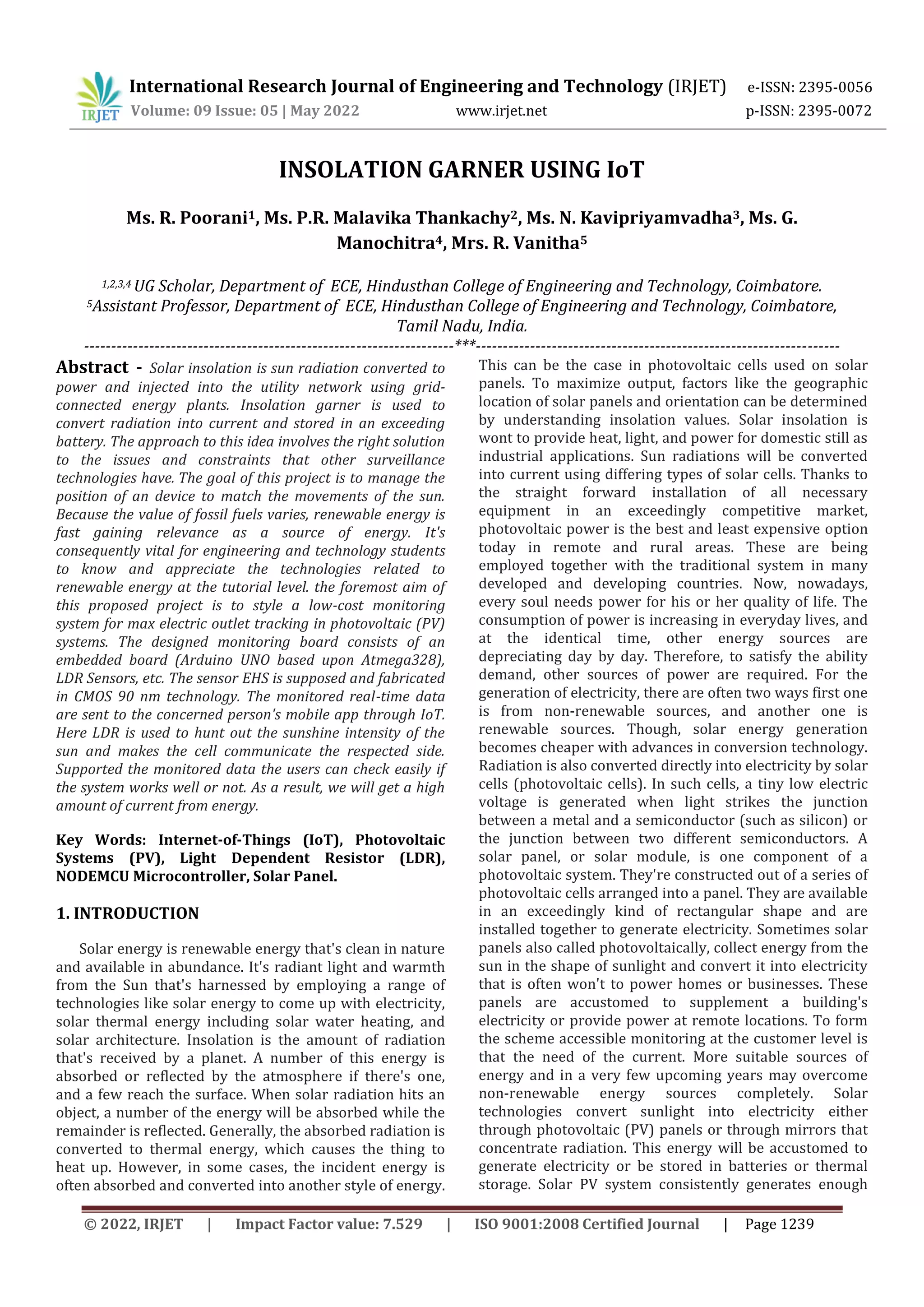
Fig -1: Existing Circuit Diagram of Solar Harvesting
The primary objective of this work is to design an
ultra-low power solar energy harvesting system (SEHS )
with a security mechanism. The reuse of the ring oscillator
(RO) available in EHS as an aging sensor would provide
information about the EHS IC, whether is fresh or
otherwise. These PUF uses less hardware and is cost-
effective. The detailed design process and validation of the
proposed concept are discussed in subsequent sections.
Due to the development of silicon technology, the chip size
is shrinking with time. System-on-a-chip (SOC)
implementation of smart nodes in IoT is a reality and
consumes a small area. The IoT intelligent nodes are SOC
capable of sensing, processing, and transmitting useful
information. The IoT is two-way communication in WSN,
where appropriate decisions are taken and implemented
in real-time. The sensors used in IoT need to be functional
for a prolonged period(maybe tens of years) regardless of
the area of deployment. A continuous power supply
requirement for these end node devices is mandatory.
Usually, small batteries have used that drain out after an
interval. Hence, it demands the design of an uninterrupted
power supply. Therefore, EHS is gaining more attention
from the researcher's perspective. The safety of the EHS
chip is an unexplored domain starting from the fab lab till
deployment. To secure the EHS chip from adverse
scenarios, and during its functioning, PUF is used as
security primitive. The establishment of the Solar Parks
has the potential of reducing the cost of electricity from
solar power. The sensors are used to monitor and collect
information about the climatic condition of the farm like
temperature, humidity, day/night mode, and also to check
the power generated on the field. GSM-based Wireless
Sensor Network (WSN) has the features of high bandwidth
and rate, non-line-transmission ability, large-scale data
collection, and high cost-effectiveness realized with Zigbee.
For the wireless section, GSM type network has been used
because it is a modern wireless sensor network.
3. PROPOSED SYSTEM
In the proposed system, the Arduino microcontroller is
used here to interface with the solar panels and sensors
used. All the data is transmitted to a remote server with
the help of a microcontroller which transfers the data to
the cloud through the Internet of Things. The cloud data is
retrieved by the user using the mobile application. An
array of solar cells can produce maximum electricity if the
solar panel is placed exactly at a right angle to the sun's
rays. The proposed system for monitoring the solar
module using helps to implement a low-cost monitoring
system. The parameters like voltage and temperature are
monitored by using the voltage sensor and temperature
sensor used here, and they are mounted on PV panels and
Power Conditioning Units (PCU). The power produced
from the solar panels is stored in the battery and delivered
this stored power to the corresponding loads. The battery
rating and the number of batteries required depend on the
load requirement. The toggle switch is used for increasing
and decreasing voltage levels. Solar tracking is also a
major feature attached to this system. Which helps to track
the solar panel automatically to the concerning direction.
This helps to store a high amount of renewable energy in
the battery. The motor is attached to the solar panel setup
and 2 LDR sensors are placed which find out the directions
of the sun and its light intensity. Based on that solar panel
moving in their direction is identified. The solar panel
converts the solar energy into electrical energy and is
stored in the battery for our future use. Here toggle for
making manual abnormality for this project. If we have
© 2022, IRJET | Impact Factor value: 7.529 | ISO 9001:2008 Certified Journal | Page 1241
any abnormal voltage fluctuations in the system, the
system detects automatically and also detects the error
and the buzzer will sound, and the gathered information
sent to the Internet of Things. All collected data of voltage,
and temperature sensor is then fed to a microcontroller
which converts the signals into digital using a serial
interface and microcontroller unit acts as a gateway and
sends this data over the cloud server and then this data is
accessed via user over the mobile application. In case any
sensor value varied than an alarm system will also be
turned ON and therefore buzzer sounds.
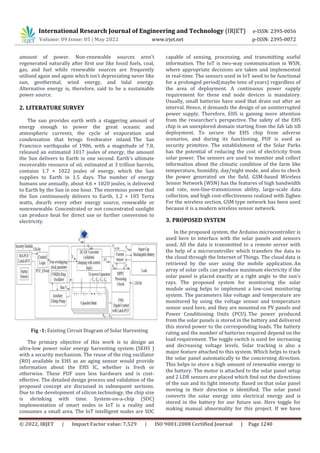
Fig -2: Circuit Diagram of Insolation Garner using IoT
The circuit setup is done as shown in Fig. 2 and all the
connections are made as per the requirement needed. 12V
40RPM Gear motor is fixed with the solar panel grids for
the motion and to and fro rotation of the motor. Since the
battery is considered a main source of the system, so
major concentration is given to the health maintenance of
the battery. The battery value is fixed as a 12V 1.3AH
battery. If any abnormalities happen to like high voltage or
high temperature, the whole system will fail and burst out
due to high temperature. In case of low temperature and
low voltage, the system will slow down the process, but it
will not cause any damage to the other parts of the system.
Nodemcu Microcontroller is fixed to control the entire
system efficiently. The analog pin A0 is given to the
temperature sensor. The input pin D1 in a microcontroller
is connected to the input pin of the drive motor and the
input pin D3 is connected to the LDR and the input pin D4
is connected to the MEMS sensor and another input pin D8
is connected to the buzzer for the output. The output pins
from the drive motor are given as input to the drive motor.
An Embedded C program will be written for the internal
work of the system. It includes delay and timing of buzzer
sound and also the on and off of the alarm system. Light
Dependent Resistor(LDR) is used to observe the sunlight.
Radiation waves from the sun. LDR 1 and LDR 2 are fixed
in either direction of the solar panel to observe the light.
Micro Electro Mechanical System(MEMS) sensor is used
for the rotation of the solar panel according to the sun rays,
the angle is fixed. Thus, we can get a high amount of solar
power without any interruptions and the collected solar
power is converted into electrical energy. The alert system
is also seen on mobile through a cloud and the application
used on the mobile is named blink. Thus, the application
shows the temperature level and voltage level of the
battery, and it is used by the user who is all working on the
installation of the solar panel and also the resource person.
It helps us to easily identify malfunctions in the system.
The converted electrical energy is used for many purposes
like industries, homes for larger areas and smaller areas
without any power cut and there is no need to spend a lot
of money on the non-renewable resources and been a
replacement of coal in upcoming days.
Node MCU microcontroller is used here to interfacing
with solar panels and sensors. Panel voltage is obtained by
applying in voltage sensor in the voltage divider circuit.
The current is sensed by the current sensing circuit and
temperature by the temperature sensor. All the data is
then transmitted to a remote server with the help of a
microcontroller which transfers the data to the cloud
through the Internet of Things. The cloud data is retrieved
by the user using a mobile application called Blink. The
proposed system for monitoring the solar module using
IoT helps to implement a low-cost monitoring system. The
parameter's voltage, current, and temperature are
monitored by using the sensor mounted on the PV panel
and Power Conditioning Units (PCU). For sensing the
voltage, the voltage sensor is used in the methodology, we
can see that the power flow of the model is explained by
that the solar radiance energy. This electrical energy is
then sensed by various sensors such as voltage generated
by the solar panel is sensed by voltage sensor for
measuring voltage. All collected data of voltage, current,
and temperature sensor is then fed to Arduino UNO
microcontroller which converts the signals into digital
using serial interface and microcontroller unit acts as a
gateway and sends this data over the cloud server and
then this data is accessed via user over the mobile
application. In case any sensor value varied then an alarm
system will also be turned ON. Solar tracking is also a
major feature attached to this system. Which helps to track
the solar panel automatically to the concerned direction.
This has been done with the help of LDR and MEMS
sensors. This helps to store a high amount of renewable
energy in the battery.
International Research Journal of Engineering and Technology (IRJET) e-ISSN: 2395-0056
Volume: 09 Issue: 05 | May 2022 www.irjet.net p-ISSN: 2395-0072
© 2022, IRJET | Impact Factor value: 7.529 | ISO 9001:2008 Certified Journal | Page 1242
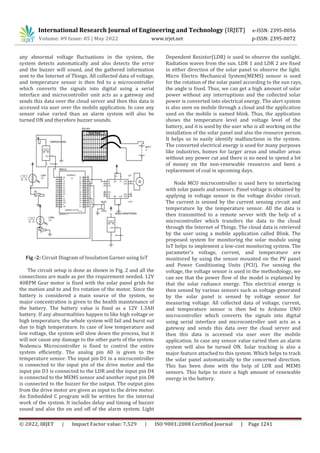
Fig- 3: Block Diagram of Insolation Garner using IoT
The experimental setup is done as shown in Fig.3 and
all the connections are made as per the given above block
diagram. The solar panel, temperature sensor, voltage
sensor, MEMS sensor, LDR1, LDR2, battery, and toggle
switch all components are given as an input to the
microcontroller, and the microcontroller output is given to
the buzzer, motor, and IoT. The obtained output is given to
the IoT and accessed through mobile. Since it is a low-cost
monitoring system, we can get a high efficient amount of
electricity from it. Once the installation process is done in
the area in which the solar panel wants to be fixed. After
installing or fixing the solar panel in the area, only the
maintenance charge and maintenance allowance will be
there, and also less amount of human intervention. This is
a great replacement for coal and all other non-renewable
energy sources. The main advantage of insolation garner is
real-time monitoring of voltage, pressure, temperature,
and current can be monitored.
4. RESULTS AND DISCUSSIONS
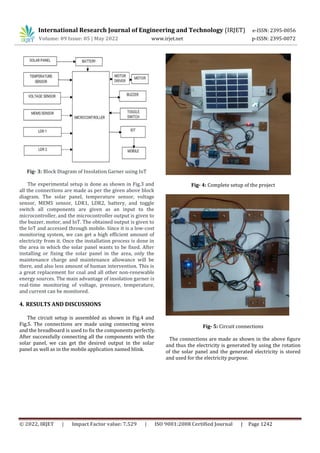
The circuit setup is assembled as shown in Fig.4 and
Fig.5. The connections are made using connecting wires
and the breadboard is used to fix the components perfectly.
After successfully connecting all the components with the
solar panel, we can get the desired output in the solar
panel as well as in the mobile application named blink.
Fig- 4: Complete setup of the project
Fig- 5: Circuit connections
The connections are made as shown in the above figure
and thus the electricity is generated by using the rotation
of the solar panel and the generated electricity is stored
and used for the electricity purpose.
International Research Journal of Engineering and Technology (IRJET) e-ISSN: 2395-0056
Volume: 09 Issue: 05 | May 2022 www.irjet.net p-ISSN: 2395-0072
International Research Journal of Engineering and Technology (IRJET) e-ISSN: 2395-0056
Volume: 09 Issue: 05 | May 2022 www.irjet.net p-ISSN: 2395-0072
© 2022, IRJET | Impact Factor value: 7.529 | ISO 9001:2008 Certified Journal | Page 1243
Fig- 6: The result is shown in the mobile application
Thus the battery voltage and temperature are
measured and the tilt ratio of LDR is also measured using
this mobile application via the IoT module.
5. CONCLUSION AND FUTURE SCOPE
In this project, a low-cost monitoring system for
optimum power tracking in a very photovoltaic module is
meant. The failure of sensor nodes within the IoT may be a
catastrophic situation. Identifying the recycled IC and
securing the EHS(energy harvesting system) IC may be a
challenge. Keeping these facts into consideration, the
proposed secure self-sustainable solar EHS may be a state-
of-the-art technology outcome for clean energy and
handling IoT edge node devices in smart cities and other
related applications. The secure solar EHS has inbuilt PUFs
(a two-stage security mechanism) for securing the IC. The
aging sensor within the chip will help in identifying the
recycled EHS chips. The upper bias voltages required are
generated on-chip, such no external bias is required. The
secure self-sustainable alternative energy harvesting
system (solar EHS ) designed is compatible with a
minimum voltage of 1.22V as MPP within the range of 1-
1.5 V. The resulting output is within the range of 3-3.55 V,
which is the requirement of the many IoT edge node
devices. The IoT technique is employed to watch data like
voltage and temperature levels of a solar photovoltaic
system. This technology makes it possible particularly to
enhance the monitoring, performance, and maintenance of
the photovoltaic system. The designed system can analyze
and or check the status of parameters being measured in a
very photovoltaic system. Solar tracking was also done
successfully. For very large solar arrays dual-axis solar
panel tracking is done. By analyzing the information it's
possible to predict the longer-term values of parameters.
Computer science is often implemented using various
machine learning algorithms so that the system can
become smart enough to form decisions about data and
performance.
REFERENCES
[1] Saswat Kumar Ram, Sauvagya Ranjan Sahoo, Banee
Bandana Das, Kamalakanta Mahapatra, Saraju
P.Mohanty “Eternal-Thing: A Secure Aging-Aware
Solar Energy Harvester Thing for Sustainable IoT”,
IEEE-2021.
[2] Jayendra R. Thakur, Harshita Ambre "Solar Energy:
Potential and Policies of India", IRJET 2020.
[3] Aravind Bharadwaj, Bindu BS, Manasa Rao G R,
Shalini K N, Mrs. Manjula BK "Solar Power
Generation, Utilization and Monitoring Using
Internet of Things", -2020.
[4] Amit Bhosale, Aditya Iyer, Kunal Jadhav, Omkar
Karekar, Dr. Subha Subramaniam, Prof. Santosh
Kamble "Energy Generation and Saving using Non-
Conventional Energy Source", -2020.
[5] Aishwarya Awhad, Suraj Dudhe, Saurabh Mohta,
"Research of Solar Panel System for Future Scope",
IRJET-2020.
[6] W. Energy, "Executive Summary of the World Energy
Investment, 2018," Int. Energy Agency, 2018.
[7] L. Bouselham, B. Hajji, A. Mellit, A. Rabhi, A. Mazari,
"A Reconfigurable PV Architecture Based on New
Irradiance Equalization Algorithm". In
International Conference on Electronic Engineering
and Renewable Energy, Springer, Singapore. pp.
470- 477, 2018.
[8] S. Patil, M. Vijayalashmi, R. Tapaskar, "Solar energy
monitoring system using IoT”, Indian J.Sci.Res,
Vol. 15,pp .149- 155, 2017.
[9] S. Made, and S. Singh" Monitoring system for
photovoltaic plant: A review". Renewable and
Sustainable Energy Reviews, Vol.67, pp.1180-
1207.,2017.
[10] Carlos D. Rodríguez-Gallegos , Oktoviano Gandhi , S.
K. Panda , and Thomas Reindl,“On the PV Tracker
Performance: Tracking the SunVersus Tracking the
Best Orientation” 2020,IEEE journal of
photovoltaics.
International Research Journal of Engineering and Technology (IRJET) e-ISSN: 2395-0056
Volume: 09 Issue: 05 | May 2022 www.irjet.net p-ISSN: 2395-0072
© 2022, IRJET | Impact Factor value: 7.529 | ISO 9001:2008 Certified Journal | Page 1244
[11] Karen Barbosa de Melo, Lucas Ramos Tavares,
Marcelo Gradella Villalva, "Statistical Analysis of
Solar Position Calculation Algorithms: SPA and
Grena 1"-5, IEEE Latin transactions, Vol 19, No.7,
July 2021.
[12] Kuldeep Jayaswal, G.S.Sharma, "Global Solar
Insolation Estimation and Investigation: A Case
Study of Various Nations and Cities", 2021 and
IEEE ACCESS.
[13] Mahdi saeedi, "Anew design of dual-axis solar
tracking system with LDR sensors by using
Wheatstone bridge circuits", 2021, IEEE sensors
journal.
[14] L. Chen, S. Li, and X. Wang, “Quickest fault detection
in photovoltaic systems,” IEEE Trans. Smart Grid,
vol. 9, no. 3, pp. 1835–1847, May 2018.

INSOLATION GARNER USING IoT

  • 1.
    International Research Journalof Engineering and Technology (IRJET) e-ISSN: 2395-0056 Volume: 09 Issue: 05 | May 2022 www.irjet.net p-ISSN: 2395-0072 © 2022, IRJET | Impact Factor value: 7.529 | ISO 9001:2008 Certified Journal | Page 1239 INSOLATION GARNER USING IoT Ms. R. Poorani1, Ms. P.R. Malavika Thankachy2, Ms. N. Kavipriyamvadha3, Ms. G. Manochitra4, Mrs. R. Vanitha5 1,2,3,4 UG Scholar, Department of ECE, Hindusthan College of Engineering and Technology, Coimbatore. 5Assistant Professor, Department of ECE, Hindusthan College of Engineering and Technology, Coimbatore, Tamil Nadu, India. --------------------------------------------------------------------***------------------------------------------------------------------- Abstract - Solar insolation is sun radiation converted to power and injected into the utility network using grid- connected energy plants. Insolation garner is used to convert radiation into current and stored in an exceeding battery. The approach to this idea involves the right solution to the issues and constraints that other surveillance technologies have. The goal of this project is to manage the position of an device to match the movements of the sun. Because the value of fossil fuels varies, renewable energy is fast gaining relevance as a source of energy. It's consequently vital for engineering and technology students to know and appreciate the technologies related to renewable energy at the tutorial level. the foremost aim of this proposed project is to style a low-cost monitoring system for max electric outlet tracking in photovoltaic (PV) systems. The designed monitoring board consists of an embedded board (Arduino UNO based upon Atmega328), LDR Sensors, etc. The sensor EHS is supposed and fabricated in CMOS 90 nm technology. The monitored real-time data are sent to the concerned person's mobile app through IoT. Here LDR is used to hunt out the sunshine intensity of the sun and makes the cell communicate the respected side. Supported the monitored data the users can check easily if the system works well or not. As a result, we will get a high amount of current from energy. Key Words: Internet-of-Things (IoT), Photovoltaic Systems (PV), Light Dependent Resistor (LDR), NODEMCU Microcontroller, Solar Panel. 1. INTRODUCTION Solar energy is renewable energy that's clean in nature and available in abundance. It's radiant light and warmth from the Sun that's harnessed by employing a range of technologies like solar energy to come up with electricity, solar thermal energy including solar water heating, and solar architecture. Insolation is the amount of radiation that's received by a planet. A number of this energy is absorbed or reflected by the atmosphere if there's one, and a few reach the surface. When solar radiation hits an object, a number of the energy will be absorbed while the remainder is reflected. Generally, the absorbed radiation is converted to thermal energy, which causes the thing to heat up. However, in some cases, the incident energy is often absorbed and converted into another style of energy. This can be the case in photovoltaic cells used on solar panels. To maximize output, factors like the geographic location of solar panels and orientation can be determined by understanding insolation values. Solar insolation is wont to provide heat, light, and power for domestic still as industrial applications. Sun radiations will be converted into current using differing types of solar cells. Thanks to the straight forward installation of all necessary equipment in an exceedingly competitive market, photovoltaic power is the best and least expensive option today in remote and rural areas. These are being employed together with the traditional system in many developed and developing countries. Now, nowadays, every soul needs power for his or her quality of life. The consumption of power is increasing in everyday lives, and at the identical time, other energy sources are depreciating day by day. Therefore, to satisfy the ability demand, other sources of power are required. For the generation of electricity, there are often two ways first one is from non-renewable sources, and another one is renewable sources. Though, solar energy generation becomes cheaper with advances in conversion technology. Radiation is also converted directly into electricity by solar cells (photovoltaic cells). In such cells, a tiny low electric voltage is generated when light strikes the junction between a metal and a semiconductor (such as silicon) or the junction between two different semiconductors. A solar panel, or solar module, is one component of a photovoltaic system. They're constructed out of a series of photovoltaic cells arranged into a panel. They are available in an exceedingly kind of rectangular shape and are installed together to generate electricity. Sometimes solar panels also called photovoltaically, collect energy from the sun in the shape of sunlight and convert it into electricity that is often won't to power homes or businesses. These panels are accustomed to supplement a building's electricity or provide power at remote locations. To form the scheme accessible monitoring at the customer level is that the need of the current. More suitable sources of energy and in a very few upcoming years may overcome non-renewable energy sources completely. Solar technologies convert sunlight into electricity either through photovoltaic (PV) panels or through mirrors that concentrate radiation. This energy will be accustomed to generate electricity or be stored in batteries or thermal storage. Solar PV system consistently generates enough
  • 2.
    International Research Journalof Engineering and Technology (IRJET) e-ISSN: 2395-0056 Volume: 09 Issue: 05 | May 2022 www.irjet.net p-ISSN: 2395-0072 © 2022, IRJET | Impact Factor value: 7.529 | ISO 9001:2008 Certified Journal | Page 1240 amount of power. Non-renewable sources aren't regenerated naturally after first use like fossil fuels, coal, gas, and fuel while renewable sources are frequently utilized again and again which isn't depreciating never like sun, geothermal, wind energy, and tidal energy. Alternative energy is, therefore, said to be a sustainable power source. 2. LITERATURE SURVEY The sun provides earth with a staggering amount of energy enough to power the great oceanic and atmospheric currents, the cycle of evaporation and condensation that brings freshwater inland. The San Francisco earthquake of 1906, with a magnitude of 7.8, released an estimated 1017 joules of energy, the amount the Sun delivers to Earth in one second. Earth's ultimate recoverable resource of oil, estimated at 3 trillion barrels, contains 1.7 × 10²² joules of energy, which the Sun supplies to Earth in 1.5 days. The number of energy humans use annually, about 4.6 × 10²⁰ joules, is delivered to Earth by the Sun in one hour. The enormous power that the Sun continuously delivers to Earth, 1.2 × 10⁵ Terra watts, dwarfs every other energy source, renewable or nonrenewable. Concentrated or not concentrated sunlight can produce heat for direct use or further conversion to electricity. Fig -1: Existing Circuit Diagram of Solar Harvesting The primary objective of this work is to design an ultra-low power solar energy harvesting system (SEHS ) with a security mechanism. The reuse of the ring oscillator (RO) available in EHS as an aging sensor would provide information about the EHS IC, whether is fresh or otherwise. These PUF uses less hardware and is cost- effective. The detailed design process and validation of the proposed concept are discussed in subsequent sections. Due to the development of silicon technology, the chip size is shrinking with time. System-on-a-chip (SOC) implementation of smart nodes in IoT is a reality and consumes a small area. The IoT intelligent nodes are SOC capable of sensing, processing, and transmitting useful information. The IoT is two-way communication in WSN, where appropriate decisions are taken and implemented in real-time. The sensors used in IoT need to be functional for a prolonged period(maybe tens of years) regardless of the area of deployment. A continuous power supply requirement for these end node devices is mandatory. Usually, small batteries have used that drain out after an interval. Hence, it demands the design of an uninterrupted power supply. Therefore, EHS is gaining more attention from the researcher's perspective. The safety of the EHS chip is an unexplored domain starting from the fab lab till deployment. To secure the EHS chip from adverse scenarios, and during its functioning, PUF is used as security primitive. The establishment of the Solar Parks has the potential of reducing the cost of electricity from solar power. The sensors are used to monitor and collect information about the climatic condition of the farm like temperature, humidity, day/night mode, and also to check the power generated on the field. GSM-based Wireless Sensor Network (WSN) has the features of high bandwidth and rate, non-line-transmission ability, large-scale data collection, and high cost-effectiveness realized with Zigbee. For the wireless section, GSM type network has been used because it is a modern wireless sensor network. 3. PROPOSED SYSTEM In the proposed system, the Arduino microcontroller is used here to interface with the solar panels and sensors used. All the data is transmitted to a remote server with the help of a microcontroller which transfers the data to the cloud through the Internet of Things. The cloud data is retrieved by the user using the mobile application. An array of solar cells can produce maximum electricity if the solar panel is placed exactly at a right angle to the sun's rays. The proposed system for monitoring the solar module using helps to implement a low-cost monitoring system. The parameters like voltage and temperature are monitored by using the voltage sensor and temperature sensor used here, and they are mounted on PV panels and Power Conditioning Units (PCU). The power produced from the solar panels is stored in the battery and delivered this stored power to the corresponding loads. The battery rating and the number of batteries required depend on the load requirement. The toggle switch is used for increasing and decreasing voltage levels. Solar tracking is also a major feature attached to this system. Which helps to track the solar panel automatically to the concerning direction. This helps to store a high amount of renewable energy in the battery. The motor is attached to the solar panel setup and 2 LDR sensors are placed which find out the directions of the sun and its light intensity. Based on that solar panel moving in their direction is identified. The solar panel converts the solar energy into electrical energy and is stored in the battery for our future use. Here toggle for making manual abnormality for this project. If we have
  • 3.
    © 2022, IRJET| Impact Factor value: 7.529 | ISO 9001:2008 Certified Journal | Page 1241 any abnormal voltage fluctuations in the system, the system detects automatically and also detects the error and the buzzer will sound, and the gathered information sent to the Internet of Things. All collected data of voltage, and temperature sensor is then fed to a microcontroller which converts the signals into digital using a serial interface and microcontroller unit acts as a gateway and sends this data over the cloud server and then this data is accessed via user over the mobile application. In case any sensor value varied than an alarm system will also be turned ON and therefore buzzer sounds. Fig -2: Circuit Diagram of Insolation Garner using IoT The circuit setup is done as shown in Fig. 2 and all the connections are made as per the requirement needed. 12V 40RPM Gear motor is fixed with the solar panel grids for the motion and to and fro rotation of the motor. Since the battery is considered a main source of the system, so major concentration is given to the health maintenance of the battery. The battery value is fixed as a 12V 1.3AH battery. If any abnormalities happen to like high voltage or high temperature, the whole system will fail and burst out due to high temperature. In case of low temperature and low voltage, the system will slow down the process, but it will not cause any damage to the other parts of the system. Nodemcu Microcontroller is fixed to control the entire system efficiently. The analog pin A0 is given to the temperature sensor. The input pin D1 in a microcontroller is connected to the input pin of the drive motor and the input pin D3 is connected to the LDR and the input pin D4 is connected to the MEMS sensor and another input pin D8 is connected to the buzzer for the output. The output pins from the drive motor are given as input to the drive motor. An Embedded C program will be written for the internal work of the system. It includes delay and timing of buzzer sound and also the on and off of the alarm system. Light Dependent Resistor(LDR) is used to observe the sunlight. Radiation waves from the sun. LDR 1 and LDR 2 are fixed in either direction of the solar panel to observe the light. Micro Electro Mechanical System(MEMS) sensor is used for the rotation of the solar panel according to the sun rays, the angle is fixed. Thus, we can get a high amount of solar power without any interruptions and the collected solar power is converted into electrical energy. The alert system is also seen on mobile through a cloud and the application used on the mobile is named blink. Thus, the application shows the temperature level and voltage level of the battery, and it is used by the user who is all working on the installation of the solar panel and also the resource person. It helps us to easily identify malfunctions in the system. The converted electrical energy is used for many purposes like industries, homes for larger areas and smaller areas without any power cut and there is no need to spend a lot of money on the non-renewable resources and been a replacement of coal in upcoming days. Node MCU microcontroller is used here to interfacing with solar panels and sensors. Panel voltage is obtained by applying in voltage sensor in the voltage divider circuit. The current is sensed by the current sensing circuit and temperature by the temperature sensor. All the data is then transmitted to a remote server with the help of a microcontroller which transfers the data to the cloud through the Internet of Things. The cloud data is retrieved by the user using a mobile application called Blink. The proposed system for monitoring the solar module using IoT helps to implement a low-cost monitoring system. The parameter's voltage, current, and temperature are monitored by using the sensor mounted on the PV panel and Power Conditioning Units (PCU). For sensing the voltage, the voltage sensor is used in the methodology, we can see that the power flow of the model is explained by that the solar radiance energy. This electrical energy is then sensed by various sensors such as voltage generated by the solar panel is sensed by voltage sensor for measuring voltage. All collected data of voltage, current, and temperature sensor is then fed to Arduino UNO microcontroller which converts the signals into digital using serial interface and microcontroller unit acts as a gateway and sends this data over the cloud server and then this data is accessed via user over the mobile application. In case any sensor value varied then an alarm system will also be turned ON. Solar tracking is also a major feature attached to this system. Which helps to track the solar panel automatically to the concerned direction. This has been done with the help of LDR and MEMS sensors. This helps to store a high amount of renewable energy in the battery. International Research Journal of Engineering and Technology (IRJET) e-ISSN: 2395-0056 Volume: 09 Issue: 05 | May 2022 www.irjet.net p-ISSN: 2395-0072
  • 4.
    © 2022, IRJET| Impact Factor value: 7.529 | ISO 9001:2008 Certified Journal | Page 1242 Fig- 3: Block Diagram of Insolation Garner using IoT The experimental setup is done as shown in Fig.3 and all the connections are made as per the given above block diagram. The solar panel, temperature sensor, voltage sensor, MEMS sensor, LDR1, LDR2, battery, and toggle switch all components are given as an input to the microcontroller, and the microcontroller output is given to the buzzer, motor, and IoT. The obtained output is given to the IoT and accessed through mobile. Since it is a low-cost monitoring system, we can get a high efficient amount of electricity from it. Once the installation process is done in the area in which the solar panel wants to be fixed. After installing or fixing the solar panel in the area, only the maintenance charge and maintenance allowance will be there, and also less amount of human intervention. This is a great replacement for coal and all other non-renewable energy sources. The main advantage of insolation garner is real-time monitoring of voltage, pressure, temperature, and current can be monitored. 4. RESULTS AND DISCUSSIONS The circuit setup is assembled as shown in Fig.4 and Fig.5. The connections are made using connecting wires and the breadboard is used to fix the components perfectly. After successfully connecting all the components with the solar panel, we can get the desired output in the solar panel as well as in the mobile application named blink. Fig- 4: Complete setup of the project Fig- 5: Circuit connections The connections are made as shown in the above figure and thus the electricity is generated by using the rotation of the solar panel and the generated electricity is stored and used for the electricity purpose. International Research Journal of Engineering and Technology (IRJET) e-ISSN: 2395-0056 Volume: 09 Issue: 05 | May 2022 www.irjet.net p-ISSN: 2395-0072
  • 5.
    International Research Journalof Engineering and Technology (IRJET) e-ISSN: 2395-0056 Volume: 09 Issue: 05 | May 2022 www.irjet.net p-ISSN: 2395-0072 © 2022, IRJET | Impact Factor value: 7.529 | ISO 9001:2008 Certified Journal | Page 1243 Fig- 6: The result is shown in the mobile application Thus the battery voltage and temperature are measured and the tilt ratio of LDR is also measured using this mobile application via the IoT module. 5. CONCLUSION AND FUTURE SCOPE In this project, a low-cost monitoring system for optimum power tracking in a very photovoltaic module is meant. The failure of sensor nodes within the IoT may be a catastrophic situation. Identifying the recycled IC and securing the EHS(energy harvesting system) IC may be a challenge. Keeping these facts into consideration, the proposed secure self-sustainable solar EHS may be a state- of-the-art technology outcome for clean energy and handling IoT edge node devices in smart cities and other related applications. The secure solar EHS has inbuilt PUFs (a two-stage security mechanism) for securing the IC. The aging sensor within the chip will help in identifying the recycled EHS chips. The upper bias voltages required are generated on-chip, such no external bias is required. The secure self-sustainable alternative energy harvesting system (solar EHS ) designed is compatible with a minimum voltage of 1.22V as MPP within the range of 1- 1.5 V. The resulting output is within the range of 3-3.55 V, which is the requirement of the many IoT edge node devices. The IoT technique is employed to watch data like voltage and temperature levels of a solar photovoltaic system. This technology makes it possible particularly to enhance the monitoring, performance, and maintenance of the photovoltaic system. The designed system can analyze and or check the status of parameters being measured in a very photovoltaic system. Solar tracking was also done successfully. For very large solar arrays dual-axis solar panel tracking is done. By analyzing the information it's possible to predict the longer-term values of parameters. Computer science is often implemented using various machine learning algorithms so that the system can become smart enough to form decisions about data and performance. REFERENCES [1] Saswat Kumar Ram, Sauvagya Ranjan Sahoo, Banee Bandana Das, Kamalakanta Mahapatra, Saraju P.Mohanty “Eternal-Thing: A Secure Aging-Aware Solar Energy Harvester Thing for Sustainable IoT”, IEEE-2021. [2] Jayendra R. Thakur, Harshita Ambre "Solar Energy: Potential and Policies of India", IRJET 2020. [3] Aravind Bharadwaj, Bindu BS, Manasa Rao G R, Shalini K N, Mrs. Manjula BK "Solar Power Generation, Utilization and Monitoring Using Internet of Things", -2020. [4] Amit Bhosale, Aditya Iyer, Kunal Jadhav, Omkar Karekar, Dr. Subha Subramaniam, Prof. Santosh Kamble "Energy Generation and Saving using Non- Conventional Energy Source", -2020. [5] Aishwarya Awhad, Suraj Dudhe, Saurabh Mohta, "Research of Solar Panel System for Future Scope", IRJET-2020. [6] W. Energy, "Executive Summary of the World Energy Investment, 2018," Int. Energy Agency, 2018. [7] L. Bouselham, B. Hajji, A. Mellit, A. Rabhi, A. Mazari, "A Reconfigurable PV Architecture Based on New Irradiance Equalization Algorithm". In International Conference on Electronic Engineering and Renewable Energy, Springer, Singapore. pp. 470- 477, 2018. [8] S. Patil, M. Vijayalashmi, R. Tapaskar, "Solar energy monitoring system using IoT”, Indian J.Sci.Res, Vol. 15,pp .149- 155, 2017. [9] S. Made, and S. Singh" Monitoring system for photovoltaic plant: A review". Renewable and Sustainable Energy Reviews, Vol.67, pp.1180- 1207.,2017. [10] Carlos D. Rodríguez-Gallegos , Oktoviano Gandhi , S. K. Panda , and Thomas Reindl,“On the PV Tracker Performance: Tracking the SunVersus Tracking the Best Orientation” 2020,IEEE journal of photovoltaics.
  • 6.
    International Research Journalof Engineering and Technology (IRJET) e-ISSN: 2395-0056 Volume: 09 Issue: 05 | May 2022 www.irjet.net p-ISSN: 2395-0072 © 2022, IRJET | Impact Factor value: 7.529 | ISO 9001:2008 Certified Journal | Page 1244 [11] Karen Barbosa de Melo, Lucas Ramos Tavares, Marcelo Gradella Villalva, "Statistical Analysis of Solar Position Calculation Algorithms: SPA and Grena 1"-5, IEEE Latin transactions, Vol 19, No.7, July 2021. [12] Kuldeep Jayaswal, G.S.Sharma, "Global Solar Insolation Estimation and Investigation: A Case Study of Various Nations and Cities", 2021 and IEEE ACCESS. [13] Mahdi saeedi, "Anew design of dual-axis solar tracking system with LDR sensors by using Wheatstone bridge circuits", 2021, IEEE sensors journal. [14] L. Chen, S. Li, and X. Wang, “Quickest fault detection in photovoltaic systems,” IEEE Trans. Smart Grid, vol. 9, no. 3, pp. 1835–1847, May 2018.