By Kelsey Baker
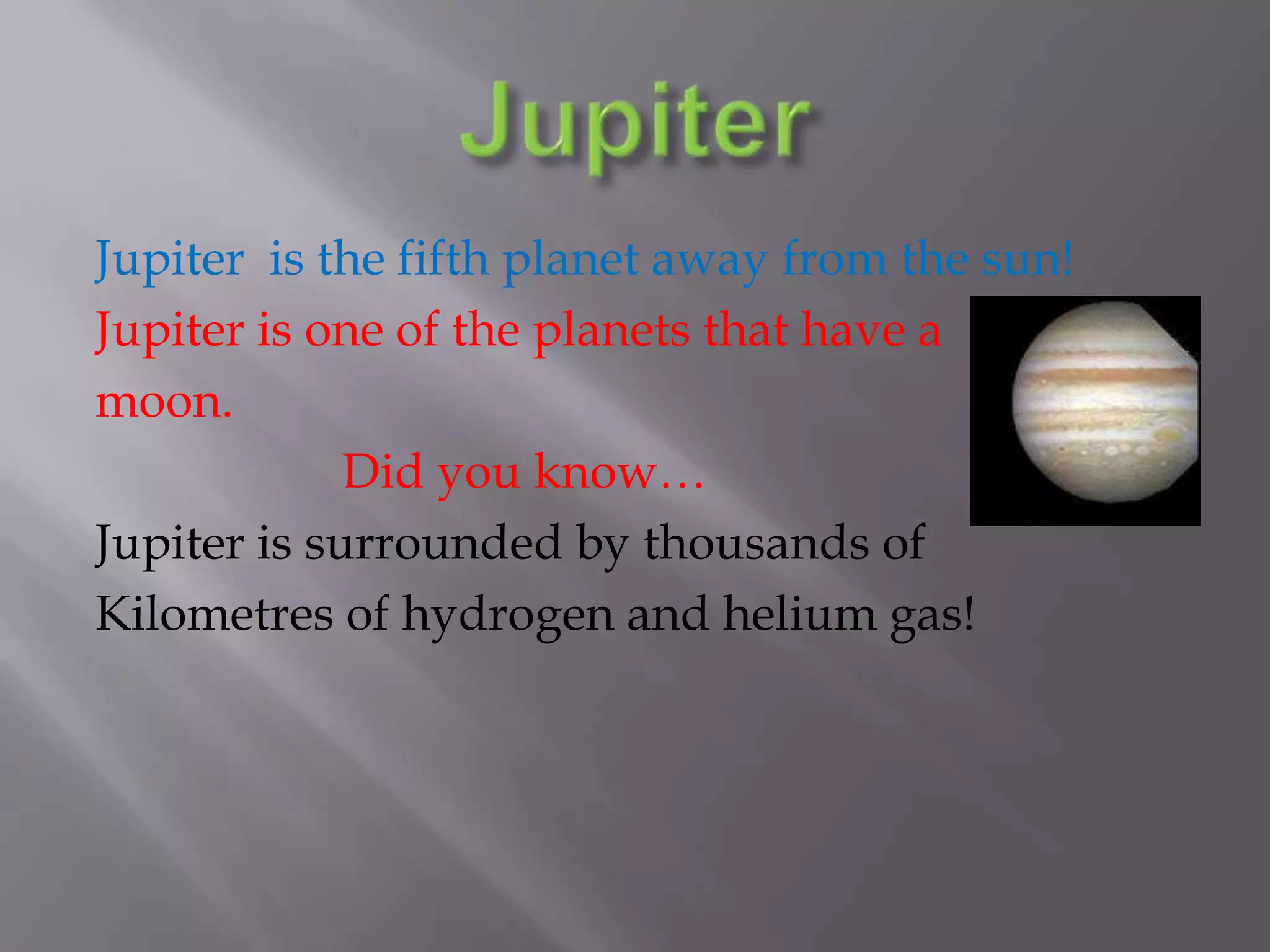
Jupiter is the fifth planet away from the sun!
Jupiter is one of the planets that have a
moon.
             Did you know…
Jupiter is surrounded by thousands of
Kilometres of hydrogen and helium gas!
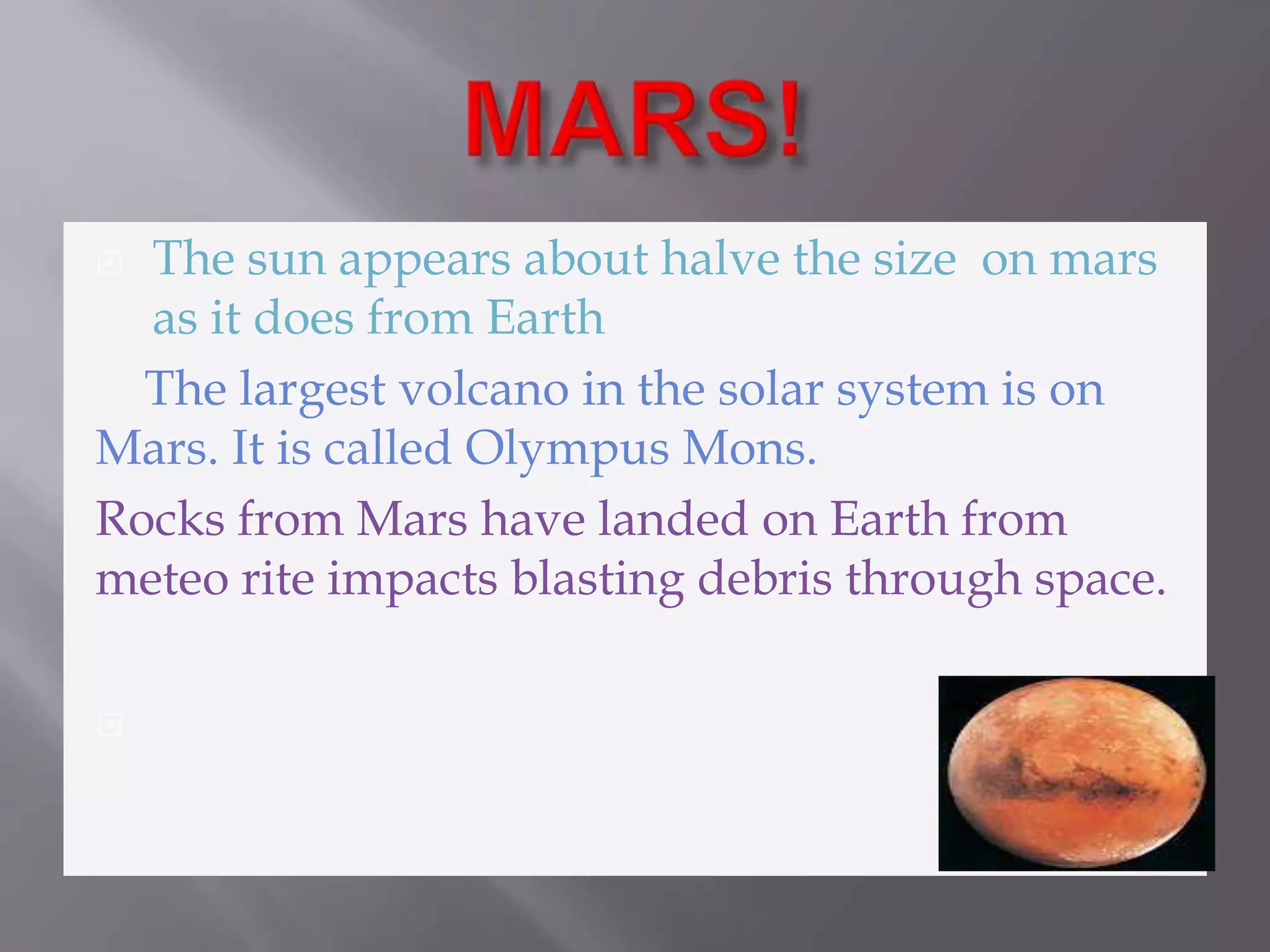
 The sun appears about halve the size on mars
  as it does from Earth
  The largest volcano in the solar system is on
Mars. It is called Olympus Mons.
Rocks from Mars have landed on Earth from
meteo rite impacts blasting debris through space.


   Venus is the second planet away from the
    sun.
   Venus and mercury are the only too planets
    that don’t have a sun orbiting them.

 If you were able to stand on the surface of Venus,
it would feel like being 1 kilometre under the sea
on Earth, a depth deep enough to sink a
submarine. A person or a creature would
immediately be crushed by Venus' amazingly
strong pressure.
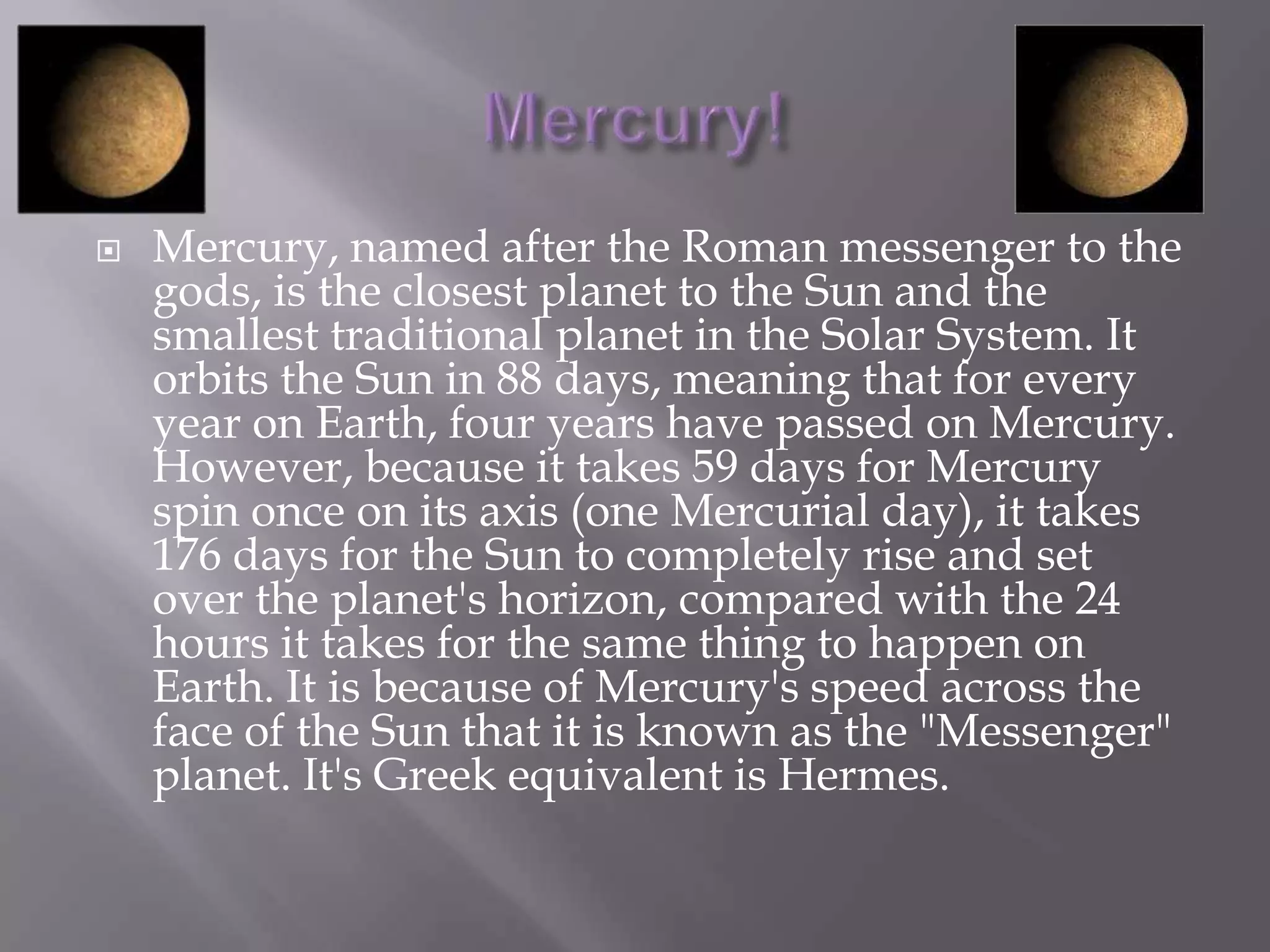
   Mercury, named after the Roman messenger to the
    gods, is the closest planet to the Sun and the
    smallest traditional planet in the Solar System. It
    orbits the Sun in 88 days, meaning that for every
    year on Earth, four years have passed on Mercury.
    However, because it takes 59 days for Mercury
    spin once on its axis (one Mercurial day), it takes
    176 days for the Sun to completely rise and set
    over the planet's horizon, compared with the 24
    hours it takes for the same thing to happen on
    Earth. It is because of Mercury's speed across the
    face of the Sun that it is known as the "Messenger"
    planet. It's Greek equivalent is Hermes.
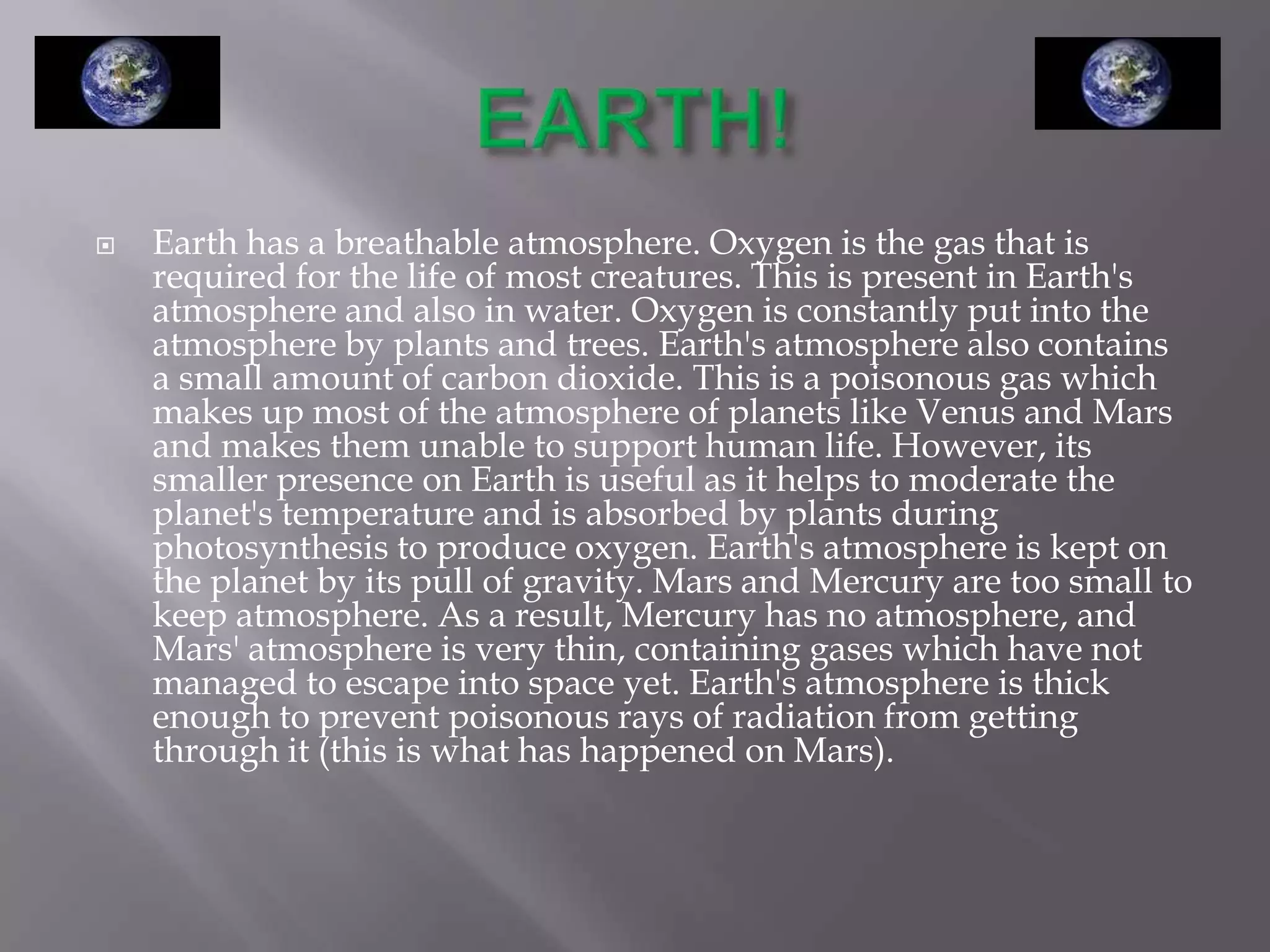
   Earth has a breathable atmosphere. Oxygen is the gas that is
    required for the life of most creatures. This is present in Earth's
    atmosphere and also in water. Oxygen is constantly put into the
    atmosphere by plants and trees. Earth's atmosphere also contains
    a small amount of carbon dioxide. This is a poisonous gas which
    makes up most of the atmosphere of planets like Venus and Mars
    and makes them unable to support human life. However, its
    smaller presence on Earth is useful as it helps to moderate the
    planet's temperature and is absorbed by plants during
    photosynthesis to produce oxygen. Earth's atmosphere is kept on
    the planet by its pull of gravity. Mars and Mercury are too small to
    keep atmosphere. As a result, Mercury has no atmosphere, and
    Mars' atmosphere is very thin, containing gases which have not
    managed to escape into space yet. Earth's atmosphere is thick
    enough to prevent poisonous rays of radiation from getting
    through it (this is what has happened on Mars).
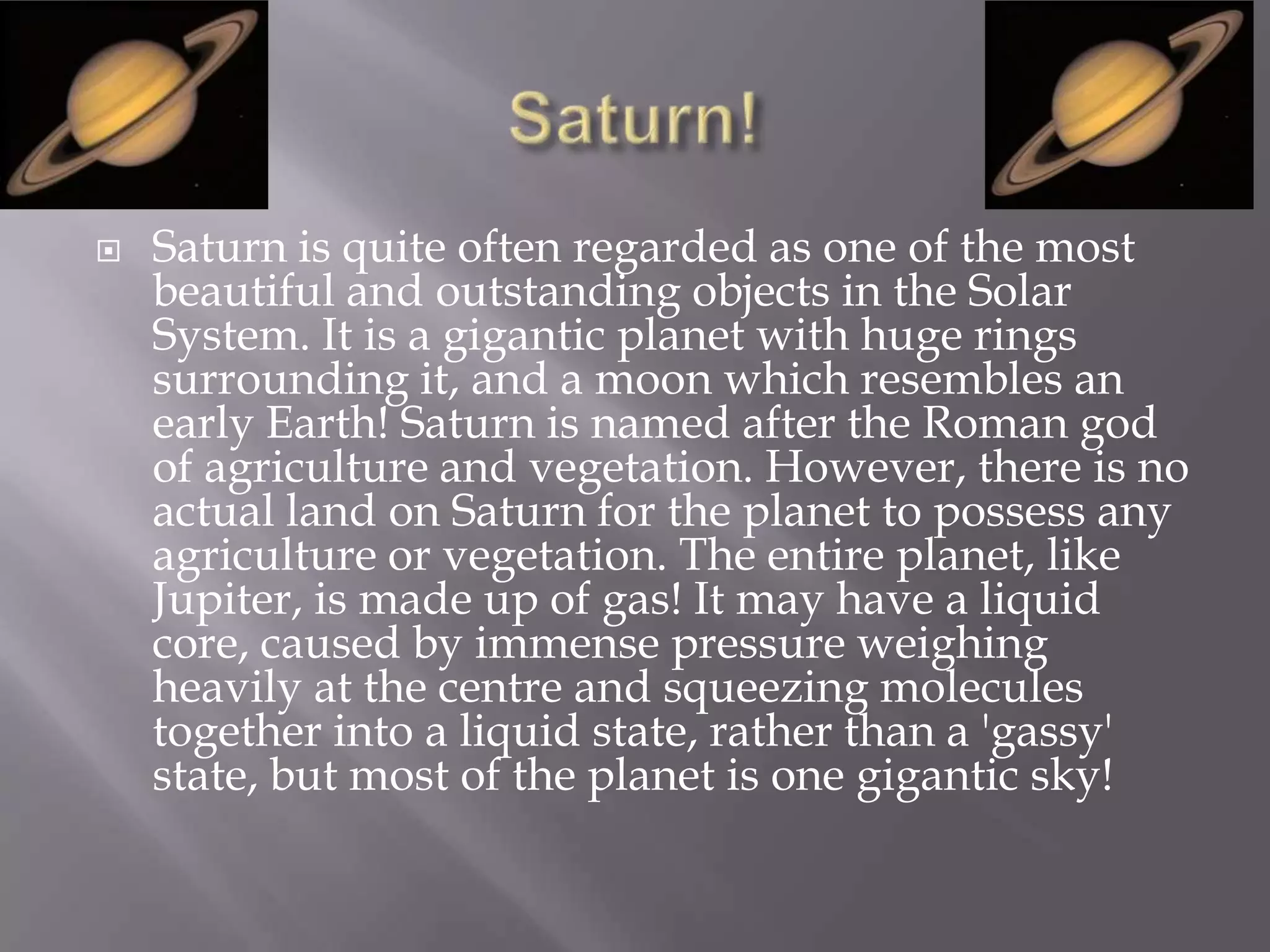
   Saturn is quite often regarded as one of the most
    beautiful and outstanding objects in the Solar
    System. It is a gigantic planet with huge rings
    surrounding it, and a moon which resembles an
    early Earth! Saturn is named after the Roman god
    of agriculture and vegetation. However, there is no
    actual land on Saturn for the planet to possess any
    agriculture or vegetation. The entire planet, like
    Jupiter, is made up of gas! It may have a liquid
    core, caused by immense pressure weighing
    heavily at the centre and squeezing molecules
    together into a liquid state, rather than a 'gassy'
    state, but most of the planet is one gigantic sky!
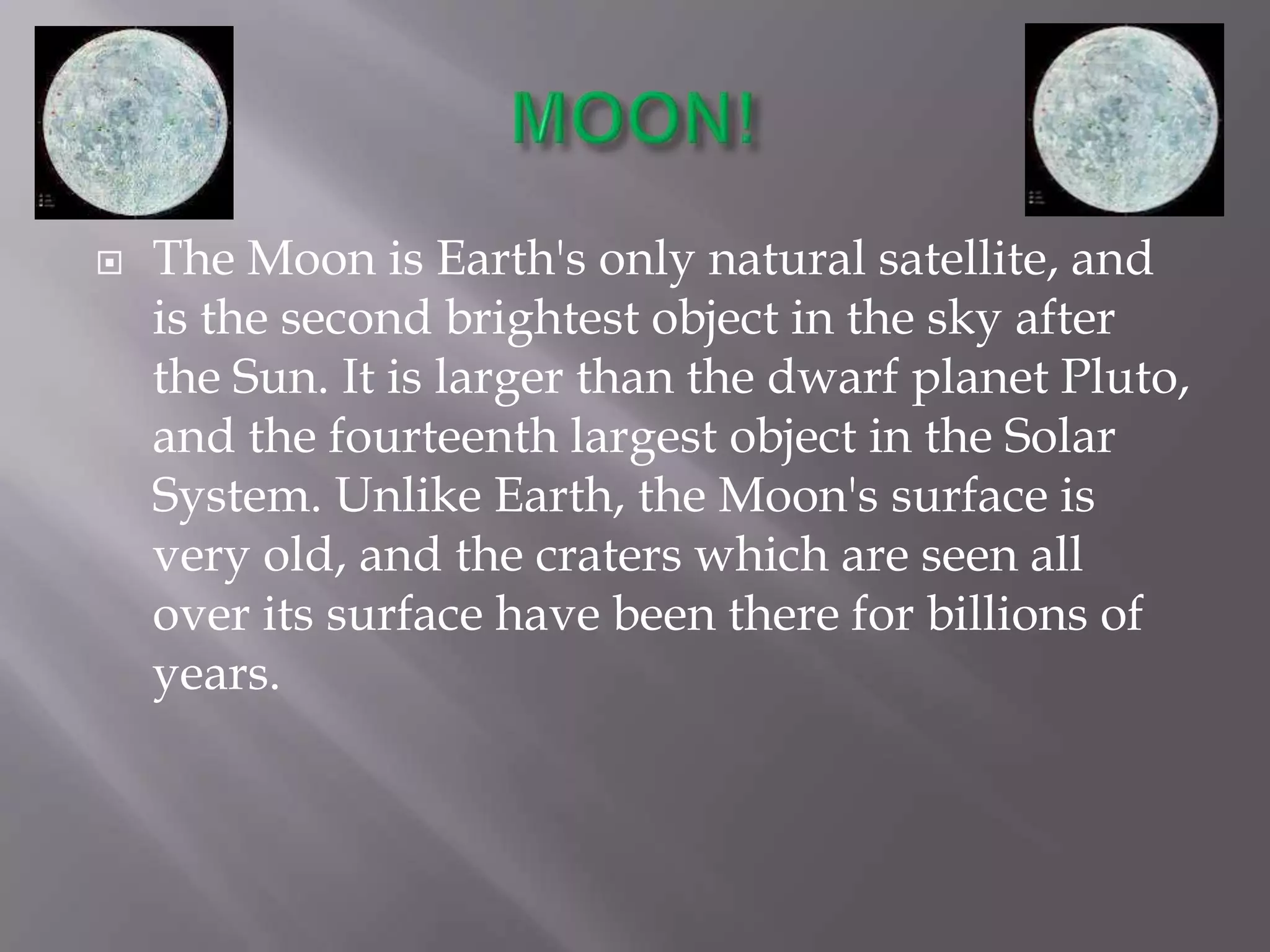
   The Moon is Earth's only natural satellite, and
    is the second brightest object in the sky after
    the Sun. It is larger than the dwarf planet Pluto,
    and the fourteenth largest object in the Solar
    System. Unlike Earth, the Moon's surface is
    very old, and the craters which are seen all
    over its surface have been there for billions of
    years.
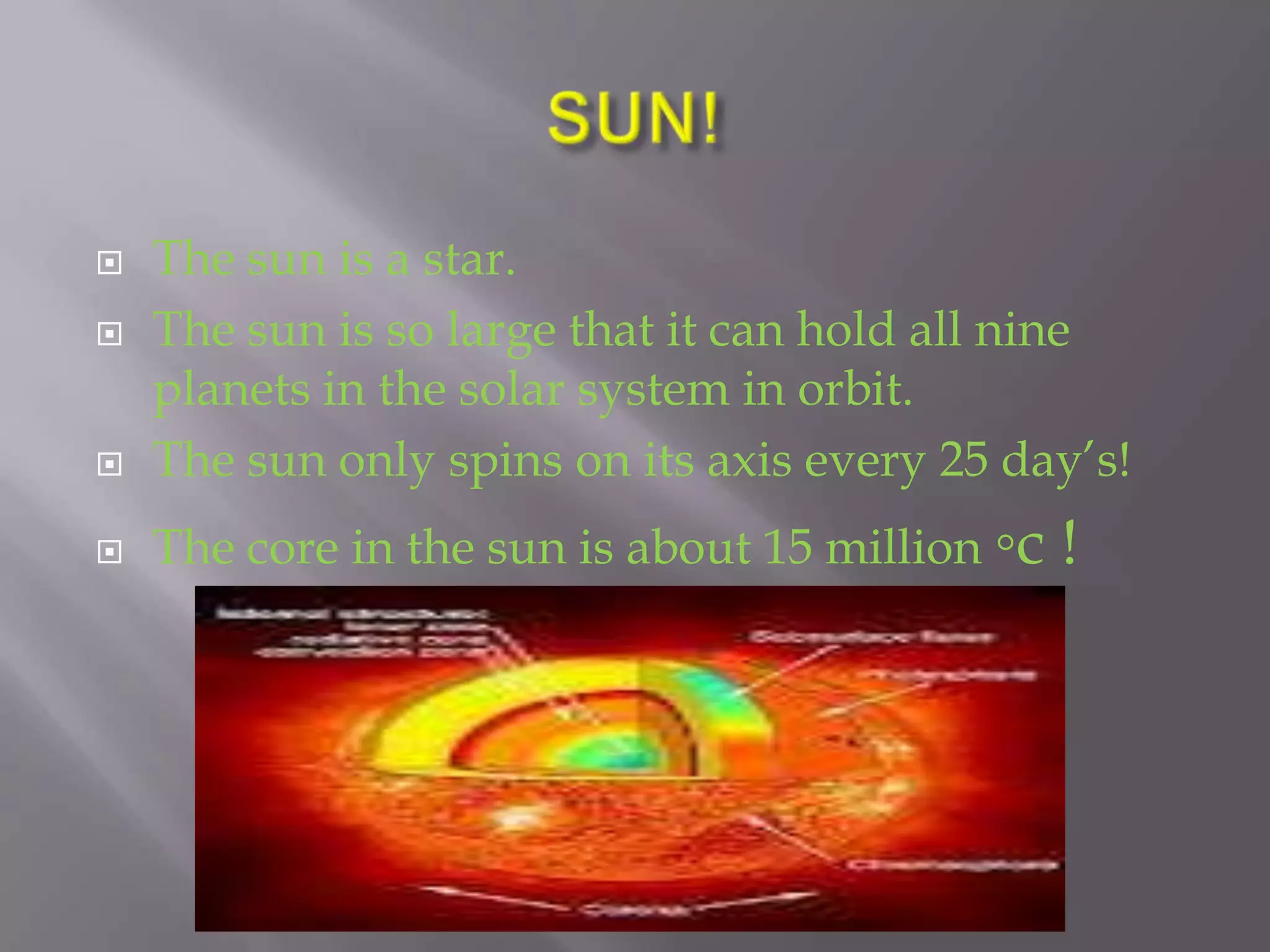
   The sun is a star.
   The sun is so large that it can hold all nine
    planets in the solar system in orbit.
   The sun only spins on its axis every 25 day’s!
   The core in the sun is about 15 million ◦c   !
   A star is a large ball of searing scorching gas,
    an example would be the sun.
   Stars two us are just little balls of light,
    although they are not actually that small
   A star is also a miniature version of the sun.

Solar system!!

  • 1.
  • 2.
    Jupiter is thefifth planet away from the sun! Jupiter is one of the planets that have a moon. Did you know… Jupiter is surrounded by thousands of Kilometres of hydrogen and helium gas!
  • 3.
     The sunappears about halve the size on mars as it does from Earth The largest volcano in the solar system is on Mars. It is called Olympus Mons. Rocks from Mars have landed on Earth from meteo rite impacts blasting debris through space. 
  • 4.
    Venus is the second planet away from the sun.  Venus and mercury are the only too planets that don’t have a sun orbiting them. If you were able to stand on the surface of Venus, it would feel like being 1 kilometre under the sea on Earth, a depth deep enough to sink a submarine. A person or a creature would immediately be crushed by Venus' amazingly strong pressure.
  • 5.
    Mercury, named after the Roman messenger to the gods, is the closest planet to the Sun and the smallest traditional planet in the Solar System. It orbits the Sun in 88 days, meaning that for every year on Earth, four years have passed on Mercury. However, because it takes 59 days for Mercury spin once on its axis (one Mercurial day), it takes 176 days for the Sun to completely rise and set over the planet's horizon, compared with the 24 hours it takes for the same thing to happen on Earth. It is because of Mercury's speed across the face of the Sun that it is known as the "Messenger" planet. It's Greek equivalent is Hermes.
  • 6.
    Earth has a breathable atmosphere. Oxygen is the gas that is required for the life of most creatures. This is present in Earth's atmosphere and also in water. Oxygen is constantly put into the atmosphere by plants and trees. Earth's atmosphere also contains a small amount of carbon dioxide. This is a poisonous gas which makes up most of the atmosphere of planets like Venus and Mars and makes them unable to support human life. However, its smaller presence on Earth is useful as it helps to moderate the planet's temperature and is absorbed by plants during photosynthesis to produce oxygen. Earth's atmosphere is kept on the planet by its pull of gravity. Mars and Mercury are too small to keep atmosphere. As a result, Mercury has no atmosphere, and Mars' atmosphere is very thin, containing gases which have not managed to escape into space yet. Earth's atmosphere is thick enough to prevent poisonous rays of radiation from getting through it (this is what has happened on Mars).
  • 7.
    Saturn is quite often regarded as one of the most beautiful and outstanding objects in the Solar System. It is a gigantic planet with huge rings surrounding it, and a moon which resembles an early Earth! Saturn is named after the Roman god of agriculture and vegetation. However, there is no actual land on Saturn for the planet to possess any agriculture or vegetation. The entire planet, like Jupiter, is made up of gas! It may have a liquid core, caused by immense pressure weighing heavily at the centre and squeezing molecules together into a liquid state, rather than a 'gassy' state, but most of the planet is one gigantic sky!
  • 8.
    The Moon is Earth's only natural satellite, and is the second brightest object in the sky after the Sun. It is larger than the dwarf planet Pluto, and the fourteenth largest object in the Solar System. Unlike Earth, the Moon's surface is very old, and the craters which are seen all over its surface have been there for billions of years.
  • 9.
    The sun is a star.  The sun is so large that it can hold all nine planets in the solar system in orbit.  The sun only spins on its axis every 25 day’s!  The core in the sun is about 15 million ◦c !
  • 10.
    A star is a large ball of searing scorching gas, an example would be the sun.  Stars two us are just little balls of light, although they are not actually that small  A star is also a miniature version of the sun.