Solar
radiation
Group 2
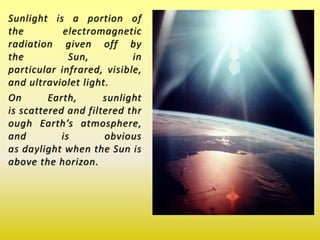
Sunlight is a portion of
the electromagnetic
radiation given off by
the Sun, in
particular infrared, visible,
and ultraviolet light.
On Earth, sunlight
is scattered and filtered thr
ough Earth’s atmosphere,
and is obvious
as daylight when the Sun is
above the horizon.
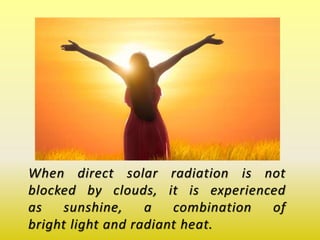
When direct solar radiation is not
blocked by clouds, it is experienced
as sunshine, a combination of
bright light and radiant heat.
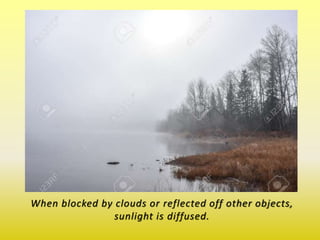
When blocked by clouds or reflected off other objects,
sunlight is diffused.
S u r fa c e i l l u m i n a t i o n
The spectrum of surface illumination depends upon solar elevation due to atmospheric effects,
with the blue spectral component dominating during twilight before and after sunrise and
sunset, respectively, and red dominating during sunrise and sunset. These effects are apparent
in natural light photography where the principal source of illumination is sunlight as mediated
by the atmosphere.
While the color of the sky is usually determined by Rayleigh scattering, an exception occurs at
sunset and twilight. "Preferential absorption of sunlight by ozone over long horizon paths gives
the zenith sky its blueness when the sun is near the horizon".
L i f e o n E a r t h
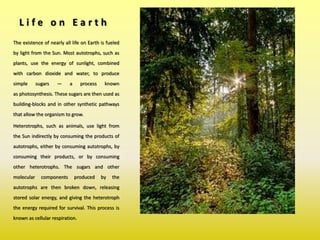
The existence of nearly all life on Earth is fueled
by light from the Sun. Most autotrophs, such as
plants, use the energy of sunlight, combined
with carbon dioxide and water, to produce
simple sugars — a process known
as photosynthesis. These sugars are then used as
building-blocks and in other synthetic pathways
that allow the organism to grow.
Heterotrophs, such as animals, use light from
the Sun indirectly by consuming the products of
autotrophs, either by consuming autotrophs, by
consuming their products, or by consuming
other heterotrophs. The sugars and other
molecular components produced by the
autotrophs are then broken down, releasing
stored solar energy, and giving the heterotroph
the energy required for survival. This process is
known as cellular respiration.
Effects on human health
• The ultraviolet radiation in sunlight has both positive
and negative health effects, as it is both a principal
source of vitamin D3 and a mutagen. A dietary
supplement can supply vitamin D without this
mutagenic effect, but bypasses natural mechanisms
that would prevent overdoses of vitamin D generated
internally from sunlight. Vitamin D has a wide range of
positive health effects, which include strengthening
bones and possibly inhibiting the growth of some
cancers. Sun exposure has also been associated with
the timing of melatonin synthesis, maintenance of
normal circadian rhythms, and reduced risk of seasonal
affective disorder.
R i s k s o f
s o l a r
r a d i a t i o n
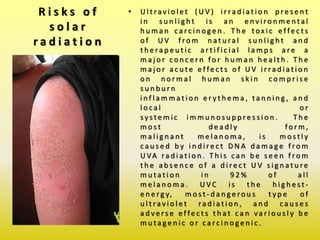
• U l t ra v i o l e t ( U V ) i r ra d i a t i o n p re s e n t
i n s u n l i g h t i s a n e n v i ro n m e n t a l
h u m a n c a rc i n o g e n . T h e t ox i c e f fe c t s
o f U V f ro m n a t u ra l s u n l i g h t a n d
t h e ra p e u t i c a r t i f i c i a l l a m p s a re a
m a j o r c o n c e r n fo r h u m a n h e a l t h . T h e
m a j o r a c u t e e f fe c t s o f U V i r ra d i a t i o n
o n n o r m a l h u m a n s k i n c o m p r i s e
s u n b u r n
i n f l a m m a t i o n e r y t h e m a , t a n n i n g , a n d
l o c a l o r
sy s t e m i c i m m u n o s u p p re s s i o n . T h e
m o s t d e a d l y fo r m ,
m a l i g n a n t m e l a n o m a , i s m o s t l y
c a u s e d b y i n d i re c t D N A d a m a g e f ro m
U VA ra d i a t i o n . T h i s c a n b e s e e n f ro m
t h e a b s e n c e o f a d i re c t U V s i g n a t u re
m u t a t i o n i n 9 2 % o f a l l
m e l a n o m a . U V C i s t h e h i g h e s t -
e n e rg y, m o s t - d a n g e ro u s t y p e o f
u l t ra v i o l e t ra d i a t i o n , a n d c a u s e s
a d v e rs e e f fe c t s t h a t c a n v a r i o u s l y b e
m u t a g e n i c o r c a rc i n o g e n i c .
Effects on eyes
• Prolonged optical exposure to sunlight, especially intense
ultraviolet light, may be linked to cortical cataracts, and
high levels of visible light may be linked to macular
degeneration.
• However, significant daily exposure to bright light may be
necessary for children to avoid myopia (nearsightedness).
• Short-term over-exposure can cause snow blindness,
which is analogous to sunburn of the cornea, or can
cause solar retinopathy, which is long-lasting retinal
damage and vision impairment from sungazing.
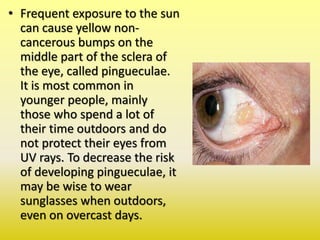
• Frequent exposure to the sun
can cause yellow non-
cancerous bumps on the
middle part of the sclera of
the eye, called pingueculae.
It is most common in
younger people, mainly
those who spend a lot of
their time outdoors and do
not protect their eyes from
UV rays. To decrease the risk
of developing pingueculae, it
may be wise to wear
sunglasses when outdoors,
even on overcast days.
Effect on plant genomes
• Elevated solar UV-B doses increase the
frequency
of DNA recombination in Arabidopsis
thaliana and tobacco plants. These increases
are accompanied by strong induction of an
enzyme with a key role in recombinational
repair of DNA damage. Thus the level of
terrestrial solar UV-B radiation likely
affects genome stability in plants.
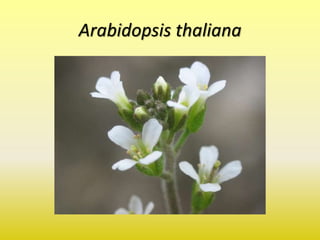
Arabidopsis thaliana
Thanks for watching 

Solar radiation Group 6

  • 1.
  • 2.
    Sunlight is aportion of the electromagnetic radiation given off by the Sun, in particular infrared, visible, and ultraviolet light. On Earth, sunlight is scattered and filtered thr ough Earth’s atmosphere, and is obvious as daylight when the Sun is above the horizon.
  • 3.
    When direct solarradiation is not blocked by clouds, it is experienced as sunshine, a combination of bright light and radiant heat.
  • 4.
    When blocked byclouds or reflected off other objects, sunlight is diffused.
  • 5.
    S u rfa c e i l l u m i n a t i o n The spectrum of surface illumination depends upon solar elevation due to atmospheric effects, with the blue spectral component dominating during twilight before and after sunrise and sunset, respectively, and red dominating during sunrise and sunset. These effects are apparent in natural light photography where the principal source of illumination is sunlight as mediated by the atmosphere. While the color of the sky is usually determined by Rayleigh scattering, an exception occurs at sunset and twilight. "Preferential absorption of sunlight by ozone over long horizon paths gives the zenith sky its blueness when the sun is near the horizon".
  • 6.
    L i fe o n E a r t h The existence of nearly all life on Earth is fueled by light from the Sun. Most autotrophs, such as plants, use the energy of sunlight, combined with carbon dioxide and water, to produce simple sugars — a process known as photosynthesis. These sugars are then used as building-blocks and in other synthetic pathways that allow the organism to grow. Heterotrophs, such as animals, use light from the Sun indirectly by consuming the products of autotrophs, either by consuming autotrophs, by consuming their products, or by consuming other heterotrophs. The sugars and other molecular components produced by the autotrophs are then broken down, releasing stored solar energy, and giving the heterotroph the energy required for survival. This process is known as cellular respiration.
  • 7.
    Effects on humanhealth • The ultraviolet radiation in sunlight has both positive and negative health effects, as it is both a principal source of vitamin D3 and a mutagen. A dietary supplement can supply vitamin D without this mutagenic effect, but bypasses natural mechanisms that would prevent overdoses of vitamin D generated internally from sunlight. Vitamin D has a wide range of positive health effects, which include strengthening bones and possibly inhibiting the growth of some cancers. Sun exposure has also been associated with the timing of melatonin synthesis, maintenance of normal circadian rhythms, and reduced risk of seasonal affective disorder.
  • 8.
    R i sk s o f s o l a r r a d i a t i o n • U l t ra v i o l e t ( U V ) i r ra d i a t i o n p re s e n t i n s u n l i g h t i s a n e n v i ro n m e n t a l h u m a n c a rc i n o g e n . T h e t ox i c e f fe c t s o f U V f ro m n a t u ra l s u n l i g h t a n d t h e ra p e u t i c a r t i f i c i a l l a m p s a re a m a j o r c o n c e r n fo r h u m a n h e a l t h . T h e m a j o r a c u t e e f fe c t s o f U V i r ra d i a t i o n o n n o r m a l h u m a n s k i n c o m p r i s e s u n b u r n i n f l a m m a t i o n e r y t h e m a , t a n n i n g , a n d l o c a l o r sy s t e m i c i m m u n o s u p p re s s i o n . T h e m o s t d e a d l y fo r m , m a l i g n a n t m e l a n o m a , i s m o s t l y c a u s e d b y i n d i re c t D N A d a m a g e f ro m U VA ra d i a t i o n . T h i s c a n b e s e e n f ro m t h e a b s e n c e o f a d i re c t U V s i g n a t u re m u t a t i o n i n 9 2 % o f a l l m e l a n o m a . U V C i s t h e h i g h e s t - e n e rg y, m o s t - d a n g e ro u s t y p e o f u l t ra v i o l e t ra d i a t i o n , a n d c a u s e s a d v e rs e e f fe c t s t h a t c a n v a r i o u s l y b e m u t a g e n i c o r c a rc i n o g e n i c .
  • 9.
    Effects on eyes •Prolonged optical exposure to sunlight, especially intense ultraviolet light, may be linked to cortical cataracts, and high levels of visible light may be linked to macular degeneration. • However, significant daily exposure to bright light may be necessary for children to avoid myopia (nearsightedness). • Short-term over-exposure can cause snow blindness, which is analogous to sunburn of the cornea, or can cause solar retinopathy, which is long-lasting retinal damage and vision impairment from sungazing.
  • 10.
    • Frequent exposureto the sun can cause yellow non- cancerous bumps on the middle part of the sclera of the eye, called pingueculae. It is most common in younger people, mainly those who spend a lot of their time outdoors and do not protect their eyes from UV rays. To decrease the risk of developing pingueculae, it may be wise to wear sunglasses when outdoors, even on overcast days.
  • 11.
    Effect on plantgenomes • Elevated solar UV-B doses increase the frequency of DNA recombination in Arabidopsis thaliana and tobacco plants. These increases are accompanied by strong induction of an enzyme with a key role in recombinational repair of DNA damage. Thus the level of terrestrial solar UV-B radiation likely affects genome stability in plants.
  • 12.
  • 13.