Solar Power Production on Brownfields CRA Brownfield Committee Meeting 12/3/09 Chris Nelson National Partner, Brownfields SCS Engineers
Context Executive Order S-3-05 (California Governor Schwarzenegger)  - June 1, 2005 CA will reduce Greenhouse Gases to: 2000 levels by 2010 1990 levels by 2020 80% below 1990 levels by 2050
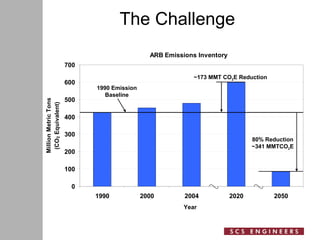
The Challenge 1990 Emission Baseline ~173 MMT CO 2 E Reduction 80% Reduction ~341 MMTCO 2 E
Context What’s driving interest in Alternative Energy (“AE”)? (California) AB 32 The Global Warming Solutions Act of 2006  Oil prices fluctuating around $80/bbl or higher Desire for Energy Security  Green Economy drivers such as Clean tech/green jobs Sustainability initiatives and mandates Government programs such as Renewable Portfolio Standards Renewable Energy Credits Federal Investment Tax Credits Feed In Tariffs
Federal Programs Department of Energy Brightfields Environmental Protection Agency RePowering America’s Lands
DOE “Brightfields” According to  www.epa.gov/brownfields/partners/brightfd.htm  : Brightfields is a revolutionary concept that addresses three of the nation's biggest challenges -  urban revitalization, toxic waste cleanup, and climate change -- by bringing pollution-free solar energy and high-tech solar manufacturing jobs to brownfields. The Brightfields approach offers a range of opportunities to link solar energy to brownfields redevelopment  and thereby transform community hazards and eyesores into productive, green ventures……
Brightfields DOE’s Brightfields also promotes the concept through the following measures: Solar Technology (PV) development ($51.5 million) to improve efficiencies of Solar PV technologies Solar Energy Deployment ($40.5 million) Concentrating Solar Power (CSP) Research & Development (R&D)
RE-Powering America’s Lands Joint EPA and NREL effort EPA launched  RE-Powering America’s Land  in 2008 Recognized the potential Alternative Energy (AE) development opportunities of certain EPA tracked sites Brownfields Superfund and CERCLIS sites Abandoned Mine Lands RCRA To date, have mapped over 16 million acres 850,000 acres of these are sites undergoing long term O&M
Why AE on EPA Mapped Sites? Many of these sites offer: Adequate Zoning Existing infrastructure - transmission lines, roads and railway NIMBY issues may be less prevalent Siting renewable energy on these sites may: Increase economic value for the property Further environmental sustainability by maximizing land use Have lower overall transaction costs compared to greenfields Reduce the stress on greenfields by reusing these sites Provide clean energy for use on-site, locally, and/or to utility grid Create local jobs for development and operation of renewable  energy facilities
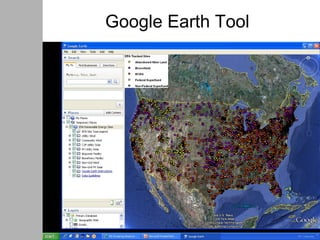
Map Tool Details Google Earth Maps Joint EPA-NREL venture produced interactive maps Mapped EPA inventory of EPA tracked sites Abandoned Mine Lands Brownfields RCRA Superfund National Renewable Energy Laboratory (NREL) Data Wind, Solar and Biomass Resources Infrastructure Data U.S. Highways U.S. States U.S. National Transportation Atlas Railroads Transmission Lines The distance EPA used to determine feasibility was within 10 miles, so clearly some refinements to the tools are warranted
Google Earth Tool
Solar Generation and Brownfields Solar Generation Facilities provide an excellent opportunity for re-use of brownfield sites: Specific brownfield sites that are suitable for solar generation include: Capped, retired landfills - Support 1-5 MW of solar generation in addition to methane capture; Large parking lots, airstrips, etc. – Provide an ideal & level building surface without the need to remove the asphalt; Retired and active mines (specifically tailings fields)  Enable onsite generation for a large electricity user Creates a positive re-use of a degraded property; No air emissions, limited water use and no generated waste fuel
Nuts and Bolts Considerations for Solar on Brownfields and closed landfills Choose older sites (20-30 years post closure) where much settlement has occurred Cleared sites with shallow south facing slopes, flat areas ideal Integrate stormwater controls into construction (account for channels being covered by panels and adjust) Maintaining the integrity of top liners, either synthetic or natural  Landfill gas collection system components (on landfills) or groundwater pump and treat systems may restrict the use of some areas  Cover vegetation removed for panels, there must be provisions to divert runoff so that erosion of a landfill soil cap does not occur  Solar panels can be wind collectors; sufficient engineering required to ensure panels and their foundations are properly anchored and will not be impacted by the elements (wind, snow, hail, etc.)
Nuts and Bolts Considerations for Solar on Brownfields and closed landfills Permitting/entitlements Financing, transaction issues  PPAs, power needs, Feed In Tariffs? Uses for power on site/proximity to the grid/transmission lines  Renewable Energy Credits Federal Investment Tax Credits Advantages Increased positive community relations opportunity Clean energy generation/GHG emission reductions Off set perpetual monitoring costs over time with sale of electricity or reduction in energy costs on site Put unproductive sites back into productive use
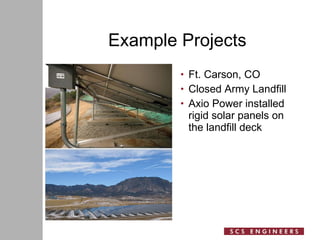
Example Projects Ft. Carson, CO Closed Army Landfill Axio Power installed rigid solar panels on the landfill deck
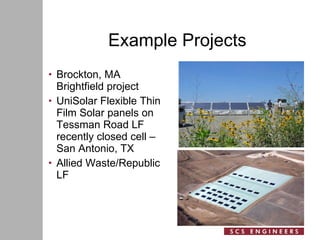
Example Projects Brockton, MA Brightfield project UniSolar Flexible Thin Film Solar panels on Tessman Road LF recently closed cell – San Antonio, TX Allied Waste/Republic LF

Solar On Brownfields

  • 1.
    Solar Power Productionon Brownfields CRA Brownfield Committee Meeting 12/3/09 Chris Nelson National Partner, Brownfields SCS Engineers
  • 2.
    Context Executive OrderS-3-05 (California Governor Schwarzenegger) - June 1, 2005 CA will reduce Greenhouse Gases to: 2000 levels by 2010 1990 levels by 2020 80% below 1990 levels by 2050
  • 3.
    The Challenge 1990Emission Baseline ~173 MMT CO 2 E Reduction 80% Reduction ~341 MMTCO 2 E
  • 4.
    Context What’s drivinginterest in Alternative Energy (“AE”)? (California) AB 32 The Global Warming Solutions Act of 2006 Oil prices fluctuating around $80/bbl or higher Desire for Energy Security Green Economy drivers such as Clean tech/green jobs Sustainability initiatives and mandates Government programs such as Renewable Portfolio Standards Renewable Energy Credits Federal Investment Tax Credits Feed In Tariffs
  • 5.
    Federal Programs Departmentof Energy Brightfields Environmental Protection Agency RePowering America’s Lands
  • 6.
    DOE “Brightfields” Accordingto www.epa.gov/brownfields/partners/brightfd.htm : Brightfields is a revolutionary concept that addresses three of the nation's biggest challenges - urban revitalization, toxic waste cleanup, and climate change -- by bringing pollution-free solar energy and high-tech solar manufacturing jobs to brownfields. The Brightfields approach offers a range of opportunities to link solar energy to brownfields redevelopment and thereby transform community hazards and eyesores into productive, green ventures……
  • 7.
    Brightfields DOE’s Brightfieldsalso promotes the concept through the following measures: Solar Technology (PV) development ($51.5 million) to improve efficiencies of Solar PV technologies Solar Energy Deployment ($40.5 million) Concentrating Solar Power (CSP) Research & Development (R&D)
  • 8.
    RE-Powering America’s LandsJoint EPA and NREL effort EPA launched RE-Powering America’s Land in 2008 Recognized the potential Alternative Energy (AE) development opportunities of certain EPA tracked sites Brownfields Superfund and CERCLIS sites Abandoned Mine Lands RCRA To date, have mapped over 16 million acres 850,000 acres of these are sites undergoing long term O&M
  • 9.
    Why AE onEPA Mapped Sites? Many of these sites offer: Adequate Zoning Existing infrastructure - transmission lines, roads and railway NIMBY issues may be less prevalent Siting renewable energy on these sites may: Increase economic value for the property Further environmental sustainability by maximizing land use Have lower overall transaction costs compared to greenfields Reduce the stress on greenfields by reusing these sites Provide clean energy for use on-site, locally, and/or to utility grid Create local jobs for development and operation of renewable energy facilities
  • 10.
    Map Tool DetailsGoogle Earth Maps Joint EPA-NREL venture produced interactive maps Mapped EPA inventory of EPA tracked sites Abandoned Mine Lands Brownfields RCRA Superfund National Renewable Energy Laboratory (NREL) Data Wind, Solar and Biomass Resources Infrastructure Data U.S. Highways U.S. States U.S. National Transportation Atlas Railroads Transmission Lines The distance EPA used to determine feasibility was within 10 miles, so clearly some refinements to the tools are warranted
  • 11.
  • 12.
    Solar Generation andBrownfields Solar Generation Facilities provide an excellent opportunity for re-use of brownfield sites: Specific brownfield sites that are suitable for solar generation include: Capped, retired landfills - Support 1-5 MW of solar generation in addition to methane capture; Large parking lots, airstrips, etc. – Provide an ideal & level building surface without the need to remove the asphalt; Retired and active mines (specifically tailings fields) Enable onsite generation for a large electricity user Creates a positive re-use of a degraded property; No air emissions, limited water use and no generated waste fuel
  • 13.
    Nuts and BoltsConsiderations for Solar on Brownfields and closed landfills Choose older sites (20-30 years post closure) where much settlement has occurred Cleared sites with shallow south facing slopes, flat areas ideal Integrate stormwater controls into construction (account for channels being covered by panels and adjust) Maintaining the integrity of top liners, either synthetic or natural Landfill gas collection system components (on landfills) or groundwater pump and treat systems may restrict the use of some areas Cover vegetation removed for panels, there must be provisions to divert runoff so that erosion of a landfill soil cap does not occur Solar panels can be wind collectors; sufficient engineering required to ensure panels and their foundations are properly anchored and will not be impacted by the elements (wind, snow, hail, etc.)
  • 14.
    Nuts and BoltsConsiderations for Solar on Brownfields and closed landfills Permitting/entitlements Financing, transaction issues PPAs, power needs, Feed In Tariffs? Uses for power on site/proximity to the grid/transmission lines Renewable Energy Credits Federal Investment Tax Credits Advantages Increased positive community relations opportunity Clean energy generation/GHG emission reductions Off set perpetual monitoring costs over time with sale of electricity or reduction in energy costs on site Put unproductive sites back into productive use
  • 15.
    Example Projects Ft.Carson, CO Closed Army Landfill Axio Power installed rigid solar panels on the landfill deck
  • 16.
    Example Projects Brockton,MA Brightfield project UniSolar Flexible Thin Film Solar panels on Tessman Road LF recently closed cell – San Antonio, TX Allied Waste/Republic LF