OBJECTIVE
SWBAT review and
practice concepts for
mastery for the 8E4 Sub-
Unit Test #1.
SUN
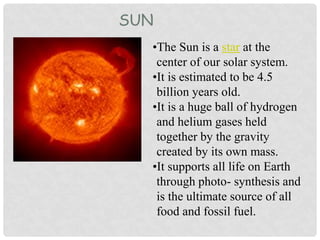
•The Sun is a star at the
center of our solar system.
•It is estimated to be 4.5
billion years old.
•It is a huge ball of hydrogen
and helium gases held
together by the gravity
created by its own mass.
•It supports all life on Earth
through photo- synthesis and
is the ultimate source of all
food and fossil fuel.
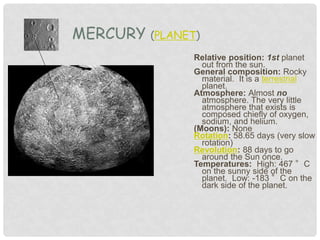
Relative position: 1st planet
out from the sun.
General composition: Rocky
material. It is a terrestrial
planet.
Atmosphere: Almost no
atmosphere. The very little
atmosphere that exists is
composed chiefly of oxygen,
sodium, and helium.
(Moons): None
Rotation: 58.65 days (very slow
rotation)
Revolution: 88 days to go
around the Sun once.
Temperatures: High: 467 °C
on the sunny side of the
planet. Low: -183 °C on the
dark side of the planet.
MERCURY (PLANET)
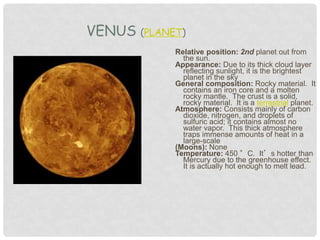
Relative position: 2nd planet out from
the sun.
Appearance: Due to its thick cloud layer
reflecting sunlight, it is the brightest
planet in the sky
General composition: Rocky material. It
contains an iron core and a molten
rocky mantle. The crust is a solid,
rocky material. It is a terrestrial planet.
Atmosphere: Consists mainly of carbon
dioxide, nitrogen, and droplets of
sulfuric acid; it contains almost no
water vapor. This thick atmosphere
traps immense amounts of heat in a
large-scale
(Moons): None
Temperature: 450 °C. It’s hotter than
Mercury due to the greenhouse effect.
It is actually hot enough to melt lead.
VENUS (PLANET)
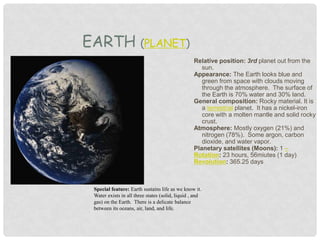
Relative position: 3rd planet out from the
sun.
Appearance: The Earth looks blue and
green from space with clouds moving
through the atmosphere. The surface of
the Earth is 70% water and 30% land.
General composition: Rocky material. It is
a terrestrial planet. It has a nickel-iron
core with a molten mantle and solid rocky
crust.
Atmosphere: Mostly oxygen (21%) and
nitrogen (78%). Some argon, carbon
dioxide, and water vapor.
Planetary satellites (Moons): 1 –
Rotation: 23 hours, 56miutes (1 day)
Revolution: 365.25 days
EARTH (PLANET)
Special feature: Earth sustains life as we know it.
Water exists in all three states (solid, liquid , and
gas) on the Earth. There is a delicate balance
between its oceans, air, land, and life.
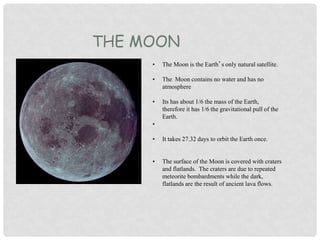
THE MOON
• The Moon is the Earth’s only natural satellite.
• The Moon contains no water and has no
atmosphere
• Its has about 1/6 the mass of the Earth,
therefore it has 1/6 the gravitational pull of the
Earth.
•
• It takes 27.32 days to orbit the Earth once.
• The surface of the Moon is covered with craters
and flatlands. The craters are due to repeated
meteorite bombardments while the dark,
flatlands are the result of ancient lava flows.
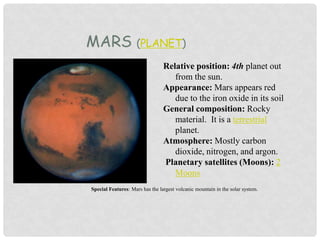
MARS (PLANET)
Relative position: 4th planet out
from the sun.
Appearance: Mars appears red
due to the iron oxide in its soil
General composition: Rocky
material. It is a terrestrial
planet.
Atmosphere: Mostly carbon
dioxide, nitrogen, and argon.
Planetary satellites (Moons): 2
Moons
Special Features: Mars has the largest volcanic mountain in the solar system.
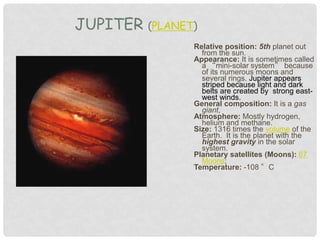
Relative position: 5th planet out
from the sun.
Appearance: It is sometimes called
a “mini-solar system” because
of its numerous moons and
several rings. Jupiter appears
striped because light and dark
belts are created by strong east-
west winds.
General composition: It is a gas
giant,
Atmosphere: Mostly hydrogen,
helium and methane.
Size: 1316 times the volume of the
Earth. It is the planet with the
highest gravity in the solar
system.
Planetary satellites (Moons): 67
Moons;
Temperature: -108 °C
JUPITER (PLANET)
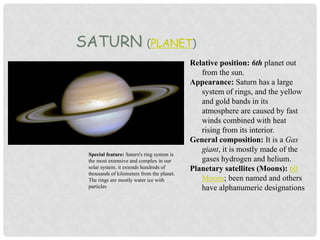
SATURN (PLANET)
Relative position: 6th planet out
from the sun.
Appearance: Saturn has a large
system of rings, and the yellow
and gold bands in its
atmosphere are caused by fast
winds combined with heat
rising from its interior.
General composition: It is a Gas
giant, it is mostly made of the
gases hydrogen and helium.
Planetary satellites (Moons): 60
Moons; been named and others
have alphanumeric designations
Special feature: Saturn's ring system is
the most extensive and complex in our
solar system; it extends hundreds of
thousands of kilometers from the planet.
The rings are mostly water ice with
particles
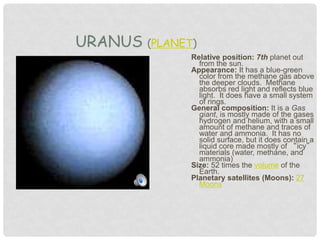
Relative position: 7th planet out
from the sun.
Appearance: It has a blue-green
color from the methane gas above
the deeper clouds. Methane
absorbs red light and reflects blue
light. It does have a small system
of rings.
General composition: It is a Gas
giant, is mostly made of the gases
hydrogen and helium, with a small
amount of methane and traces of
water and ammonia. It has no
solid surface, but it does contain a
liquid core made mostly of “icy”
materials (water, methane, and
ammonia)
Size: 52 times the volume of the
Earth.
Planetary satellites (Moons): 27
Moons
URANUS (PLANET)
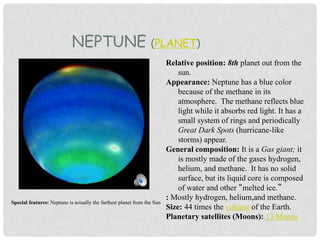
NEPTUNE (PLANET)
Relative position: 8th planet out from the
sun.
Appearance: Neptune has a blue color
because of the methane in its
atmosphere. The methane reflects blue
light while it absorbs red light. It has a
small system of rings and periodically
Great Dark Spots (hurricane-like
storms) appear.
General composition: It is a Gas giant; it
is mostly made of the gases hydrogen,
helium, and methane. It has no solid
surface, but its liquid core is composed
of water and other “melted ice.”
: Mostly hydrogen, helium,and methane.
Size: 44 times the volume of the Earth.
Planetary satellites (Moons): 13 Moons
Special features: Neptune is actually the farthest planet from the Sun
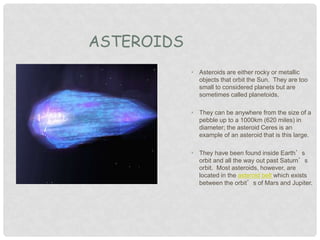
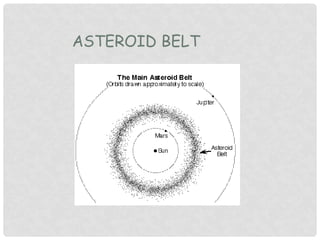
• Asteroids are either rocky or metallic
objects that orbit the Sun. They are too
small to considered planets but are
sometimes called planetoids.
• They can be anywhere from the size of a
pebble up to a 1000km (620 miles) in
diameter; the asteroid Ceres is an
example of an asteroid that is this large.
• They have been found inside Earth’s
orbit and all the way out past Saturn’s
orbit. Most asteroids, however, are
located in the asteroid belt which exists
between the orbit’s of Mars and Jupiter.
ASTEROIDS
ASTEROID BELT
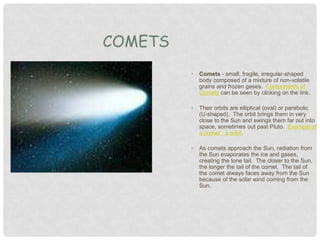
• Comets - small, fragile, irregular-shaped
body composed of a mixture of non-volatile
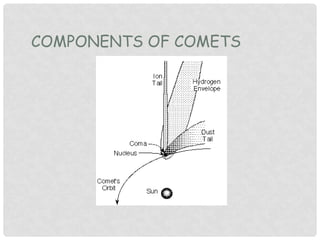
grains and frozen gases. Components of
Comets can be seen by clicking on the link.
• Their orbits are elliptical (oval) or parabolic
(U-shaped). The orbit brings them in very
close to the Sun and swings them far out into
space, sometimes out past Pluto. Example of
a comet’s orbit.
• As comets approach the Sun, radiation from
the Sun evaporates the ice and gases,
creating the lone tail. The closer to the Sun,
the longer the tail of the comet. The tail of
the comet always faces away from the Sun
because of the solar wind coming from the
Sun.
COMETS
COMPONENTS OF COMETS
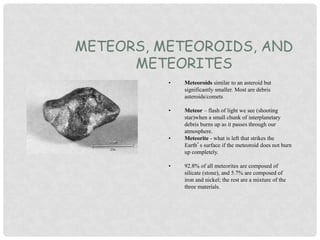
METEORS, METEOROIDS, AND
METEORITES
• Meteoroids similar to an asteroid but
significantly smaller. Most are debris
asteroids/comets
• Meteor – flash of light we see (shooting
star)when a small chunk of interplanetary
debris burns up as it passes through our
atmosphere.
• Meteorite - what is left that strikes the
Earth’s surface if the meteoroid does not burn
up completely.
• 92.8% of all meteorites are composed of
silicate (stone), and 5.7% are composed of
iron and nickel; the rest are a mixture of the
three materials.
REVIEW
QUIZZIZ

solar lesson.ppt

  • 1.
    OBJECTIVE SWBAT review and practiceconcepts for mastery for the 8E4 Sub- Unit Test #1.
  • 2.
    SUN •The Sun isa star at the center of our solar system. •It is estimated to be 4.5 billion years old. •It is a huge ball of hydrogen and helium gases held together by the gravity created by its own mass. •It supports all life on Earth through photo- synthesis and is the ultimate source of all food and fossil fuel.
  • 3.
    Relative position: 1stplanet out from the sun. General composition: Rocky material. It is a terrestrial planet. Atmosphere: Almost no atmosphere. The very little atmosphere that exists is composed chiefly of oxygen, sodium, and helium. (Moons): None Rotation: 58.65 days (very slow rotation) Revolution: 88 days to go around the Sun once. Temperatures: High: 467 °C on the sunny side of the planet. Low: -183 °C on the dark side of the planet. MERCURY (PLANET)
  • 4.
    Relative position: 2ndplanet out from the sun. Appearance: Due to its thick cloud layer reflecting sunlight, it is the brightest planet in the sky General composition: Rocky material. It contains an iron core and a molten rocky mantle. The crust is a solid, rocky material. It is a terrestrial planet. Atmosphere: Consists mainly of carbon dioxide, nitrogen, and droplets of sulfuric acid; it contains almost no water vapor. This thick atmosphere traps immense amounts of heat in a large-scale (Moons): None Temperature: 450 °C. It’s hotter than Mercury due to the greenhouse effect. It is actually hot enough to melt lead. VENUS (PLANET)
  • 5.
    Relative position: 3rdplanet out from the sun. Appearance: The Earth looks blue and green from space with clouds moving through the atmosphere. The surface of the Earth is 70% water and 30% land. General composition: Rocky material. It is a terrestrial planet. It has a nickel-iron core with a molten mantle and solid rocky crust. Atmosphere: Mostly oxygen (21%) and nitrogen (78%). Some argon, carbon dioxide, and water vapor. Planetary satellites (Moons): 1 – Rotation: 23 hours, 56miutes (1 day) Revolution: 365.25 days EARTH (PLANET) Special feature: Earth sustains life as we know it. Water exists in all three states (solid, liquid , and gas) on the Earth. There is a delicate balance between its oceans, air, land, and life.
  • 6.
    THE MOON • TheMoon is the Earth’s only natural satellite. • The Moon contains no water and has no atmosphere • Its has about 1/6 the mass of the Earth, therefore it has 1/6 the gravitational pull of the Earth. • • It takes 27.32 days to orbit the Earth once. • The surface of the Moon is covered with craters and flatlands. The craters are due to repeated meteorite bombardments while the dark, flatlands are the result of ancient lava flows.
  • 7.
    MARS (PLANET) Relative position:4th planet out from the sun. Appearance: Mars appears red due to the iron oxide in its soil General composition: Rocky material. It is a terrestrial planet. Atmosphere: Mostly carbon dioxide, nitrogen, and argon. Planetary satellites (Moons): 2 Moons Special Features: Mars has the largest volcanic mountain in the solar system.
  • 8.
    Relative position: 5thplanet out from the sun. Appearance: It is sometimes called a “mini-solar system” because of its numerous moons and several rings. Jupiter appears striped because light and dark belts are created by strong east- west winds. General composition: It is a gas giant, Atmosphere: Mostly hydrogen, helium and methane. Size: 1316 times the volume of the Earth. It is the planet with the highest gravity in the solar system. Planetary satellites (Moons): 67 Moons; Temperature: -108 °C JUPITER (PLANET)
  • 9.
    SATURN (PLANET) Relative position:6th planet out from the sun. Appearance: Saturn has a large system of rings, and the yellow and gold bands in its atmosphere are caused by fast winds combined with heat rising from its interior. General composition: It is a Gas giant, it is mostly made of the gases hydrogen and helium. Planetary satellites (Moons): 60 Moons; been named and others have alphanumeric designations Special feature: Saturn's ring system is the most extensive and complex in our solar system; it extends hundreds of thousands of kilometers from the planet. The rings are mostly water ice with particles
  • 10.
    Relative position: 7thplanet out from the sun. Appearance: It has a blue-green color from the methane gas above the deeper clouds. Methane absorbs red light and reflects blue light. It does have a small system of rings. General composition: It is a Gas giant, is mostly made of the gases hydrogen and helium, with a small amount of methane and traces of water and ammonia. It has no solid surface, but it does contain a liquid core made mostly of “icy” materials (water, methane, and ammonia) Size: 52 times the volume of the Earth. Planetary satellites (Moons): 27 Moons URANUS (PLANET)
  • 11.
    NEPTUNE (PLANET) Relative position:8th planet out from the sun. Appearance: Neptune has a blue color because of the methane in its atmosphere. The methane reflects blue light while it absorbs red light. It has a small system of rings and periodically Great Dark Spots (hurricane-like storms) appear. General composition: It is a Gas giant; it is mostly made of the gases hydrogen, helium, and methane. It has no solid surface, but its liquid core is composed of water and other “melted ice.” : Mostly hydrogen, helium,and methane. Size: 44 times the volume of the Earth. Planetary satellites (Moons): 13 Moons Special features: Neptune is actually the farthest planet from the Sun
  • 12.
    • Asteroids areeither rocky or metallic objects that orbit the Sun. They are too small to considered planets but are sometimes called planetoids. • They can be anywhere from the size of a pebble up to a 1000km (620 miles) in diameter; the asteroid Ceres is an example of an asteroid that is this large. • They have been found inside Earth’s orbit and all the way out past Saturn’s orbit. Most asteroids, however, are located in the asteroid belt which exists between the orbit’s of Mars and Jupiter. ASTEROIDS
  • 13.
  • 14.
    • Comets -small, fragile, irregular-shaped body composed of a mixture of non-volatile grains and frozen gases. Components of Comets can be seen by clicking on the link. • Their orbits are elliptical (oval) or parabolic (U-shaped). The orbit brings them in very close to the Sun and swings them far out into space, sometimes out past Pluto. Example of a comet’s orbit. • As comets approach the Sun, radiation from the Sun evaporates the ice and gases, creating the lone tail. The closer to the Sun, the longer the tail of the comet. The tail of the comet always faces away from the Sun because of the solar wind coming from the Sun. COMETS
  • 15.
  • 16.
    METEORS, METEOROIDS, AND METEORITES •Meteoroids similar to an asteroid but significantly smaller. Most are debris asteroids/comets • Meteor – flash of light we see (shooting star)when a small chunk of interplanetary debris burns up as it passes through our atmosphere. • Meteorite - what is left that strikes the Earth’s surface if the meteoroid does not burn up completely. • 92.8% of all meteorites are composed of silicate (stone), and 5.7% are composed of iron and nickel; the rest are a mixture of the three materials.
  • 17.