Maintenance and Reengineering
Maintenance
 Defect correction
 Extend capabilities
 Changing environments
 Changing needs of customers (internally and externally driven)
Software Maintenance
 Software maintenance is a part of the Software Development
Life Cycle. Its primary goal is to modify and update software
application after delivery to correct errors and to improve
performance. Software is a model of the real world.When
the real world changes, the software require alteration
wherever possible.
 Software Maintenance is an inclusive activity that includes
error corrections, enhancement of capabilities, deletion of
obsolete capabilities, and optimization.
Need for Maintenance
Software Maintenance is needed for:-
 Correct errors
 Change in user requirement with time
 Changing hardware/software requirements
 To improve system efficiency
 To optimize the code to run faster
 To modify the components
 To reduce any unwanted side effects.
Thus the maintenance is required to ensure that the system
continues to satisfy user requirements.
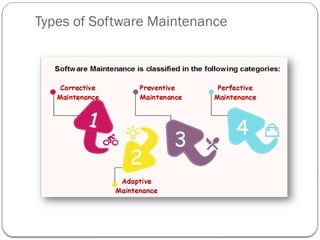
Types of Software Maintenance
Why do needs change?
 Given a capability, users see new ways to use it.
 Given a system, users see holes and gaps that they did not
anticipate.
 When given a system, users may find other things that they
do that might be automated.
 Users not involved originally may find uses (along with
special adaptations)
Why do needs change
 GOVERNMENT and other REGULATION
 The “government” is involved in many aspects of “business”
 Taxes (both payroll and other versions of taxation)
 Regulation (regulation requires documentation)
 Other “outside agencies”
 Insurers
 Vendors
 Customers
How does the environment change?
 Software has a long life – hardware does not
 The explosion in hardware capabilities has altered the need
for small storage and processing speed.
 Central server with “dumb” terminals gave way to distributed
systems in a client-server environment has given way to
many internet based applications. What’s next?
Why is it so hard to do maintenance?
 Maintenance folks are rarely the development folks.
 People move on, if not from the company perhaps to new
responsibilities.
 Our code memory is short lived. Look at code you wrote 6
months ago and you probably will not recognize it.
 Coders hate to do documentation and documentation I might
write for myself may not make sense to another reader.
How do we improve maintainability?
 Well documented development process.
 Why were decisions made?
 What is the scope of the existing product? ($$$$)
 What were the design decisions specifically?
 Standards maintained throughout the coding.
 Highly maintainable code is well compartmentalized.
 Highly maintainable code uses well understood patterns.
 All of the things that have led us to this point in the course.
Support includes
 A mechanism for customers to report defects
 A mechanism for recording and categorizing defects
 minor cosmetic issues may take a back seat to
 major functionality issues
 A mechanism for systematically correcting defects, testing
resulting code and deploying corrections.
This is all costly to the organization, but a necessary step.
How is support funded?
 Built into the cost of the software. (Like OS and many other
off the shelf products.We don’t pay maintenance fees, but at
some point may be forced to upgrade to a later version.
 Maintenance agreements. Based on the “normal” costs to
maintain the software, a maintenance agreement provides a
certain level of support. (Extended warranties).
 Cost per service call. A specific charge is assessed the
customer making each support call. Additional charges for
coding changes usually apply.
13
These slides are designed to accompany Software
Engineering:A Practitioner’s Approach,7/e (McGraw-Hill
2009). Slides copyright 2009 by Roger Pressman.
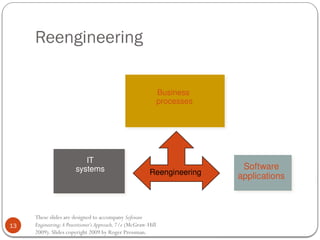
Reengineering
Business
processes
IT
systems Software
applications
Reengineering
Reengineering
 At some point, the cost to maintain software becomes too
great or the product is breaking down at an unacceptable
rate.
 OR Business needs change and you need to reengineer
processes and along with that they software systems that
support those processes.
15
These slides are designed to accompany Software
Engineering:A Practitioner’s Approach,7/e (McGraw-Hill
2009). Slides copyright 2009 by Roger Pressman.
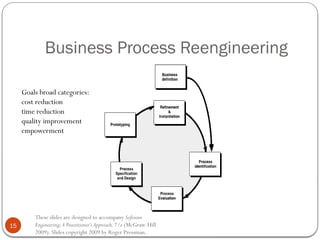
Business Process Reengineering
Goals broad categories:
cost reduction
time reduction
quality improvement
empowerment
16
These slides are designed to accompany Software
Engineering:A Practitioner’s Approach,7/e (McGraw-Hill
2009). Slides copyright 2009 by Roger Pressman.
BPR Principles
 Organize around outcomes, not tasks.
 Have those who use the output of the process perform the process.
 Incorporate information processing work into the real work that
produces the raw information.
 Treat geographically dispersed resources as though they were
centralized.
 Link parallel activities instead of integrated their results. When
different
 Put the decision point where the work is performed, and build control
into the process.
 Capture data once, at its source.
17
These slides are designed to accompany Software
Engineering:A Practitioner’s Approach,7/e (McGraw-Hill
2009). Slides copyright 2009 by Roger Pressman.
Software Reengineering
Forward
engineering
Data
restructuring
code
restructuring
reverse
engineering
document
restructuring
inventory
analysis
18
These slides are designed to accompany Software
Engineering:A Practitioner’s Approach,7/e (McGraw-Hill
2009). Slides copyright 2009 by Roger Pressman.
Inventory Analysis
 build a table that contains all applications
 establish a list of criteria, e.g.,
 name of the application
 year it was originally created
 number of substantive changes made to it
 total effort applied to make these changes
 date of last substantive change
 effort applied to make the last change
 system(s) in which it resides
 applications to which it interfaces, ...
 analyze and prioritize to select candidates for
reengineering
19
These slides are designed to accompany Software
Engineering:A Practitioner’s Approach,7/e (McGraw-Hill
2009). Slides copyright 2009 by Roger Pressman.
Document Restructuring
 Weak documentation is the trademark of many legacy systems.
 But what do we do about it? What are our options?
 Options …
 Creating documentation is far too time consuming. If the system
works, we’ll live with what we have. In some cases, this is the
correct approach.
 Documentation must be updated, but we have limited resources.
We’ll use a “document when touched” approach. It may not be
necessary to fully redocument an application.
 The system is business critical and must be fully redocumented.
Even in this case, an intelligent approach is to pare documentation to
an essential minimum.
20
These slides are designed to accompany Software
Engineering:A Practitioner’s Approach,7/e (McGraw-Hill
2009). Slides copyright 2009 by Roger Pressman.
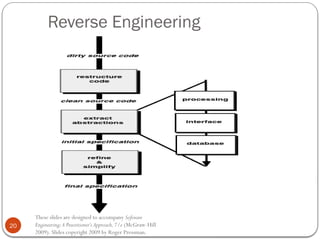
Reverse Engineering
21
These slides are designed to accompany Software
Engineering:A Practitioner’s Approach,7/e (McGraw-Hill
2009). Slides copyright 2009 by Roger Pressman.
Code Restructuring
 Source code is analyzed using a restructuring tool.
 Poorly design code segments are redesigned
 Violations of structured programming constructs are
noted and code is then restructured (this can be done
automatically)
 The resultant restructured code is reviewed and tested
to ensure that no anomalies have been introduced
 Internal code documentation is updated.
22
These slides are designed to accompany Software
Engineering:A Practitioner’s Approach,7/e (McGraw-Hill
2009). Slides copyright 2009 by Roger Pressman.
Data Restructuring
 Unlike code restructuring, which occurs at a relatively low level
of abstraction, data structuring is a full-scale reengineering
activity
 In most cases, data restructuring begins with a reverse
engineering activity.
 Current data architecture is dissected and necessary data models are
defined (Chapter 9).
 Data objects and attributes are identified, and existing data structures
are reviewed for quality.
 When data structure is weak (e.g., flat files are currently implemented,
when a relational approach would greatly simplify processing), the
data are reengineered.
 Because data architecture has a strong influence on program
architecture and the algorithms that populate it, changes to the
data will invariably result in either architectural or code-level
changes.
23
These slides are designed to accompany Software
Engineering:A Practitioner’s Approach,7/e (McGraw-Hill
2009). Slides copyright 2009 by Roger Pressman.
Forward Engineering
1. The cost to maintain one line of source code may be 20 to 40
times the cost of initial development of that line.
2. Redesign of the software architecture (program and/or data
structure), using modern design concepts, can greatly facilitate
future maintenance.
3. Because a prototype of the software already exists, development
productivity should be much higher than average.
4. The user now has experience with the software. Therefore, new
requirements and the direction of change can be ascertained with
greater ease.
5. CASE tools for reengineering will automate some parts of the
job.
6. A complete software configuration (documents, programs and
data) will exist upon completion of preventive maintenance.
24
These slides are designed to accompany Software
Engineering:A Practitioner’s Approach,7/e (McGraw-Hill
2009). Slides copyright 2009 by Roger Pressman.
Economics of Reengineering-I
 A cost/benefit analysis model for reengineering has
been proposed by Sneed [Sne95]. Nine parameters are
defined:
 P1 = current annual maintenance cost for an application.
 P2 = current annual operation cost for an application.
 P3 = current annual business value of an application.
 P4 = predicted annual maintenance cost after reengineering.
 P5 = predicted annual operations cost after reengineering.
 P6 = predicted annual business value after reengineering.
 P7 = estimated reengineering costs.
 P8 = estimated reengineering calendar time.
 P9 = reengineering risk factor (P9 = 1.0 is nominal).
 L = expected life of the system.
25
These slides are designed to accompany Software
Engineering:A Practitioner’s Approach,7/e (McGraw-Hill
2009). Slides copyright 2009 by Roger Pressman.
Economics of Reengineering-II
 The cost associated with continuing maintenance of a candidate
application (i.e., reengineering is not performed) can be defined as
Cmaint = [P3 - (P1 + P2)] x L
 The costs associated with reengineering are defined using the following
relationship:
Creeng = [P6 - (P4 + P5) x (L - P8) - (P7x P9)] `
 Using the costs presented in equations above, the overall benefit of
reengineering can be computed as
cost benefit = Creeng - Cmaint

Software engineering concept reengineeri

  • 1.
  • 2.
    Maintenance  Defect correction Extend capabilities  Changing environments  Changing needs of customers (internally and externally driven)
  • 3.
    Software Maintenance  Softwaremaintenance is a part of the Software Development Life Cycle. Its primary goal is to modify and update software application after delivery to correct errors and to improve performance. Software is a model of the real world.When the real world changes, the software require alteration wherever possible.  Software Maintenance is an inclusive activity that includes error corrections, enhancement of capabilities, deletion of obsolete capabilities, and optimization.
  • 4.
    Need for Maintenance SoftwareMaintenance is needed for:-  Correct errors  Change in user requirement with time  Changing hardware/software requirements  To improve system efficiency  To optimize the code to run faster  To modify the components  To reduce any unwanted side effects. Thus the maintenance is required to ensure that the system continues to satisfy user requirements.
  • 5.
    Types of SoftwareMaintenance
  • 6.
    Why do needschange?  Given a capability, users see new ways to use it.  Given a system, users see holes and gaps that they did not anticipate.  When given a system, users may find other things that they do that might be automated.  Users not involved originally may find uses (along with special adaptations)
  • 7.
    Why do needschange  GOVERNMENT and other REGULATION  The “government” is involved in many aspects of “business”  Taxes (both payroll and other versions of taxation)  Regulation (regulation requires documentation)  Other “outside agencies”  Insurers  Vendors  Customers
  • 8.
    How does theenvironment change?  Software has a long life – hardware does not  The explosion in hardware capabilities has altered the need for small storage and processing speed.  Central server with “dumb” terminals gave way to distributed systems in a client-server environment has given way to many internet based applications. What’s next?
  • 9.
    Why is itso hard to do maintenance?  Maintenance folks are rarely the development folks.  People move on, if not from the company perhaps to new responsibilities.  Our code memory is short lived. Look at code you wrote 6 months ago and you probably will not recognize it.  Coders hate to do documentation and documentation I might write for myself may not make sense to another reader.
  • 10.
    How do weimprove maintainability?  Well documented development process.  Why were decisions made?  What is the scope of the existing product? ($$$$)  What were the design decisions specifically?  Standards maintained throughout the coding.  Highly maintainable code is well compartmentalized.  Highly maintainable code uses well understood patterns.  All of the things that have led us to this point in the course.
  • 11.
    Support includes  Amechanism for customers to report defects  A mechanism for recording and categorizing defects  minor cosmetic issues may take a back seat to  major functionality issues  A mechanism for systematically correcting defects, testing resulting code and deploying corrections. This is all costly to the organization, but a necessary step.
  • 12.
    How is supportfunded?  Built into the cost of the software. (Like OS and many other off the shelf products.We don’t pay maintenance fees, but at some point may be forced to upgrade to a later version.  Maintenance agreements. Based on the “normal” costs to maintain the software, a maintenance agreement provides a certain level of support. (Extended warranties).  Cost per service call. A specific charge is assessed the customer making each support call. Additional charges for coding changes usually apply.
  • 13.
    13 These slides aredesigned to accompany Software Engineering:A Practitioner’s Approach,7/e (McGraw-Hill 2009). Slides copyright 2009 by Roger Pressman. Reengineering Business processes IT systems Software applications Reengineering
  • 14.
    Reengineering  At somepoint, the cost to maintain software becomes too great or the product is breaking down at an unacceptable rate.  OR Business needs change and you need to reengineer processes and along with that they software systems that support those processes.
  • 15.
    15 These slides aredesigned to accompany Software Engineering:A Practitioner’s Approach,7/e (McGraw-Hill 2009). Slides copyright 2009 by Roger Pressman. Business Process Reengineering Goals broad categories: cost reduction time reduction quality improvement empowerment
  • 16.
    16 These slides aredesigned to accompany Software Engineering:A Practitioner’s Approach,7/e (McGraw-Hill 2009). Slides copyright 2009 by Roger Pressman. BPR Principles  Organize around outcomes, not tasks.  Have those who use the output of the process perform the process.  Incorporate information processing work into the real work that produces the raw information.  Treat geographically dispersed resources as though they were centralized.  Link parallel activities instead of integrated their results. When different  Put the decision point where the work is performed, and build control into the process.  Capture data once, at its source.
  • 17.
    17 These slides aredesigned to accompany Software Engineering:A Practitioner’s Approach,7/e (McGraw-Hill 2009). Slides copyright 2009 by Roger Pressman. Software Reengineering Forward engineering Data restructuring code restructuring reverse engineering document restructuring inventory analysis
  • 18.
    18 These slides aredesigned to accompany Software Engineering:A Practitioner’s Approach,7/e (McGraw-Hill 2009). Slides copyright 2009 by Roger Pressman. Inventory Analysis  build a table that contains all applications  establish a list of criteria, e.g.,  name of the application  year it was originally created  number of substantive changes made to it  total effort applied to make these changes  date of last substantive change  effort applied to make the last change  system(s) in which it resides  applications to which it interfaces, ...  analyze and prioritize to select candidates for reengineering
  • 19.
    19 These slides aredesigned to accompany Software Engineering:A Practitioner’s Approach,7/e (McGraw-Hill 2009). Slides copyright 2009 by Roger Pressman. Document Restructuring  Weak documentation is the trademark of many legacy systems.  But what do we do about it? What are our options?  Options …  Creating documentation is far too time consuming. If the system works, we’ll live with what we have. In some cases, this is the correct approach.  Documentation must be updated, but we have limited resources. We’ll use a “document when touched” approach. It may not be necessary to fully redocument an application.  The system is business critical and must be fully redocumented. Even in this case, an intelligent approach is to pare documentation to an essential minimum.
  • 20.
    20 These slides aredesigned to accompany Software Engineering:A Practitioner’s Approach,7/e (McGraw-Hill 2009). Slides copyright 2009 by Roger Pressman. Reverse Engineering
  • 21.
    21 These slides aredesigned to accompany Software Engineering:A Practitioner’s Approach,7/e (McGraw-Hill 2009). Slides copyright 2009 by Roger Pressman. Code Restructuring  Source code is analyzed using a restructuring tool.  Poorly design code segments are redesigned  Violations of structured programming constructs are noted and code is then restructured (this can be done automatically)  The resultant restructured code is reviewed and tested to ensure that no anomalies have been introduced  Internal code documentation is updated.
  • 22.
    22 These slides aredesigned to accompany Software Engineering:A Practitioner’s Approach,7/e (McGraw-Hill 2009). Slides copyright 2009 by Roger Pressman. Data Restructuring  Unlike code restructuring, which occurs at a relatively low level of abstraction, data structuring is a full-scale reengineering activity  In most cases, data restructuring begins with a reverse engineering activity.  Current data architecture is dissected and necessary data models are defined (Chapter 9).  Data objects and attributes are identified, and existing data structures are reviewed for quality.  When data structure is weak (e.g., flat files are currently implemented, when a relational approach would greatly simplify processing), the data are reengineered.  Because data architecture has a strong influence on program architecture and the algorithms that populate it, changes to the data will invariably result in either architectural or code-level changes.
  • 23.
    23 These slides aredesigned to accompany Software Engineering:A Practitioner’s Approach,7/e (McGraw-Hill 2009). Slides copyright 2009 by Roger Pressman. Forward Engineering 1. The cost to maintain one line of source code may be 20 to 40 times the cost of initial development of that line. 2. Redesign of the software architecture (program and/or data structure), using modern design concepts, can greatly facilitate future maintenance. 3. Because a prototype of the software already exists, development productivity should be much higher than average. 4. The user now has experience with the software. Therefore, new requirements and the direction of change can be ascertained with greater ease. 5. CASE tools for reengineering will automate some parts of the job. 6. A complete software configuration (documents, programs and data) will exist upon completion of preventive maintenance.
  • 24.
    24 These slides aredesigned to accompany Software Engineering:A Practitioner’s Approach,7/e (McGraw-Hill 2009). Slides copyright 2009 by Roger Pressman. Economics of Reengineering-I  A cost/benefit analysis model for reengineering has been proposed by Sneed [Sne95]. Nine parameters are defined:  P1 = current annual maintenance cost for an application.  P2 = current annual operation cost for an application.  P3 = current annual business value of an application.  P4 = predicted annual maintenance cost after reengineering.  P5 = predicted annual operations cost after reengineering.  P6 = predicted annual business value after reengineering.  P7 = estimated reengineering costs.  P8 = estimated reengineering calendar time.  P9 = reengineering risk factor (P9 = 1.0 is nominal).  L = expected life of the system.
  • 25.
    25 These slides aredesigned to accompany Software Engineering:A Practitioner’s Approach,7/e (McGraw-Hill 2009). Slides copyright 2009 by Roger Pressman. Economics of Reengineering-II  The cost associated with continuing maintenance of a candidate application (i.e., reengineering is not performed) can be defined as Cmaint = [P3 - (P1 + P2)] x L  The costs associated with reengineering are defined using the following relationship: Creeng = [P6 - (P4 + P5) x (L - P8) - (P7x P9)] `  Using the costs presented in equations above, the overall benefit of reengineering can be computed as cost benefit = Creeng - Cmaint