Conventional software management- Objectives & characteristics
• Barry Boehm's "Industrial Software Metrics of Top 10 List" is a
good, objective characterization of the state of software development.
1) Finding and fixing a software problem after delivery costs 100
times more than finding and fixing the problem in early design
phases.
2) You can compress software development schedules 25% of normal,
but no more.
3) For every $1 you spend on development, you will spend $2 on
maintenance.
3.
4) Software developmentand maintenance costs are primarily a
function of the number of source lines of code (SLOC).
5) Variations among people account for the biggest differences
in software productivity rate is 17%
6) The overall ratio of software to hardware costs is still growing.
In 1955 it was 15:85; in 1985, 85:15.
7) Only about 15% of software development efforts is devoted
to basic programming.
4.
8) Software systemsand products typically cost 3 times as much per
SLOC as individual software programs by profits of products.
9) Walkthroughs catch 60% of the errors. (Later 80-20 factors).
10) 80% of the contribution comes from 20% of the contributors.
11) 80% of the engineering is consumed by 20% of the requirements.
12) 80% of the software cost is consumed by 20% of the components.
13) 80% of the errors are caused by 20% of the components.
14) 80% of software scrap and rework is caused by 20% of the
errors.
15) 80% of the progress is made by 20% of the people.
16) 80% of the Construction phase caused by 20% of competitors to
projects.
5.
Evolution in SoftwareEconomics
• Most software cost models can be described five parameters :
Size, Process, Personnel, Environment and Required quality.
1) The size of the end product which is typically measured
in terms of the number of source lines or the number of
function points developed to achieve the required functionality.
2) Bythe process used to produce the end product, the ability
of the process is to avoid non-value adding activities.
---- Unnecessary Meetings, Tasks, Approvals.
6.
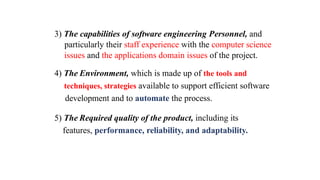
3) The capabilitiesof software engineering Personnel, and
particularly their staff experience with the computer science
issues and the applications domain issues of the project.
4) The Environment, which is made up of the tools and
techniques, strategies available to support efficient software
development and to automate the process.
5) The Required quality of the product, including its
features, performance, reliability, and adaptability.




![Project Management (October - 2016) [CBSGS - Paper Solution] {Mumbai University}](https://cdn.slidesharecdn.com/ss_thumbnails/pm-cbsgs-oct-2016-ps-190613193656-thumbnail.jpg?width=640&height=640&fit=bounds)


![Project Management (October - 2014) [CBSGS - Paper Solution] {Mumbai University}](https://cdn.slidesharecdn.com/ss_thumbnails/pm-cbsgs-oct-2014-ps-190613193642-thumbnail.jpg?width=640&height=640&fit=bounds)


