Software Engineering and
Software Process
Presented By - Ravina Jeswani Sophia Girls college(Autonomous) Ajmer
www.sophiacollegeajmer.in
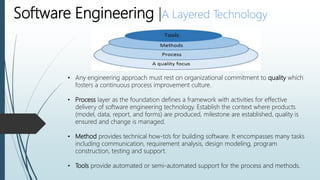
Software Engineering |A Layered Technology
• Any engineering approach must rest on organizational commitment to quality which
fosters a continuous process improvement culture.
• Process layer as the foundation defines a framework with activities for effective
delivery of software engineering technology. Establish the context where products
(model, data, report, and forms) are produced, milestone are established, quality is
ensured and change is managed.
• Method provides technical how-to’s for building software. It encompasses many tasks
including communication, requirement analysis, design modeling, program
construction, testing and support.
• Tools provide automated or semi-automated support for the process and methods.
Software Process
 A process is a collection of activities, actions and tasks that are
performed when some work product is to be created. It is not a rigid
prescription for how to build computer software. Rather, it is an
adaptable approach that enables the people doing the work to pick
and choose the appropriate set of work actions and tasks.
 Purpose of process is to deliver software in a timely manner and with
sufficient quality to satisfy those who have sponsored its creation
and those who will use it.
Software Process
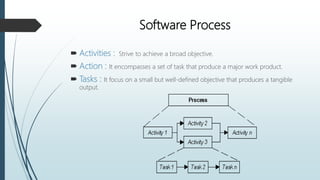
 Activities : Strive to achieve a broad objective.
 Action : It encompasses a set of task that produce a major work product.
 Tasks : It focus on a small but well-defined objective that produces a tangible
output.
A Process Framework
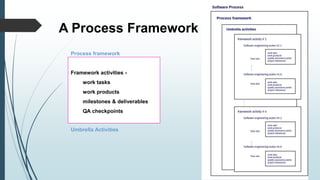
Process framework
Framework activities -
work tasks
work products
milestones & deliverables
QA checkpoints
Umbrella Activities
Framework Activities
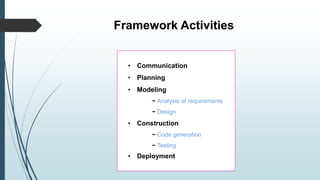
• Communication
• Planning
• Modeling
~ Analysis of requirements
~ Design
• Construction
~ Code generation
~ Testing
• Deployment
Five Activities of a Generic Process framework
 Communication: communicate with customer to understand objectives and gather
requirements
 Planning: creates a “ map ” defines the work by describing the tasks, risks and
resources, work products and work schedule.
 Modeling: Create a “sketch”, what it looks like architecturally, how the constituent
parts fit together and other characteristics.
 Construction: code generation and the testing.
 Deployment: Delivered to the customer who evaluates the products and provides
feedback based on the evaluation.
These five framework activities can be used to all software development regardless of
the application domain, size of the project, complexity of the efforts etc.
• The details will be different in each case.
For many software projects, these framework activities are applied iteratively as a
project progresses.
• Each iteration produces a software increment that provides a subset of
overall software features and functionality.
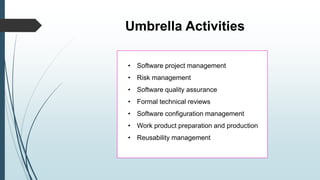
Umbrella Activities
• Software project management
• Risk management
• Software quality assurance
• Formal technical reviews
• Software configuration management
• Work product preparation and production
• Reusability management
Umbrella Activities
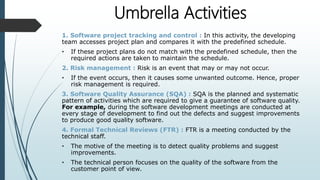
1. Software project tracking and control : In this activity, the developing
team accesses project plan and compares it with the predefined schedule.
• If these project plans do not match with the predefined schedule, then the
required actions are taken to maintain the schedule.
2. Risk management : Risk is an event that may or may not occur.
• If the event occurs, then it causes some unwanted outcome. Hence, proper
risk management is required.
3. Software Quality Assurance (SQA) : SQA is the planned and systematic
pattern of activities which are required to give a guarantee of software quality.
For example, during the software development meetings are conducted at
every stage of development to find out the defects and suggest improvements
to produce good quality software.
4. Formal Technical Reviews (FTR) : FTR is a meeting conducted by the
technical staff.
• The motive of the meeting is to detect quality problems and suggest
improvements.
• The technical person focuses on the quality of the software from the
customer point of view.
Umbrella Activities
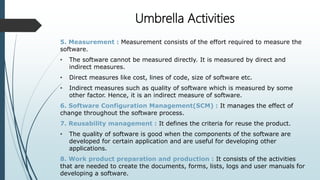
5. Measurement : Measurement consists of the effort required to measure the
software.
• The software cannot be measured directly. It is measured by direct and
indirect measures.
• Direct measures like cost, lines of code, size of software etc.
• Indirect measures such as quality of software which is measured by some
other factor. Hence, it is an indirect measure of software.
6. Software Configuration Management(SCM) : It manages the effect of
change throughout the software process.
7. Reusability management : It defines the criteria for reuse the product.
• The quality of software is good when the components of the software are
developed for certain application and are useful for developing other
applications.
8. Work product preparation and production : It consists of the activities
that are needed to create the documents, forms, lists, logs and user manuals for
developing a software.

Software Process

  • 1.
    Software Engineering and SoftwareProcess Presented By - Ravina Jeswani Sophia Girls college(Autonomous) Ajmer www.sophiacollegeajmer.in
  • 2.
    Software Engineering |ALayered Technology • Any engineering approach must rest on organizational commitment to quality which fosters a continuous process improvement culture. • Process layer as the foundation defines a framework with activities for effective delivery of software engineering technology. Establish the context where products (model, data, report, and forms) are produced, milestone are established, quality is ensured and change is managed. • Method provides technical how-to’s for building software. It encompasses many tasks including communication, requirement analysis, design modeling, program construction, testing and support. • Tools provide automated or semi-automated support for the process and methods.
  • 3.
    Software Process  Aprocess is a collection of activities, actions and tasks that are performed when some work product is to be created. It is not a rigid prescription for how to build computer software. Rather, it is an adaptable approach that enables the people doing the work to pick and choose the appropriate set of work actions and tasks.  Purpose of process is to deliver software in a timely manner and with sufficient quality to satisfy those who have sponsored its creation and those who will use it.
  • 4.
    Software Process  Activities: Strive to achieve a broad objective.  Action : It encompasses a set of task that produce a major work product.  Tasks : It focus on a small but well-defined objective that produces a tangible output.
  • 5.
    A Process Framework Processframework Framework activities - work tasks work products milestones & deliverables QA checkpoints Umbrella Activities
  • 6.
    Framework Activities • Communication •Planning • Modeling ~ Analysis of requirements ~ Design • Construction ~ Code generation ~ Testing • Deployment
  • 7.
    Five Activities ofa Generic Process framework  Communication: communicate with customer to understand objectives and gather requirements  Planning: creates a “ map ” defines the work by describing the tasks, risks and resources, work products and work schedule.  Modeling: Create a “sketch”, what it looks like architecturally, how the constituent parts fit together and other characteristics.  Construction: code generation and the testing.  Deployment: Delivered to the customer who evaluates the products and provides feedback based on the evaluation. These five framework activities can be used to all software development regardless of the application domain, size of the project, complexity of the efforts etc. • The details will be different in each case. For many software projects, these framework activities are applied iteratively as a project progresses. • Each iteration produces a software increment that provides a subset of overall software features and functionality.
  • 8.
    Umbrella Activities • Softwareproject management • Risk management • Software quality assurance • Formal technical reviews • Software configuration management • Work product preparation and production • Reusability management
  • 9.
    Umbrella Activities 1. Softwareproject tracking and control : In this activity, the developing team accesses project plan and compares it with the predefined schedule. • If these project plans do not match with the predefined schedule, then the required actions are taken to maintain the schedule. 2. Risk management : Risk is an event that may or may not occur. • If the event occurs, then it causes some unwanted outcome. Hence, proper risk management is required. 3. Software Quality Assurance (SQA) : SQA is the planned and systematic pattern of activities which are required to give a guarantee of software quality. For example, during the software development meetings are conducted at every stage of development to find out the defects and suggest improvements to produce good quality software. 4. Formal Technical Reviews (FTR) : FTR is a meeting conducted by the technical staff. • The motive of the meeting is to detect quality problems and suggest improvements. • The technical person focuses on the quality of the software from the customer point of view.
  • 10.
    Umbrella Activities 5. Measurement: Measurement consists of the effort required to measure the software. • The software cannot be measured directly. It is measured by direct and indirect measures. • Direct measures like cost, lines of code, size of software etc. • Indirect measures such as quality of software which is measured by some other factor. Hence, it is an indirect measure of software. 6. Software Configuration Management(SCM) : It manages the effect of change throughout the software process. 7. Reusability management : It defines the criteria for reuse the product. • The quality of software is good when the components of the software are developed for certain application and are useful for developing other applications. 8. Work product preparation and production : It consists of the activities that are needed to create the documents, forms, lists, logs and user manuals for developing a software.