1
MCA : 3
05MC0301
(SoftwareEngineering)
Unit : 1
Introduction to Software Engineering
& Process Models
Chapter : 1
Software and Software Engineering
2.
2
Introduction of S/WEng.
What is S/W Engineering ?
The seminal definition:
[Software engineering is] the establishment and use of sound
engineering principles in order to obtain economically software
that is reliable and works efficiently on real machines.
The IEEE definition:
Software Engineering :
It is an application of a systematic, disciplined, quantifiable
approach to the development, operation, and maintenance of
software; that is, the application of engineering to software.
3.
3
What is software?
Software is:
(1) It is a set of instructions (computer programs) that when
executed provide desired features, function, and performance;
Characteristics of Software :
Software is developed or engineered, it is not manufactured in the
classical sense.
Software doesn't "wear out." [use or be used until useless]
Industry is moving toward component-based construction, most
software continues to be custom-built.
4.
4
Software Application domain
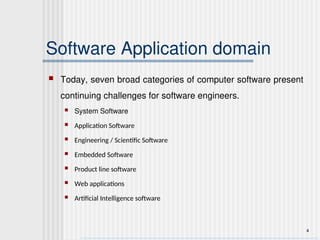
Today, seven broad categories of computer software present
continuing challenges for software engineers.
System Software
Application Software
Engineering / Scientific Software
Embedded Software
Product line software
Web applications
Artificial Intelligence software
5.
5
Q: Software EngineeringLayers
What do you mean by the term Software Engineering? Explain Software
Engineering as a Layered Technology.
Introduction :
Software Engineering is the application of a systematic,
disciplined, quantifiable approach to the development,
operation, and maintenance of software; that is, the application
of engineering to software.
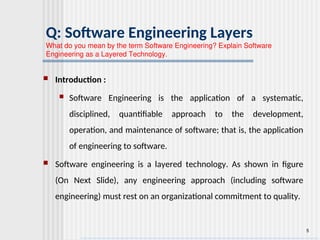
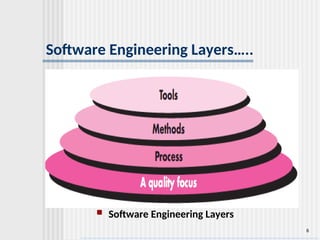
Software engineering is a layered technology. As shown in figure
(On Next Slide), any engineering approach (including software
engineering) must rest on an organizational commitment to quality.
7
Software Engineering Layers…..
Process Layer :
The foundation for software engineering is the process layer.
Process defines a framework that must be established for effective delivery
of software engineering technology.
The software process forms the basis for management control of software
projects and establishes the context in which
• Technical methods are applied,
• Work products (models, documents, data, reports, forms,
etc.) are produced,
• Milestones are established,
• Quality is ensured, and change is properly managed.
8.
8
Software Engineering Layers…..
Method Layer :
Software engineering methods provide the technical solution for building
software.
Methods includes a broad array of tasks that includes,
• Communication,
• Requirements analysis,
• Design modeling,
• Program construction,
• Testing, and support.
It is a set of basic principles that manage each area of the technology and
include modeling activities and other descriptive techniques.
9.
9
Software Engineering Layers…..
Tools Layer :
Software engineering tools provide automated or semi-
automated support for the process and the methods.
When tools are integrated so that information created by one
tool can be used by another.
A system for the support of software development, called
computer-aided software engineering, is established.
10.
10
The Software Process
Q:-Which are the elements of software Process?
Introduction :
A process is a collection of activities, actions, and tasks that are
performed when some work product is to be created.
An activity includes to achieve a broad objective (e.g., communication
with stakeholders) and is applied regardless of the application domain,
size of the project, complexity of the effort which software engineering
is to be applied.
An action (e.g., architectural design) includes a set of tasks that produce
a major work product (e.g., an architectural design model).
A task focuses on a small, but well-defined objective (e.g., conducting a
unit test) that produces a tangible outcome
11.
11
The Software Process……
A generic process framework for software engineering includes
five framework activities:
Communication
Planning
Modeling
Construction
Deployment
12.
12
The Software Process……
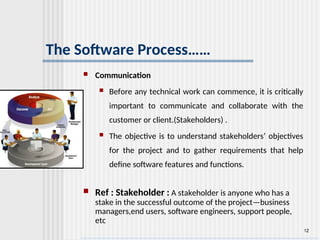
Communication
Before any technical work can commence, it is critically
important to communicate and collaborate with the
customer or client.(Stakeholders) .
The objective is to understand stakeholders’ objectives
for the project and to gather requirements that help
define software features and functions.
Ref : Stakeholder : A stakeholder is anyone who has a
stake in the successful outcome of the project—business
managers,end users, software engineers, support people,
etc
13.
13
The Software Process……
Planning :
It defines the software engineering work by
• Describing the technical tasks to be
conducted,
• The risks that are likely,
• The resources that will be required,
• The work products to be produced,
and a work schedule.
It is similar like a map which guide us about our
journey.
14.
14
The Software Process……
Modeling :
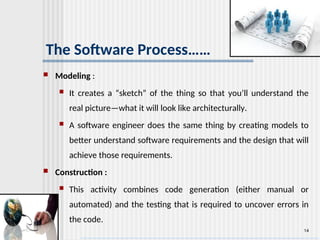
It creates a “sketch” of the thing so that you’ll understand the
real picture—what it will look like architecturally.
A software engineer does the same thing by creating models to
better understand software requirements and the design that will
achieve those requirements.
Construction :
This activity combines code generation (either manual or
automated) and the testing that is required to uncover errors in
the code.
15.
15
The Software Process……
Deployment :
The software (as a complete entity or as a partially completed
increment) is delivered to the customer who evaluates the delivered
product and provides feedback based on the evaluation.
These five generic framework activities can be used during the
development of small, simple programs, the creation of large Web
applications, and for the engineering of large, complex computer-based
systems.
The details of the software process will be quite different in each case,
but the framework activities remain the same.
16.
16
The Software Process……
For many software projects, framework activities are applied
iteratively as a project progresses.
Each project iteration produces a software increment that provides
stakeholders with a subset of overall software features and
functionality.
As each increment is produced, the software becomes more and more
complete.
17.
17
The Software Process……
Software engineering process framework activities are
complemented by a number of umbrella activities.
In general, umbrella activities are applied throughout a software
project and help a software team manage and control progress,
quality, change, and risk.
18.
18
The Software Process……
Typical umbrella activities include:
Software project tracking and control—allows the software team to assess progress
against the project plan and take any necessary action to maintain the schedule.
Risk management—assesses risks that may affect the outcome of the project or the
quality of the product.
Software quality assurance—defines and conducts the activities required to ensure
software quality.
Technical reviews—assesses software engineering work products in an effort to
uncover and remove errors before they are propagated to the next activity.
Measurement—defines and collects process, project, and product measures that assist
the team in delivering software that meets stakeholders’ needs; can be used in
conjunction with all other framework and umbrella activities.
19.
19
The Software Process……
Software configuration management—manages the effects of
change throughout the software process.
Reusability management—defines criteria for work product reuse
(including software components) and establishes mechanisms to
achieve reusable components.
Work product preparation and production—encompasses the
activities required to create work products such as models,
documents, logs, forms, and lists.
20.
20
Questions :
(1) Whatdo you mean by the term Software Engineering? Explain
Software Engineering as a Layered Technology.
(2) Explain software engineering as a layered technology.
![2
Introduction of S/W Eng.
What is S/W Engineering ?
The seminal definition:
[Software engineering is] the establishment and use of sound
engineering principles in order to obtain economically software
that is reliable and works efficiently on real machines.
The IEEE definition:
Software Engineering :
It is an application of a systematic, disciplined, quantifiable
approach to the development, operation, and maintenance of
software; that is, the application of engineering to software.](https://image.slidesharecdn.com/unit-1chp-01-250820040636-4c2fc36a/85/Introduction-to-Software-Engineering-Principles-2-320.jpg)
![3
What is software?
Software is:
(1) It is a set of instructions (computer programs) that when
executed provide desired features, function, and performance;
Characteristics of Software :
Software is developed or engineered, it is not manufactured in the
classical sense.
Software doesn't "wear out." [use or be used until useless]
Industry is moving toward component-based construction, most
software continues to be custom-built.](https://image.slidesharecdn.com/unit-1chp-01-250820040636-4c2fc36a/85/Introduction-to-Software-Engineering-Principles-3-320.jpg)


![[Deck] What's New in Spark-Iceberg Integration via DSV2.pptx](https://cdn.slidesharecdn.com/ss_thumbnails/deckwhatsnewinspark-icebergintegrationviadsv2-260210005337-25955b12-thumbnail.jpg?width=640&height=640&fit=bounds)


