1
SRI KRISHNA ARTS AND SCIENCE COLLEGE
Department of Information Technology and Cognitive
Systems
Software Engineering
Class II BSC IT A
Course Code 24CSS10
Google Classroom Code ejngui73
Unit 1- A process framework
Course Coordinator
S. SOUNDHARYA
ATTENDANCE
SNAP TALK
4
Topics to be Covered
• Software Engineering
• The Software Process
• A Process Framework
• Framework Activities
• Umbrella Activities
• Process Adaptation
Software Engineering
Some realities:
• A concerted effort should be made to understand the problem
before a software solution is developed. (Understand the
problem before build a solution)
• Design becomes a pivotal activity.
• Software should exhibit high quality.
• Software should be maintainable.(fix bugs or add new features).
Continue…
6
• SE means using proper engineering methods and principles to build
software
• In order to obtain economically software that is reliable and works
efficiently on real machines.
• The IEEE definition:
⮚Software Engineering: The application of a systematic, disciplined,
quantifiable approach to the development, operation, and
maintenance of software; that is, the application of engineering to
software.
7
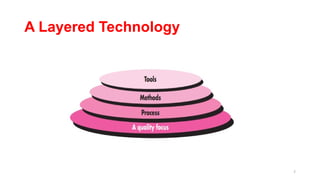
A Layered Technology
8
Methods and Tools
Method
• Provides technical how-tools for building software.
• It encompasses many tasks including communication, requirement analysis, design
modeling, program construction, testing and support.
Tools
• Provide automated or semi-automated support for the process and methods.
• When tools are integrated so that information created by one tool can be used by another.
• A system for the support of software development, called computer-aided software
engineering(CASE) is established.(faster, more efficient, and better organized)
9
The Software Process
 A process is a collection of activities, actions and tasks that are
performed when some work product is to be created.
 An activity – strives to achieve a board objective.
(Example: Communication with stakeholders)
 An action - a set of tasks that produce major work product
(Example: Architectural design)
 A task - focuses on a small, but well defined.
(Example: Conducting a unit test)
10
A Process Framework
 Establishes the foundation for a complete software
process
 Identifies a number of framework activities applicable
to all software projects
 Also include a set of umbrella activities that are
applicable across the entire software process.
Five Activities of Process Framework
1) Communication
2) Planning
3) Modeling
4) Construction
5) Deployment.
Continues…
12
Communication: Discuss with customers and stakeholders to
understand their needs and gather software requirements.
Planning: Create a detailed project plan outlining tasks, risks,
resources, deliverables, and timelines.
Modeling: Design models (like sketches) to visualize the software’s
structure and behavior before building it.
Construction: Write and test the code to develop a working product.
Deployment: Deliver the software to the customer for use and
feedback.
13
Umbrella activities
 Software engineering process framework activities are
complemented by a number of umbrella activities.
 Umbrella activities are applied throughout a software project
and help a software team manage and Track progress,
Maintain quality, Handle changes, and Manage risk.
14
Typical umbrella activities include:
• Software project tracking and control
• Risk management
• Software quality assurance
• Technical reviews
• Measurement
• Software configuration management
• Reusability management
• Work product preparation & production
15
Software project tracking and control:
Allows the software team to assess progress against the project plan
and take any necessary action to maintain the schedule.
Risk management:
Assesses risks that may affect the outcome of the project or the
quality of the product.
Software quality assurance:
Defines and conducts the activities required to ensure software
quality.
16
Technical reviews:
Assesses software engineering work products in an effort to uncover
and remove errors before they are propagated to the next activity.
Measurement:
Defines and collects process, project, and product measures that
assist the team in delivering software that meets stakeholders’ needs; can be
used in conjunction with all other framework and umbrella activities.
Software configuration management:
Manages the effects of change throughout the software process.
17
Reusability management:
Defines criteria for work product reuse (including software
components) and establishes mechanisms to achieve reusable
components.
Work product preparation and production:
Encompasses the activities required to create work products
such as models, documents, logs, forms, and lists.
18
Process Adaptation
 Process Adaptation refers to the ability to modify and tailor
the software engineering process based on the specific
needs of a project, team, or organization.
 It means that the software process is not fixed—Key aspects
that may vary include the workflow, task detail, quality
checks, team roles, and customer involvement.
 Process Adaptation is about making the process flexible and
suitable for each unique situation
Continue,..
19
 Overall flow of activities, actions, and tasks and the interdependencies
among them
 Degree to which actions and tasks are defined within each framework activity
 Degree to which work products are identified and required.
 Manner in which quality assurance activities are applied
 Manner in which project tracking and control activities are applied
 Overall degree of detail and rigor with which the process is described
 Degree to which the customer and other stakeholders are involved with the
project
 Level of autonomy given to the software team
MCQ
1. Which is not Layered Technology?
a) Process
b) Quality
c) Tools
d) Activity
SKASC 20
21
2. __________ is the continuous process improvement culture?
a) Tools
b) Methods
c) Quality
d) Process
MCQ
3. _________is a glue that holds the technology
layers together
a)software method
b)software process
c)software quality
d)software tool
SKASC 22
23
4. An __________ is a set of tasks that produce major work
product ?
a) activity
b) action
c) process
d) task
24
5. Which activity helps the software team assess progress
against the project plan and take corrective actions if needed?
A. Software configuration management
B. Software project tracking and control
C. Technical reviews
D. Measurement
25
Next Topic
• Process Models
• A Generic Process Model
• Defining a Framework Activity
26
THANK YOU

Lecture 2 - A process framework.pptx UNIT 1

  • 1.
    1 SRI KRISHNA ARTSAND SCIENCE COLLEGE Department of Information Technology and Cognitive Systems Software Engineering Class II BSC IT A Course Code 24CSS10 Google Classroom Code ejngui73 Unit 1- A process framework Course Coordinator S. SOUNDHARYA
  • 2.
  • 3.
  • 4.
    4 Topics to beCovered • Software Engineering • The Software Process • A Process Framework • Framework Activities • Umbrella Activities • Process Adaptation
  • 5.
    Software Engineering Some realities: •A concerted effort should be made to understand the problem before a software solution is developed. (Understand the problem before build a solution) • Design becomes a pivotal activity. • Software should exhibit high quality. • Software should be maintainable.(fix bugs or add new features). Continue…
  • 6.
    6 • SE meansusing proper engineering methods and principles to build software • In order to obtain economically software that is reliable and works efficiently on real machines. • The IEEE definition: ⮚Software Engineering: The application of a systematic, disciplined, quantifiable approach to the development, operation, and maintenance of software; that is, the application of engineering to software.
  • 7.
  • 8.
    8 Methods and Tools Method •Provides technical how-tools for building software. • It encompasses many tasks including communication, requirement analysis, design modeling, program construction, testing and support. Tools • Provide automated or semi-automated support for the process and methods. • When tools are integrated so that information created by one tool can be used by another. • A system for the support of software development, called computer-aided software engineering(CASE) is established.(faster, more efficient, and better organized)
  • 9.
    9 The Software Process A process is a collection of activities, actions and tasks that are performed when some work product is to be created.  An activity – strives to achieve a board objective. (Example: Communication with stakeholders)  An action - a set of tasks that produce major work product (Example: Architectural design)  A task - focuses on a small, but well defined. (Example: Conducting a unit test)
  • 10.
    10 A Process Framework Establishes the foundation for a complete software process  Identifies a number of framework activities applicable to all software projects  Also include a set of umbrella activities that are applicable across the entire software process.
  • 11.
    Five Activities ofProcess Framework 1) Communication 2) Planning 3) Modeling 4) Construction 5) Deployment. Continues…
  • 12.
    12 Communication: Discuss withcustomers and stakeholders to understand their needs and gather software requirements. Planning: Create a detailed project plan outlining tasks, risks, resources, deliverables, and timelines. Modeling: Design models (like sketches) to visualize the software’s structure and behavior before building it. Construction: Write and test the code to develop a working product. Deployment: Deliver the software to the customer for use and feedback.
  • 13.
    13 Umbrella activities  Softwareengineering process framework activities are complemented by a number of umbrella activities.  Umbrella activities are applied throughout a software project and help a software team manage and Track progress, Maintain quality, Handle changes, and Manage risk.
  • 14.
    14 Typical umbrella activitiesinclude: • Software project tracking and control • Risk management • Software quality assurance • Technical reviews • Measurement • Software configuration management • Reusability management • Work product preparation & production
  • 15.
    15 Software project trackingand control: Allows the software team to assess progress against the project plan and take any necessary action to maintain the schedule. Risk management: Assesses risks that may affect the outcome of the project or the quality of the product. Software quality assurance: Defines and conducts the activities required to ensure software quality.
  • 16.
    16 Technical reviews: Assesses softwareengineering work products in an effort to uncover and remove errors before they are propagated to the next activity. Measurement: Defines and collects process, project, and product measures that assist the team in delivering software that meets stakeholders’ needs; can be used in conjunction with all other framework and umbrella activities. Software configuration management: Manages the effects of change throughout the software process.
  • 17.
    17 Reusability management: Defines criteriafor work product reuse (including software components) and establishes mechanisms to achieve reusable components. Work product preparation and production: Encompasses the activities required to create work products such as models, documents, logs, forms, and lists.
  • 18.
    18 Process Adaptation  ProcessAdaptation refers to the ability to modify and tailor the software engineering process based on the specific needs of a project, team, or organization.  It means that the software process is not fixed—Key aspects that may vary include the workflow, task detail, quality checks, team roles, and customer involvement.  Process Adaptation is about making the process flexible and suitable for each unique situation Continue,..
  • 19.
    19  Overall flowof activities, actions, and tasks and the interdependencies among them  Degree to which actions and tasks are defined within each framework activity  Degree to which work products are identified and required.  Manner in which quality assurance activities are applied  Manner in which project tracking and control activities are applied  Overall degree of detail and rigor with which the process is described  Degree to which the customer and other stakeholders are involved with the project  Level of autonomy given to the software team
  • 20.
    MCQ 1. Which isnot Layered Technology? a) Process b) Quality c) Tools d) Activity SKASC 20
  • 21.
    21 2. __________ isthe continuous process improvement culture? a) Tools b) Methods c) Quality d) Process
  • 22.
    MCQ 3. _________is aglue that holds the technology layers together a)software method b)software process c)software quality d)software tool SKASC 22
  • 23.
    23 4. An __________is a set of tasks that produce major work product ? a) activity b) action c) process d) task
  • 24.
    24 5. Which activityhelps the software team assess progress against the project plan and take corrective actions if needed? A. Software configuration management B. Software project tracking and control C. Technical reviews D. Measurement
  • 25.
    25 Next Topic • ProcessModels • A Generic Process Model • Defining a Framework Activity
  • 26.