What is softwareengineering?
The application of a systematic, disciplined, quantifiable approach to the development, operation, and
maintenance of software; that is, the application of engineering to software.
Software engineering is the establishment and use of sound engineering principles in order to obtain
economically software that is reliable and works efficiently on real machines.
Software engineering is also:-
• A modeling activity
• A problem-solving activity
• A knowledge acquisition activity
• A rationale-driven activity
2.
Software engineersshould adopt
• Systematic and organized approach to their work
• Use appropriate tools and techniques depending on the problem to be solved
• The development constraints and the resources available
Software Engineering is the science and art of building (designing and writing
programs) a software systems that are:
• On time
• On budget
• With acceptable performance
• With correct operation
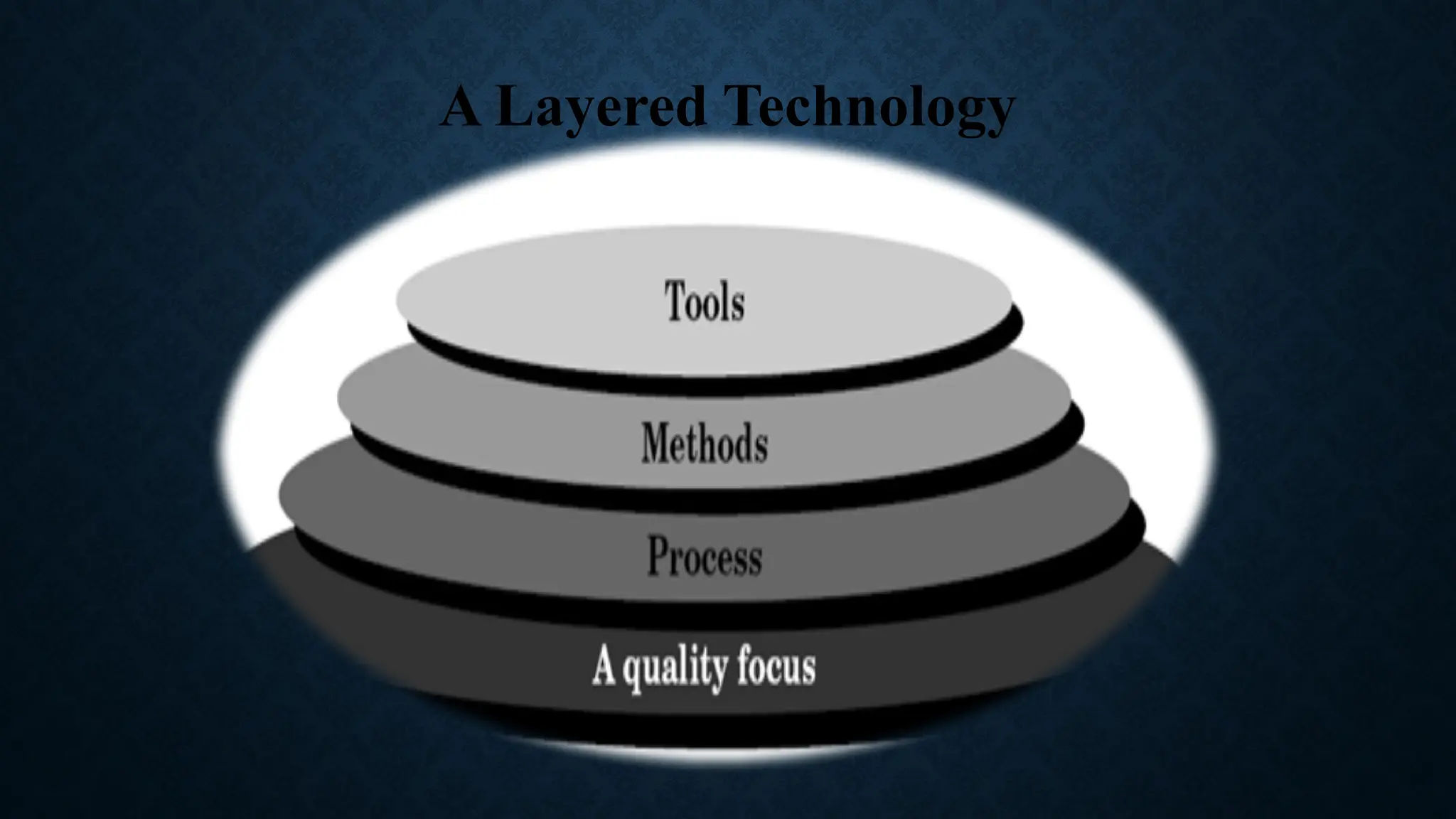
Software Engineeringis a layered technology.
Quality focus:-
Main principle of Software Engineering is Quality focus.
An engineering approach must have a focus on quality.
Total Quality Management(TQM), Six Sigma, ISO 9001, ISO 9000-3 , Capability Maturity Model(CMM) ,
CMMI & similar approaches encourages a continuous process improvement culture.
Process :-
The foundation for software engineering is the process layer.
Software engineering process is the glue that holds the technology layers together.
Process defines a framework activities for effective delivery of software engineering technology.
5.
Methods :-
Softwareengineering methods provide the technical how-to's for building software.
Methods encompass a broad array of tasks that include requirements analysis, design, program construction,
testing, and support.
Software engineering methods rely on a set of basic principles that govern each area of the technology and
include modeling activities and other descriptive techniques.
Tools :-
Software engineering tools provide automated or semi-automated support for the process and the methods.
When tools are integrated so that information created by one tool can be used by another, a system for the support
of software development, called computer-aided software engineering, is established.
CASE combines software, hardware, and a software engineering database (a repository containing important
information about analysis, design, program construction, and testing) to create a software engineering
environment analogous to CAD/CAE (computer-aided design/engineering) for hardware.
6.
SOFTWARE PROCESS FRAMEWORK
Asoftware process:-
is a roadmap to building high quality software products.
provides a framework for managing activities.
adapts to meet needs of software engineers and managers.
What is a process?
Sequence of steps required to develop or maintain software.
Characteristics
prescribes major activities
constraints and controls apply to activities, resources, and products
utilizes resources, subject to constraints such as schedule, to produce intermediate and final results
constraints on activities: time, budget, tools
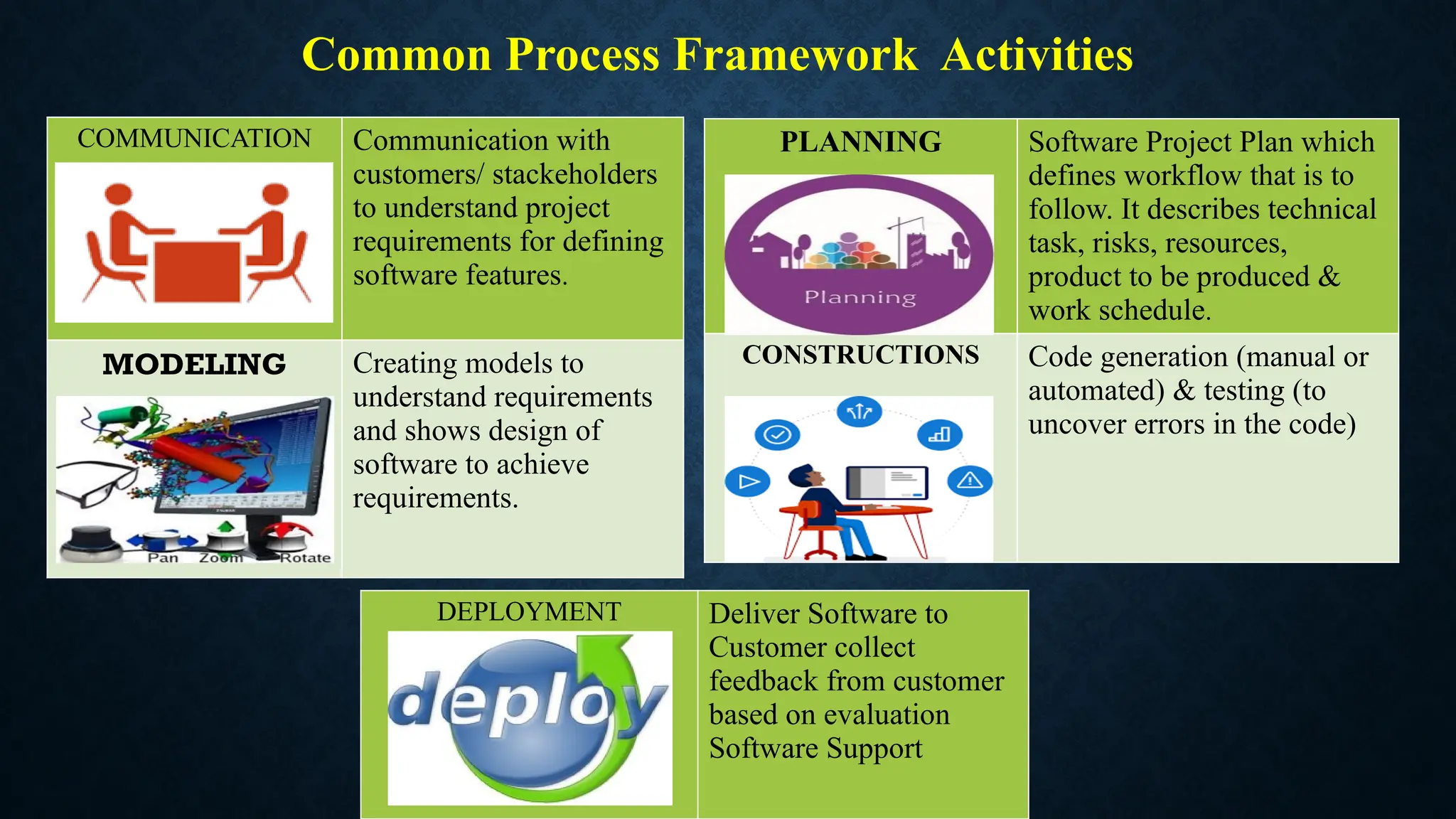
COMMUNICATION Communication with
customers/stackeholders
to understand project
requirements for defining
software features.
MODELING Creating models to
understand requirements
and shows design of
software to achieve
requirements.
PLANNING Software Project Plan which
defines workflow that is to
follow. It describes technical
task, risks, resources,
product to be produced &
work schedule.
CONSTRUCTIONS Code generation (manual or
automated) & testing (to
uncover errors in the code)
DEPLOYMENT Deliver Software to
Customer collect
feedback from customer
based on evaluation
Software Support
Common Process Framework Activities
9.
Umbrella Activities
Software projecttracking and control
Assessing progress against the project plan.
Take adequate action to maintain schedule.
Formal technical reviews
Assessing software work products in an effort to uncover and remove errors before goes into next action or
activity.
Software quality assurance
Define and conducts the activities required to ensure software quality.
Software configuration management
Manages the effects of change.
Document preparation and production
Help to create work products such as models, documents, logs, form and list.
10.
Reusability management
Definecriteria for work product reuse
Mechanisms to achieve reusable components.
Measurement
Define and collects process, project, and product measures
Assist the team in delivering software that meets customer’s needs.
Risk management
Assesses risks that may effect that outcome of project or quality of product (i.e. software)
11.
GENERIC PROCESS MODEL
•GenericProcess Model is a definitive description of processes.
•Generic Processes are designed to run outside a normal component or on an
application processor.
•These processes are not specific to any particular component, can be used in any
number of applications.
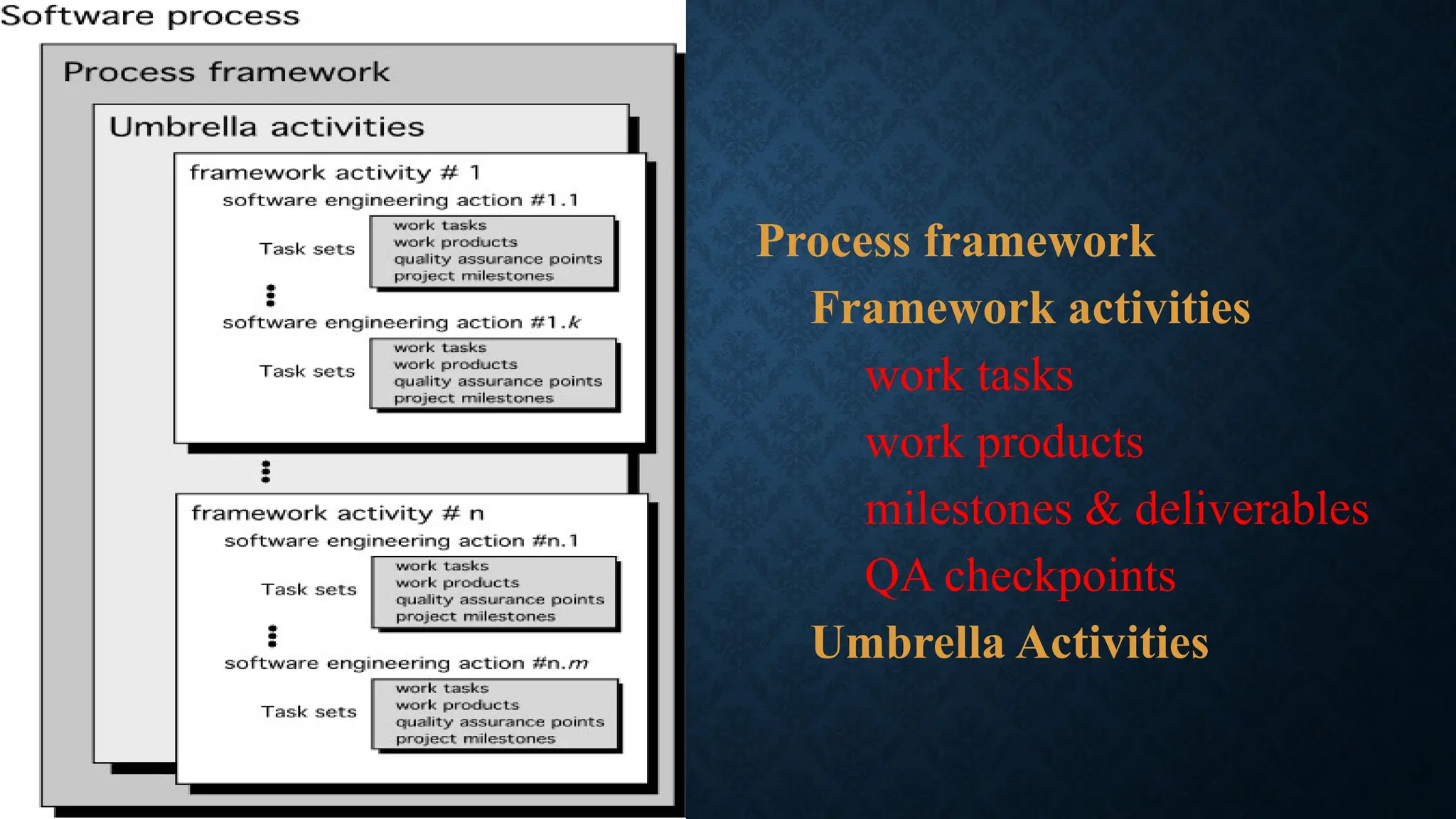
•The software process is a collection of various activities. These activities include
communication, planning, modeling, construction, and deployment.
•Each of these activities includes a set of engineering actions and each action defines
a set of tasks that incorporate work products, project milestones, and SQA, Software
Quality Assurance points
12.
Generic Process modelincludes the below five framework activities,
• Communication: This is the first step in the software development process which
starts with the communication between the customer and the developer.
• Planning: This step consists of a complete estimation of the project, scheduling
for development of the project, and tracking.
• Modeling: This step consists of complete requirement analysis and project
design like algorithm, flowchart, etc.
• Construction: This step consists of code generation and its testing. Coding will
implement the design details using appropriate programming languages.
• Deployment: This step consists of delivering the final product to the customer
and take feedback. If there are any suggestions or addition of other capabilities,
then this change is required for improvement in software quality.
13.
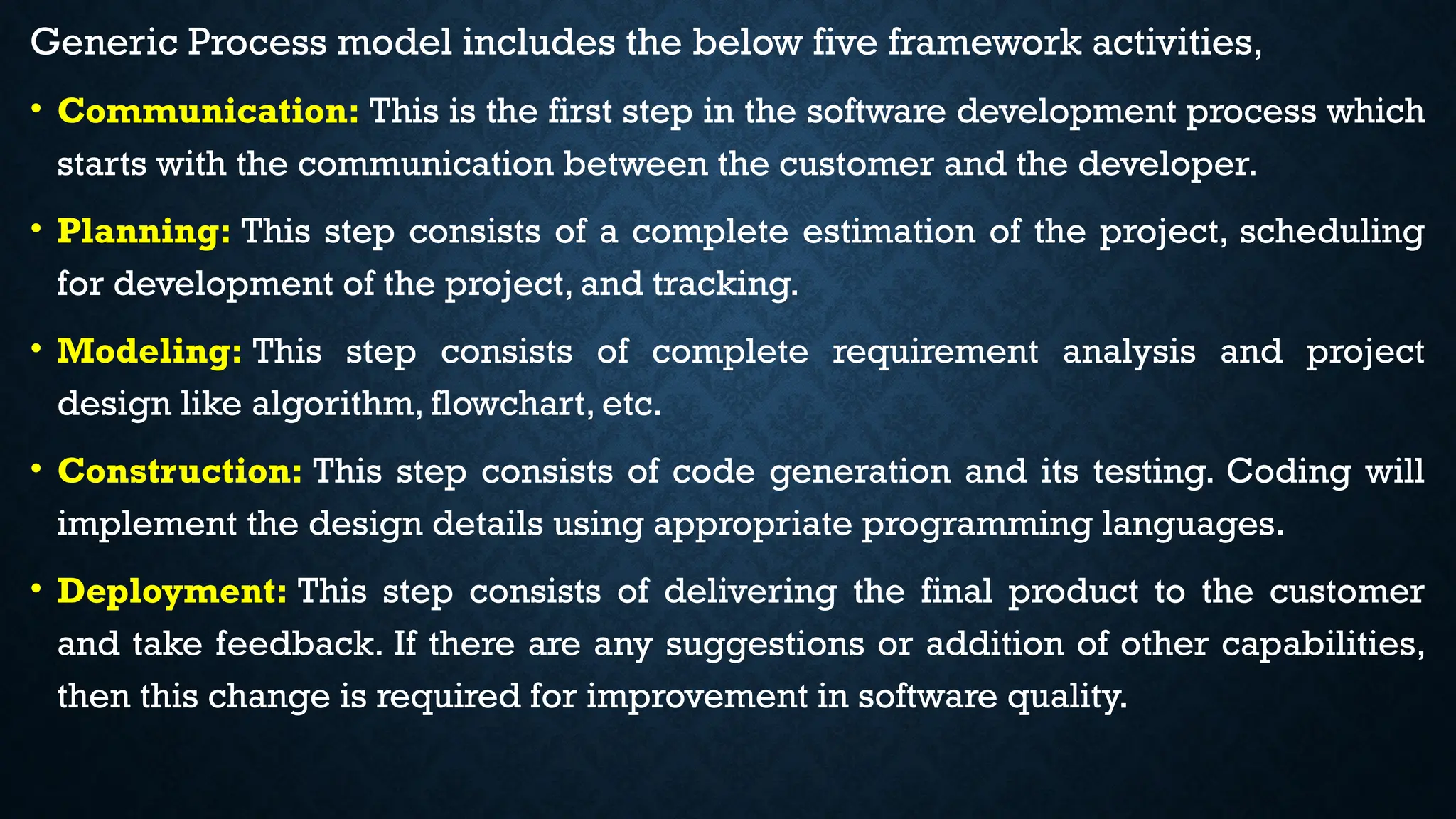
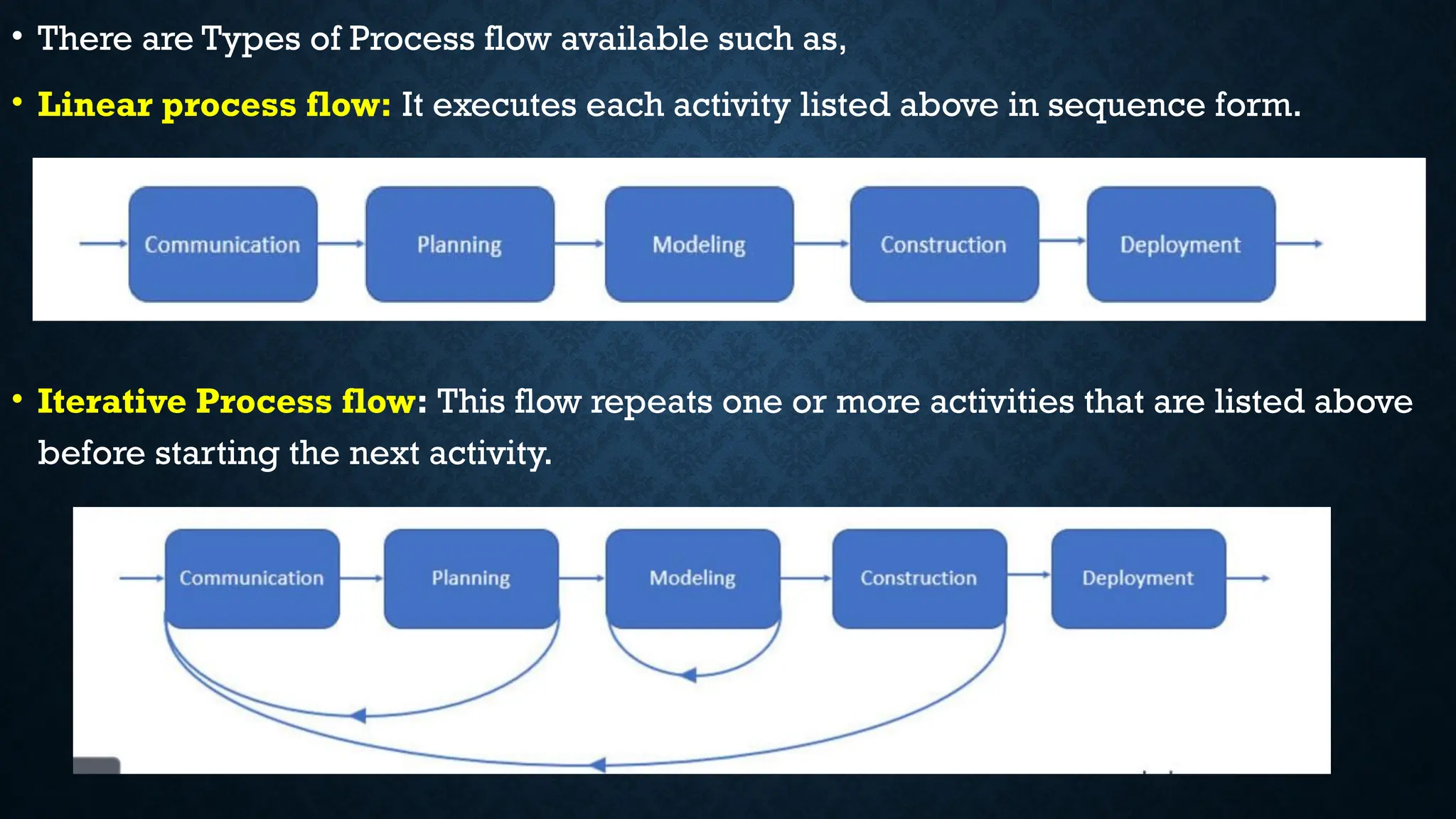
• There areTypes of Process flow available such as,
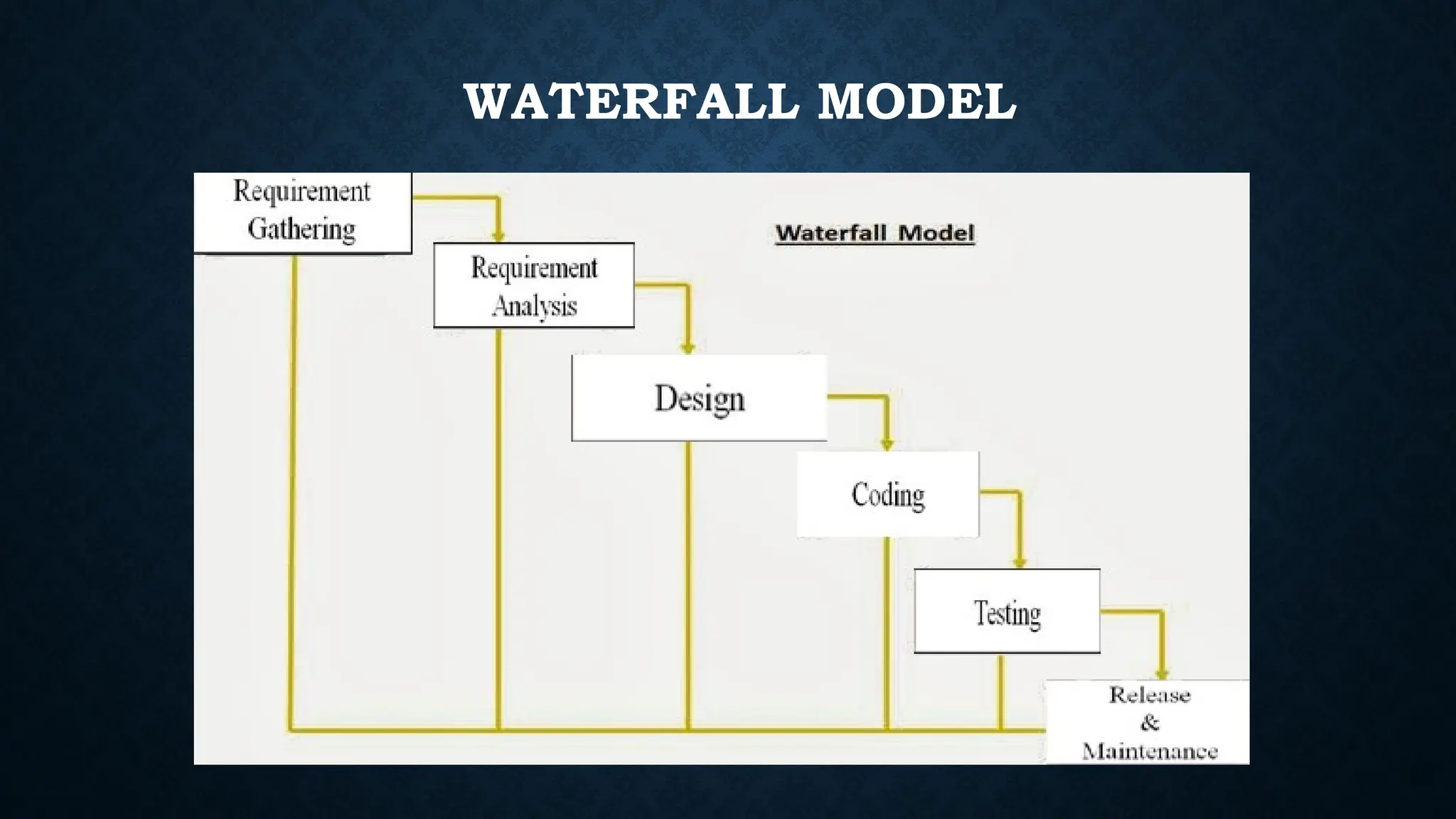
• Linear process flow: It executes each activity listed above in sequence form.
• Iterative Process flow: This flow repeats one or more activities that are listed above
before starting the next activity.
14.
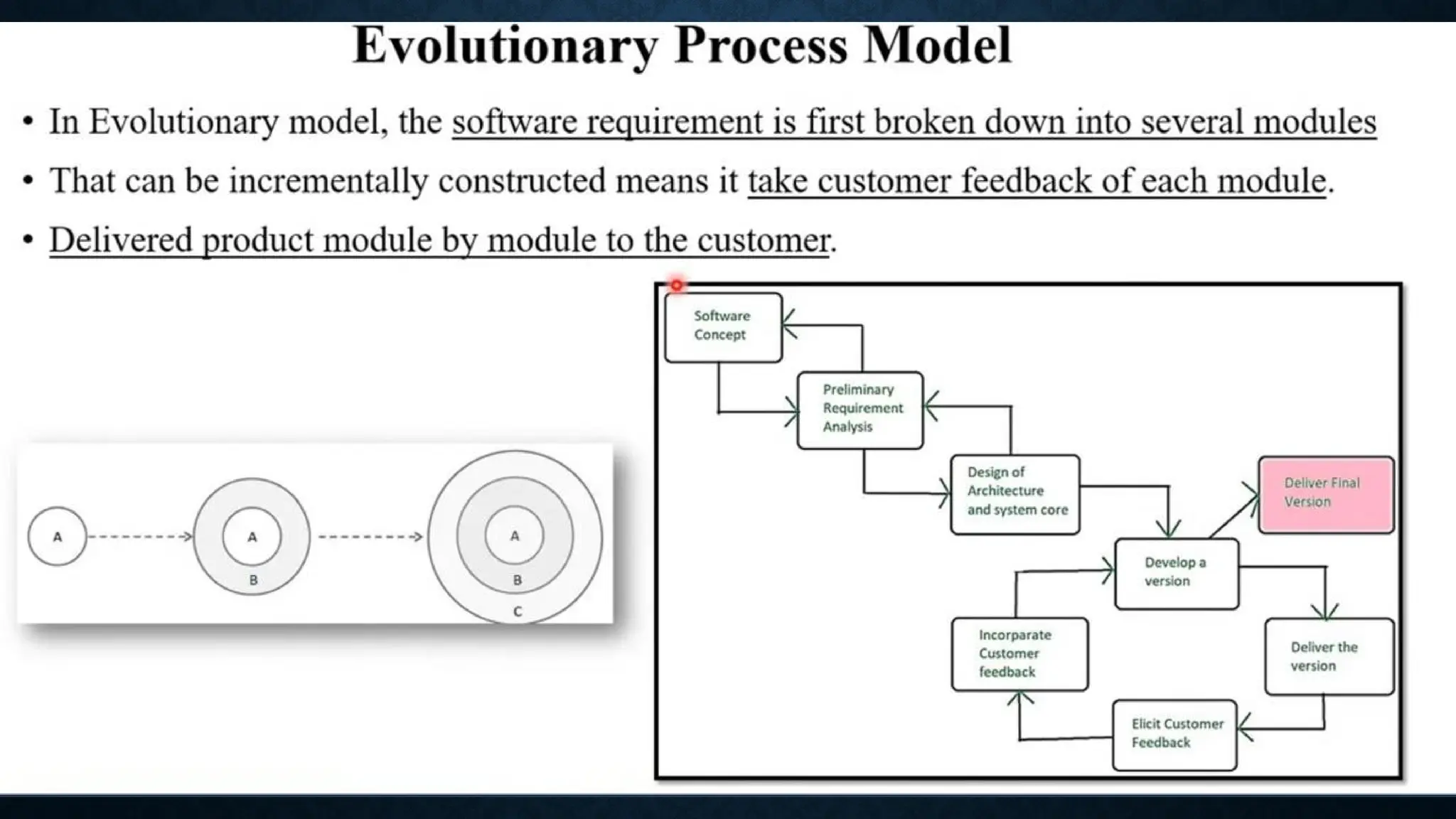
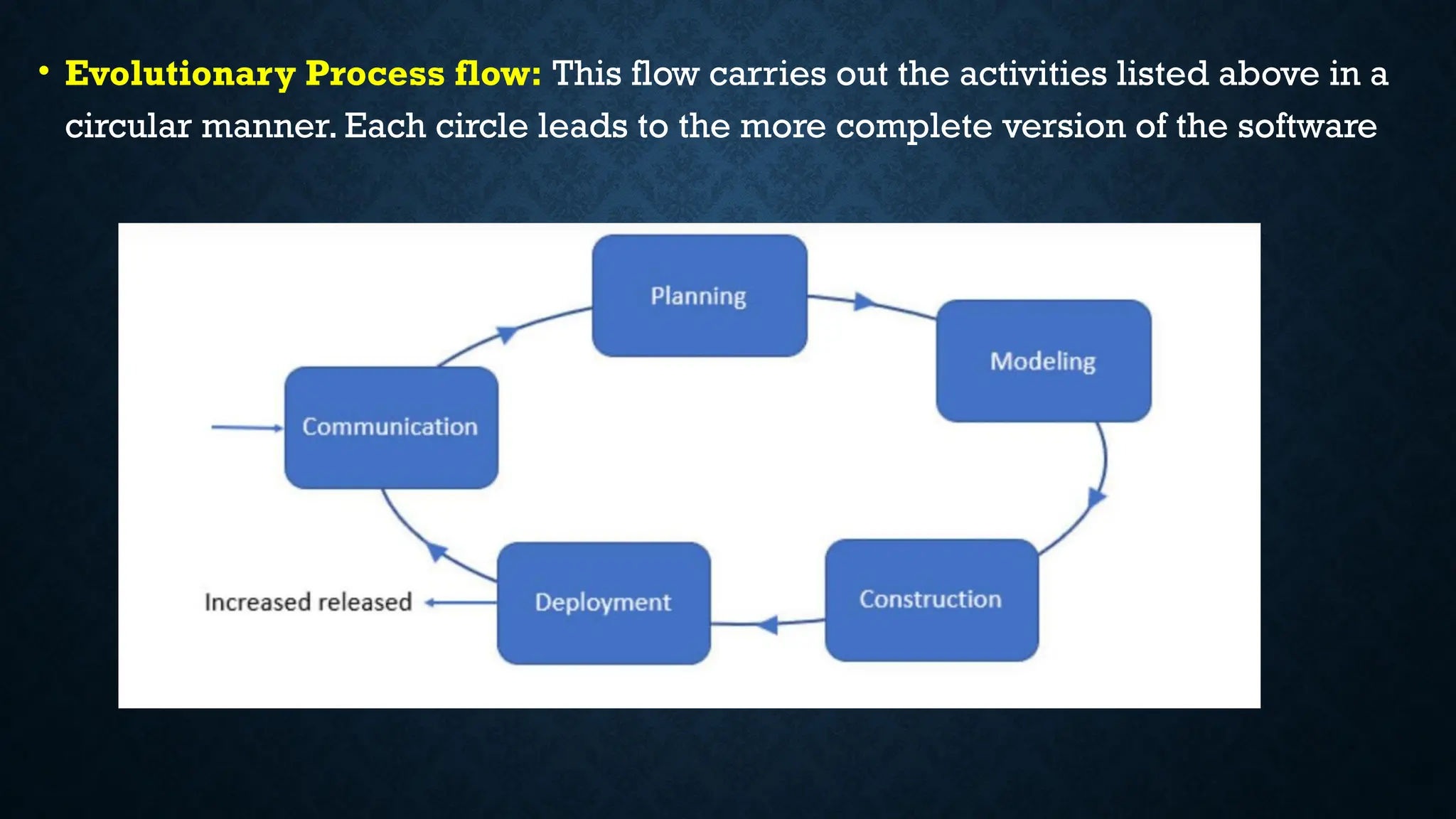
• Evolutionary Processflow: This flow carries out the activities listed above in a
circular manner. Each circle leads to the more complete version of the software
15.
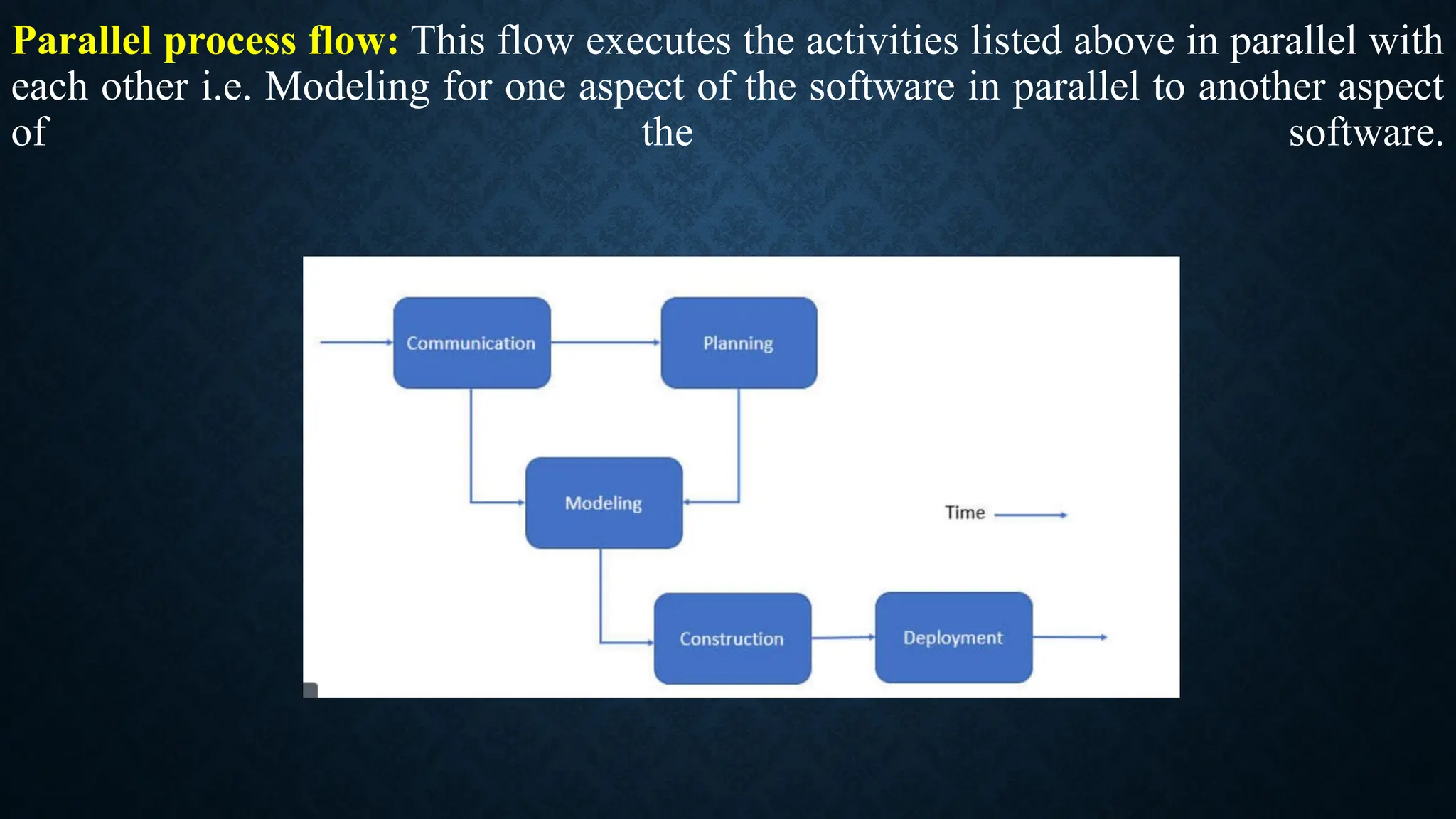
Parallel process flow:This flow executes the activities listed above in parallel with
each other i.e. Modeling for one aspect of the software in parallel to another aspect
of the software.
16.
IDENTIFYING A TASKSET
A task set defines the actual work to be done to accomplish the
objectives of a software engineering action.
A list of the task to be accomplished
A list of the work products to be produced
A list of the quality assurance filters to be applied
17.
PROCESS PATTERNS
Aprocess pattern
describes a process-related problem that is encountered during
software engineering work,
identifies the environment in which the problem has been
encountered, and
suggests one or more proven solutions to the problem.
Stated in more general terms, a process pattern provides you with a
template [Amb98]—a consistent method for describing problem
solutions within the context of the software process.
18.
PROCESS PATTERN TYPES
Stage patterns—defines a problem associated with a framework activity
for the process.
Task patterns—defines a problem associated with a software
engineering action or work task and relevant to successful software
engineering practice
Phase patterns—define the sequence of framework activities that
occur with the process, even when the overall flow of activities is
iterative in nature.
19.
PROCESS ASSESSMENT ANDIMPROVEMENT
Standard CMMI Assessment Method for Process Improvement (SCAMPI) —
provides a five step process assessment model that incorporates five phases: initiating,
diagnosing, establishing, acting and learning.
CMM-Based Appraisal for Internal Process Improvement (CBA IPI)
—provides a diagnostic technique for assessing the relative maturity of a software
organization; uses the SEI CMM as the basis for the assessment [Dun01]
SPICE—The SPICE (ISO/IEC15504) standard defines a set of requirements for
software process assessment. The intent of the standard is to assist organizations in
developing an objective evaluation of the efficacy of any defined software process.
[ISO08]
ISO 9001:2000 for Software—a generic standard that applies to any organization that
wants to improve the overall quality of the products, systems, or services that it provides.
Therefore, the standard is directly applicable to software organizations and companies.
[Ant06]
20.
PRESCRIPTIVE MODELS
Prescriptiveprocess models advocate an orderly approach to software
engineering
That leads to a few questions …
If prescriptive process models strive for structure and order, are they
inappropriate for a software world that thrives on change?
Yet, if we reject traditional process models (and the order they imply) and
replace them with something less structured, do we make it impossible to
achieve coordination and coherence in software work?
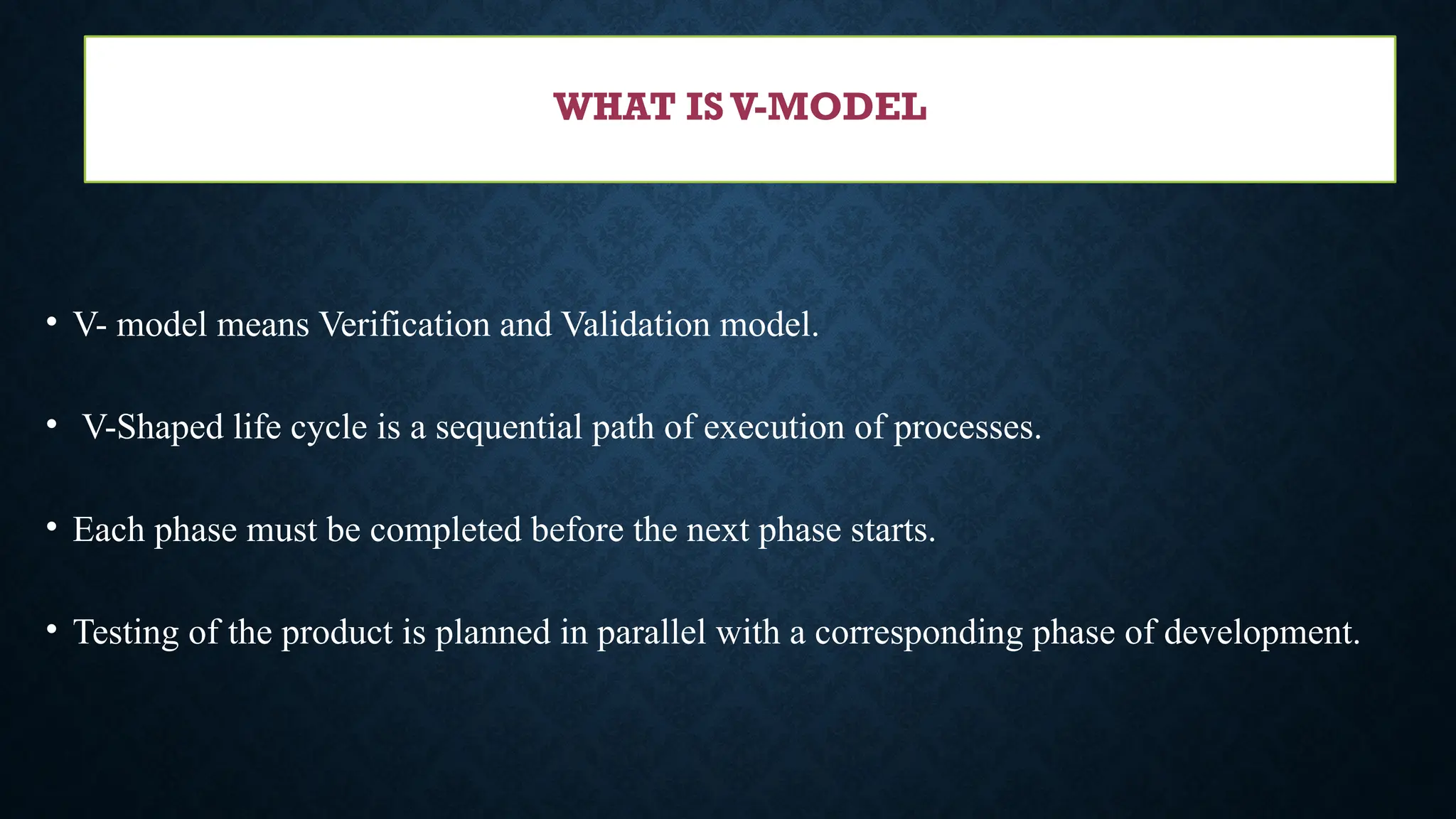
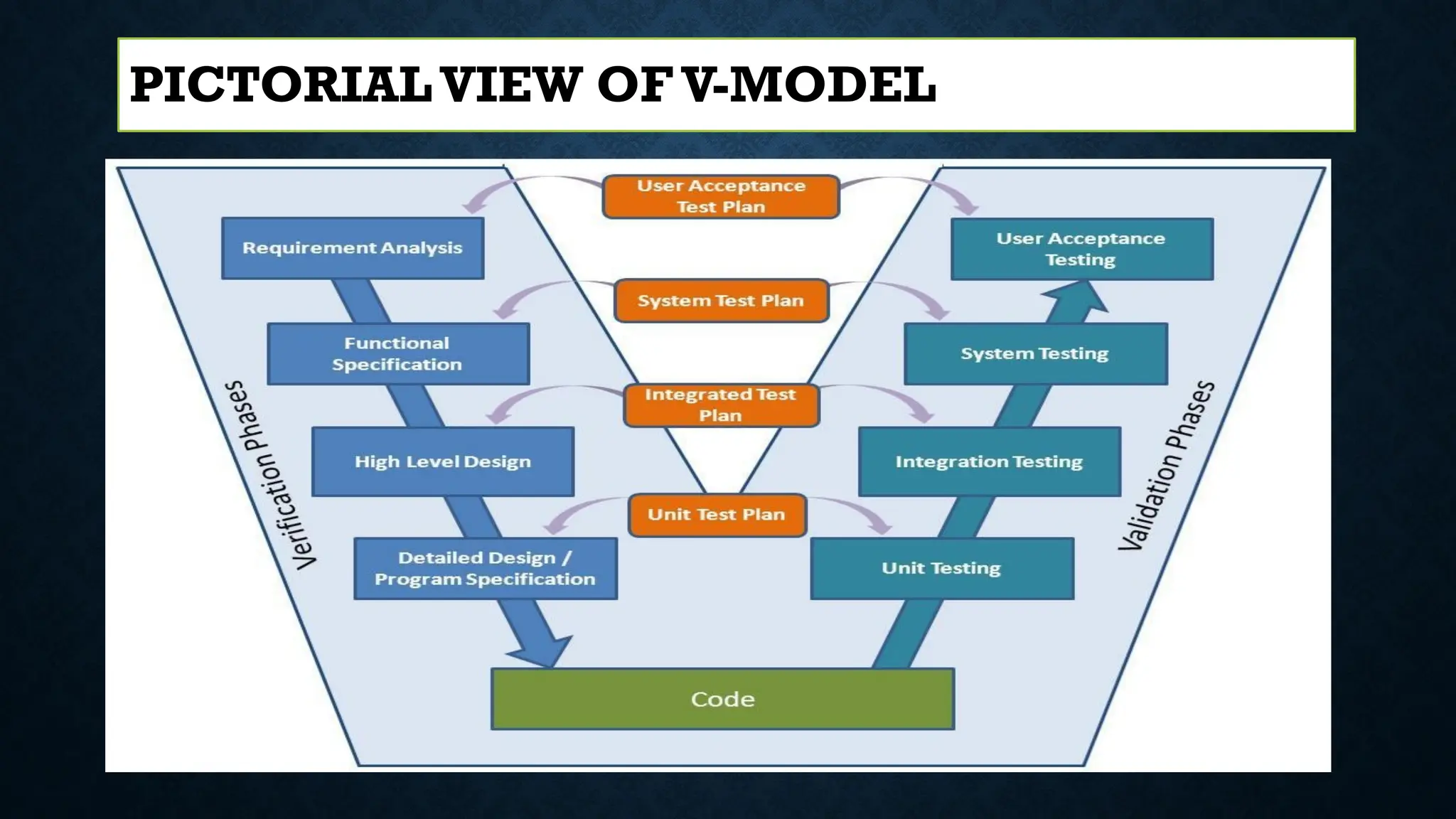
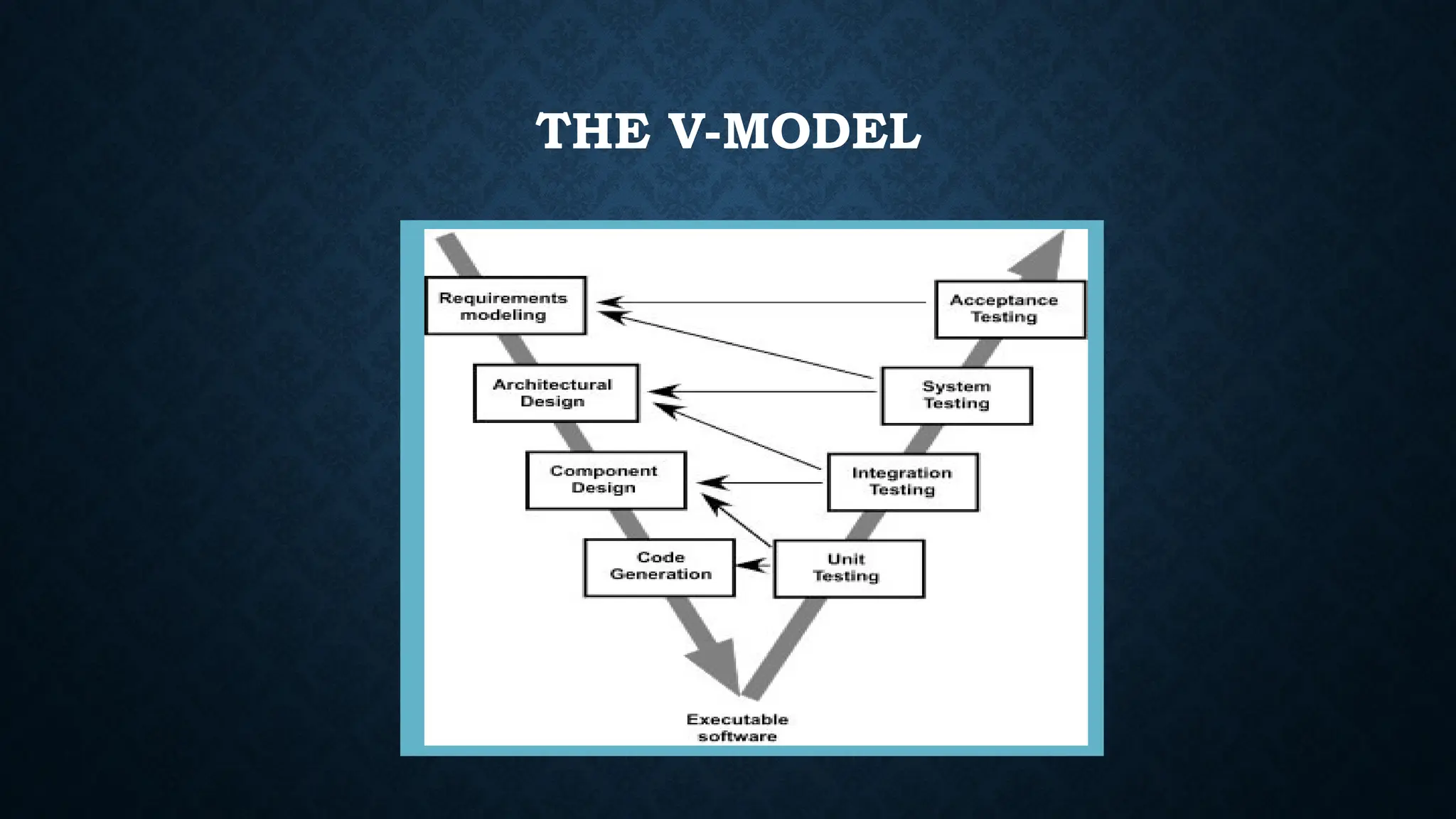
• V- modelmeans Verification and Validation model.
• V-Shaped life cycle is a sequential path of execution of processes.
• Each phase must be completed before the next phase starts.
• Testing of the product is planned in parallel with a corresponding phase of development.
WHAT IS V-MODEL
32.
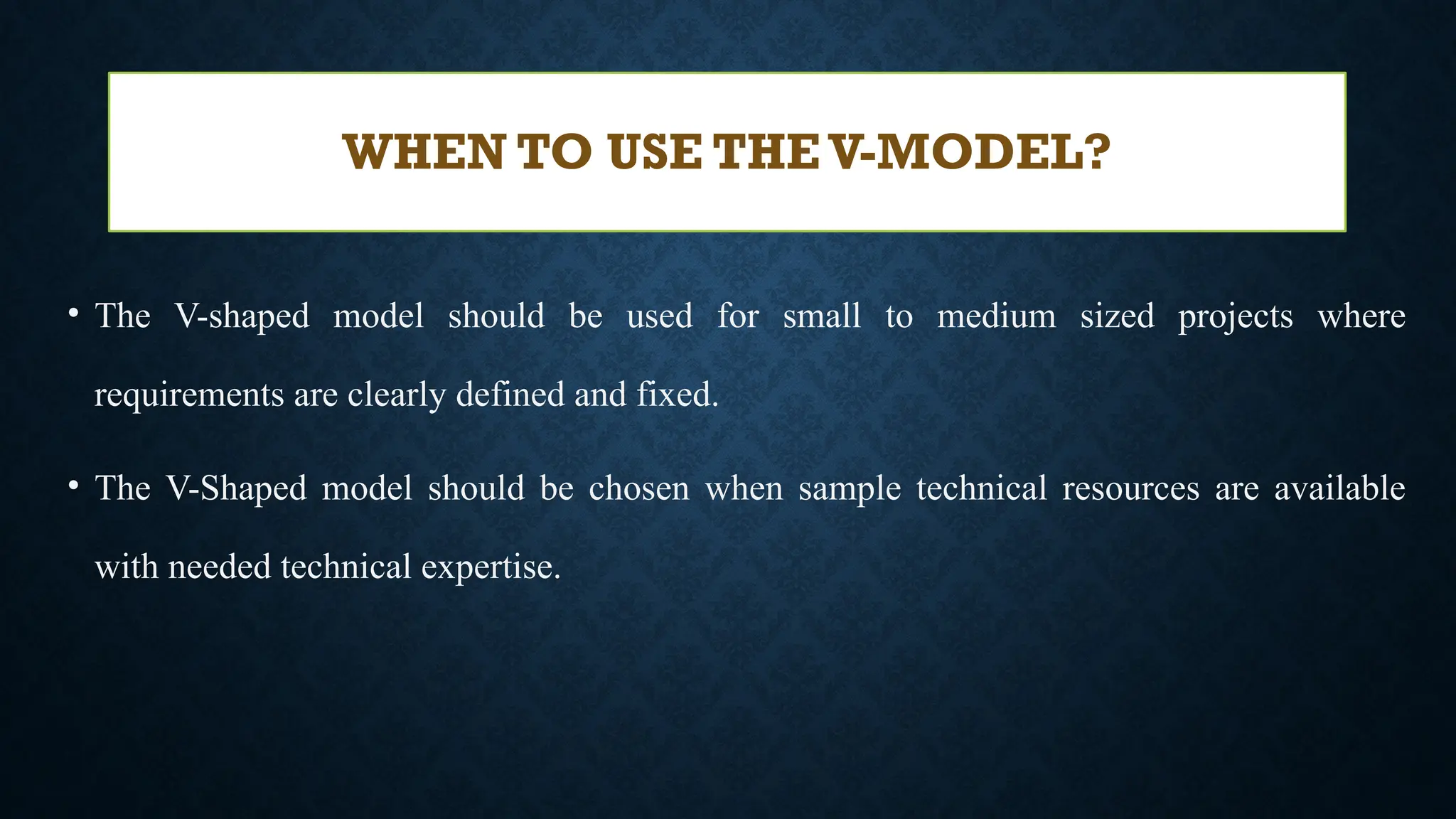
• The V-shapedmodel should be used for small to medium sized projects where
requirements are clearly defined and fixed.
• The V-Shaped model should be chosen when sample technical resources are available
with needed technical expertise.
WHEN TO USE THE V-MODEL?
33.
There are twophases
• Verification Phase
• Validation Phase
PHASES
• Requirements Analysis:
thefirst step in the verification process, the requirements of the system are collected by
analyzing the needs of the user.
• System design:
In this phase system engineers analyze and understand the business of the proposed
system by studying the user requirements document.
VERIFICATION PHASE
36.
• Architecture design
Thebaseline in selecting the architecture is that it should realize all which typically consists
of the list of modules, brief functionality of each module, their interface
relationships, dependencies, database tables, architecture diagrams, technology details etc.
The integration testing design is carried out in the particular phase.
VERIFICATION PHASE
37.
• Module design
Themodule design phase can also be referred to as low-level design. The designed system is
broken up into smaller units or modules and each of them is explained so that the
programmer can start coding directly. The low level design document or program
specifications will contain a detailed functional logic of the module, in pseudo-code:
database tables, with all elements, including their type and size
all interface details with complete API references
all dependency issues
error message listings
complete input and outputs for a module.
VERIFICATION PHASE
38.
• This isat the bottom of the V-Shape model. Module design is converted into code
by developers.
CODING
39.
• Unit testing
UnitTest Plans (UTPs) are developed during module design phase. These UTPs
are executed to eliminate bugs at code level or unit level.
A unit is the smallest entity which can independently exist, e.g. a program
module. Unit testing verifies that the smallest entity can function correctly when
isolated from the rest of the codes/units.
VALIDATION PHASE
40.
• Integration testing
IntegrationTest Plans are developed during the Architectural Design Phase. These tests
verify that units created and tested independently can coexist and communicate among
themselves.
• System testing
System Tests Plans are developed during System Design Phase. Unlike Unit and
Integration Test Plans, System Test Plans are composed by client's business team. System
Test ensures that expectations from application developed are met.
VALIDATION PHASE
41.
• User acceptancetesting
User Acceptance Test (UAT) Plans are developed during the Requirements Analysis
phase. Test Plans are composed by business users. UAT is performed in a user
environment that resembles the production environment, using realistic data.
VALIDATION PHASE
42.
• Simple andeasy to use.
• Testing activities like planning, test designing happens well before coding.
• This saves a lot of time. Hence higher chance of success over the waterfall
model.
• Proactive defect tracking – that is defects are found at early stage.
• Avoids the downward flow of the defects.
• Works well for small projects where requirements are easily understood.
MERITS
43.
• Very rigidand least flexible.
• Software is developed during the implementation phase, so no early prototypes
of the software are produced.
• If any changes happen in midway, then the test documents along with
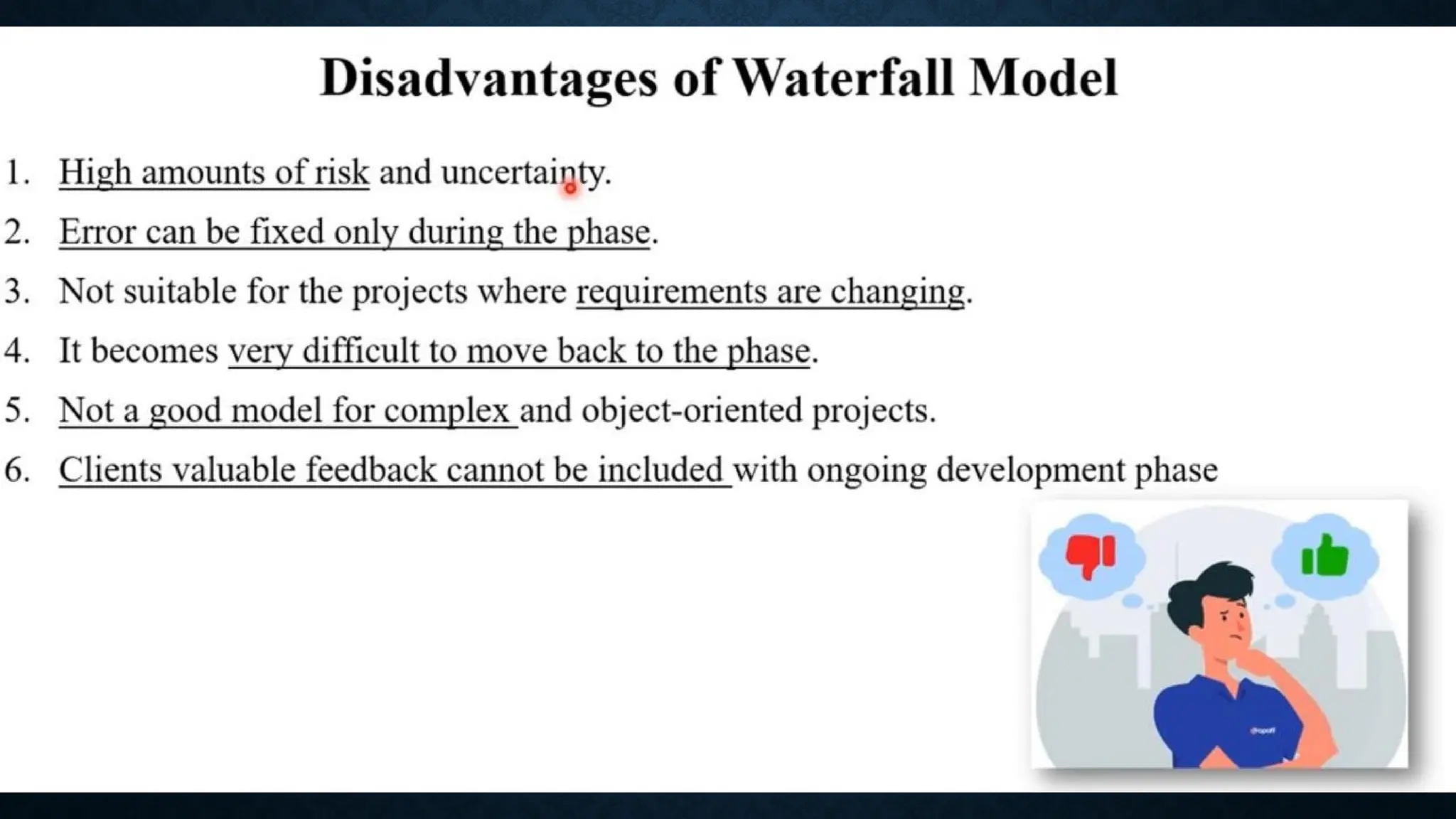
requirement documents has to be updated.
DEMERITS
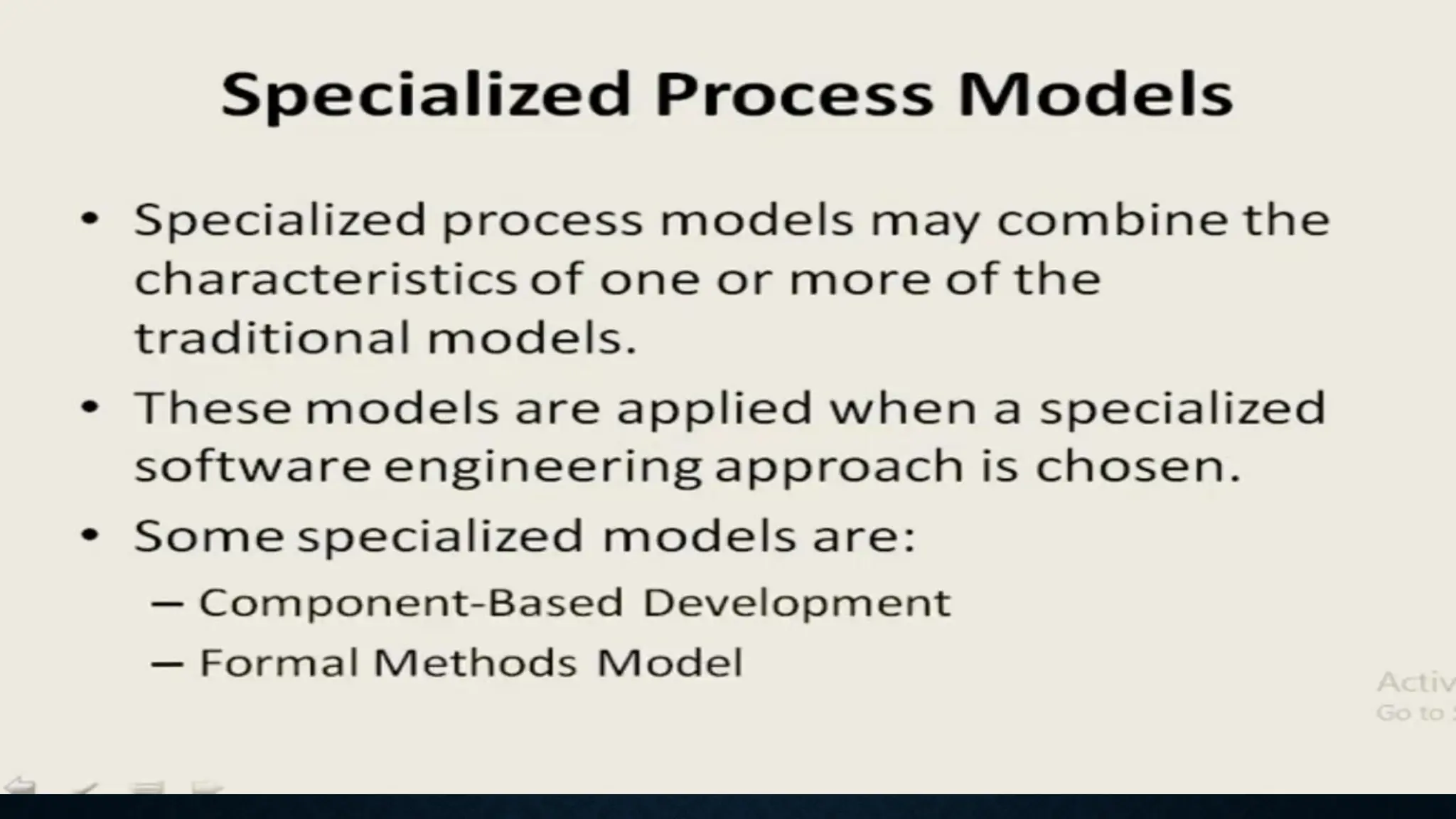
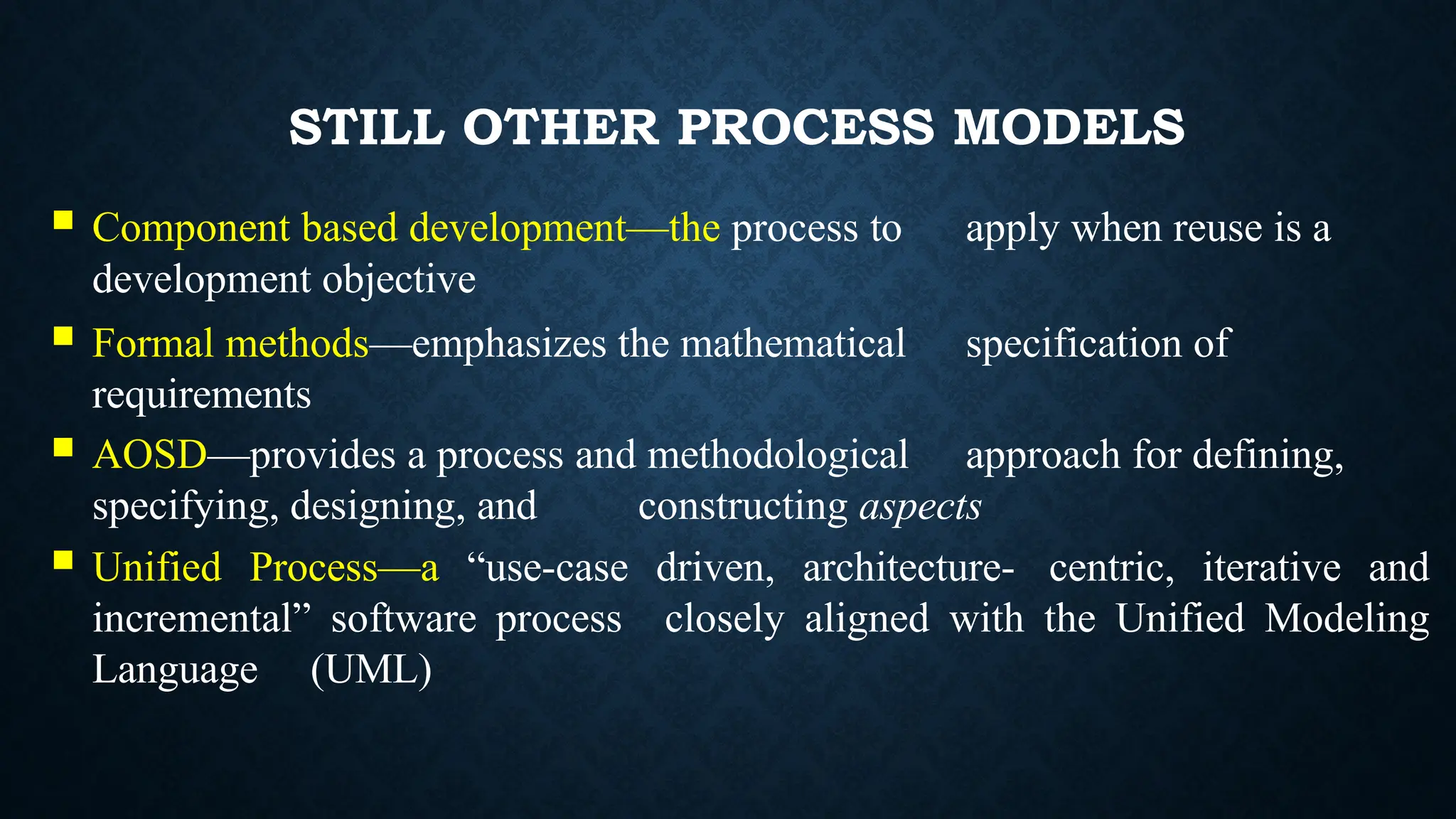
STILL OTHER PROCESSMODELS
Component based development—the process to apply when reuse is a
development objective
Formal methods—emphasizes the mathematical specification of
requirements
AOSD—provides a process and methodological approach for defining,
specifying, designing, and constructing aspects
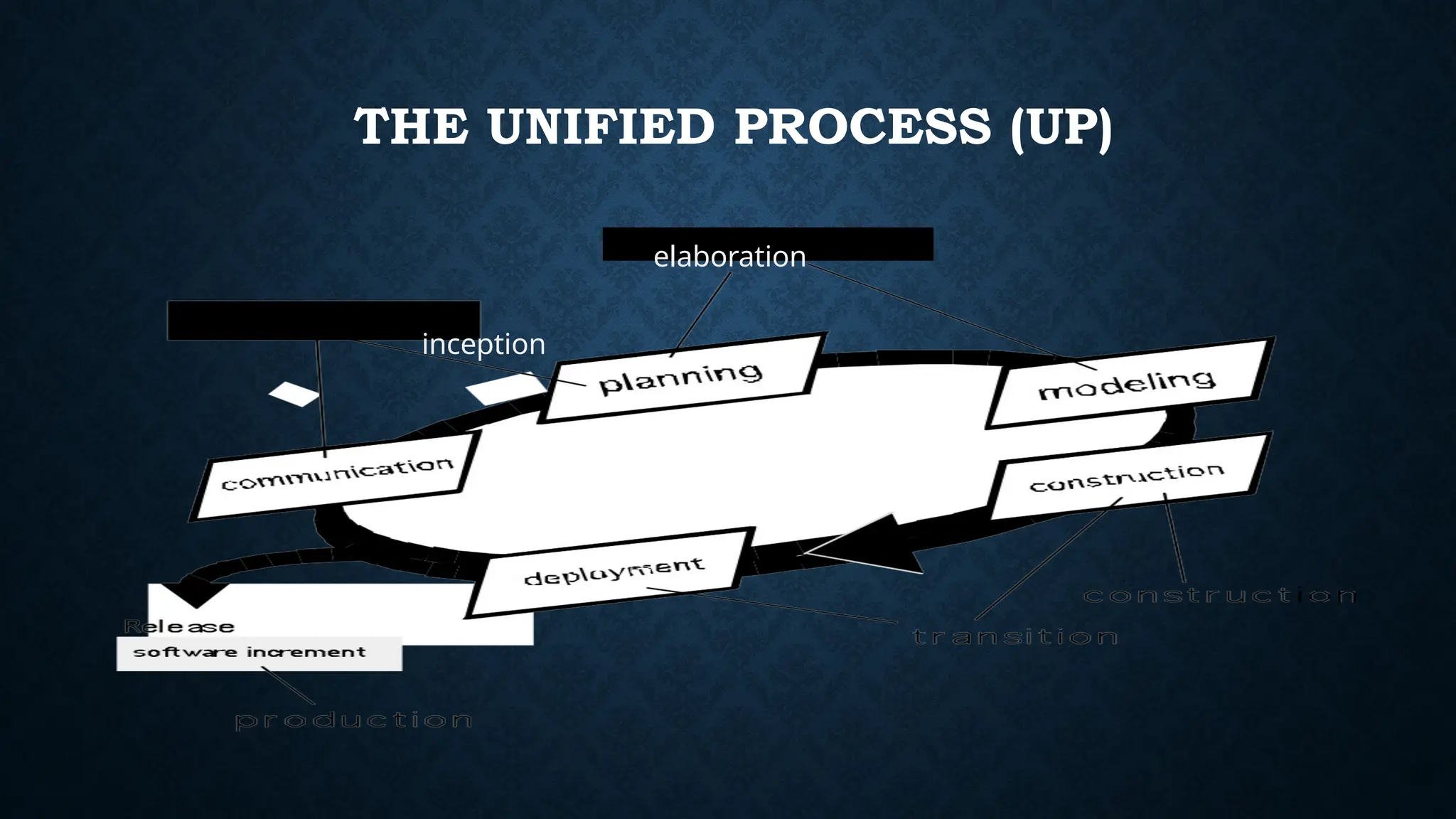
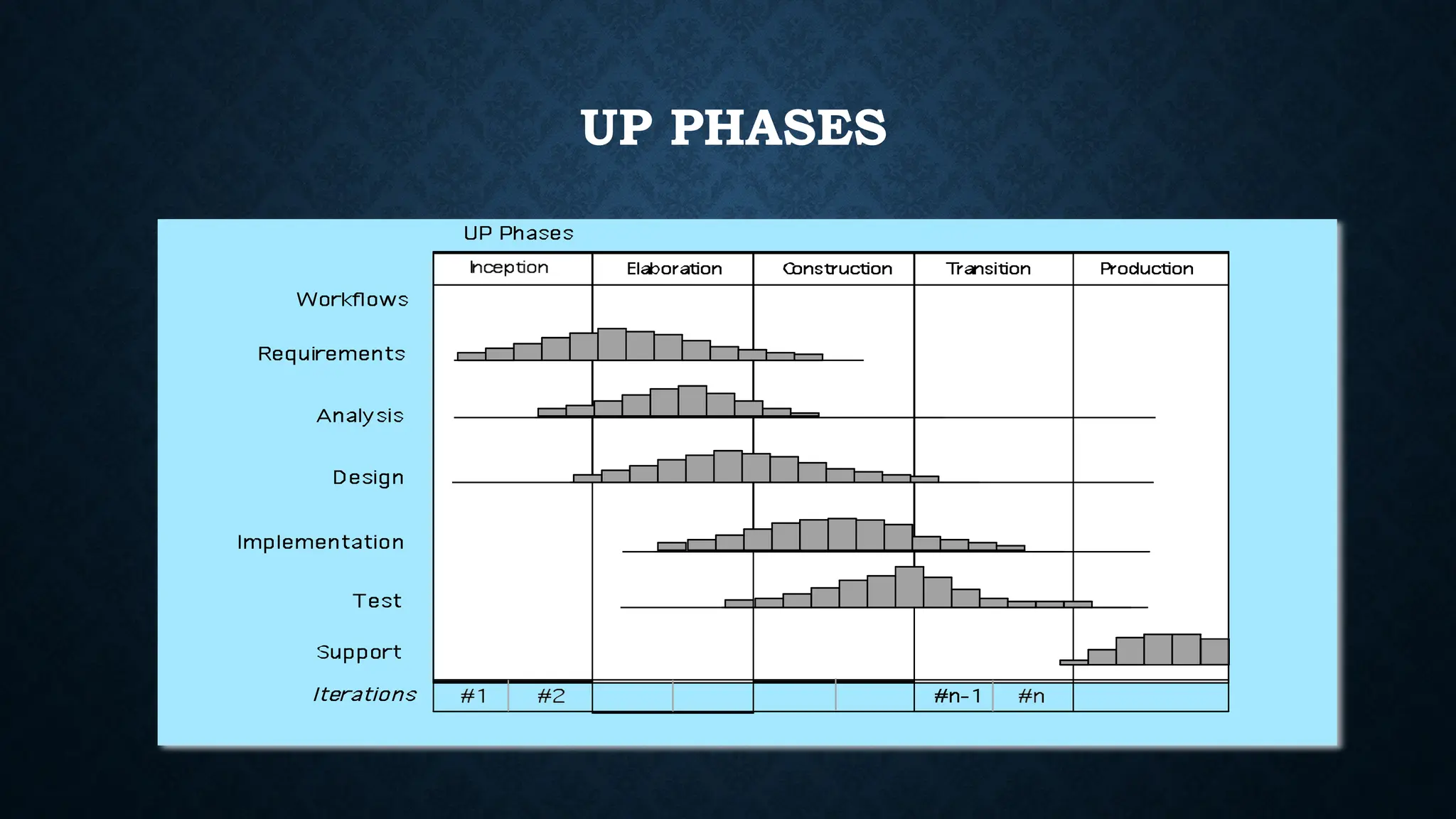
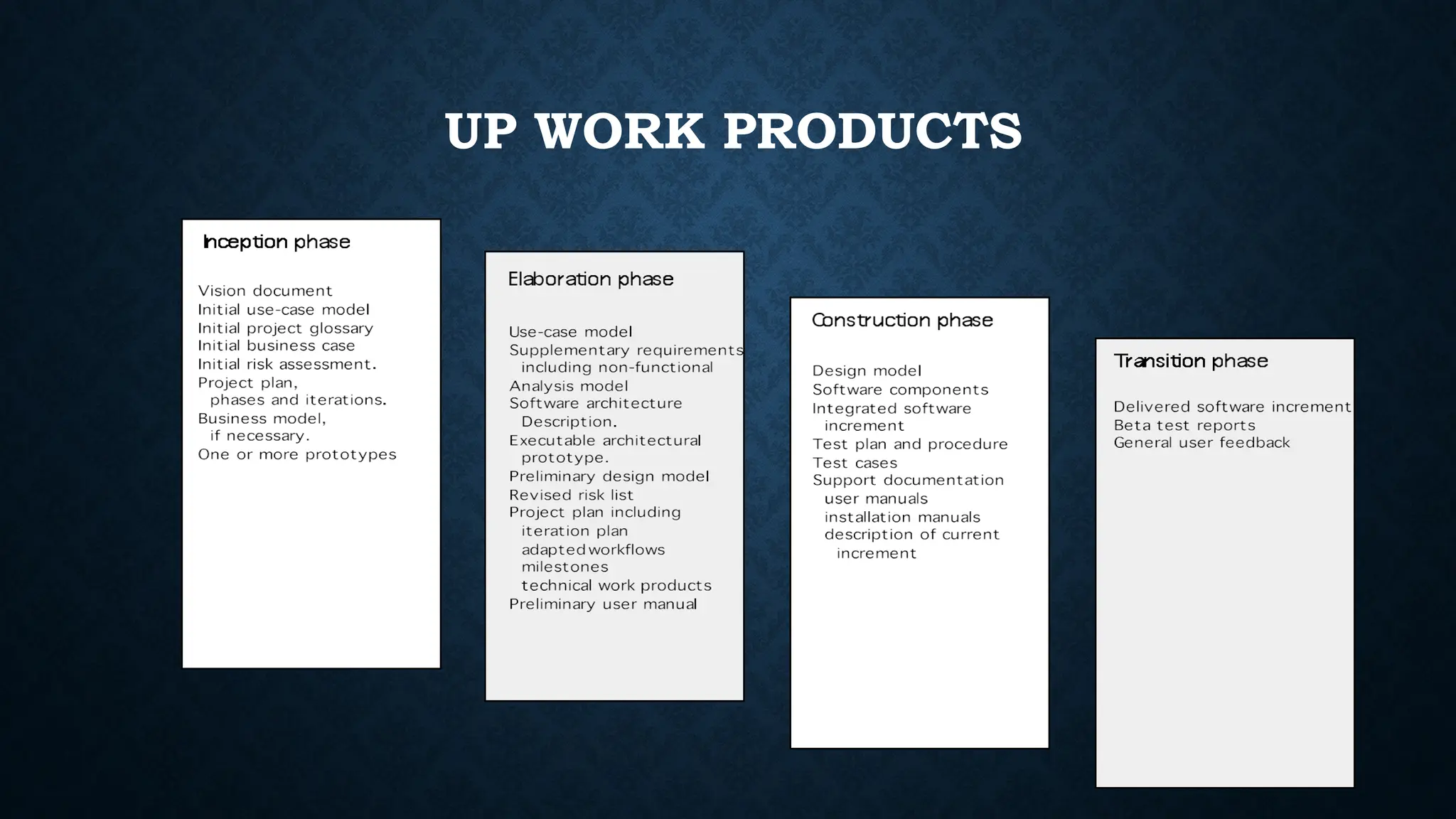
Unified Process—a “use-case driven, architecture- centric, iterative and
incremental” software process closely aligned with the Unified Modeling
Language (UML)
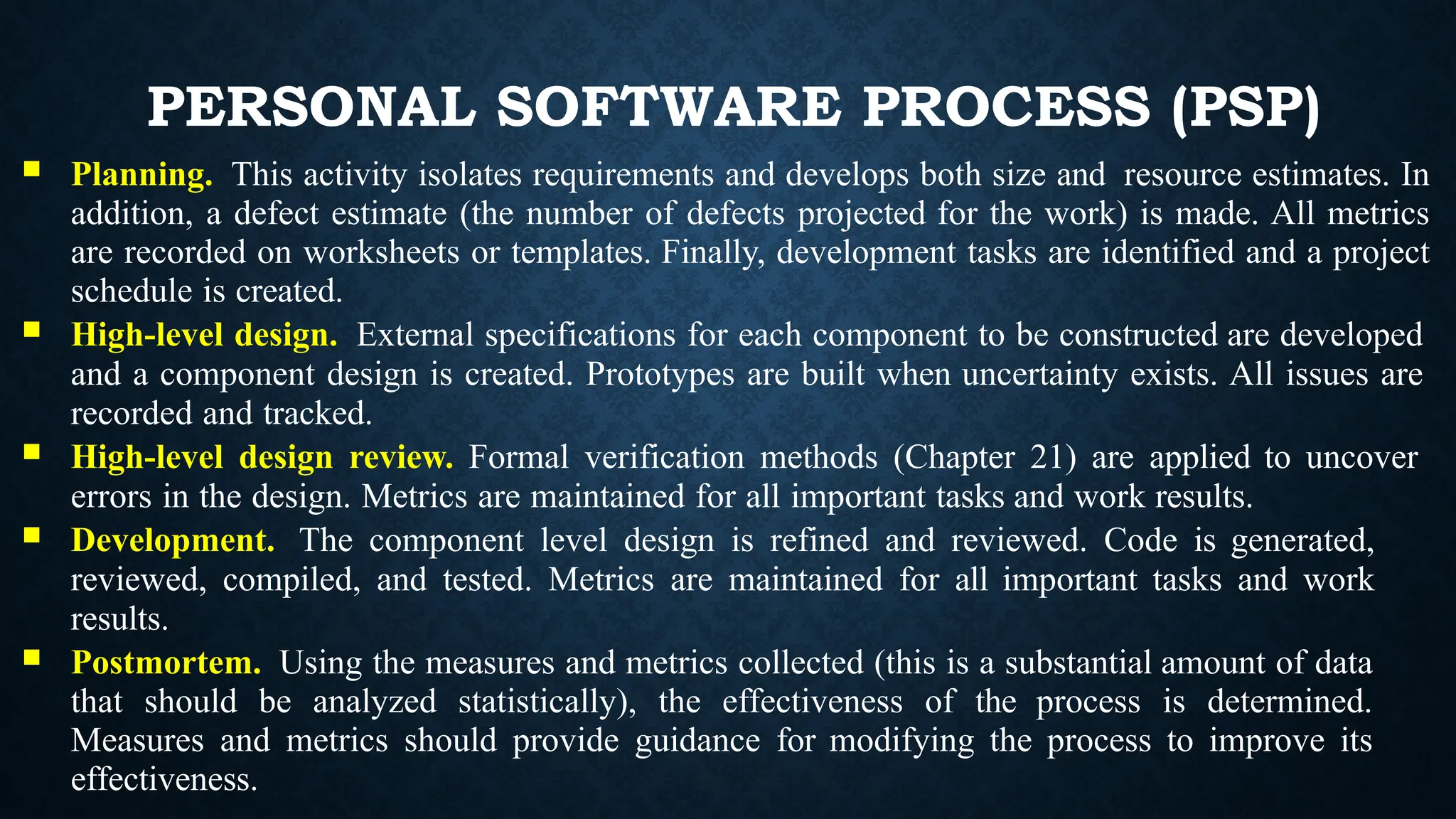
PERSONAL SOFTWARE PROCESS(PSP)
Planning. This activity isolates requirements and develops both size and resource estimates. In
addition, a defect estimate (the number of defects projected for the work) is made. All metrics
are recorded on worksheets or templates. Finally, development tasks are identified and a project
schedule is created.
High-level design. External specifications for each component to be constructed are developed
and a component design is created. Prototypes are built when uncertainty exists. All issues are
recorded and tracked.
High-level design review. Formal verification methods (Chapter 21) are applied to uncover
errors in the design. Metrics are maintained for all important tasks and work results.
Development. The component level design is refined and reviewed. Code is generated,
reviewed, compiled, and tested. Metrics are maintained for all important tasks and work
results.
Postmortem. Using the measures and metrics collected (this is a substantial amount of data
that should be analyzed statistically), the effectiveness of the process is determined.
Measures and metrics should provide guidance for modifying the process to improve its
effectiveness.
92.
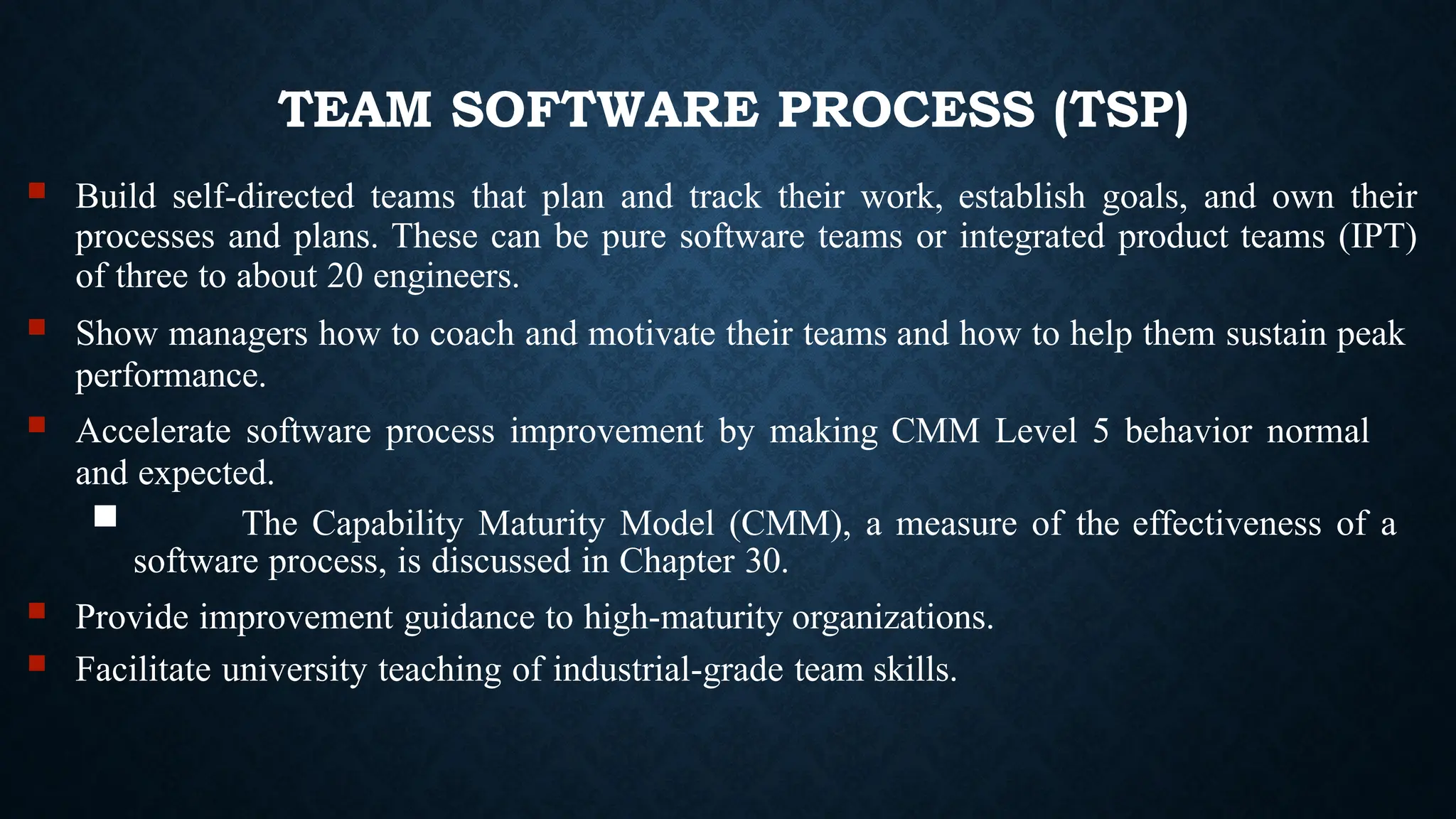
TEAM SOFTWARE PROCESS(TSP)
Build self-directed teams that plan and track their work, establish goals, and own their
processes and plans. These can be pure software teams or integrated product teams (IPT)
of three to about 20 engineers.
Show managers how to coach and motivate their teams and how to help them sustain peak
performance.
Accelerate software process improvement by making CMM Level 5 behavior normal
and expected.
The Capability Maturity Model (CMM), a measure of the effectiveness of a
software process, is discussed in Chapter 30.
Provide improvement guidance to high-maturity organizations.
Facilitate university teaching of industrial-grade team skills.
![PROCESS PATTERNS
A process pattern
describes a process-related problem that is encountered during
software engineering work,
identifies the environment in which the problem has been
encountered, and
suggests one or more proven solutions to the problem.
Stated in more general terms, a process pattern provides you with a
template [Amb98]—a consistent method for describing problem
solutions within the context of the software process.](https://image.slidesharecdn.com/semod1ppt1-250916144736-f610f15c/75/SE-MOD-1-PPTMOD-1-PPTMOD-1-PPTMOD-1-PPT-1-pptx-17-2048.jpg)
![PROCESS ASSESSMENT AND IMPROVEMENT
Standard CMMI Assessment Method for Process Improvement (SCAMPI) —
provides a five step process assessment model that incorporates five phases: initiating,
diagnosing, establishing, acting and learning.
CMM-Based Appraisal for Internal Process Improvement (CBA IPI)
—provides a diagnostic technique for assessing the relative maturity of a software
organization; uses the SEI CMM as the basis for the assessment [Dun01]
SPICE—The SPICE (ISO/IEC15504) standard defines a set of requirements for
software process assessment. The intent of the standard is to assist organizations in
developing an objective evaluation of the efficacy of any defined software process.
[ISO08]
ISO 9001:2000 for Software—a generic standard that applies to any organization that
wants to improve the overall quality of the products, systems, or services that it provides.
Therefore, the standard is directly applicable to software organizations and companies.
[Ant06]](https://image.slidesharecdn.com/semod1ppt1-250916144736-f610f15c/75/SE-MOD-1-PPTMOD-1-PPTMOD-1-PPTMOD-1-PPT-1-pptx-19-2048.jpg)