SOFTWARE ENGINEERING
Ms.R.Sasikala
Assistant Professor
Department of Computer Science and Engineering
KIT-Kalaignarkarunanidhi Institute of Technology
Software Engineering Fundamentals
SOFTWARE ENGINEERING
• Software engineering is an engineering branch associated
with development of software product using well-defined
scientific principles, methods and procedures.
• The outcome of software engineering is an efficient and
reliable software product.
• Software is more than just a program code. A program is an
executable code, which serves some computational
purpose. Software is considered to be collection of
executable programming code, associated libraries and
documentations. Software, when made for a specific
requirement is called software product.
• Engineering on the other hand, is all about developing
products, using well-defined, scientific principles and
methods.
Software engineering
• Software engineering is an engineering branch associated
with development of software product using well-defined
scientific principles, methods and procedures.
• The outcome of software engineering is an efficient and
reliable software product.
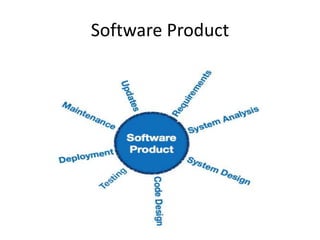
Software Product
Software Evolution
• The process of developing a software product using
software engineering principles and methods is referred to
as software evolution.
• This includes the initial development of software and its
maintenance and updates, till desired software product is
developed, which satisfies the expected requirements.
Software Evolution
• Evolution starts from the requirement gathering process.
• After which developers create a prototype of the intended
software and show it to the users to get their feedback at
the early stage of software product development.
• The users suggest changes, on which several consecutive
updates and maintenance keep on changing too.
• This process changes to the original software, till the
desired software is accomplished.
Software Evolution
• Even after the user has desired software in hand, the
advancing technology and the changing requirements force
the software product to change accordingly.
• Re-creating software from scratch and to go one-on-one
with requirement is not feasible.
• The only feasible and economical solution is to update the
existing software so that it matches the latest
requirements.
Software Paradigms
• Software paradigms refer to the methods and steps, which
are taken while designing the software.
• There are many methods proposed and are in work today,
but we need to see where in the software engineering
these paradigms stand.
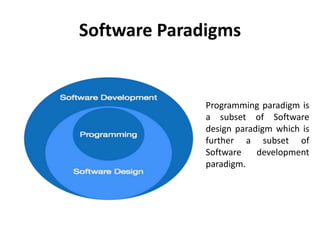
• These can be combined into various categories, though
each of them is contained in one another:
Software Paradigms
Programming paradigm is
a subset of Software
design paradigm which is
further a subset of
Software development
paradigm.
Software Development Paradigm
• This Paradigm is known as software engineering paradigms
where all the engineering concepts pertaining to the
development of software are applied.
• It includes various researches and requirement gathering
which helps the software product to build.
• It consists of –
Requirement gathering
Software design
Programming
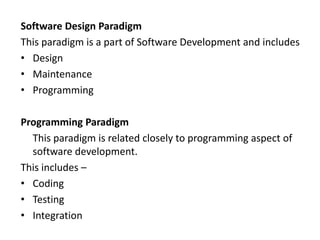
Software Design Paradigm
This paradigm is a part of Software Development and includes
• Design
• Maintenance
• Programming
Programming Paradigm
This paradigm is related closely to programming aspect of
software development.
This includes –
• Coding
• Testing
• Integration
Need of Software Engineering
The need of software engineering arises because of higher
rate of change in user requirements and environment on
which the software is working.
• Large software - It is easier to build a wall than to a house
or building, likewise, as the size of software become large
engineering has to step to give it a scientific process.
• Scalability- If the software process were not based on
scientific and engineering concepts, it would be easier to
re-create new software than to scale an existing one.
Need of Software Engineering
• Cost- As hardware industry has shown its skills and huge
manufacturing has lower down he price of computer and electronic
hardware. But the cost of software remains high if proper process is
not adapted.
• Dynamic Nature- The always growing and adapting nature of
software hugely depends upon the environment in which user
works.
• If the nature of software is always changing, new enhancements
need to be done in the existing one. This is where software
engineering plays a good role.
• Quality Management- Better process of software development
provides better and quality software product.
Characteristics of good software
• A software product can be judged by what it offers and how
well it can be used.
• This software must satisfy on the following grounds:
Operational
Transitional
Maintenance
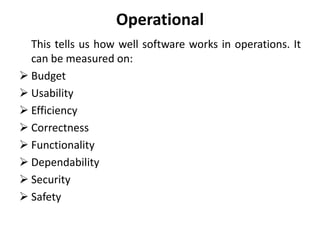
Operational
This tells us how well software works in operations. It
can be measured on:
 Budget
 Usability
 Efficiency
 Correctness
 Functionality
 Dependability
 Security
 Safety
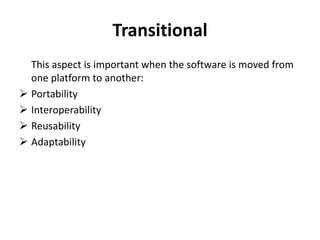
Transitional
This aspect is important when the software is moved from
one platform to another:
 Portability
 Interoperability
 Reusability
 Adaptability
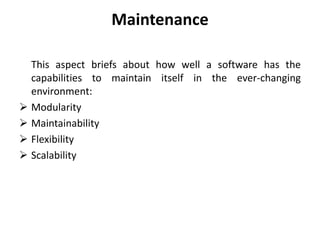
Maintenance
This aspect briefs about how well a software has the
capabilities to maintain itself in the ever-changing
environment:
 Modularity
 Maintainability
 Flexibility
 Scalability

Software Engineering - Introdution.ppt

  • 1.
    SOFTWARE ENGINEERING Ms.R.Sasikala Assistant Professor Departmentof Computer Science and Engineering KIT-Kalaignarkarunanidhi Institute of Technology
  • 2.
  • 3.
    SOFTWARE ENGINEERING • Softwareengineering is an engineering branch associated with development of software product using well-defined scientific principles, methods and procedures. • The outcome of software engineering is an efficient and reliable software product.
  • 4.
    • Software ismore than just a program code. A program is an executable code, which serves some computational purpose. Software is considered to be collection of executable programming code, associated libraries and documentations. Software, when made for a specific requirement is called software product. • Engineering on the other hand, is all about developing products, using well-defined, scientific principles and methods.
  • 5.
    Software engineering • Softwareengineering is an engineering branch associated with development of software product using well-defined scientific principles, methods and procedures. • The outcome of software engineering is an efficient and reliable software product.
  • 6.
  • 7.
    Software Evolution • Theprocess of developing a software product using software engineering principles and methods is referred to as software evolution. • This includes the initial development of software and its maintenance and updates, till desired software product is developed, which satisfies the expected requirements.
  • 8.
    Software Evolution • Evolutionstarts from the requirement gathering process. • After which developers create a prototype of the intended software and show it to the users to get their feedback at the early stage of software product development. • The users suggest changes, on which several consecutive updates and maintenance keep on changing too. • This process changes to the original software, till the desired software is accomplished.
  • 9.
    Software Evolution • Evenafter the user has desired software in hand, the advancing technology and the changing requirements force the software product to change accordingly. • Re-creating software from scratch and to go one-on-one with requirement is not feasible. • The only feasible and economical solution is to update the existing software so that it matches the latest requirements.
  • 10.
    Software Paradigms • Softwareparadigms refer to the methods and steps, which are taken while designing the software. • There are many methods proposed and are in work today, but we need to see where in the software engineering these paradigms stand. • These can be combined into various categories, though each of them is contained in one another:
  • 11.
    Software Paradigms Programming paradigmis a subset of Software design paradigm which is further a subset of Software development paradigm.
  • 12.
    Software Development Paradigm •This Paradigm is known as software engineering paradigms where all the engineering concepts pertaining to the development of software are applied. • It includes various researches and requirement gathering which helps the software product to build. • It consists of – Requirement gathering Software design Programming
  • 13.
    Software Design Paradigm Thisparadigm is a part of Software Development and includes • Design • Maintenance • Programming Programming Paradigm This paradigm is related closely to programming aspect of software development. This includes – • Coding • Testing • Integration
  • 14.
    Need of SoftwareEngineering The need of software engineering arises because of higher rate of change in user requirements and environment on which the software is working. • Large software - It is easier to build a wall than to a house or building, likewise, as the size of software become large engineering has to step to give it a scientific process. • Scalability- If the software process were not based on scientific and engineering concepts, it would be easier to re-create new software than to scale an existing one.
  • 15.
    Need of SoftwareEngineering • Cost- As hardware industry has shown its skills and huge manufacturing has lower down he price of computer and electronic hardware. But the cost of software remains high if proper process is not adapted. • Dynamic Nature- The always growing and adapting nature of software hugely depends upon the environment in which user works. • If the nature of software is always changing, new enhancements need to be done in the existing one. This is where software engineering plays a good role. • Quality Management- Better process of software development provides better and quality software product.
  • 16.
    Characteristics of goodsoftware • A software product can be judged by what it offers and how well it can be used. • This software must satisfy on the following grounds: Operational Transitional Maintenance
  • 17.
    Operational This tells ushow well software works in operations. It can be measured on:  Budget  Usability  Efficiency  Correctness  Functionality  Dependability  Security  Safety
  • 18.
    Transitional This aspect isimportant when the software is moved from one platform to another:  Portability  Interoperability  Reusability  Adaptability
  • 19.
    Maintenance This aspect briefsabout how well a software has the capabilities to maintain itself in the ever-changing environment:  Modularity  Maintainability  Flexibility  Scalability