RDBMS
CHAPTER - 2
RELATIONAL MODEL
E.F.Codd Rules
 Information Rule
All information in the database should be
represented in one and only one way - as values
in a table.

Guaranteed Access Rule
Each and every datum (atomic value) is
guaranteed to be logically accessible by
resorting to a combination of table name, primary
key value and column name.
E.F.Codd Rules
 Systematic Treatment of Null Values
Null values (distinct from empty character
string or a string of blank characters and
distinct from zero or any other number) are
supported in the fully relational DBMS for
representing missing information in a
systematic way, independent of data type.
E.F.Codd Rules
 Dynamic On-line Catalog Based on the
Relational Model
The database description is represented at
the logical level in the same way as
ordinary data, so authorized users can
apply the same relational language to its
interrogation as they apply to regular data.

E.F.Codd Rules
 Comprehensive Data Sublanguage Rule
A relational system may support several languages and
various modes of terminal use. However, there must be
at least one language whose statements are expressible,
per some well-defined syntax, as character strings and
whose ability to support all of the following is
comprehensible:
 data definition
 view definition
 data manipulation (interactive and by program)
 integrity constraints
 authorization
 transaction boundaries (begin, commit, and rollback).

E.F.Codd Rules
 View Updating Rule
All views that are theoretically updateable are
also updateable by the system.
 High-level Insert, Update, and Delete
The capability of handling a base relation or a
derived relation as a single operand applies nor
only to the retrieval of data but also to the
insertion, update, and deletion of data.
E.F.Codd Rules
 Physical Data Independence
Application programs and terminal activities
remain logically unimpaired whenever any
changes are made in either storage
representation or access methods.
 Logical Data Independence
Application programs and terminal activities
remain logically unimpaired when information
preserving changes of any kind that theoretically
permit unimpairment are made to the base
tables.
E.F.Codd Rules
 Integrity Independence
Integrity constraints specific to a particular
relational database must be definable in the
relational data sublanguage and storable in the
catalog, not in the application programs.
 Distribution Independence
The data manipulation sublanguage of a
relational DBMS must enable application
programs and terminal activities to remain
logically unimpaired whether and whenever data
are physically centralized or distributed.
E.F.Codd Rules
 Nonsubversion Rule
If a relational system has or supports a low-
level (single-record-at-a-time) language, that
low-level language cannot be used to
subvert or bypass the integrity rules or
constraints expressed in the higher-level
(multiple-records-at-a-time) relational
language.

Keys
 Super Key
 Candidate Key
 Primary Key
 Foreign Key
Types Of Integrity Constraints
 Domain Integrity Constraint
 Entity Integrity Constraint
 Referential Integrity Constraint
Foreign Key
 On Delete Cascade
 On Update Cascade
 Eg:- references rollno
 on delete cascade
 on update cascade
Database Security
1. Data Tempering
Eaves Dropping
Falsifying user Identities
 Pretend to be some one else
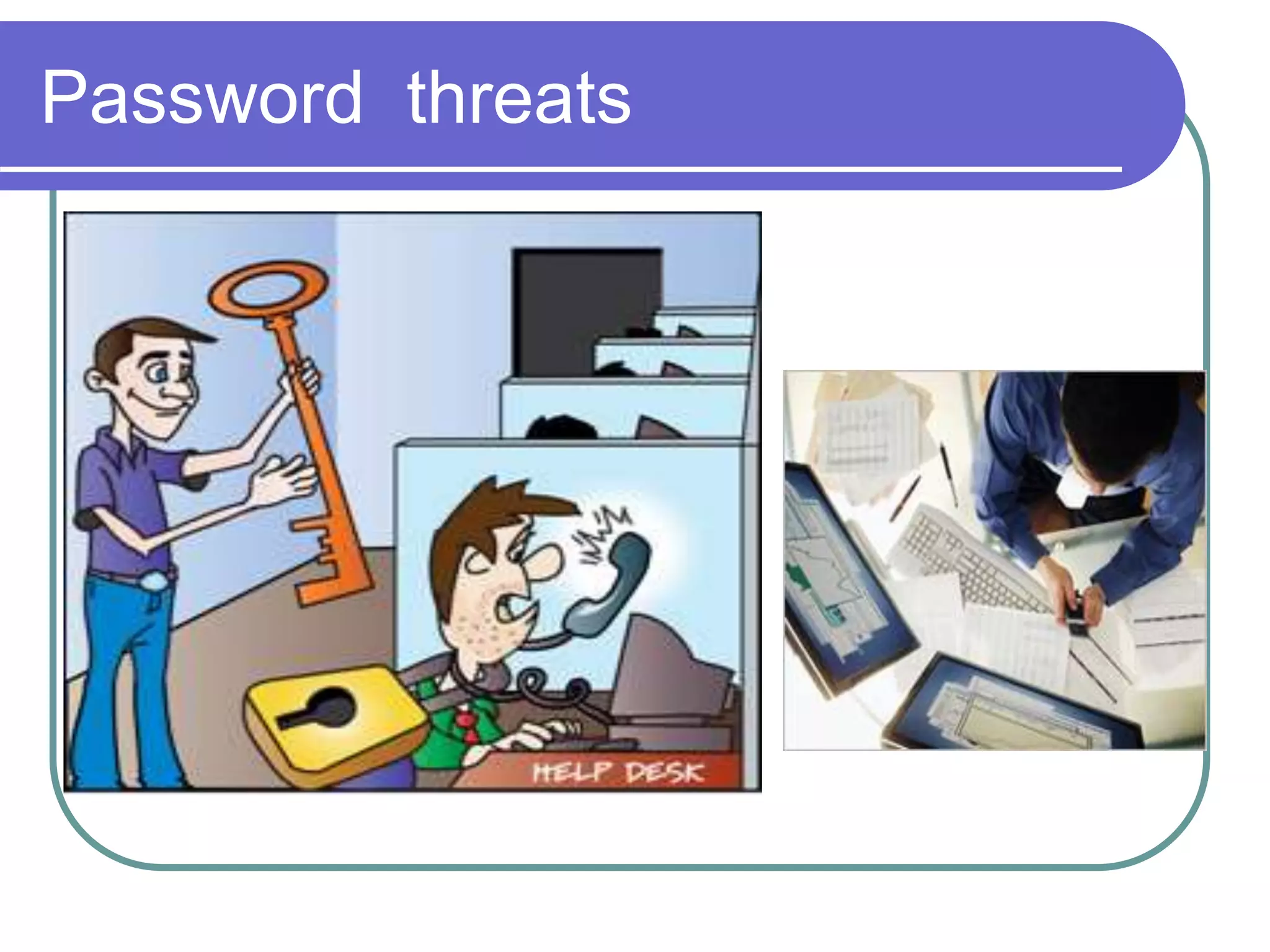
Password threats
Threats
 Unauthorized access
to table and columns
Columns
Unauthorized Access to rows
Rows
Threats
 Lack of Accountability
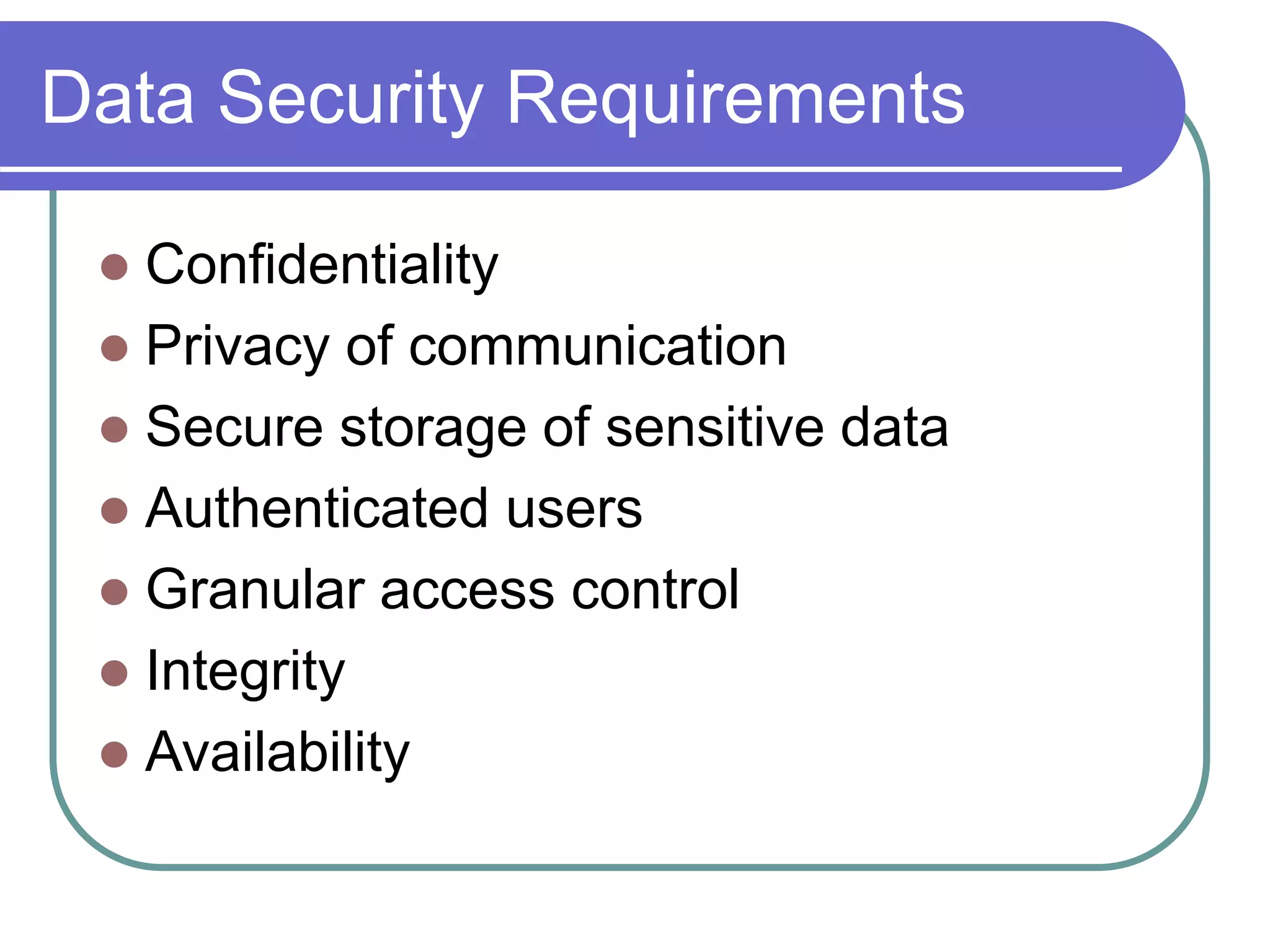
Data Security Requirements
 Confidentiality
 Privacy of communication
 Secure storage of sensitive data
 Authenticated users
 Granular access control
 Integrity
 Availability
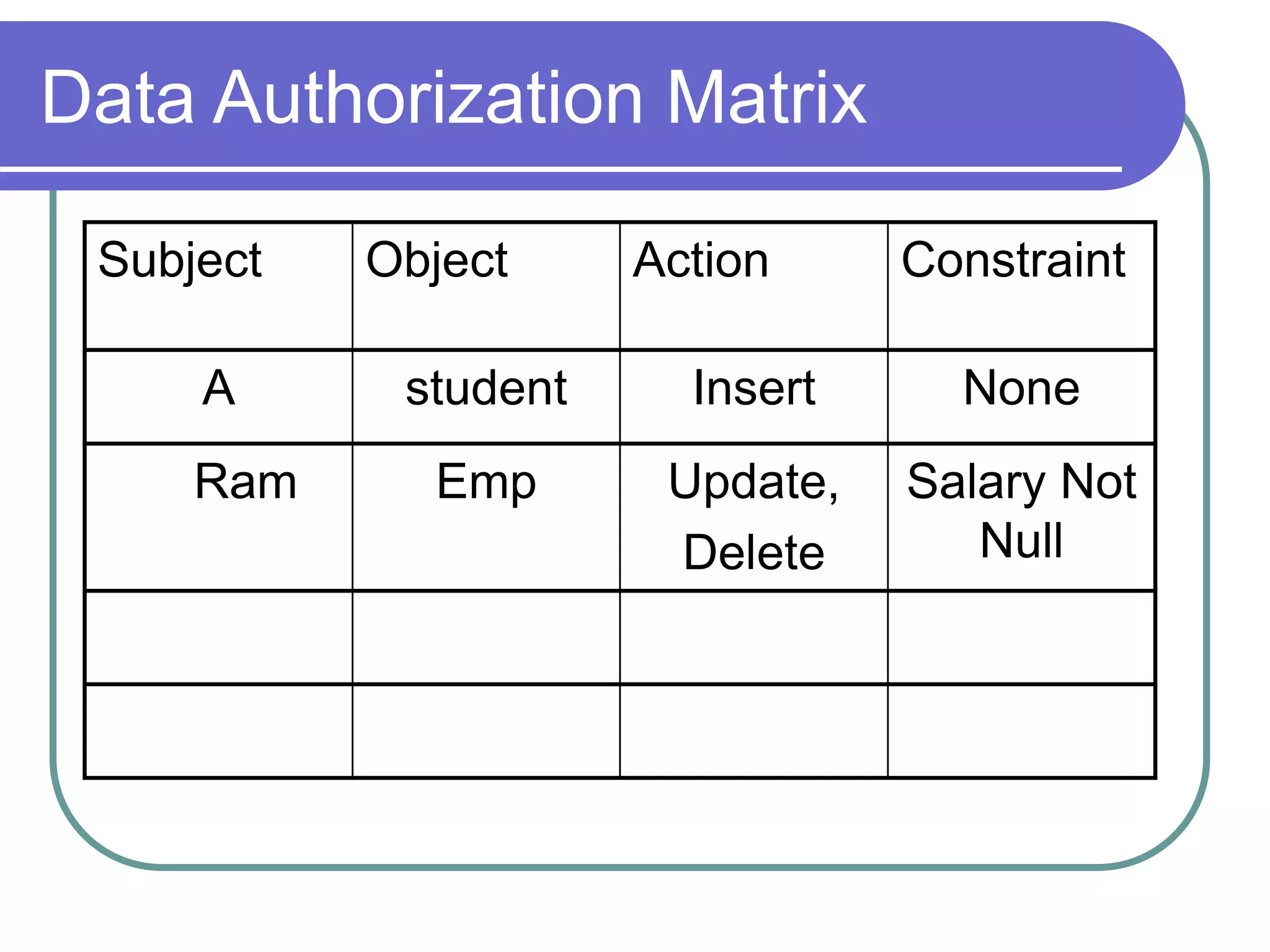
Data Authorization Matrix
Subject Object Action Constraint
A student Insert None
Ram Emp Update,
Delete
Salary Not
Null
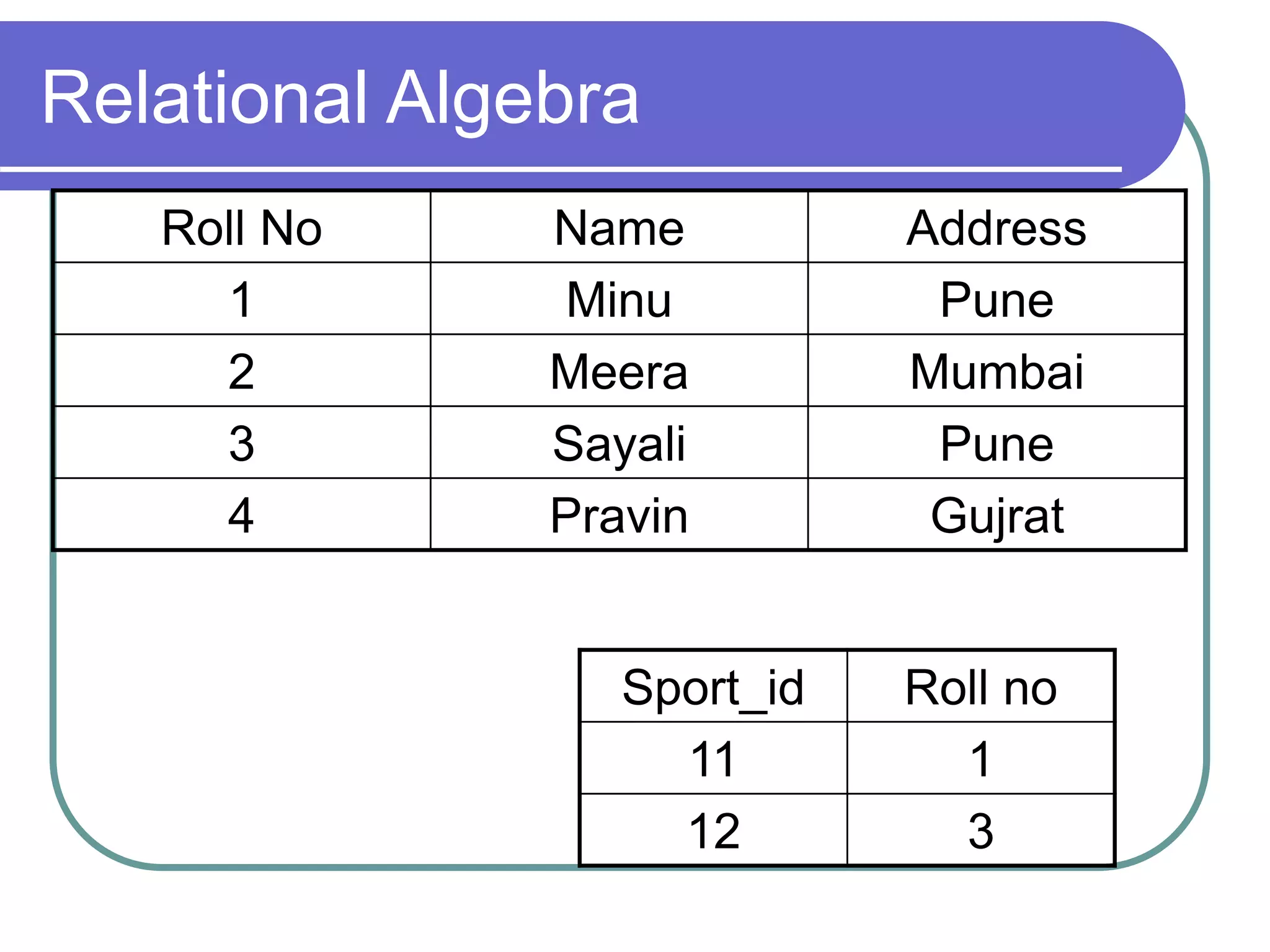
Relational Algebra
Roll No Name Address
1 Minu Pune
2 Meera Mumbai
3 Sayali Pune
4 Pravin Gujrat
Sport_id Roll no
11 1
12 3
Relational Algebra
 Select Operation ( σ )
 TO select a particular row
 σ
(roll no = 1 (student))
1 Minu Pune
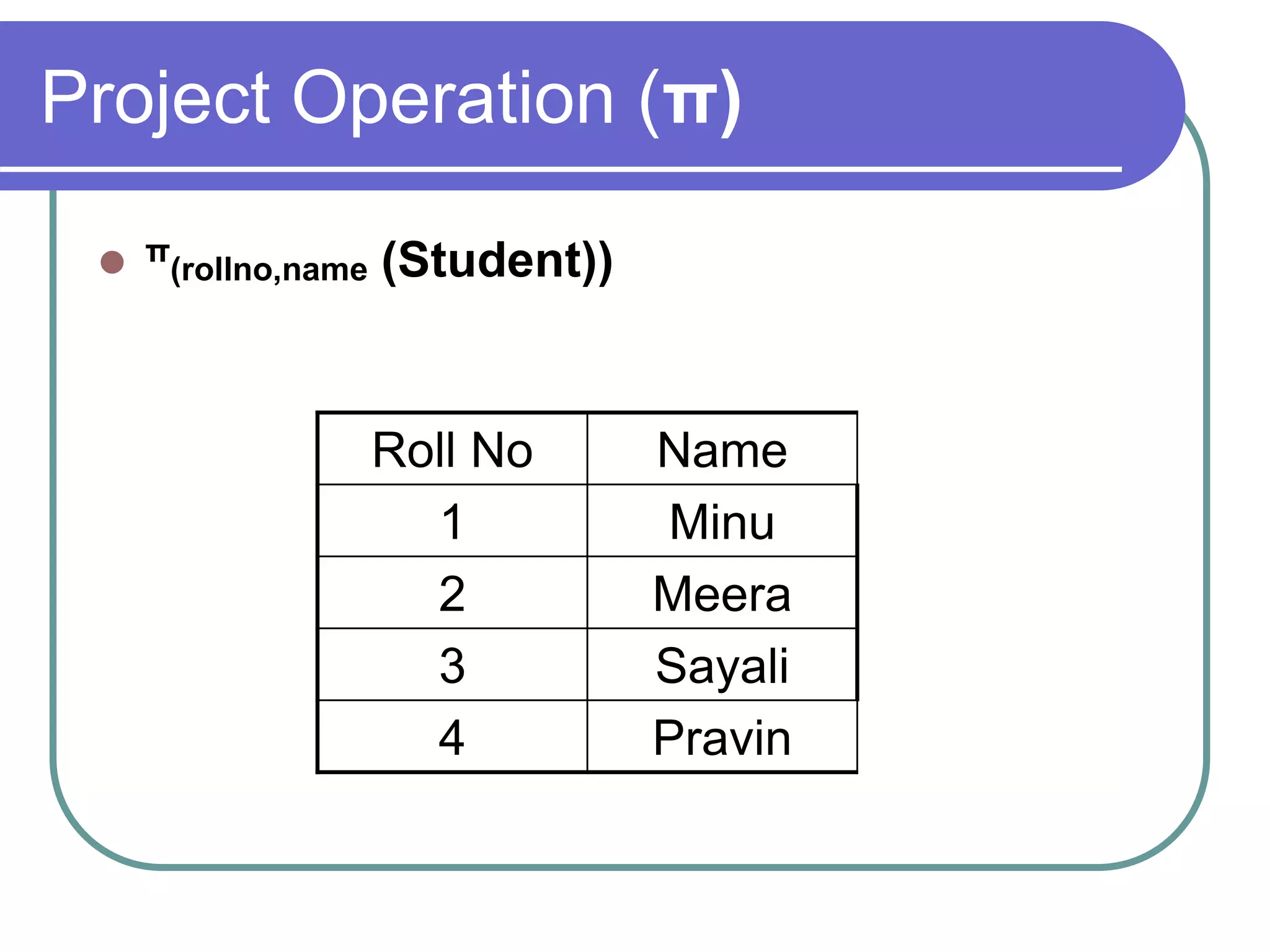
Project Operation (π)
 π
(rollno,name (Student))
Roll No Name
1 Minu
2 Meera
3 Sayali
4 Pravin
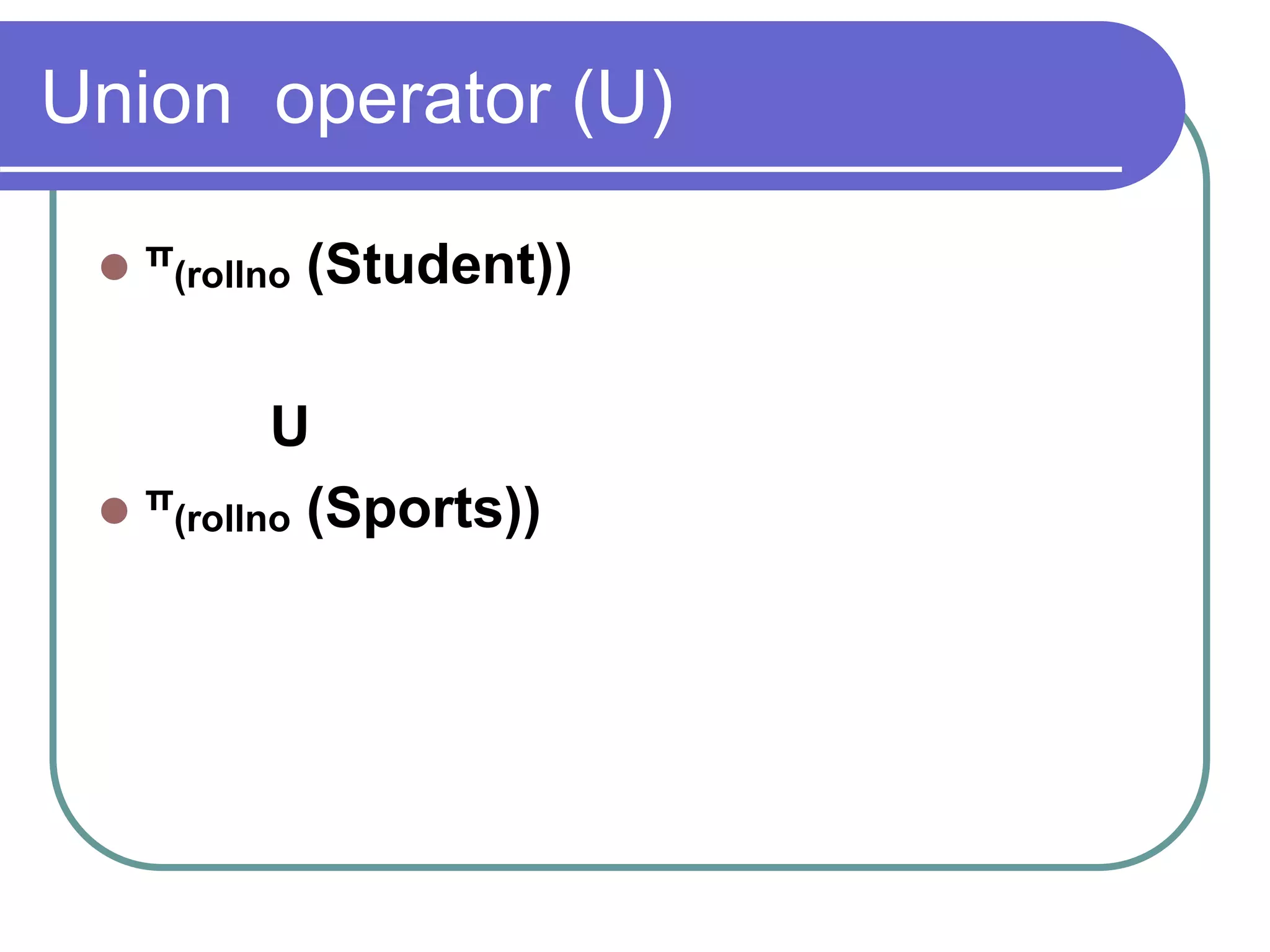
Union operator (U)
 π
(rollno (Student))
U
 π
(rollno (Sports))
Minus operator (-)
 π
(rollno (Student))
-
 π
(rollno (Sports))
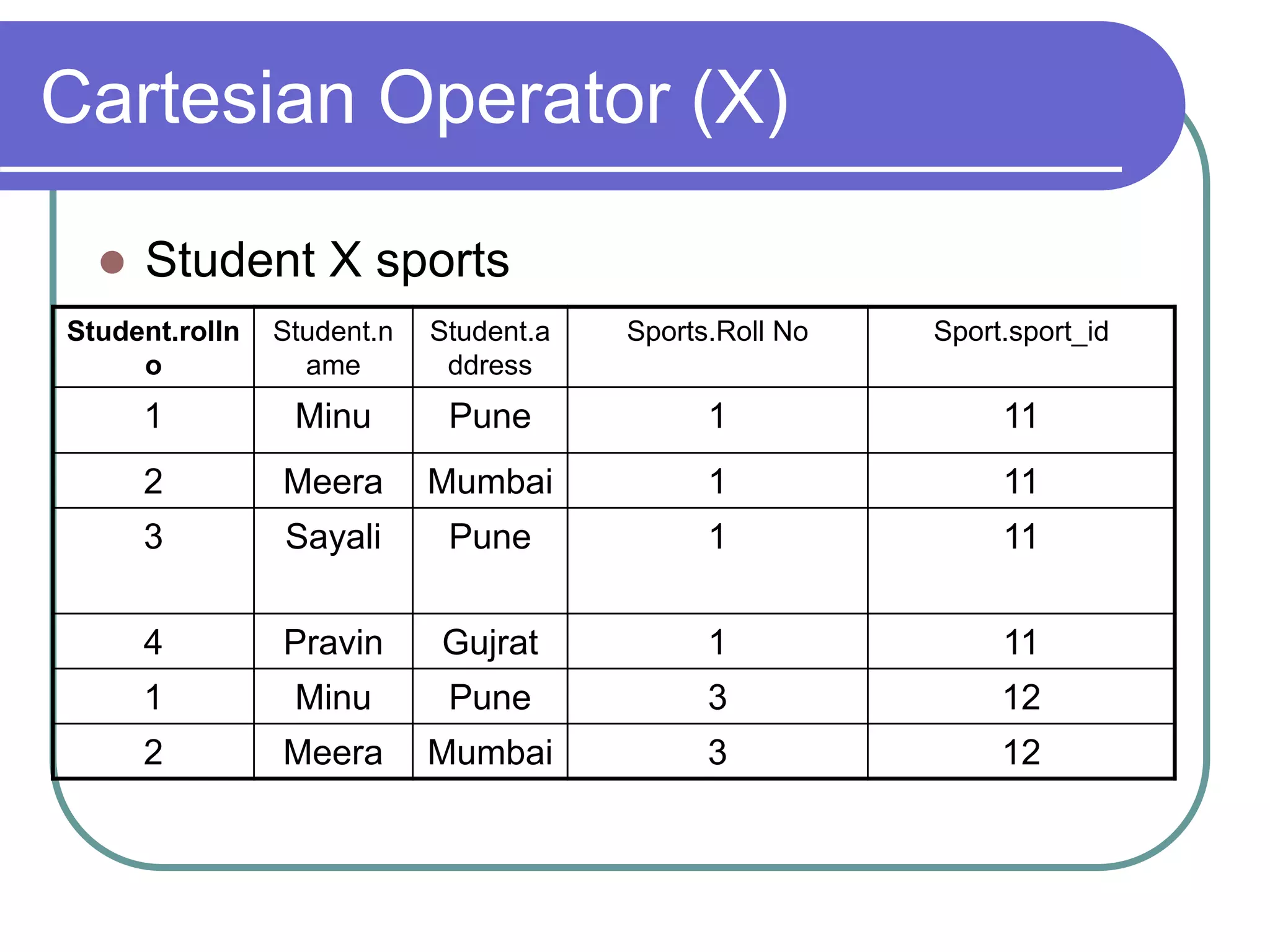
Cartesian Operator (X)
 Student X sports
Student.rolln
o
Student.n
ame
Student.a
ddress
Sports.Roll No Sport.sport_id
1 Minu Pune 1 11
2 Meera Mumbai 1 11
3 Sayali Pune 1 11
4 Pravin Gujrat 1 11
1 Minu Pune 3 12
2 Meera Mumbai 3 12
Rename Operation(ρ)
 π
(s.rollno,s.name,s.address,s1,rollno,s1.sport_id (ρ s
Student X ρ s1 sports))
Other Relational Operators
 n (Intersection operator)
 π
(rollno (Student))
n
 π
(rollno (Sports))
Natural Join ⋈
 π
(s.rollno,s.name,s.address,s1,rollno,s1.sport_id (ρ s
Student ⋈ ρ s1 sports))
Assignment Operator
 Temp1 π
r -s( R)
Extended Relational operators
 Generalized Projection
 π
(marks1+marks2 (Student))
Marks1 Marks 2
10 11
12 11
Output----------- Marks1+marks2
----------------------
21
23
Aggregation Function(G)
 G sum(marks)(Student)
 G sum(marks),avg(marks),min(marks),max(marks)(Student)
Outer Join
 Full Outer Join
 Left Outer Join
 Right Outer Join

Chapter2.ppt

  • 1.
  • 2.
  • 3.
    E.F.Codd Rules  InformationRule All information in the database should be represented in one and only one way - as values in a table.  Guaranteed Access Rule Each and every datum (atomic value) is guaranteed to be logically accessible by resorting to a combination of table name, primary key value and column name.
  • 4.
    E.F.Codd Rules  SystematicTreatment of Null Values Null values (distinct from empty character string or a string of blank characters and distinct from zero or any other number) are supported in the fully relational DBMS for representing missing information in a systematic way, independent of data type.
  • 5.
    E.F.Codd Rules  DynamicOn-line Catalog Based on the Relational Model The database description is represented at the logical level in the same way as ordinary data, so authorized users can apply the same relational language to its interrogation as they apply to regular data. 
  • 6.
    E.F.Codd Rules  ComprehensiveData Sublanguage Rule A relational system may support several languages and various modes of terminal use. However, there must be at least one language whose statements are expressible, per some well-defined syntax, as character strings and whose ability to support all of the following is comprehensible:  data definition  view definition  data manipulation (interactive and by program)  integrity constraints  authorization  transaction boundaries (begin, commit, and rollback). 
  • 7.
    E.F.Codd Rules  ViewUpdating Rule All views that are theoretically updateable are also updateable by the system.  High-level Insert, Update, and Delete The capability of handling a base relation or a derived relation as a single operand applies nor only to the retrieval of data but also to the insertion, update, and deletion of data.
  • 8.
    E.F.Codd Rules  PhysicalData Independence Application programs and terminal activities remain logically unimpaired whenever any changes are made in either storage representation or access methods.  Logical Data Independence Application programs and terminal activities remain logically unimpaired when information preserving changes of any kind that theoretically permit unimpairment are made to the base tables.
  • 9.
    E.F.Codd Rules  IntegrityIndependence Integrity constraints specific to a particular relational database must be definable in the relational data sublanguage and storable in the catalog, not in the application programs.  Distribution Independence The data manipulation sublanguage of a relational DBMS must enable application programs and terminal activities to remain logically unimpaired whether and whenever data are physically centralized or distributed.
  • 10.
    E.F.Codd Rules  NonsubversionRule If a relational system has or supports a low- level (single-record-at-a-time) language, that low-level language cannot be used to subvert or bypass the integrity rules or constraints expressed in the higher-level (multiple-records-at-a-time) relational language. 
  • 11.
    Keys  Super Key Candidate Key  Primary Key  Foreign Key
  • 12.
    Types Of IntegrityConstraints  Domain Integrity Constraint  Entity Integrity Constraint  Referential Integrity Constraint
  • 13.
    Foreign Key  OnDelete Cascade  On Update Cascade  Eg:- references rollno  on delete cascade  on update cascade
  • 14.
  • 15.
  • 16.
    Falsifying user Identities Pretend to be some one else
  • 17.
  • 18.
    Threats  Unauthorized access totable and columns Columns
  • 19.
  • 20.
    Threats  Lack ofAccountability
  • 21.
    Data Security Requirements Confidentiality  Privacy of communication  Secure storage of sensitive data  Authenticated users  Granular access control  Integrity  Availability
  • 22.
    Data Authorization Matrix SubjectObject Action Constraint A student Insert None Ram Emp Update, Delete Salary Not Null
  • 23.
    Relational Algebra Roll NoName Address 1 Minu Pune 2 Meera Mumbai 3 Sayali Pune 4 Pravin Gujrat Sport_id Roll no 11 1 12 3
  • 24.
    Relational Algebra  SelectOperation ( σ )  TO select a particular row  σ (roll no = 1 (student)) 1 Minu Pune
  • 25.
    Project Operation (π) π (rollno,name (Student)) Roll No Name 1 Minu 2 Meera 3 Sayali 4 Pravin
  • 26.
    Union operator (U) π (rollno (Student)) U  π (rollno (Sports))
  • 27.
    Minus operator (-) π (rollno (Student)) -  π (rollno (Sports))
  • 28.
    Cartesian Operator (X) Student X sports Student.rolln o Student.n ame Student.a ddress Sports.Roll No Sport.sport_id 1 Minu Pune 1 11 2 Meera Mumbai 1 11 3 Sayali Pune 1 11 4 Pravin Gujrat 1 11 1 Minu Pune 3 12 2 Meera Mumbai 3 12
  • 29.
  • 30.
    Other Relational Operators n (Intersection operator)  π (rollno (Student)) n  π (rollno (Sports))
  • 31.
    Natural Join ⋈ π (s.rollno,s.name,s.address,s1,rollno,s1.sport_id (ρ s Student ⋈ ρ s1 sports))
  • 32.
  • 33.
    Extended Relational operators Generalized Projection  π (marks1+marks2 (Student)) Marks1 Marks 2 10 11 12 11 Output----------- Marks1+marks2 ---------------------- 21 23
  • 34.
    Aggregation Function(G)  Gsum(marks)(Student)  G sum(marks),avg(marks),min(marks),max(marks)(Student)
  • 35.
    Outer Join  FullOuter Join  Left Outer Join  Right Outer Join