2
Introduction
Software maintenance:
any modifications to a software
product after it has been delivered
to the customer.
Software maintenance is an
important activity for many
organizations.
3.
3
Introduction
Maintenance isinevitable for
almost any kind of product.
Most products need maintenance:
due to wear and tear caused by use.
Software products do not need
maintenance on this count.
4.
4
Introduction
Many peoplethink
only bad software products need
maintenance.
The opposite is true:
bad products are thrown away,
good products are maintained and
used for a long time.
6
Corrective
Corrective maintenanceof
a software product:
to correct bugs observed
while the system is in use.
to enhance performance of
the product.
7.
7
Adaptive
A softwareproduct needs
maintenance (porting) when
customers:
need the product to run on new
platforms,
or, on new operating systems,
need the product to interface
with new hardware or software.
10
Causes for maintenance
During development:
Software not anticipated to last very
long (e.g., Y2K problem).
Rate of hardware obsolescence:
immortality of software products
maintenance necessary for software
performing low-level functions.
11.
11
Causes for
maintenance
Userswant existing software
to run on new platforms:
to run in new environments,
and/or with enhanced
features.
12.
12
Causes for
maintenance
Wheneverother software it
works with change:
maintenance is needed to cope
up with the newer interface.
For instance, a software product
may need maintenance when
the operating system changes.
13.
13
Software evolution
Everysoftware product
continues to evolve after its
development:
through maintenance efforts.
Larger software products stay
in operation for longer time:
because of high replacement
cost.
14.
14
Laws of Maintenance
There will always be a lot
of old software needing
maintenance.
Good products are
maintained, bad products
are thrown away.
15.
15
Laws of Maintenance
Lehman’s first Law:
“Software products must
change continuously, or
become progressively less
useful.”
16.
16
Laws of Maintenance
Lehman’s Second Law
“When software is
maintained, its structure
degrades,
unless active efforts are made
to avoid this phenomenon.”
18
Other Laws of
Maintenance
All large programs will
undergo significant
changes during operation
phase of their life cycle,
regardless of apriori
intentions.
19.
19
Legacy code--- Major
maintenanceproblems
Unstructured code (bad programs)
Maintenance programmers have:
insufficient knowledge of the system or
the application domain.
Software maintenance has a bad image.
Documentation absent, out of date,
or insufficient.
20.
20
Insufficient knowledge
Maintenanceteam is usually
different from development
team.
even after reading all documents
it is very difficult to understand why
a thing was done in a certain way.
Also there is a limit to the rate at
which a person can study
documents
and extract relevant information
21.
21
Bad image of
maintenance?
Maintainers are skilled not only in
writing code:
proficient in understanding others’
code
detecting problems, modifying the
design, code, and documentation
working with end-users
22.
22
Maintenance
Nightmares
Use ofgotos
Lengthy procedures
Poor and inconsistent naming
Poor module structure
Weak cohesion and high coupling
Deeply nested conditional statements
Functions having side effects
23.
23
How to dobetter
maintenance?
Program understanding
Reverse engineering
Design recovery
Reengineering
Maintenance process models
24.
24
Maintenance activities
Twotypes of activities:
Productive activities:
modification of analysis, design,
coding, etc.
Non-productive activities:
understanding system design,
code, etc.
26
Software Reverse
Engineering
Reverseengineering is an
important maintenance technique:
several existing software
products are unstructured,
lack proper documentation,
were not developed using
software engineering principles.
29
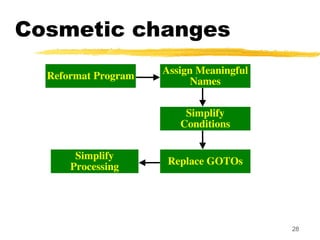
Cosmetic Changes
Reformatthe program:
use any pretty printer program
layout the program neatly.
Give more meaningful names
to:
Variables, data structures, and
functions.
30.
30
Cosmetic Changes
Replacecomplex and nested
conditional expressions:
simpler conditional
statements
whenever appropriate use
case statements.
31.
31
Software Reverse
Engineering
Inorder to extract the design:
fully understand the code.
Automatic tools can be used to
help derive:
data flow and control flow
diagrams from the code.
32.
32
Software Reverse
Engineering
Extractstructure chart:
module invocation sequence and data
interchange among modules.
Extract requirements specification:
after thoroughly understanding the
code.
design has been extracted.
33.
33
Software Maintenance
Process Models
Maintenance activities are not
unique:
depend on the extent of
modifications required,
also, depend on condition of the
product:
how structured it is,
how well documented it is, etc.
34.
34
Software Maintenance Process
Model- 1
When the required changes are
small and simple:
the code can be directly modified
changes reflected in all relevant
documents.
more elaborate activities are required
when required changes are not
trivial.
35.
35
Software Maintenance Process
Model- 1
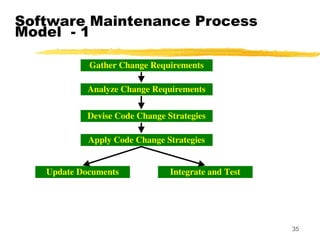
Gather Change Requirements
Analyze Change Requirements
Devise Code Change Strategies
Apply Code Change Strategies
Update Documents Integrate and Test
36.
36
Software Maintenance Process
Model1
Start by gathering change
requirements.
Analyze change
requirements
formulate strategies for code
change.
37.
37
Software Maintenance Process
Model1
Formulating strategies for
code change:
presence of few members of the
original development team
helps in reducing cycle time,
especially for unstructured and
inadequately documented code.
38.
38
Software Maintenance Process
Model1
Availability of a working old system
at the maintenance site:
greatly helps the maintenance team
provides a good insight into the
working of the old system
can compare the working of the
modified system with the old system.
39.
39
Software Maintenance Process
Model1
Debugging the system under
maintenance becomes
easier:
program traces of both the
systems can be compared to
localize bugs.
40.
40
Software Maintenance Process
Model-2
For complex maintenance projects,
software reengineering needed:
a reverse engineering cycle followed
by a forward engineering cycle.
with as much reuse as possible from
existing code and other documents.
41.
41
Maintenance Process
Model 2
Preferable when:
amount of rework is significant
software has poor structure.
Can be represented by a reverse
engineering cycle:
followed by a forward engineering
cycle.