Software and its Types
Vatsal Guleria
Class. : IX
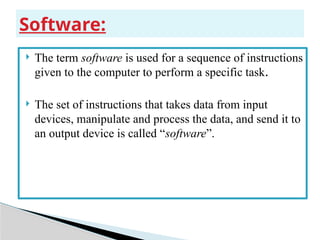
 The term software is used for a sequence of instructions
given to the computer to perform a specific task.
 The set of instructions that takes data from input
devices, manipulate and process the data, and send it to
an output device is called “software”.
Software:
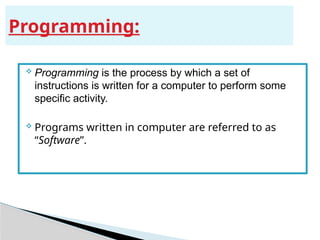
 Programming is the process by which a set of
instructions is written for a computer to perform some
specific activity.
 Programs written in computer are referred to as
“Software”.
Programming:
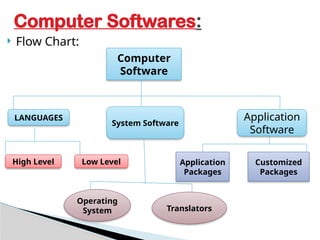
 Flow Chart:
Computer Softwares:
Computer
Software
LANGUAGES
System Software
Application
Software
High Level Low Level
Operating
System Translators
Application
Packages
Customized
Packages
 Low level Languages: Low level computer languages are machine codes or
close to it.
 For example: 0 and 1
 Low level languages are further divided in to;
o 1) Machine Language: It expresses instructions in the binary codes of
computer i:e 0 and 1.
o 2) Assembly Language: It utilizes symbols to represent operation codes
and storage locations, also called symbolic language. It is alphanumeric
language known as “mnemonic codes”.
o Example: ADD for Addition, SUB for subtraction, start label etc.
Computer Languages:
 Very close to English Language.
 They are basically symbolic languages which use English
words and mathematical symbols rather than mnemonic
codes.
 Each instruction in this language is translated into many
machine language instructions.
 Example: PL/1 (Programming language, version 1), C
Language, GPSS etc
High Level Languages:
 Programs which hold instructions related with the working of
hardware and software of the computer system.
 The set of programs which increase the capabilities of the
system and to make the use of computer more effective.
 They are also called “Firmware”.
 Further divided into two categories.
System Software:
 A set of programs which coordinate and control
computer operations.
 They provide communication between the user and
the computer hardware.
 Main functions of OS are :
 Job control
 Memory management
 Supervisor
 Multiprogramming
 Produce error messages
1)Operating Systems(OS):
 Before defining translators, the following terms must be
defined:
a. Source Program: A program written in non-machine
language. For example, a program written in assembly or
high level language like FORTAN, COBOL etc is source
program.
b. Object Program: The source program is translated
into machine language. The translated program is called
Object Program.
2) TRANSLATORS:
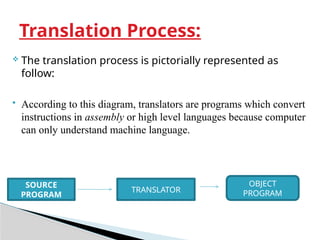
 The translation process is pictorially represented as
follow:
 According to this diagram, translators are programs which convert
instructions in assembly or high level languages because computer
can only understand machine language.
Translation Process:
SOURCE
PROGRAM
TRANSLATOR
OBJECT
PROGRAM
 They are also known as “packages”.
 They help the users to require their required outputs.
 These are the software developed by experts in
high/low level languages for non-experts.
o There are two types of Application software/packages:
I. Application software/packages
II. Customized Packages
APPLICATION SOFTWARE:
 The general programs in the market developed by
famous software development companies are known
as Application Programs. E.g.
 Word processors: word star, MS-word etc.
 Games: IGI, Chicken invaders, FIFA
 Spread sheets; Lotus, Excel etc
 Graphics: Haward Graphics, Instant Artist.
 Educational: Medicine, Commerce, Archeology etc.
I) Application software:
 These are developed according to the needs of an
organization.
 The program can be developed by a single
programmer or by a team of programmers
depending upon the requirements. E.g.
Programming for:-
• Banking
• Accounts
• Industries
• Stock and sales etc.
ii) Customized Software/Packages:

Software and its Types use of software types

  • 1.
    Software and itsTypes Vatsal Guleria Class. : IX
  • 2.
     The termsoftware is used for a sequence of instructions given to the computer to perform a specific task.  The set of instructions that takes data from input devices, manipulate and process the data, and send it to an output device is called “software”. Software:
  • 3.
     Programming isthe process by which a set of instructions is written for a computer to perform some specific activity.  Programs written in computer are referred to as “Software”. Programming:
  • 4.
     Flow Chart: ComputerSoftwares: Computer Software LANGUAGES System Software Application Software High Level Low Level Operating System Translators Application Packages Customized Packages
  • 5.
     Low levelLanguages: Low level computer languages are machine codes or close to it.  For example: 0 and 1  Low level languages are further divided in to; o 1) Machine Language: It expresses instructions in the binary codes of computer i:e 0 and 1. o 2) Assembly Language: It utilizes symbols to represent operation codes and storage locations, also called symbolic language. It is alphanumeric language known as “mnemonic codes”. o Example: ADD for Addition, SUB for subtraction, start label etc. Computer Languages:
  • 6.
     Very closeto English Language.  They are basically symbolic languages which use English words and mathematical symbols rather than mnemonic codes.  Each instruction in this language is translated into many machine language instructions.  Example: PL/1 (Programming language, version 1), C Language, GPSS etc High Level Languages:
  • 7.
     Programs whichhold instructions related with the working of hardware and software of the computer system.  The set of programs which increase the capabilities of the system and to make the use of computer more effective.  They are also called “Firmware”.  Further divided into two categories. System Software:
  • 8.
     A setof programs which coordinate and control computer operations.  They provide communication between the user and the computer hardware.  Main functions of OS are :  Job control  Memory management  Supervisor  Multiprogramming  Produce error messages 1)Operating Systems(OS):
  • 9.
     Before definingtranslators, the following terms must be defined: a. Source Program: A program written in non-machine language. For example, a program written in assembly or high level language like FORTAN, COBOL etc is source program. b. Object Program: The source program is translated into machine language. The translated program is called Object Program. 2) TRANSLATORS:
  • 10.
     The translationprocess is pictorially represented as follow:  According to this diagram, translators are programs which convert instructions in assembly or high level languages because computer can only understand machine language. Translation Process: SOURCE PROGRAM TRANSLATOR OBJECT PROGRAM
  • 11.
     They arealso known as “packages”.  They help the users to require their required outputs.  These are the software developed by experts in high/low level languages for non-experts. o There are two types of Application software/packages: I. Application software/packages II. Customized Packages APPLICATION SOFTWARE:
  • 12.
     The generalprograms in the market developed by famous software development companies are known as Application Programs. E.g.  Word processors: word star, MS-word etc.  Games: IGI, Chicken invaders, FIFA  Spread sheets; Lotus, Excel etc  Graphics: Haward Graphics, Instant Artist.  Educational: Medicine, Commerce, Archeology etc. I) Application software:
  • 13.
     These aredeveloped according to the needs of an organization.  The program can be developed by a single programmer or by a team of programmers depending upon the requirements. E.g. Programming for:- • Banking • Accounts • Industries • Stock and sales etc. ii) Customized Software/Packages: