


Presented By:
Pratibha
MCA 5th Sem
Contents
The Origin of SOFI
Making of Robot Fish
What can SOFI do?
Block Diagram
Materials and Methods
News Report
Results
Underwater Observatory
Limitations and Future steps
Conclusion
The story of robotic fish is not exactly
new. Reaching all the way back to 1994
when the world’s first robofish, Charlie
the Robo-Tuna took a swim, scientists
have been using the movements of
fish, to design underwater robots.
Almost a decade ago, in 2009, a team
of researchers were mimicking the
Amazonian knifefish, to create a
swimming robot.
Now, a team of roboticists, meaning
robot scientist, from MIT have built
what they call the most advanced
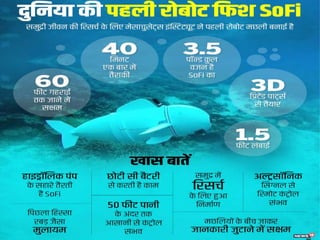
robotic fish ever made i.e. SOFI
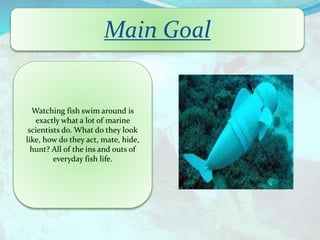
Watching fish swim around is
exactly what a lot of marine
scientists do. What do they look
like, how do they act, mate, hide,
hunt? All of the ins and outs of
everyday fish life.
Main Goal
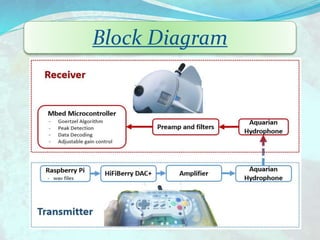
Block Diagram
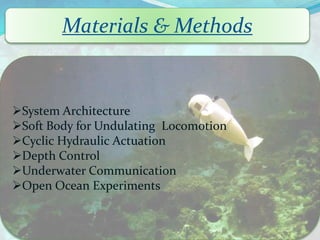
System Architecture
Soft Body for Undulating Locomotion
Cyclic Hydraulic Actuation
Depth Control
Underwater Communication
Open Ocean Experiments
Materials & Methods
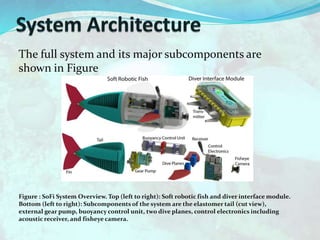
The full system and its major subcomponents are
shown in Figure
Figure : SoFi System Overview. Top (left to right): Soft robotic fish and diver interface module.
Bottom (left to right): Subcomponents of the system are the elastomer tail (cut view),
external gear pump, buoyancy control unit, two dive planes, control electronics including
acoustic receiver, and fisheye camera.
Signal Flow within the System. The command flow from human diver to the robot.
The diver sends acoustic commands such as thrust, left/right and up/down as well
as camera modes from the transmitter within the diver interface module. The
analog signal travels several meters underwater and is then amplified by the
receiver and parsed by the microcontroller. The microcontroller adjusts the pump
speed, the dive plane position, the BCU, and the mode of the camera.
The fish achieves undulating locomotion via a hydraulically actuated soft
fish tail with two internal cavities. The soft fish tail, shown in Figure , is a
fluidic elastomer actuator.
Figure : Soft Tail, Pump, and BCU. Top left: Soft fish tail in actuated state (two views).Top
right: Custom external gear pump in an exploded view. Bottom: One of two identical BCU
modules in an exploded view
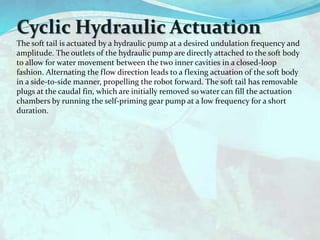
Cyclic Hydraulic Actuation
The soft tail is actuated by a hydraulic pump at a desired undulation frequency and
amplitude. The outlets of the hydraulic pump are directly attached to the soft body
to allow for water movement between the two inner cavities in a closed-loop
fashion. Alternating the flow direction leads to a flexing actuation of the soft body
in a side-to-side manner, propelling the robot forward. The soft tail has removable
plugs at the caudal fin, which are initially removed so water can fill the actuation
chambers by running the self-priming gear pump at a low frequency for a short
duration.
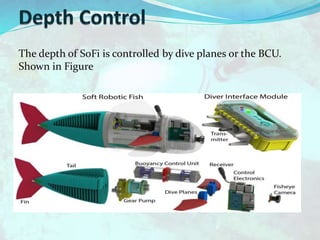
The depth of SoFi is controlled by dive planes or the BCU.
Shown in Figure
The dive planes allow the diver to finely control the robot’s
change in depth through dynamic diving for limited
deviations from its baseline depth before a buoyancy
adjustment is needed. Manually adding or removing
magnetic weights attached to the bottom of the robot
adjusts the neutral depth level. This allows the diver to
operate the robot over a larger depth range.
Additionally, the diver can remotely adjust the neutral
buoyancy of the
robot using the BCU. The BCU, shown in Figure, can
simultaneously control the buoyancy and pitch of the robot.
The mechanical design of the BCU comprises two mirroring
volume control modules in the form of two pistons. The
BCU is symmetrically oriented at the robot’s center of
buoyancy. An exploded view of a single unit is presented in
Figure.
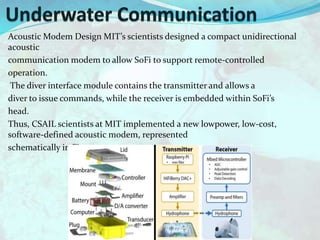
Acoustic Modem Design MIT’s scientists designed a compact unidirectional
acoustic
communication modem to allow SoFi to support remote-controlled
operation.
The diver interface module contains the transmitter and allows a
diver to issue commands, while the receiver is embedded within SoFi’s
head.
Thus, CSAIL scientists at MIT implemented a new lowpower, low-cost,
software-defined acoustic modem, represented
schematically in Figure
They tested the complete system in the open ocean, with a diver
remotely adjusting the fish’s state and navigating it to points of
interest in a complex underwater environment. Six dives were
conducted over the course of three days, exploring the Somosomo
Strait in Taveuni, Fiji (see Table for details):
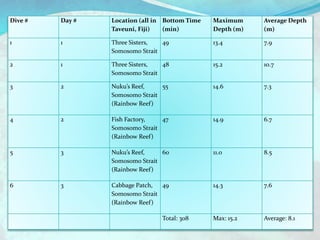
Table: Dive summaries. Six dives were performed over the course of 3
days, exploring various coral reef environments in Fiji. The depths and
times presented were recorded for one of the divers participating in
the experiments; while the trajectory of the diver and of SoFi were not
the same, the diver was typically within several meters of SoFi and can
therefore indicate the type of conditions that SoFi experienced. The
experimenters were typically at slightly shallower depths than SoFi.
Dive # Day # Location (all in
Taveuni, Fiji)
Bottom Time
(min)
Maximum
Depth (m)
Average Depth
(m)
1 1 Three Sisters,
Somosomo Strait
49 13.4 7.9
2 1 Three Sisters,
Somosomo Strait
48 15.2 10.7
3 2 Nuku’s Reef,
Somosomo Strait
(Rainbow Reef)
55 14.6 7.3
4 2 Fish Factory,
Somosomo Strait
(Rainbow Reef)
47 14.9 6.7
5 3 Nuku’s Reef,
Somosomo Strait
(Rainbow Reef)
60 11.0 8.5
6 3 Cabbage Patch,
Somosomo Strait
(Rainbow Reef)
49 14.3 7.6
Total: 308 Max: 15.2 Average: 8.1
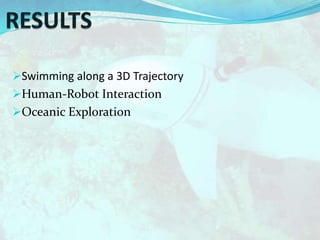
Swimming along a 3D Trajectory
Human-Robot Interaction
Oceanic Exploration
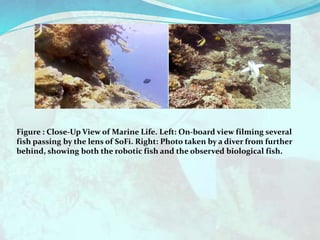
Figure : Close-Up View of Marine Life. Left: On-board view filming several
fish passing by the lens of SoFi. Right: Photo taken by a diver from further
behind, showing both the robotic fish and the observed biological fish.
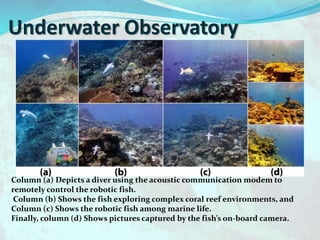
Underwater Observatory
Column (a) Depicts a diver using the acoustic communication modem to
remotely control the robotic fish.
Column (b) Shows the fish exploring complex coral reef environments, and
Column (c) Shows the robotic fish among marine life.
Finally, column (d) Shows pictures captured by the fish’s on-board camera.
Limitations and Future Steps
Scientists demonstrated that SoFi can navigate in natural environments. The
next steps are to use SoFi as an instrument to
1) Close-Up View of Marine Life.
2) Study the behavior of marine life over long periods of time without human.
3) Create robotic swarms.
Conclusion
MIT team presented an untethered soft-bodied robotic fish that demonstrates
prolonged and consistent underwater remote-controlled operation. While most
soft robots are pneumatically powered and tethered, our hydraulically-driven soft
actuator enables prolonged untethered swimming over several hundred meters
for 40 minutes. The hydraulic system can perform low to high frequency tail
actuation to achieve a range of swimming speeds, and can execute turns by
adjusting the baseline deflection around which the tail undulates. Dive planes
and the BCU enable vertical swimming. A camera is mounted at the tip of the
robot, allowing a diver to remotely explore and capture close-up recordings of
marine life and environments. The acoustic communication system provides a
compact, software-defined modulation scheme for transmitting data that is
robust to substantial noise and interference from complex environments. In
open-ocean coral reefs including obstacles, sources of noise, and multipath
effects, SoFi was able to transmit 16-bit words once per second over distances of
up to 10 m. This successfully enabled divers to send high-level commands and
navigate the robotic fish, observing the marine life and exploring their
surroundings.
SOFI "The Soft Robotic Fish"

SOFI "The Soft Robotic Fish"

  • 1.
  • 3.
    Contents The Origin ofSOFI Making of Robot Fish What can SOFI do? Block Diagram Materials and Methods News Report Results Underwater Observatory Limitations and Future steps Conclusion
  • 4.
    The story ofrobotic fish is not exactly new. Reaching all the way back to 1994 when the world’s first robofish, Charlie the Robo-Tuna took a swim, scientists have been using the movements of fish, to design underwater robots. Almost a decade ago, in 2009, a team of researchers were mimicking the Amazonian knifefish, to create a swimming robot. Now, a team of roboticists, meaning robot scientist, from MIT have built what they call the most advanced robotic fish ever made i.e. SOFI
  • 6.
    Watching fish swimaround is exactly what a lot of marine scientists do. What do they look like, how do they act, mate, hide, hunt? All of the ins and outs of everyday fish life. Main Goal
  • 7.
  • 8.
    System Architecture Soft Bodyfor Undulating Locomotion Cyclic Hydraulic Actuation Depth Control Underwater Communication Open Ocean Experiments Materials & Methods
  • 9.
    The full systemand its major subcomponents are shown in Figure Figure : SoFi System Overview. Top (left to right): Soft robotic fish and diver interface module. Bottom (left to right): Subcomponents of the system are the elastomer tail (cut view), external gear pump, buoyancy control unit, two dive planes, control electronics including acoustic receiver, and fisheye camera.
  • 10.
    Signal Flow withinthe System. The command flow from human diver to the robot. The diver sends acoustic commands such as thrust, left/right and up/down as well as camera modes from the transmitter within the diver interface module. The analog signal travels several meters underwater and is then amplified by the receiver and parsed by the microcontroller. The microcontroller adjusts the pump speed, the dive plane position, the BCU, and the mode of the camera.
  • 11.
    The fish achievesundulating locomotion via a hydraulically actuated soft fish tail with two internal cavities. The soft fish tail, shown in Figure , is a fluidic elastomer actuator. Figure : Soft Tail, Pump, and BCU. Top left: Soft fish tail in actuated state (two views).Top right: Custom external gear pump in an exploded view. Bottom: One of two identical BCU modules in an exploded view
  • 12.
    Cyclic Hydraulic Actuation Thesoft tail is actuated by a hydraulic pump at a desired undulation frequency and amplitude. The outlets of the hydraulic pump are directly attached to the soft body to allow for water movement between the two inner cavities in a closed-loop fashion. Alternating the flow direction leads to a flexing actuation of the soft body in a side-to-side manner, propelling the robot forward. The soft tail has removable plugs at the caudal fin, which are initially removed so water can fill the actuation chambers by running the self-priming gear pump at a low frequency for a short duration.
  • 13.
    The depth ofSoFi is controlled by dive planes or the BCU. Shown in Figure
  • 14.
    The dive planesallow the diver to finely control the robot’s change in depth through dynamic diving for limited deviations from its baseline depth before a buoyancy adjustment is needed. Manually adding or removing magnetic weights attached to the bottom of the robot adjusts the neutral depth level. This allows the diver to operate the robot over a larger depth range. Additionally, the diver can remotely adjust the neutral buoyancy of the robot using the BCU. The BCU, shown in Figure, can simultaneously control the buoyancy and pitch of the robot. The mechanical design of the BCU comprises two mirroring volume control modules in the form of two pistons. The BCU is symmetrically oriented at the robot’s center of buoyancy. An exploded view of a single unit is presented in Figure.
  • 15.
    Acoustic Modem DesignMIT’s scientists designed a compact unidirectional acoustic communication modem to allow SoFi to support remote-controlled operation. The diver interface module contains the transmitter and allows a diver to issue commands, while the receiver is embedded within SoFi’s head. Thus, CSAIL scientists at MIT implemented a new lowpower, low-cost, software-defined acoustic modem, represented schematically in Figure
  • 16.
    They tested thecomplete system in the open ocean, with a diver remotely adjusting the fish’s state and navigating it to points of interest in a complex underwater environment. Six dives were conducted over the course of three days, exploring the Somosomo Strait in Taveuni, Fiji (see Table for details): Table: Dive summaries. Six dives were performed over the course of 3 days, exploring various coral reef environments in Fiji. The depths and times presented were recorded for one of the divers participating in the experiments; while the trajectory of the diver and of SoFi were not the same, the diver was typically within several meters of SoFi and can therefore indicate the type of conditions that SoFi experienced. The experimenters were typically at slightly shallower depths than SoFi.
  • 17.
    Dive # Day# Location (all in Taveuni, Fiji) Bottom Time (min) Maximum Depth (m) Average Depth (m) 1 1 Three Sisters, Somosomo Strait 49 13.4 7.9 2 1 Three Sisters, Somosomo Strait 48 15.2 10.7 3 2 Nuku’s Reef, Somosomo Strait (Rainbow Reef) 55 14.6 7.3 4 2 Fish Factory, Somosomo Strait (Rainbow Reef) 47 14.9 6.7 5 3 Nuku’s Reef, Somosomo Strait (Rainbow Reef) 60 11.0 8.5 6 3 Cabbage Patch, Somosomo Strait (Rainbow Reef) 49 14.3 7.6 Total: 308 Max: 15.2 Average: 8.1
  • 20.
    Swimming along a3D Trajectory Human-Robot Interaction Oceanic Exploration
  • 21.
    Figure : Close-UpView of Marine Life. Left: On-board view filming several fish passing by the lens of SoFi. Right: Photo taken by a diver from further behind, showing both the robotic fish and the observed biological fish.
  • 22.
    Underwater Observatory Column (a)Depicts a diver using the acoustic communication modem to remotely control the robotic fish. Column (b) Shows the fish exploring complex coral reef environments, and Column (c) Shows the robotic fish among marine life. Finally, column (d) Shows pictures captured by the fish’s on-board camera.
  • 24.
    Limitations and FutureSteps Scientists demonstrated that SoFi can navigate in natural environments. The next steps are to use SoFi as an instrument to 1) Close-Up View of Marine Life. 2) Study the behavior of marine life over long periods of time without human. 3) Create robotic swarms.
  • 25.
    Conclusion MIT team presentedan untethered soft-bodied robotic fish that demonstrates prolonged and consistent underwater remote-controlled operation. While most soft robots are pneumatically powered and tethered, our hydraulically-driven soft actuator enables prolonged untethered swimming over several hundred meters for 40 minutes. The hydraulic system can perform low to high frequency tail actuation to achieve a range of swimming speeds, and can execute turns by adjusting the baseline deflection around which the tail undulates. Dive planes and the BCU enable vertical swimming. A camera is mounted at the tip of the robot, allowing a diver to remotely explore and capture close-up recordings of marine life and environments. The acoustic communication system provides a compact, software-defined modulation scheme for transmitting data that is robust to substantial noise and interference from complex environments. In open-ocean coral reefs including obstacles, sources of noise, and multipath effects, SoFi was able to transmit 16-bit words once per second over distances of up to 10 m. This successfully enabled divers to send high-level commands and navigate the robotic fish, observing the marine life and exploring their surroundings.