OBSERVATIONAL LEARNING
MARIA CLAUDIA CONTRERAS
SOE115 - PSYCHOLOGY OF TEACHING AND LEARNING
KENDALL COLLEGE
OVERVIEW
"Observational learning occurs by observing, retaining,
and replicating behavior seen in others. The individuals
performing the imitated behavior are called models. In
my study, the models will be teachers and parents.
While this type of learning can take place at any stage
in life, it is thought to be particularly important during
childhood, when authority is important." (Boundless,
2016).
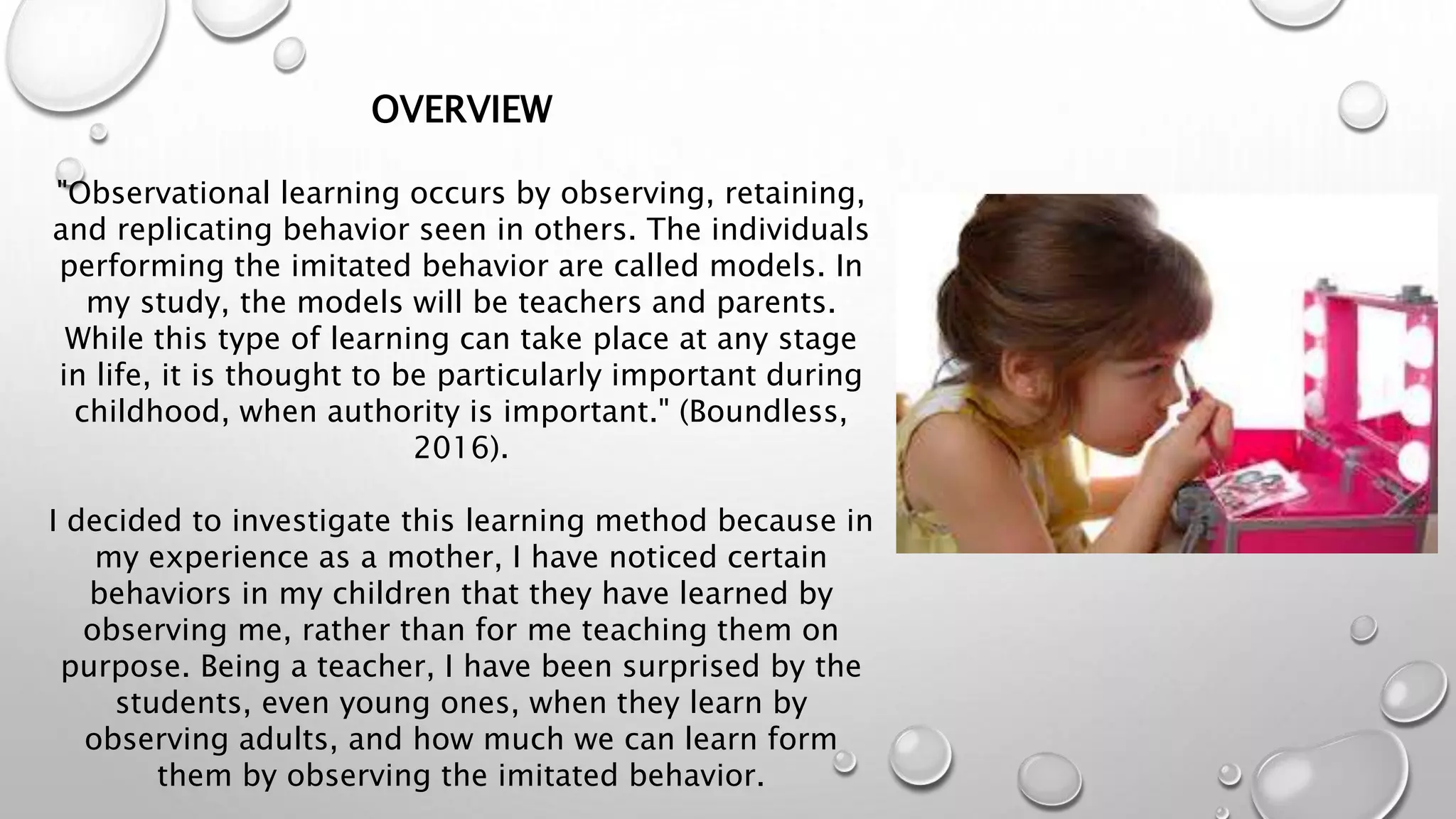
I decided to investigate this learning method because in
my experience as a mother, I have noticed certain
behaviors in my children that they have learned by
observing me, rather than for me teaching them on
purpose. Being a teacher, I have been surprised by the
students, even young ones, when they learn by
observing adults, and how much we can learn form
them by observing the imitated behavior.
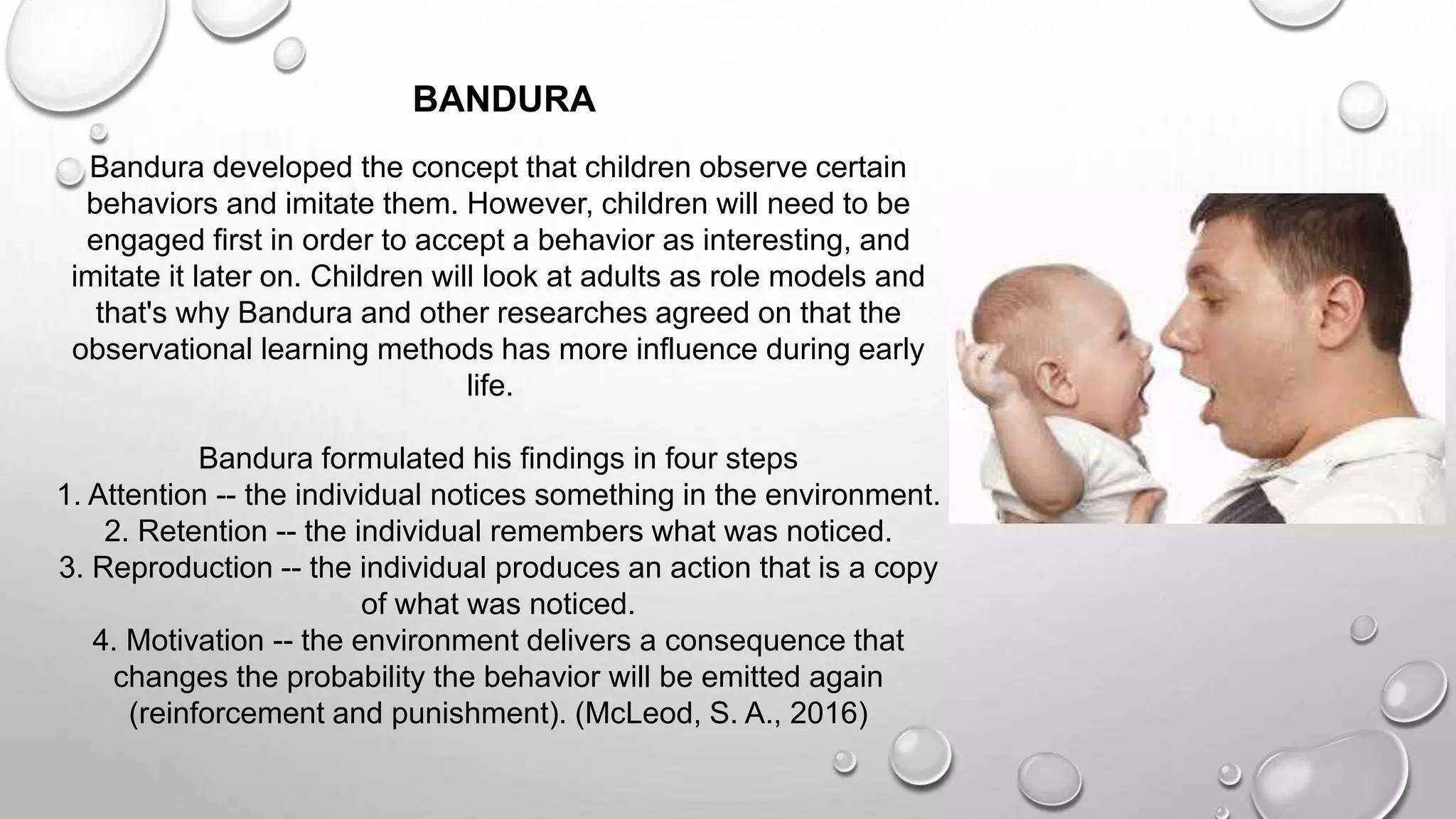
Bandura developed the concept that children observe certain
behaviors and imitate them. However, children will need to be
engaged first in order to accept a behavior as interesting, and
imitate it later on. Children will look at adults as role models and
that's why Bandura and other researches agreed on that the
observational learning methods has more influence during early
life.
Bandura formulated his findings in four steps
1. Attention -- the individual notices something in the environment.
2. Retention -- the individual remembers what was noticed.
3. Reproduction -- the individual produces an action that is a copy
of what was noticed.
4. Motivation -- the environment delivers a consequence that
changes the probability the behavior will be emitted again
(reinforcement and punishment). (McLeod, S. A., 2016)
BANDURA
According to Lipoff, it is extremely important for adults
to model the desired behavior when approaching
observational learning, in order to get positive results.
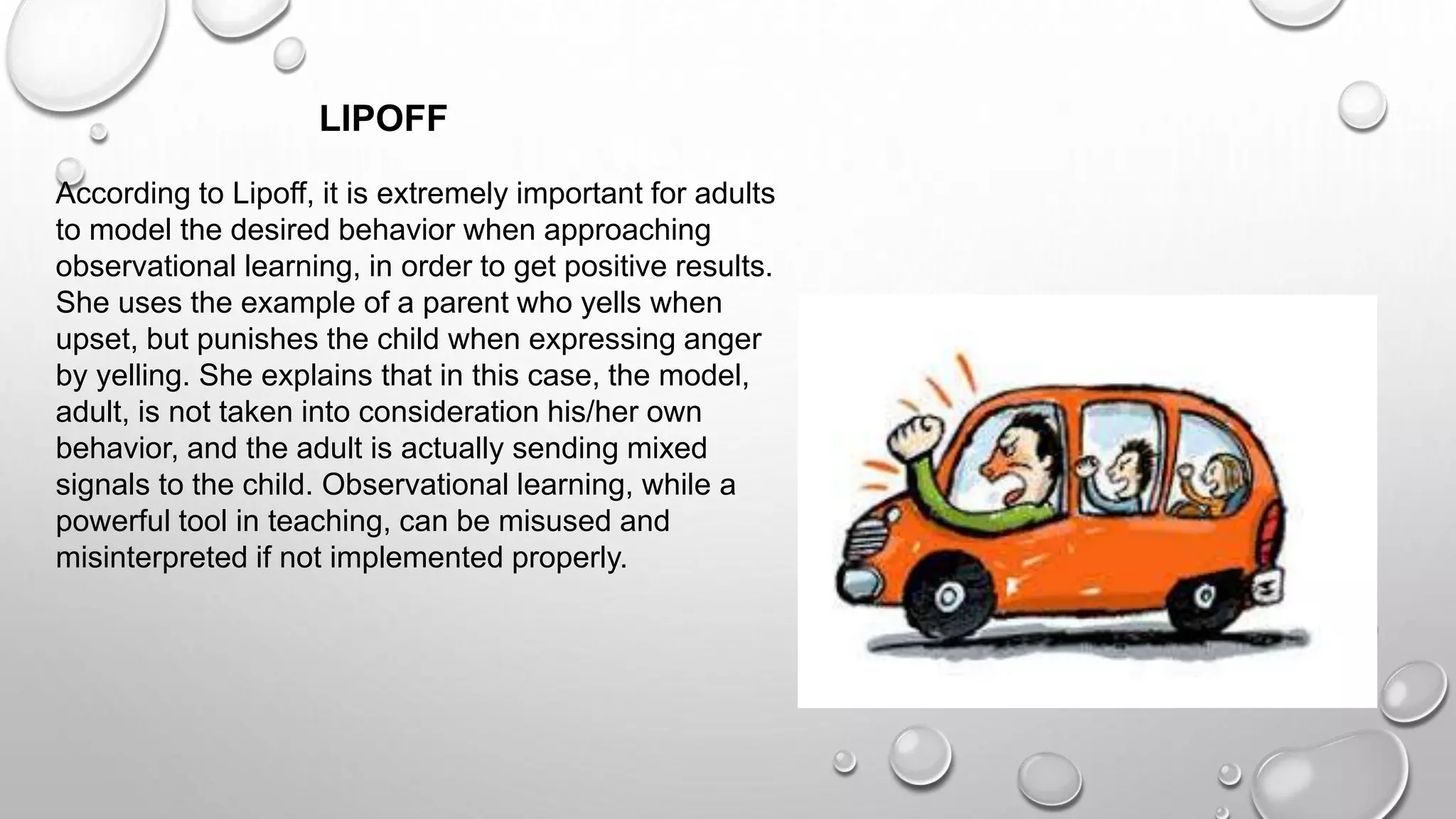
She uses the example of a parent who yells when
upset, but punishes the child when expressing anger
by yelling. She explains that in this case, the model,
adult, is not taken into consideration his/her own
behavior, and the adult is actually sending mixed
signals to the child. Observational learning, while a
powerful tool in teaching, can be misused and
misinterpreted if not implemented properly.
LIPOFF
The implications of observational learning do not develop
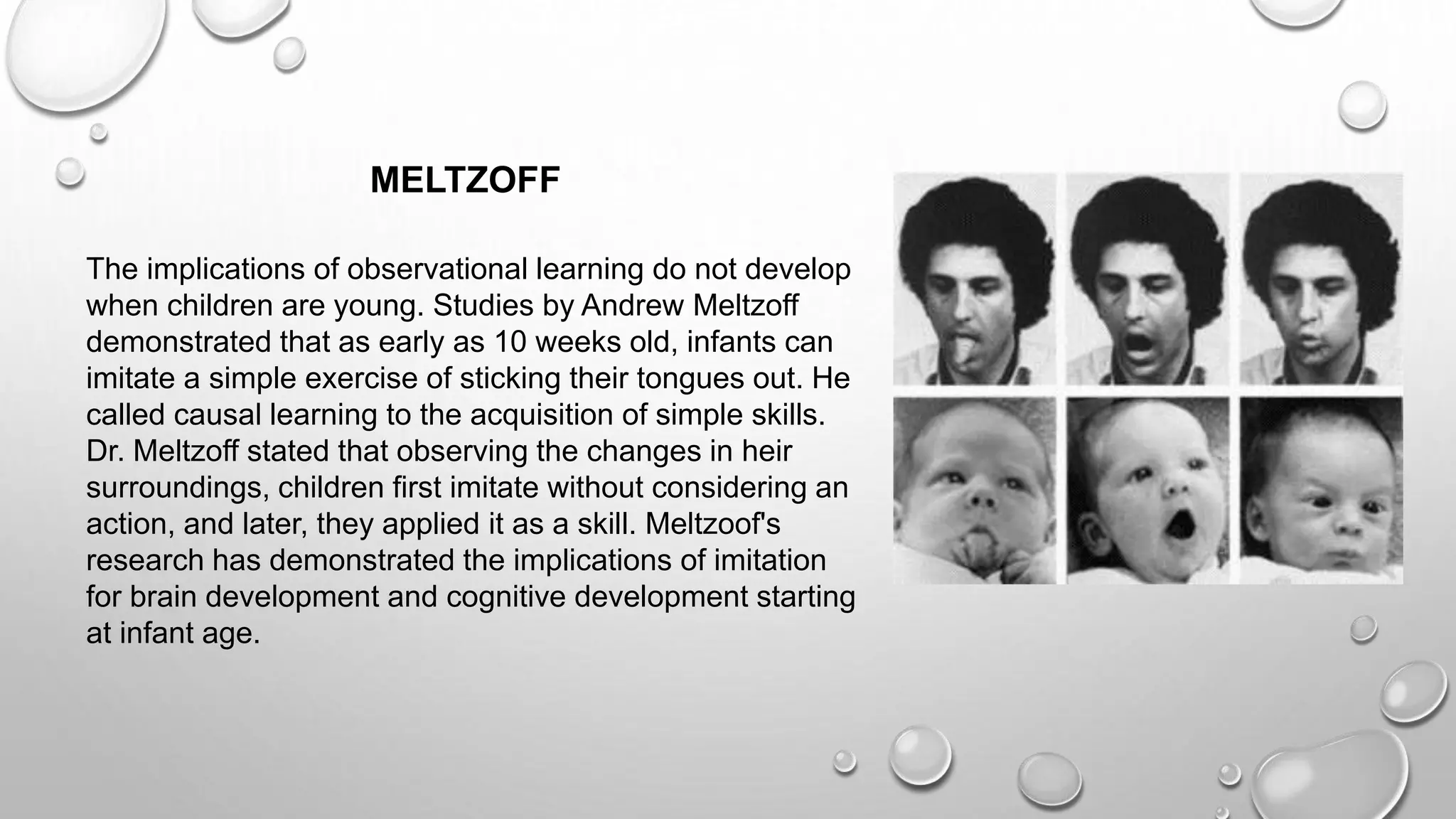
when children are young. Studies by Andrew Meltzoff
demonstrated that as early as 10 weeks old, infants can
imitate a simple exercise of sticking their tongues out. He
called causal learning to the acquisition of simple skills.
Dr. Meltzoff stated that observing the changes in heir
surroundings, children first imitate without considering an
action, and later, they applied it as a skill. Meltzoof's
research has demonstrated the implications of imitation
for brain development and cognitive development starting
at infant age.
MELTZOFF
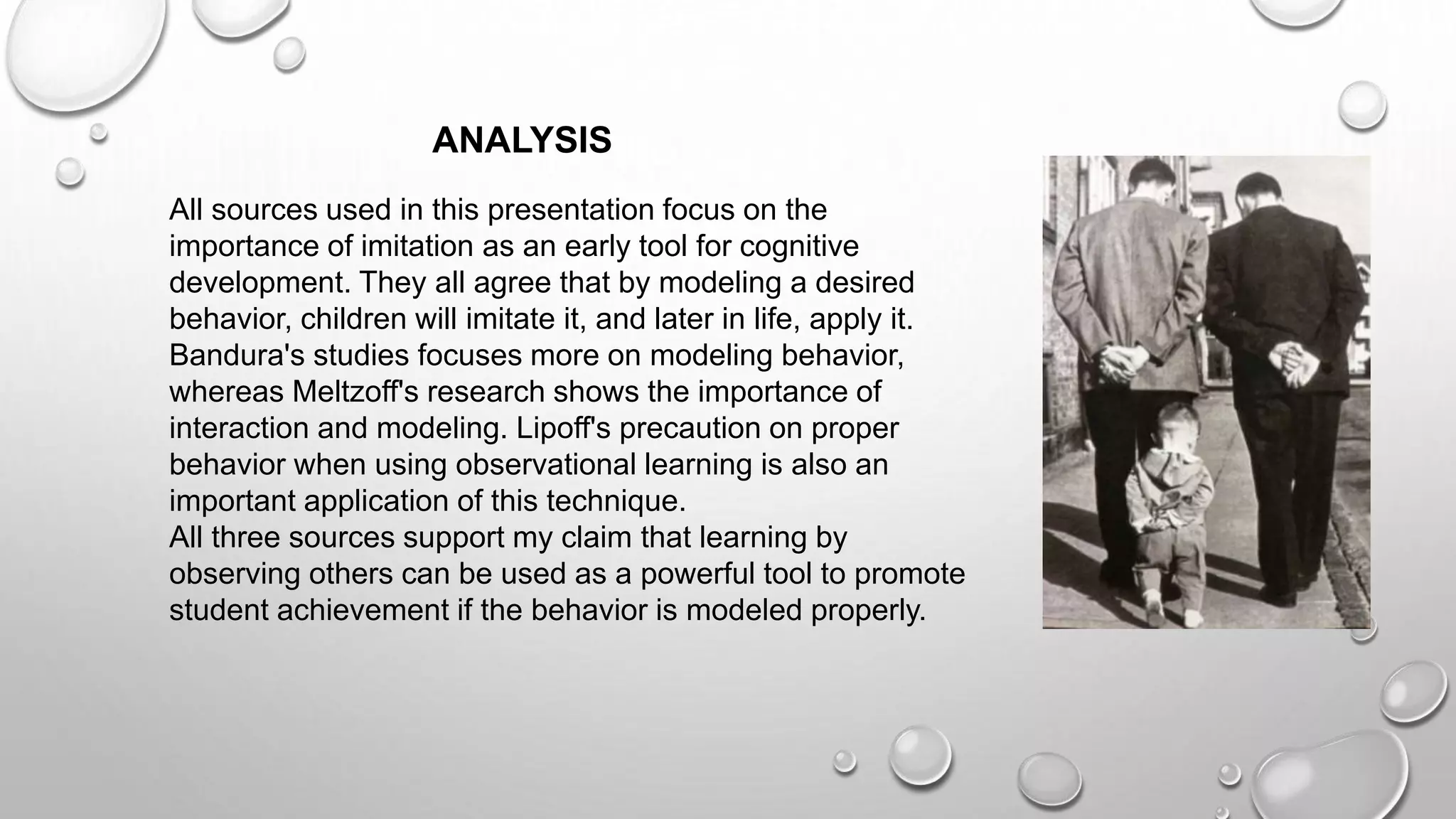
All sources used in this presentation focus on the
importance of imitation as an early tool for cognitive
development. They all agree that by modeling a desired
behavior, children will imitate it, and later in life, apply it.
Bandura's studies focuses more on modeling behavior,
whereas Meltzoff's research shows the importance of
interaction and modeling. Lipoff's precaution on proper
behavior when using observational learning is also an
important application of this technique.
All three sources support my claim that learning by
observing others can be used as a powerful tool to promote
student achievement if the behavior is modeled properly.
ANALYSIS
Learning by observation is a method researched,
experimented and developed by experts in
different fields related to education and human
development. Its implications can be applied and
tied to language development and early cognition.
It is also a window to discover children's
understanding of other people, and its
repercussions on brain development and
personality.
The implications are not limited to academic
achievement.
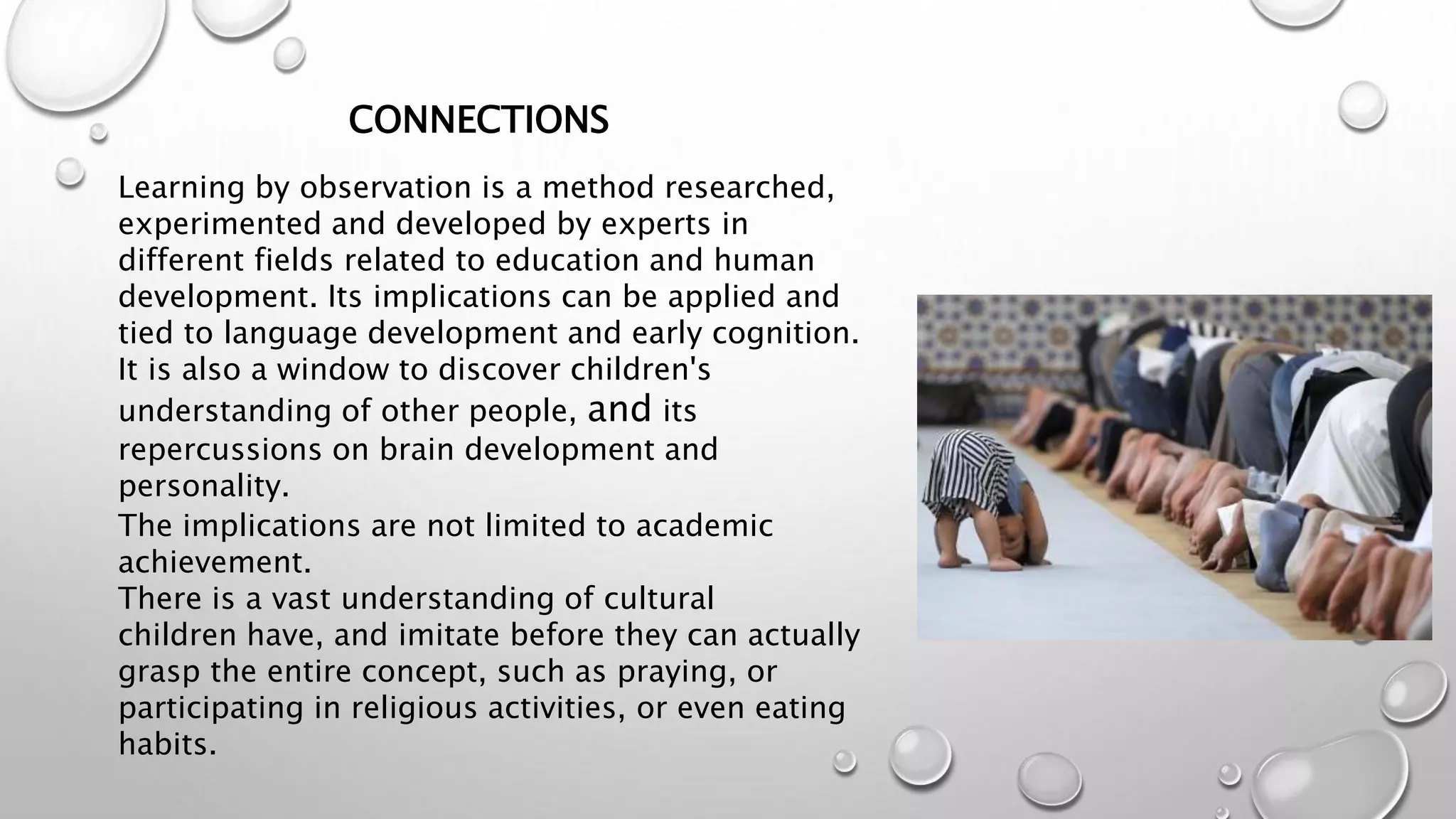
There is a vast understanding of cultural
children have, and imitate before they can actually
grasp the entire concept, such as praying, or
participating in religious activities, or even eating
habits.
CONNECTIONS
In Early Childhood Education, teachers are more prone to be
imitated by the students. We normally are working with young
children who are still learning, children who are exposed to all kind
of stimuli, and it is our job to model proper behavior in order to pass
it on to our young pupils. Children will explore and learn things by
themselves, but we can not deny that certain traits will be passes
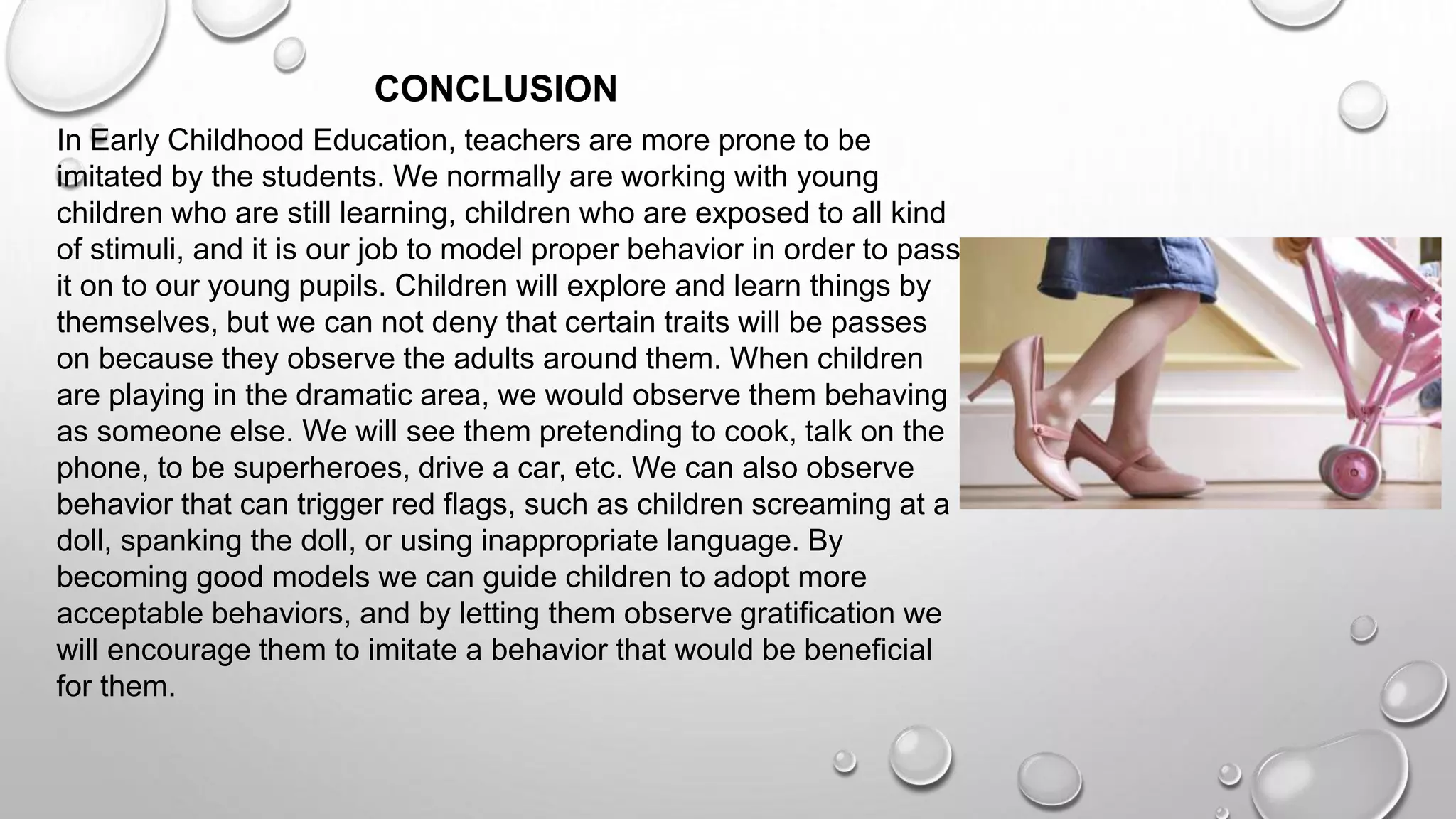
on because they observe the adults around them. When children
are playing in the dramatic area, we would observe them behaving
as someone else. We will see them pretending to cook, talk on the
phone, to be superheroes, drive a car, etc. We can also observe
behavior that can trigger red flags, such as children screaming at a
doll, spanking the doll, or using inappropriate language. By
becoming good models we can guide children to adopt more
acceptable behaviors, and by letting them observe gratification we
will encourage them to imitate a behavior that would be beneficial
for them.
CONCLUSION
If a parent were to ask me about the importance of learning by
observation, I would say:
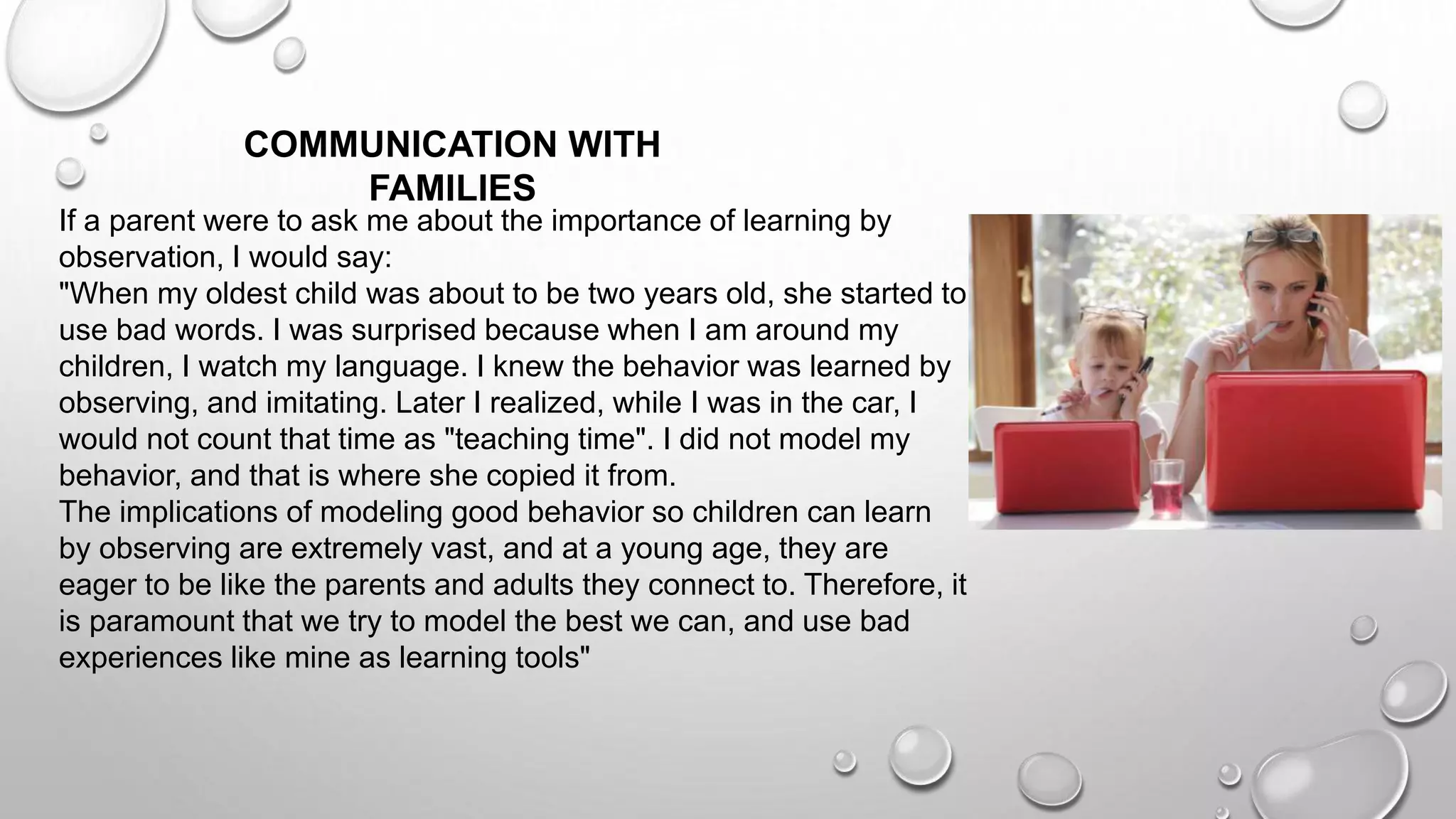
"When my oldest child was about to be two years old, she started to
use bad words. I was surprised because when I am around my
children, I watch my language. I knew the behavior was learned by
observing, and imitating. Later I realized, while I was in the car, I
would not count that time as "teaching time". I did not model my
behavior, and that is where she copied it from.
The implications of modeling good behavior so children can learn
by observing are extremely vast, and at a young age, they are
eager to be like the parents and adults they connect to. Therefore, it
is paramount that we try to model the best we can, and use bad
experiences like mine as learning tools"
COMMUNICATION WITH
FAMILIES
• Source: Boundless. “Bandura and Observational Learning.” Boundless Psychology
Boundless, 08 Aug. 2016. Retrieved 16 Feb. 2017 from
https://www.boundless.com/psychology/textbooks/boundless-psychology-
textbook/learning-7/cognitive-approaches-to-learning-48/bandura-and-observational-
learning-203-12738/
• McLeod, S. A. (2016). Bandura - Social Learning Theory. Retrieved from
www.simplypsychology.org/bandura.html
• Lipoff, S. (2011, April 26). Observational Learning and the Young Child. Retrieved
February 17, 2017, from http://www.funderstanding.com/theory/child-
development/observational-learning-and-the-young-child/
• Meltzoff, A., Waismeyer, A., & Gopnik, A. (2012, February 27). Learning about causes from
people: observational causal learning in 24-month-old infants. Retrieved February 17,
2017, from https://www.ncbi.nlm.nih.gov/pubmed/22369335
REFERENCES

Soe115 pp presentation

  • 1.
    OBSERVATIONAL LEARNING MARIA CLAUDIACONTRERAS SOE115 - PSYCHOLOGY OF TEACHING AND LEARNING KENDALL COLLEGE
  • 2.
    OVERVIEW "Observational learning occursby observing, retaining, and replicating behavior seen in others. The individuals performing the imitated behavior are called models. In my study, the models will be teachers and parents. While this type of learning can take place at any stage in life, it is thought to be particularly important during childhood, when authority is important." (Boundless, 2016). I decided to investigate this learning method because in my experience as a mother, I have noticed certain behaviors in my children that they have learned by observing me, rather than for me teaching them on purpose. Being a teacher, I have been surprised by the students, even young ones, when they learn by observing adults, and how much we can learn form them by observing the imitated behavior.
  • 3.
    Bandura developed theconcept that children observe certain behaviors and imitate them. However, children will need to be engaged first in order to accept a behavior as interesting, and imitate it later on. Children will look at adults as role models and that's why Bandura and other researches agreed on that the observational learning methods has more influence during early life. Bandura formulated his findings in four steps 1. Attention -- the individual notices something in the environment. 2. Retention -- the individual remembers what was noticed. 3. Reproduction -- the individual produces an action that is a copy of what was noticed. 4. Motivation -- the environment delivers a consequence that changes the probability the behavior will be emitted again (reinforcement and punishment). (McLeod, S. A., 2016) BANDURA
  • 4.
    According to Lipoff,it is extremely important for adults to model the desired behavior when approaching observational learning, in order to get positive results. She uses the example of a parent who yells when upset, but punishes the child when expressing anger by yelling. She explains that in this case, the model, adult, is not taken into consideration his/her own behavior, and the adult is actually sending mixed signals to the child. Observational learning, while a powerful tool in teaching, can be misused and misinterpreted if not implemented properly. LIPOFF
  • 5.
    The implications ofobservational learning do not develop when children are young. Studies by Andrew Meltzoff demonstrated that as early as 10 weeks old, infants can imitate a simple exercise of sticking their tongues out. He called causal learning to the acquisition of simple skills. Dr. Meltzoff stated that observing the changes in heir surroundings, children first imitate without considering an action, and later, they applied it as a skill. Meltzoof's research has demonstrated the implications of imitation for brain development and cognitive development starting at infant age. MELTZOFF
  • 6.
    All sources usedin this presentation focus on the importance of imitation as an early tool for cognitive development. They all agree that by modeling a desired behavior, children will imitate it, and later in life, apply it. Bandura's studies focuses more on modeling behavior, whereas Meltzoff's research shows the importance of interaction and modeling. Lipoff's precaution on proper behavior when using observational learning is also an important application of this technique. All three sources support my claim that learning by observing others can be used as a powerful tool to promote student achievement if the behavior is modeled properly. ANALYSIS
  • 7.
    Learning by observationis a method researched, experimented and developed by experts in different fields related to education and human development. Its implications can be applied and tied to language development and early cognition. It is also a window to discover children's understanding of other people, and its repercussions on brain development and personality. The implications are not limited to academic achievement. There is a vast understanding of cultural children have, and imitate before they can actually grasp the entire concept, such as praying, or participating in religious activities, or even eating habits. CONNECTIONS
  • 8.
    In Early ChildhoodEducation, teachers are more prone to be imitated by the students. We normally are working with young children who are still learning, children who are exposed to all kind of stimuli, and it is our job to model proper behavior in order to pass it on to our young pupils. Children will explore and learn things by themselves, but we can not deny that certain traits will be passes on because they observe the adults around them. When children are playing in the dramatic area, we would observe them behaving as someone else. We will see them pretending to cook, talk on the phone, to be superheroes, drive a car, etc. We can also observe behavior that can trigger red flags, such as children screaming at a doll, spanking the doll, or using inappropriate language. By becoming good models we can guide children to adopt more acceptable behaviors, and by letting them observe gratification we will encourage them to imitate a behavior that would be beneficial for them. CONCLUSION
  • 9.
    If a parentwere to ask me about the importance of learning by observation, I would say: "When my oldest child was about to be two years old, she started to use bad words. I was surprised because when I am around my children, I watch my language. I knew the behavior was learned by observing, and imitating. Later I realized, while I was in the car, I would not count that time as "teaching time". I did not model my behavior, and that is where she copied it from. The implications of modeling good behavior so children can learn by observing are extremely vast, and at a young age, they are eager to be like the parents and adults they connect to. Therefore, it is paramount that we try to model the best we can, and use bad experiences like mine as learning tools" COMMUNICATION WITH FAMILIES
  • 10.
    • Source: Boundless.“Bandura and Observational Learning.” Boundless Psychology Boundless, 08 Aug. 2016. Retrieved 16 Feb. 2017 from https://www.boundless.com/psychology/textbooks/boundless-psychology- textbook/learning-7/cognitive-approaches-to-learning-48/bandura-and-observational- learning-203-12738/ • McLeod, S. A. (2016). Bandura - Social Learning Theory. Retrieved from www.simplypsychology.org/bandura.html • Lipoff, S. (2011, April 26). Observational Learning and the Young Child. Retrieved February 17, 2017, from http://www.funderstanding.com/theory/child- development/observational-learning-and-the-young-child/ • Meltzoff, A., Waismeyer, A., & Gopnik, A. (2012, February 27). Learning about causes from people: observational causal learning in 24-month-old infants. Retrieved February 17, 2017, from https://www.ncbi.nlm.nih.gov/pubmed/22369335 REFERENCES