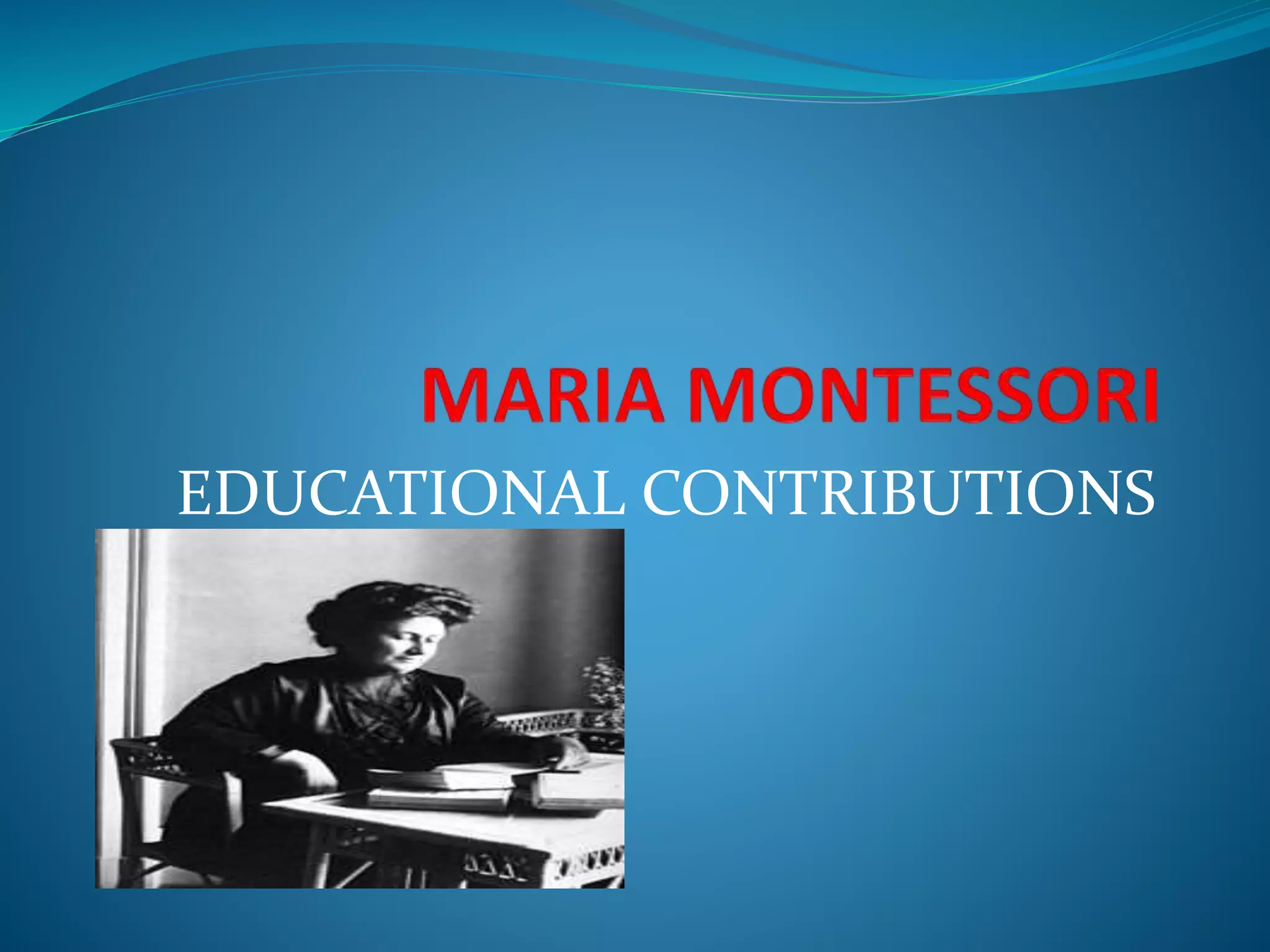
EDUCATIONAL CONTRIBUTIONS
Maria Tecla Artemisia Montessori
 Born
August 31, 1870
Chiaravalle, Marche, Italy
 Died
May 6, 1952 (aged 81)
Noordwijk, South Holland, Netherlands
 Resting place
Noordwijk, Netherlands
 Nationality
Italian
 Education
University of Rome La Sapienza
Medical School
 Occupation
Physician and educator
 Known for
Founder of the Montessori method of education
 Religion
Catholic
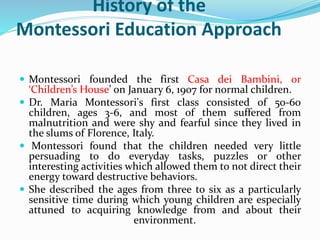
History of the
Montessori Education Approach
 Montessori founded the first Casa dei Bambini, or
‘Children’s House’ on January 6, 1907 for normal children.
 Dr. Maria Montessori's first class consisted of 50-60
children, ages 3-6, and most of them suffered from
malnutrition and were shy and fearful since they lived in
the slums of Florence, Italy.
 Montessori found that the children needed very little
persuading to do everyday tasks, puzzles or other
interesting activities which allowed them to not direct their
energy toward destructive behaviors.
 She described the ages from three to six as a particularly
sensitive time during which young children are especially
attuned to acquiring knowledge from and about their
environment.
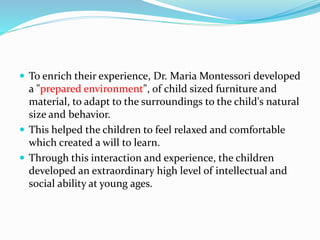
 To enrich their experience, Dr. Maria Montessori developed
a "prepared environment", of child sized furniture and
material, to adapt to the surroundings to the child's natural
size and behavior.
 This helped the children to feel relaxed and comfortable
which created a will to learn.
 Through this interaction and experience, the children
developed an extraordinary high level of intellectual and
social ability at young ages.
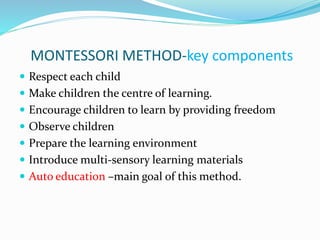
MONTESSORI METHOD-key components
 Respect each child
 Make children the centre of learning.
 Encourage children to learn by providing freedom
 Observe children
 Prepare the learning environment
 Introduce multi-sensory learning materials
 Auto education –main goal of this method.
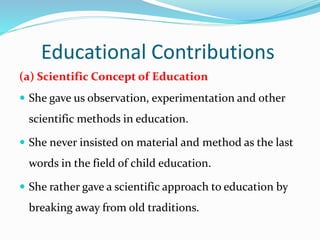
Educational Contributions
(a) Scientific Concept of Education
 She gave us observation, experimentation and other
scientific methods in education.
 She never insisted on material and method as the last
words in the field of child education.
 She rather gave a scientific approach to education by
breaking away from old traditions.
(b) Emphasis on Individual Teaching
 As against collective and class reading, Montessori
stresses individual treatment of each child.
 Because of individual differences in physical and
mental make-up, each pupil should be observed,
studied and handed in a different manner.
 Thus, like the modern educators, she made child as
the “unit of teaching” in place of class.
(c) Psychological Approach to Education
 Like Froebel, she has also given emphasis on sense
training, which is based on psychological principles.
 She has advocated auto-education in an atmosphere of
freedom and in the spirit of play.
 She has also emphasized child’s development from
within through his own efforts. All these principles
have made learning more important than teaching,
which is universally accepted today.
(d) Love and Respect for Small Children
 In her own words, “The child’s soul which is pure and
very sensitive requires our most delicate care”.
 For her “child was God, her school was the temple and
deity of the temple was the essence of childhood.”
 The profound love for children that she had compelled
her to travel from one corner of the world to another to
start institutions for them.
 She also stayed in India from 1939 to 1951 and
conducted a number of training courses for teachers in
her system of child education.
MAJOR WORKS
(1909) Metodo della Pedagogia Scientifica applicato
all’ educazione infantile nelle Case dei Bambini
(1910) Antropologia Pedagogia
• (1913) English edition: Pedagogical Anthropology
(1914) Dr. Montessori’s Own Handbook
(1934) Psico Geometrica (Spanish)
• (2011) English edition: Psychogeometry
(1934) Psico Arithmetica
• (1971) Italian edition: Psicoarithmetica
AWARDS
 First early childhood educator nominated for Nobel
Peace Prize.
 French Legion of Honor
 Received Honorary Doctorate of the university of
Amsterdam.
 Officer of the Dutch Order of Orange Nassau.
THANK YOU

Maria montessori ppt

  • 1.
  • 2.
    Maria Tecla ArtemisiaMontessori  Born August 31, 1870 Chiaravalle, Marche, Italy  Died May 6, 1952 (aged 81) Noordwijk, South Holland, Netherlands  Resting place Noordwijk, Netherlands  Nationality Italian  Education University of Rome La Sapienza Medical School
  • 3.
     Occupation Physician andeducator  Known for Founder of the Montessori method of education  Religion Catholic
  • 4.
    History of the MontessoriEducation Approach  Montessori founded the first Casa dei Bambini, or ‘Children’s House’ on January 6, 1907 for normal children.  Dr. Maria Montessori's first class consisted of 50-60 children, ages 3-6, and most of them suffered from malnutrition and were shy and fearful since they lived in the slums of Florence, Italy.  Montessori found that the children needed very little persuading to do everyday tasks, puzzles or other interesting activities which allowed them to not direct their energy toward destructive behaviors.  She described the ages from three to six as a particularly sensitive time during which young children are especially attuned to acquiring knowledge from and about their environment.
  • 5.
     To enrichtheir experience, Dr. Maria Montessori developed a "prepared environment", of child sized furniture and material, to adapt to the surroundings to the child's natural size and behavior.  This helped the children to feel relaxed and comfortable which created a will to learn.  Through this interaction and experience, the children developed an extraordinary high level of intellectual and social ability at young ages.
  • 6.
    MONTESSORI METHOD-key components Respect each child  Make children the centre of learning.  Encourage children to learn by providing freedom  Observe children  Prepare the learning environment  Introduce multi-sensory learning materials  Auto education –main goal of this method.
  • 7.
    Educational Contributions (a) ScientificConcept of Education  She gave us observation, experimentation and other scientific methods in education.  She never insisted on material and method as the last words in the field of child education.  She rather gave a scientific approach to education by breaking away from old traditions.
  • 8.
    (b) Emphasis onIndividual Teaching  As against collective and class reading, Montessori stresses individual treatment of each child.  Because of individual differences in physical and mental make-up, each pupil should be observed, studied and handed in a different manner.  Thus, like the modern educators, she made child as the “unit of teaching” in place of class.
  • 9.
    (c) Psychological Approachto Education  Like Froebel, she has also given emphasis on sense training, which is based on psychological principles.  She has advocated auto-education in an atmosphere of freedom and in the spirit of play.  She has also emphasized child’s development from within through his own efforts. All these principles have made learning more important than teaching, which is universally accepted today.
  • 10.
    (d) Love andRespect for Small Children  In her own words, “The child’s soul which is pure and very sensitive requires our most delicate care”.  For her “child was God, her school was the temple and deity of the temple was the essence of childhood.”  The profound love for children that she had compelled her to travel from one corner of the world to another to start institutions for them.  She also stayed in India from 1939 to 1951 and conducted a number of training courses for teachers in her system of child education.
  • 11.
    MAJOR WORKS (1909) Metododella Pedagogia Scientifica applicato all’ educazione infantile nelle Case dei Bambini (1910) Antropologia Pedagogia • (1913) English edition: Pedagogical Anthropology (1914) Dr. Montessori’s Own Handbook (1934) Psico Geometrica (Spanish) • (2011) English edition: Psychogeometry (1934) Psico Arithmetica • (1971) Italian edition: Psicoarithmetica
  • 12.
    AWARDS  First earlychildhood educator nominated for Nobel Peace Prize.  French Legion of Honor  Received Honorary Doctorate of the university of Amsterdam.  Officer of the Dutch Order of Orange Nassau.
  • 13.