1


Measuring Crime
OUTLINE
 Introduction
 General Issues in Measuring Crime
 Crimes Known to Police
 Measuring Crime Through Victim
  Surveys
 Surveys of Offending
 Drug Surveillance Systems
 Measuring Crime for Specific Purposes
3


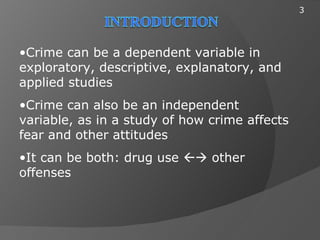
•Crime can be a dependent variable in
exploratory, descriptive, explanatory, and
applied studies
•Crime can also be an independent
variable, as in a study of how crime affects
fear and other attitudes
•It can be both: drug use  other
offenses
4


•What offenses?
•What units of analysis?
  •Specific entities about which researchers
  collect information
  •Offender, victim, offenses, incidents
•What purpose?
  •Monitoring
  •Agency Accountability
  •Research
5


•Most widely used measures of crime are
based on police records
•Certain types are detected almost exclusively
by observation (traffic and victimless offenses)
•Most crimes reported by victim or witnesses
•What crimes are not measured well by police
records?
  •Assaults
  •Robberies
6


•Circa 1929, under FBI since 1930s
•Originally, reporting voluntary, but now very
common
•Type I offenses (Index crimes/offenses):
murder, rape, robbery, larceny, burglary,
aggravated assault, motor vehicle theft and
arson (added in 1979)
•Type II offenses: a compilation of less serious
crimes
•Summary-based, group level unit of analysis
7


•The UCR is neither an exclusive nor an
exhaustive measure
•Not all law enforcement agencies submit
complete reports to the FBI, and the quality of
the data submitted varies
•Summary-Based Measure of Crime
  •UCR data includes summary, or total, crime
  counts for reporting agencies (cities/counties)
•UCR data are aggregates - cannot be used in
descriptive or explanatory studies that focus
on individual crimes, offenders, or victims
8


•Based on incidents as units of analysis
•Supplementary Homicide Reports (SHR)
  •Police agencies submit detailed info about
  individual homicide incidents
•Can conduct a variety of studies that examine
individual events
9


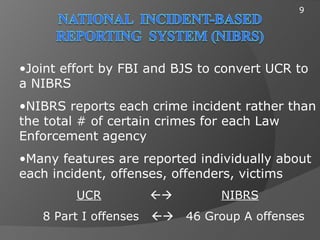
•Joint effort by FBI and BJS to convert UCR to
a NIBRS
•NIBRS reports each crime incident rather than
the total # of certain crimes for each Law
Enforcement agency
•Many features are reported individually about
each incident, offenses, offenders, victims
         UCR                   NIBRS
   8 Part I offenses      46 Group A offenses
10


•Hierarchy rule dropped
•Victim type (individual, business,
government, society/public)
•Attempted/Completed
•Drug-related offenses
•Computers and crime
•Quality control; states require certification
11


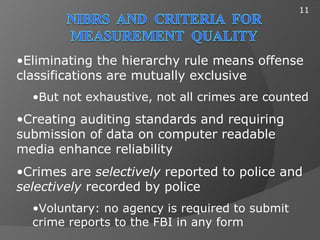
•Eliminating the hierarchy rule means offense
classifications are mutually exclusive
  •But not exhaustive, not all crimes are counted
•Creating auditing standards and requiring
submission of data on computer readable
media enhance reliability
•Crimes are selectively reported to police and
selectively recorded by police
  •Voluntary: no agency is required to submit
  crime reports to the FBI in any form
12


•Can obtain info on crimes not reported to
police
•Can measure incidents police may not
officially record as crimes
•Provides data on victims/offenders
(individuals), and the incidents themselves
(social artifacts)
13


•Since 1972 by Census Bureau
•Sought to illuminate the “dark figure of
unreported crime”
•Longitudinal panel study: households agree to
participated for 3 years (7 interviews; one
every 6 months) and then replaced
•Does not measure all crime
•Respondents are asked screening questions
14


•Measures both reported and unreported
crime
•Independent of changes in reporting
•More information about how crime impacted
victim than UCR
•Provides more victim characteristics than
UCR
15


•Telescoping incident dates
•Faulty memory
•Little information on offenders
•No information on CJS response if reported
•Excludes crimes against commercial
establishments
•Only includes residents of US
16


•Sought to improve measurement of domestic
violence and sexual assault
•Revised screening questions and added cues
to help respondents recall and distinguish
minor incidents
•More direct questions on rape and other
sexual crimes
•Greater attention to measuring victimizations
by someone the respondent knows
•Gradual increase of telephone interviews to
replace in-person interviews
17


•First Development in late 1960’s
  •A series of city-level surveys by the Census
  Bureau
•1998 BJS and the Office of Community
Oriented Policing Services (COPS) launched
pilot surveys in 12 large and medium-sized
cities
  •Jointly developed a guidebook and software so
  that local law enforcement agencies and other
  groups can conduct their own community
  surveys
18


•Crimes Known to Police:
  •UCR
  •SHR
  •NIBRS
•Victim Surveys
  •NCVS
  •Community Victimization Surveys
19


•Delinquency, "victimless" crimes, and crimes
rarely observed or reported to police may be
measured by self-report surveys
  •Example: prostitution, drug abuse, public
  order, shoplifting, drunk driving
•Two ongoing self-report studies
  •National Survey on Drug Use and Health
  (NSDUH)
  •Monitor The Future (MTF)
20


•Based on a national sample of households
•Conducted since 1971; 2004 sample had
68,000 individuals
•Includes questions to distinguish between
lifetime use, current use, and heavy use
•Encourages candid responses via procedures
•Includes residents of college dorms, rooming
houses, and homeless shelters
21


•Conducted since 1975 by the National
Institute on Drug Abuse
•Includes several samples of high school
students and others, totaling about 50,000
respondents each year
•Questions concern self-reported use of
alcohol, tobacco, illegal drugs, delinquency,
other acts
•A subset of 2,400 MTF respondents receive
follow-up questionnaire
22


•Surveillance systems have been developed to
obtain alternative measures of drug use
•Arrestee Drug Abuse Monitoring (ADAM) –
provides ongoing assessment of drug use
among arrestees
•Drug Abuse Warning Network (DAWN) –
collects emergency medical treatment reports
for “drug episodes” from a sample of hospitals
23


•Local Crime and Self-Report Surveys
  •e.g., any purpose!
•Incident-Based Crime Reports
  •e.g., Newark PD vehicle theft
•Observing Crime
  •e.g., shoplifting, bar drinking and violence
24


•UCR & SHR: best for murder and crimes in
which the victim is a business or commercial
establishment
•NCVS: best for crimes against persons or
households that are not reported to police
•Self-report surveys: best at measuring
crimes that do not have readily identifiable
victims and that are less often observed by or
reported to police

Ch06 Measuring Crime

  • 1.
  • 2.
    OUTLINE  Introduction  GeneralIssues in Measuring Crime  Crimes Known to Police  Measuring Crime Through Victim Surveys  Surveys of Offending  Drug Surveillance Systems  Measuring Crime for Specific Purposes
  • 3.
    3 •Crime can bea dependent variable in exploratory, descriptive, explanatory, and applied studies •Crime can also be an independent variable, as in a study of how crime affects fear and other attitudes •It can be both: drug use  other offenses
  • 4.
    4 •What offenses? •What unitsof analysis? •Specific entities about which researchers collect information •Offender, victim, offenses, incidents •What purpose? •Monitoring •Agency Accountability •Research
  • 5.
    5 •Most widely usedmeasures of crime are based on police records •Certain types are detected almost exclusively by observation (traffic and victimless offenses) •Most crimes reported by victim or witnesses •What crimes are not measured well by police records? •Assaults •Robberies
  • 6.
    6 •Circa 1929, underFBI since 1930s •Originally, reporting voluntary, but now very common •Type I offenses (Index crimes/offenses): murder, rape, robbery, larceny, burglary, aggravated assault, motor vehicle theft and arson (added in 1979) •Type II offenses: a compilation of less serious crimes •Summary-based, group level unit of analysis
  • 7.
    7 •The UCR isneither an exclusive nor an exhaustive measure •Not all law enforcement agencies submit complete reports to the FBI, and the quality of the data submitted varies •Summary-Based Measure of Crime •UCR data includes summary, or total, crime counts for reporting agencies (cities/counties) •UCR data are aggregates - cannot be used in descriptive or explanatory studies that focus on individual crimes, offenders, or victims
  • 8.
    8 •Based on incidentsas units of analysis •Supplementary Homicide Reports (SHR) •Police agencies submit detailed info about individual homicide incidents •Can conduct a variety of studies that examine individual events
  • 9.
    9 •Joint effort byFBI and BJS to convert UCR to a NIBRS •NIBRS reports each crime incident rather than the total # of certain crimes for each Law Enforcement agency •Many features are reported individually about each incident, offenses, offenders, victims UCR  NIBRS 8 Part I offenses  46 Group A offenses
  • 10.
    10 •Hierarchy rule dropped •Victimtype (individual, business, government, society/public) •Attempted/Completed •Drug-related offenses •Computers and crime •Quality control; states require certification
  • 11.
    11 •Eliminating the hierarchyrule means offense classifications are mutually exclusive •But not exhaustive, not all crimes are counted •Creating auditing standards and requiring submission of data on computer readable media enhance reliability •Crimes are selectively reported to police and selectively recorded by police •Voluntary: no agency is required to submit crime reports to the FBI in any form
  • 12.
    12 •Can obtain infoon crimes not reported to police •Can measure incidents police may not officially record as crimes •Provides data on victims/offenders (individuals), and the incidents themselves (social artifacts)
  • 13.
    13 •Since 1972 byCensus Bureau •Sought to illuminate the “dark figure of unreported crime” •Longitudinal panel study: households agree to participated for 3 years (7 interviews; one every 6 months) and then replaced •Does not measure all crime •Respondents are asked screening questions
  • 14.
    14 •Measures both reportedand unreported crime •Independent of changes in reporting •More information about how crime impacted victim than UCR •Provides more victim characteristics than UCR
  • 15.
    15 •Telescoping incident dates •Faultymemory •Little information on offenders •No information on CJS response if reported •Excludes crimes against commercial establishments •Only includes residents of US
  • 16.
    16 •Sought to improvemeasurement of domestic violence and sexual assault •Revised screening questions and added cues to help respondents recall and distinguish minor incidents •More direct questions on rape and other sexual crimes •Greater attention to measuring victimizations by someone the respondent knows •Gradual increase of telephone interviews to replace in-person interviews
  • 17.
    17 •First Development inlate 1960’s •A series of city-level surveys by the Census Bureau •1998 BJS and the Office of Community Oriented Policing Services (COPS) launched pilot surveys in 12 large and medium-sized cities •Jointly developed a guidebook and software so that local law enforcement agencies and other groups can conduct their own community surveys
  • 18.
    18 •Crimes Known toPolice: •UCR •SHR •NIBRS •Victim Surveys •NCVS •Community Victimization Surveys
  • 19.
    19 •Delinquency, "victimless" crimes,and crimes rarely observed or reported to police may be measured by self-report surveys •Example: prostitution, drug abuse, public order, shoplifting, drunk driving •Two ongoing self-report studies •National Survey on Drug Use and Health (NSDUH) •Monitor The Future (MTF)
  • 20.
    20 •Based on anational sample of households •Conducted since 1971; 2004 sample had 68,000 individuals •Includes questions to distinguish between lifetime use, current use, and heavy use •Encourages candid responses via procedures •Includes residents of college dorms, rooming houses, and homeless shelters
  • 21.
    21 •Conducted since 1975by the National Institute on Drug Abuse •Includes several samples of high school students and others, totaling about 50,000 respondents each year •Questions concern self-reported use of alcohol, tobacco, illegal drugs, delinquency, other acts •A subset of 2,400 MTF respondents receive follow-up questionnaire
  • 22.
    22 •Surveillance systems havebeen developed to obtain alternative measures of drug use •Arrestee Drug Abuse Monitoring (ADAM) – provides ongoing assessment of drug use among arrestees •Drug Abuse Warning Network (DAWN) – collects emergency medical treatment reports for “drug episodes” from a sample of hospitals
  • 23.
    23 •Local Crime andSelf-Report Surveys •e.g., any purpose! •Incident-Based Crime Reports •e.g., Newark PD vehicle theft •Observing Crime •e.g., shoplifting, bar drinking and violence
  • 24.
    24 •UCR & SHR:best for murder and crimes in which the victim is a business or commercial establishment •NCVS: best for crimes against persons or households that are not reported to police •Self-report surveys: best at measuring crimes that do not have readily identifiable victims and that are less often observed by or reported to police