Religion and social changeL.O. Can religion force social change?
Religion as a conservative forceHow can religion be seen as a conservative force? ‘Traditional’ Upholds Moral views Functions to preserve things the way they areMaintains the status quoStabilises society
Religion’s conservative beliefsOppose changes that would allow people to have more sexual freedom:  Can you think of how religion may do this?Upholds family values and favours a traditional patriarchal domestic division of labour.  How does religion do this?
Religion’s conservative functionsPreserves the status quo- Marxists/Functionalists/FeministsContributes to social stabilityReligion and consensus- prevents society from disintegrating and promotes social solidarity, also helps us to deal with stresses that would otherwise disrupt society.Religion and capitalism- Marx sees religion as conservative ideology that prevents social change, by legitimating and disguising inequality.  It creates false consciousness in the working class and prevents revolution.Feminists see religion as a conservative force as it is an ideology that legitimates patriarchal power and maintains women’s subordination in the family and wider society.
Overview Weber is a Social Action theoristStudies interaction and how humans make sense of the worldFocus on the social construction of realityVerstehenThe importance of IDEAS in driving society
Weber:  religion as a force for changeNot all sociologists think that religion is a conservative force- some like Max Weber (1905) thinks it can bring about change.Weber argues that Calvinism (a form of Protestantism) brought about by John Calvin during the Reformation helped to bring about major social change- including bringing about modern capitalism in Northern Europe in the 16th and 17th Centuries.
Spirit of capitalismBefore Calvinism many societies had capitalism in the sense of greed for wealth but the SoC was brought about by Calvinist beliefs and attitudes.The SoC is based on an ordered rational and efficient pursuit of profit for its own sake rather than for consumption.
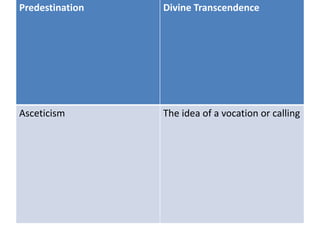
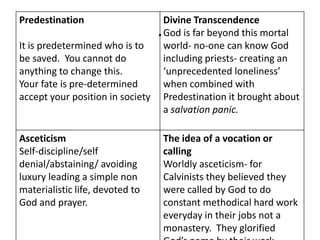
Calvinism beliefs
.
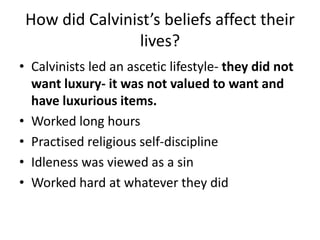
How did Calvinist’s beliefs affect their lives?Calvinists led an ascetic lifestyle- they did not want luxury- it was not valued to want and have luxurious items.Worked long hoursPractised religious self-disciplineIdleness was viewed as a sinWorked hard at whatever they did
What effect did this have?The wealth and success performed a psychological function and helped them cope with the salvation panic.A Calvinist view:‘why would God have allowed me to prosper and get very wealthy if he did not favour me and choose me to be saved?’
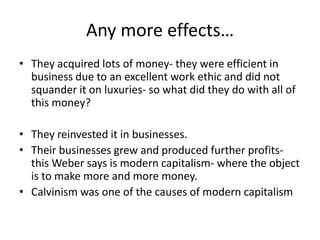
Any more effects…They acquired lots of money- they were efficient in business due to an excellent work ethic and did not squander it on luxuries- so what did they do with all of this money?They reinvested it in businesses.  Their businesses grew and produced further profits- this Weber says is modern capitalism- where the object is to make more and more money.  Calvinism was one of the causes of modern capitalism
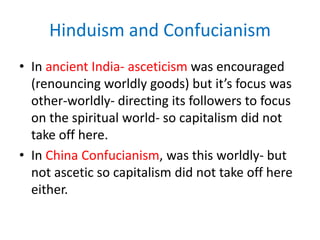
Hinduism and ConfucianismIn ancient India- asceticism was encouraged (renouncing worldly goods) but it’s focus was other-worldly- directing its followers to focus on the spiritual world- so capitalism did not take off here.In China Confucianism, was this worldly- but not ascetic so capitalism did not take off here either.
Evaluation AO 2Why is Weber’s work often described as a debate with Marx’s Ghost?
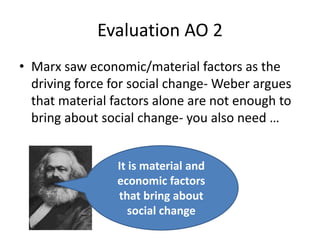
Evaluation AO 2Marx saw economic/material factors as the driving force for social change- Weber argues that material factors alone are not enough to bring about social change- you also need …It is material and economic factors that bring about social change
Evaluation AO 2Karl Kautsky (1927) said that capitalism was around before Calvinism so there is your proof that it was not much of an influence.Weber – according to Kautsky- you overestimate the role and ideas of Calvinism and underestimate the influence of economic factors.
Evaluation AO 2R H Tawney (1926) argues…Other arguments against Weber…
Religion and social protestSteve Bruce 2003 is also interested in the relationship between religion and social change.  He compares two examples of the role of religiously inspired protest movements in America that have tried to change society:The Civil Rights Movement and he New Christian Right.
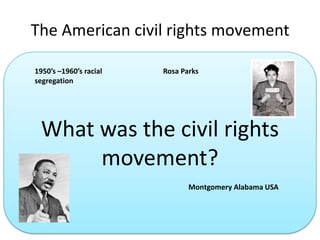
The American civil rights movementWhat was the civil rights movement?Rosa Parks1950’s –1960’s racial segregationMontgomery Alabama USA
How are religious organisations equipped to support protests to bring about change?Taking the moral high ground:Channelling dissent:Acting as an honest broker:Mobilising public opinion:
The New Christian RightConservative fundamentalist Protestant group opposing liberalising of America.

SociologyExchange.co.uk Shared Resource

  • 1.
    Religion and socialchangeL.O. Can religion force social change?
  • 2.
    Religion as aconservative forceHow can religion be seen as a conservative force? ‘Traditional’ Upholds Moral views Functions to preserve things the way they areMaintains the status quoStabilises society
  • 3.
    Religion’s conservative beliefsOpposechanges that would allow people to have more sexual freedom: Can you think of how religion may do this?Upholds family values and favours a traditional patriarchal domestic division of labour. How does religion do this?
  • 4.
    Religion’s conservative functionsPreservesthe status quo- Marxists/Functionalists/FeministsContributes to social stabilityReligion and consensus- prevents society from disintegrating and promotes social solidarity, also helps us to deal with stresses that would otherwise disrupt society.Religion and capitalism- Marx sees religion as conservative ideology that prevents social change, by legitimating and disguising inequality. It creates false consciousness in the working class and prevents revolution.Feminists see religion as a conservative force as it is an ideology that legitimates patriarchal power and maintains women’s subordination in the family and wider society.
  • 5.
    Overview Weber isa Social Action theoristStudies interaction and how humans make sense of the worldFocus on the social construction of realityVerstehenThe importance of IDEAS in driving society
  • 6.
    Weber: religionas a force for changeNot all sociologists think that religion is a conservative force- some like Max Weber (1905) thinks it can bring about change.Weber argues that Calvinism (a form of Protestantism) brought about by John Calvin during the Reformation helped to bring about major social change- including bringing about modern capitalism in Northern Europe in the 16th and 17th Centuries.
  • 7.
    Spirit of capitalismBeforeCalvinism many societies had capitalism in the sense of greed for wealth but the SoC was brought about by Calvinist beliefs and attitudes.The SoC is based on an ordered rational and efficient pursuit of profit for its own sake rather than for consumption.
  • 8.
  • 9.
  • 10.
    How did Calvinist’sbeliefs affect their lives?Calvinists led an ascetic lifestyle- they did not want luxury- it was not valued to want and have luxurious items.Worked long hoursPractised religious self-disciplineIdleness was viewed as a sinWorked hard at whatever they did
  • 11.
    What effect didthis have?The wealth and success performed a psychological function and helped them cope with the salvation panic.A Calvinist view:‘why would God have allowed me to prosper and get very wealthy if he did not favour me and choose me to be saved?’
  • 12.
    Any more effects…Theyacquired lots of money- they were efficient in business due to an excellent work ethic and did not squander it on luxuries- so what did they do with all of this money?They reinvested it in businesses. Their businesses grew and produced further profits- this Weber says is modern capitalism- where the object is to make more and more money. Calvinism was one of the causes of modern capitalism
  • 13.
    Hinduism and ConfucianismInancient India- asceticism was encouraged (renouncing worldly goods) but it’s focus was other-worldly- directing its followers to focus on the spiritual world- so capitalism did not take off here.In China Confucianism, was this worldly- but not ascetic so capitalism did not take off here either.
  • 14.
    Evaluation AO 2Whyis Weber’s work often described as a debate with Marx’s Ghost?
  • 15.
    Evaluation AO 2Marxsaw economic/material factors as the driving force for social change- Weber argues that material factors alone are not enough to bring about social change- you also need …It is material and economic factors that bring about social change
  • 16.
    Evaluation AO 2KarlKautsky (1927) said that capitalism was around before Calvinism so there is your proof that it was not much of an influence.Weber – according to Kautsky- you overestimate the role and ideas of Calvinism and underestimate the influence of economic factors.
  • 17.
    Evaluation AO 2RH Tawney (1926) argues…Other arguments against Weber…
  • 18.
    Religion and socialprotestSteve Bruce 2003 is also interested in the relationship between religion and social change. He compares two examples of the role of religiously inspired protest movements in America that have tried to change society:The Civil Rights Movement and he New Christian Right.
  • 19.
    The American civilrights movementWhat was the civil rights movement?Rosa Parks1950’s –1960’s racial segregationMontgomery Alabama USA
  • 20.
    How are religiousorganisations equipped to support protests to bring about change?Taking the moral high ground:Channelling dissent:Acting as an honest broker:Mobilising public opinion:
  • 21.
    The New ChristianRightConservative fundamentalist Protestant group opposing liberalising of America.

Editor's Notes

  • #7 Reformation- Protestant Revolt to change the practices of the Catholic Church
  • #9 Summarise the beliefs and state how these would bring about the spirit of capitalism.
  • #10 Summarise the beliefs and state how these would bring about the spirit of capitalism.
  • #16 Finish the sentence
  • #20 How does Bruce see religion in this context as an ideological resource?