Have you ever wondered why women are more religious than men?
There have been certain trends among the religious beliefs and
participation of different social groups. People of different genders
and from different ethnicities and social classes have distinctive
attitudes towards religions. Age is also influential in the formation of
patterns of religiosity in society.
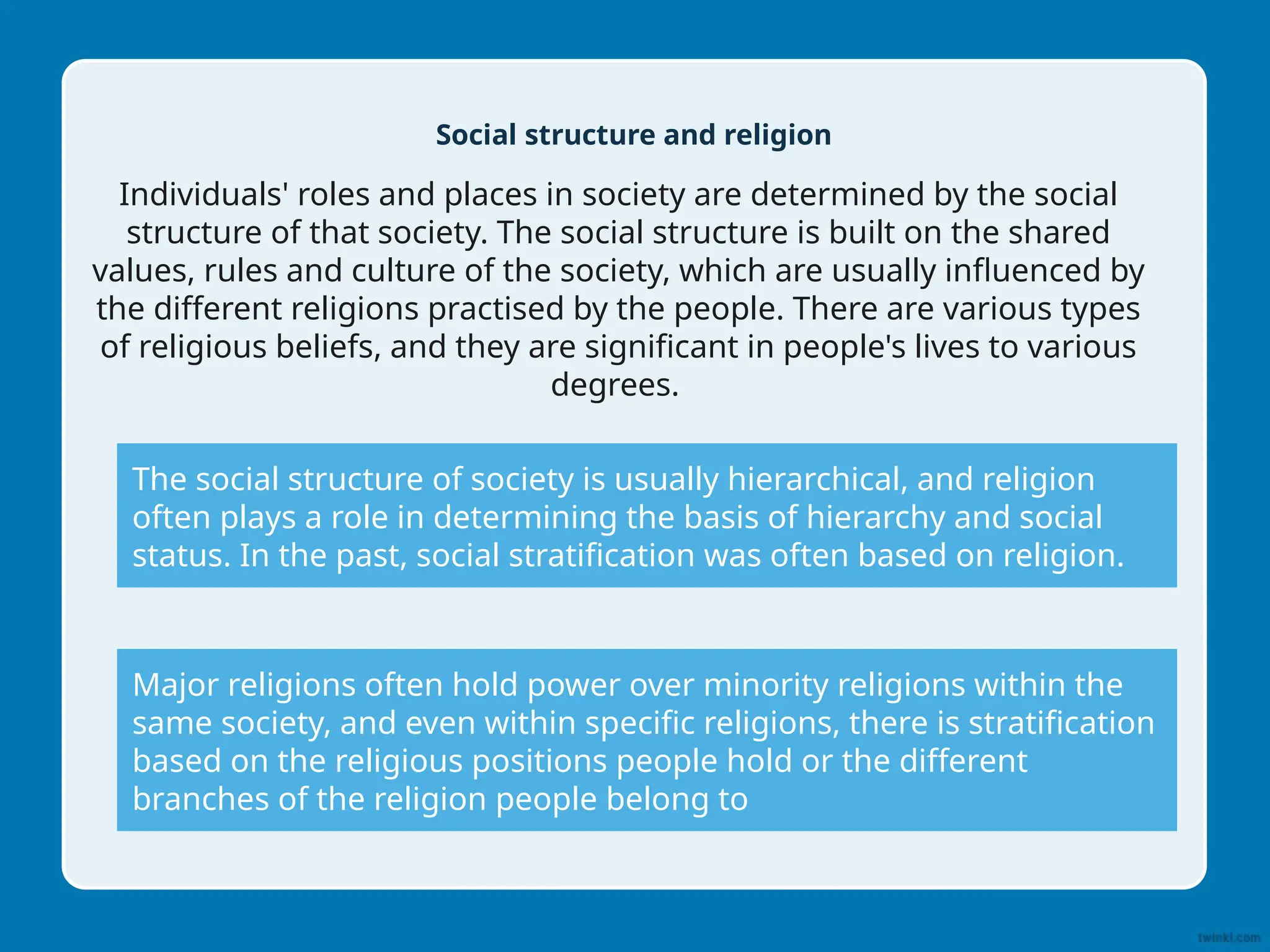
Social structure and religion
Individuals' roles and places in society are determined by the social
structure of that society. The social structure is built on the shared
values, rules and culture of the society, which are usually influenced by
the different religions practised by the people. There are various types
of religious beliefs, and they are significant in people's lives to various
degrees.
The social structure of society is usually hierarchical, and religion
often plays a role in determining the basis of hierarchy and social
status. In the past, social stratification was often based on religion.
Major religions often hold power over minority religions within the
same society, and even within specific religions, there is stratification
based on the religious positions people hold or the different
branches of the religion people belong to
Hinduism and the caste system
Hindu society in India used to be divided into castes. A person's
caste was determined at birth and could not be changed in
one's lifetime. It also determined one's social status and
occupation. In the highest caste were the Brahmins, who
usually fulfilled the roles of religious leaders, intellectuals and
teachers. Below them were the Kshatriyas, who were mainly
politicians and military personnel. Then came the traders,
agricultural workers and shopkeepers, the Vaishyas; and finally
the Shudras, who engaged in manual labour. The group in the
lowest position, so low that they were considered to be outside
the caste hierarchy, were the Dalits. They performed the "least
desirable" jobs of society, such as collecting rubbish and
cleaning bathrooms.
• A.S. Miller and J.P. Hoffmann (1995) found that women are more
interested in religion than men, have stronger commitments to
religious movements, and attend church services in higher
numbers than men.
Gender and religion
Why are women more religious than men?
The most common sociological explanation for the higher number of
female followers of religion comes from the ‘traditional social role
theory’. Traditional femininity assumes a caring, nurturing,
emotional, passive, and submissive role for women, which were all
seen as virtues by many religions, including Christianity. The women
who accepted these roles could easily find comfort and support in
the traditional religion, more so than men.
1. Some sociologists argue that the higher rate of female participation
in religion is connected to age trends, not to social role theory. Older
people tend to be more religious than younger people; since women
live longer than men, there are more women among those who
practice religion.
Other Explanations
3. Glock and Stark (1969) and Stark and Bainbridge (1985) assert that
religion is appealing to women because they suffer from deprivation
in higher numbers than men.
2. Miller and Hoffmann (1995) claim that women are more likely to
work in part-time positions, so they have more time to get involved
with religious activities.
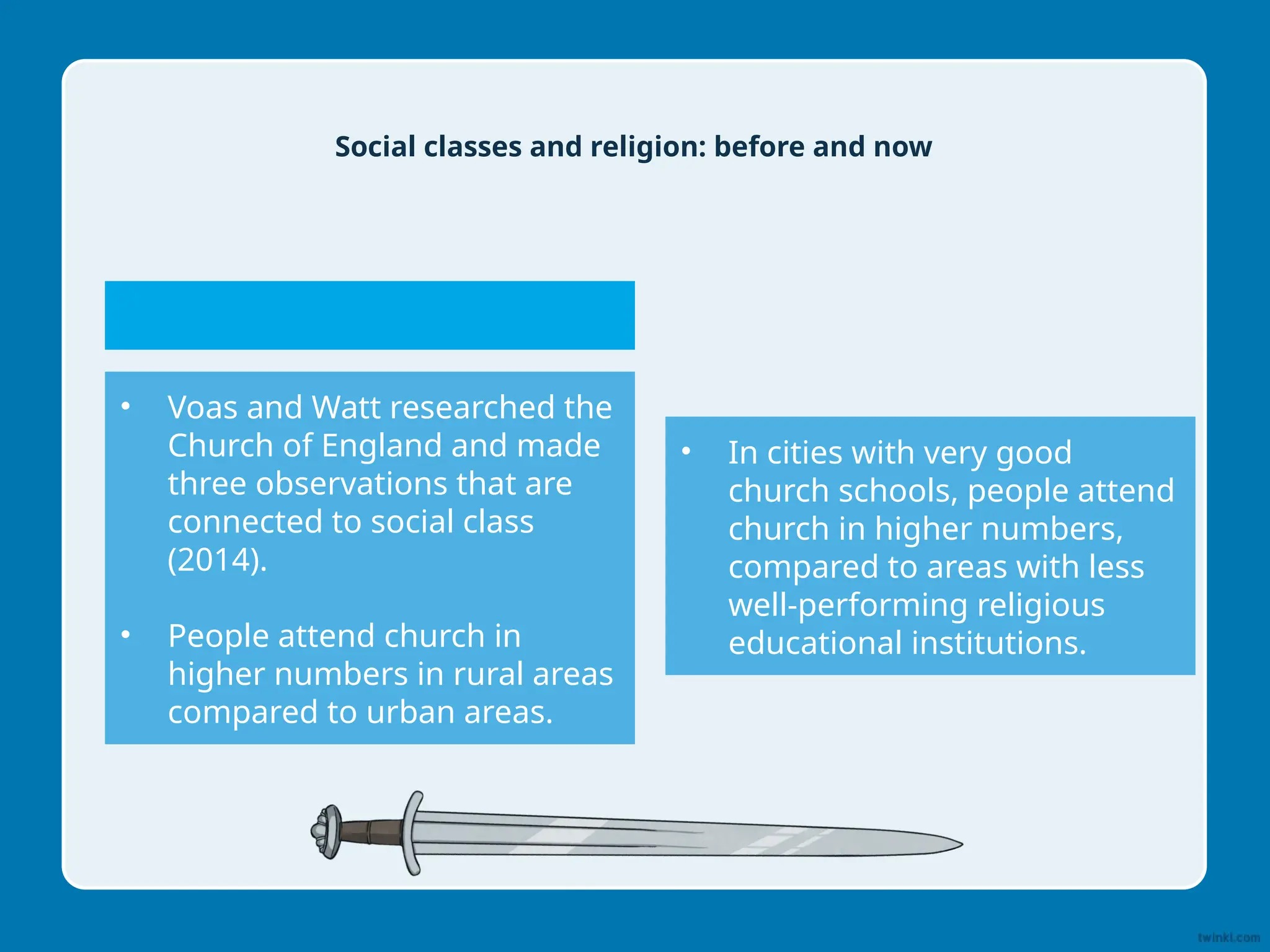
• Voas and Watt researched the
Church of England and made
three observations that are
connected to social class
(2014).
• People attend church in
higher numbers in rural areas
compared to urban areas.
• In cities with very good
church schools, people attend
church in higher numbers,
compared to areas with less
well-performing religious
educational institutions.
Social classes and religion: before and now
The Functionalist Perpective on Religion
The functionalist perspective, which originates
from Emile Durkheim’s work on religion,
highlights the social role of religion.
The positivist tradition encourages the study of society using
dispassionate and scientific methods.
Emile Durkheim argued that religion provides social cohesion and
social control to maintain society in social solidarity.
Collective consciousness, which is the fusion of all of our individual
consciousnesses, creates a reality of its own.
Critics of the functionalist approach point out that religion can be
dysfunctional. For example, religion may incite violence by a
fundamentalist religious group
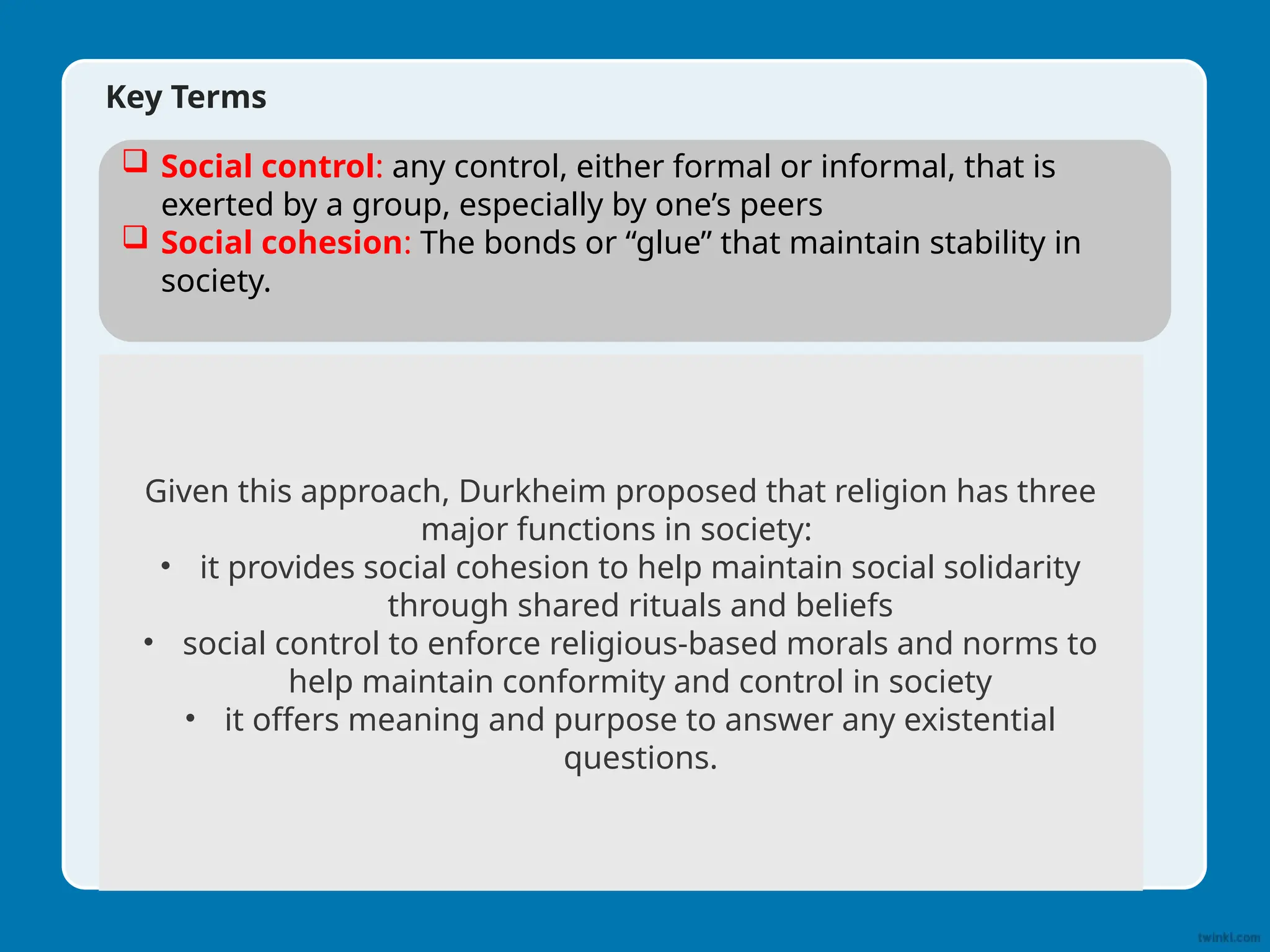
Key Terms
 Social control: any control, either formal or informal, that is
exerted by a group, especially by one’s peers
 Social cohesion: The bonds or “glue” that maintain stability in
society.
Given this approach, Durkheim proposed that religion has three
major functions in society:
• it provides social cohesion to help maintain social solidarity
through shared rituals and beliefs
• social control to enforce religious-based morals and norms to
help maintain conformity and control in society
• it offers meaning and purpose to answer any existential
questions.
Religion and Social Support
Learning Objectives
Discuss the relationship between religion and social and individual well-
being
Many studies suggest that religious people
• are happier and less stressed than their non-religious counterparts.
• The Legatum Prosperity Index reflects the research that there is a
positive link between religious engagement and well-being.
• Religiosity has a salutary relationship with psychological adjustment,
because it is related to less psychological distress, more life
satisfaction, and better self-actualization.
Key Terms
 well-being : a state of health, happiness and/or prosperity
 self-actualization: Self-actualization is a term that has been
used in various psychology theories, often in slightly different
ways. The term was originally introduced by the organismic
theorist Kurt Goldstein for the motive to realize one’s full
potential. However, the concept was brought most fully to
prominence in Abraham Maslow’s hierarchy of needs theory, in
which “self-actualization” was the final level of psychological
development that can be achieved when all basic and mental
needs are fulfilled. In such a case, the “actualization” of full
personal potential takes place.
religiosity: An index of how strongly religious a person is
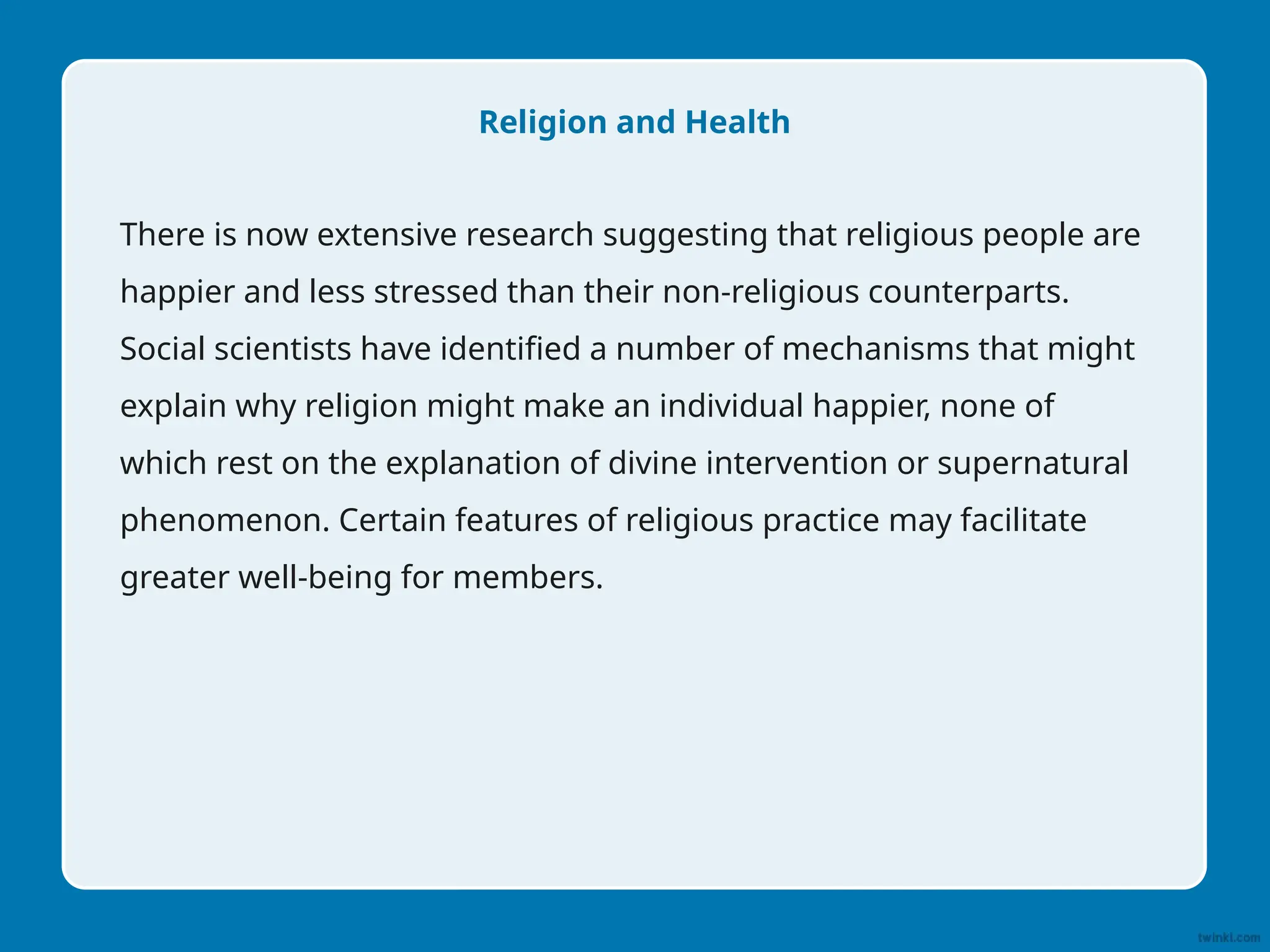
Religion and Health
There is now extensive research suggesting that religious people are
happier and less stressed than their non-religious counterparts.
Social scientists have identified a number of mechanisms that might
explain why religion might make an individual happier, none of
which rest on the explanation of divine intervention or supernatural
phenomenon. Certain features of religious practice may facilitate
greater well-being for members.
Studies of Religion and Health
1. The Legatum Prosperity Index reflects the research that suggests
that there is a positive link between religious engagement and well-
being. People who report that God is very important in their lives are
on average more satisfied with their lives,
2. An analysis of over 200 studies contends that high religiousness
predicts a lower risk of depression, a lower risk of drug abuse, fewer
suicide attempts. Those same studies associate religious involvement
with reports of higher satisfaction with a sense of well-being
3. 1993 study by Kosmin & Lachman indicated that people without a
religious affiliation appeared to be at greater risk for depressive
symptoms than individuals affiliated with a religion
4. Surveys by Gallup, the National Opinion Research Center and the Pew
Organization conclude that spiritually committed people are twice as
likely to report being “very happy” than the least religiously committed
people.
The Marxist Perpective on Religion
Marx on Religion
• Marx viewed society through a scientific perspective and saw
religion as a conservative force
• Marx viewed religion as a form ideology that controlled the
masses
• Religion served rhe needs of capitalism as it maintained the
oppressive structure of society
Religion and Social Control
Religion maintains social control
Marx argued that religion was one of the ways in which the ruling
class maintained control of society. He argued that religion is a
form of ideology that controls the masses.
The rewards for the proletariat’s hard work would come in the
afterlife, which is a way to motivate the poor to continue working.
Religion, according to Marx, inhibits social change because if
workers are promised rewards in the afterlife believe that they
cannot change their position because it is God’s will, they are not
likely to try to change their conditions. Ultimately, religion prevents
a revolution from the working class.
Criticisms of the Marxist perspective on religion
• Firstly, it is clear that religion does not always prevent social
change by creating false class consciousness. There are plenty of
examples of where oppressed groups have used religion to
attempt (whether successful or not is moot here) to bring about
social change, as we will see in the neo-Marxist perspective on
religion.
• Secondly, religion still exists where there is (arguably) no
oppression: the USSR communist state placed limits on the practice
of religion, including banning religious instruction to children,
however, religious belief remained stronger in the 20th century in
Russia and Eastern Europe than it did in the capitalist west.
• Thirdly, and building on the previous point: just because religion
can be used as a tool of manipulation and oppression, this does
not explain its existence: religion seems to be more or less
universal in all societies, so it is likely that it fulfills other individual
and social needs, possibly in a more positive way as suggested by
Functionalist theorists such as Durkheim, Malinowski, and Parsons.

religion of sociology igcse paper 1 .pptx

  • 1.
    Have you everwondered why women are more religious than men? There have been certain trends among the religious beliefs and participation of different social groups. People of different genders and from different ethnicities and social classes have distinctive attitudes towards religions. Age is also influential in the formation of patterns of religiosity in society.
  • 2.
    Social structure andreligion Individuals' roles and places in society are determined by the social structure of that society. The social structure is built on the shared values, rules and culture of the society, which are usually influenced by the different religions practised by the people. There are various types of religious beliefs, and they are significant in people's lives to various degrees. The social structure of society is usually hierarchical, and religion often plays a role in determining the basis of hierarchy and social status. In the past, social stratification was often based on religion. Major religions often hold power over minority religions within the same society, and even within specific religions, there is stratification based on the religious positions people hold or the different branches of the religion people belong to
  • 3.
    Hinduism and thecaste system Hindu society in India used to be divided into castes. A person's caste was determined at birth and could not be changed in one's lifetime. It also determined one's social status and occupation. In the highest caste were the Brahmins, who usually fulfilled the roles of religious leaders, intellectuals and teachers. Below them were the Kshatriyas, who were mainly politicians and military personnel. Then came the traders, agricultural workers and shopkeepers, the Vaishyas; and finally the Shudras, who engaged in manual labour. The group in the lowest position, so low that they were considered to be outside the caste hierarchy, were the Dalits. They performed the "least desirable" jobs of society, such as collecting rubbish and cleaning bathrooms.
  • 4.
    • A.S. Millerand J.P. Hoffmann (1995) found that women are more interested in religion than men, have stronger commitments to religious movements, and attend church services in higher numbers than men. Gender and religion Why are women more religious than men? The most common sociological explanation for the higher number of female followers of religion comes from the ‘traditional social role theory’. Traditional femininity assumes a caring, nurturing, emotional, passive, and submissive role for women, which were all seen as virtues by many religions, including Christianity. The women who accepted these roles could easily find comfort and support in the traditional religion, more so than men.
  • 5.
    1. Some sociologistsargue that the higher rate of female participation in religion is connected to age trends, not to social role theory. Older people tend to be more religious than younger people; since women live longer than men, there are more women among those who practice religion. Other Explanations 3. Glock and Stark (1969) and Stark and Bainbridge (1985) assert that religion is appealing to women because they suffer from deprivation in higher numbers than men. 2. Miller and Hoffmann (1995) claim that women are more likely to work in part-time positions, so they have more time to get involved with religious activities.
  • 6.
    • Voas andWatt researched the Church of England and made three observations that are connected to social class (2014). • People attend church in higher numbers in rural areas compared to urban areas. • In cities with very good church schools, people attend church in higher numbers, compared to areas with less well-performing religious educational institutions. Social classes and religion: before and now
  • 7.
    The Functionalist Perpectiveon Religion The functionalist perspective, which originates from Emile Durkheim’s work on religion, highlights the social role of religion. The positivist tradition encourages the study of society using dispassionate and scientific methods. Emile Durkheim argued that religion provides social cohesion and social control to maintain society in social solidarity. Collective consciousness, which is the fusion of all of our individual consciousnesses, creates a reality of its own. Critics of the functionalist approach point out that religion can be dysfunctional. For example, religion may incite violence by a fundamentalist religious group
  • 8.
    Key Terms  Socialcontrol: any control, either formal or informal, that is exerted by a group, especially by one’s peers  Social cohesion: The bonds or “glue” that maintain stability in society. Given this approach, Durkheim proposed that religion has three major functions in society: • it provides social cohesion to help maintain social solidarity through shared rituals and beliefs • social control to enforce religious-based morals and norms to help maintain conformity and control in society • it offers meaning and purpose to answer any existential questions.
  • 9.
    Religion and SocialSupport Learning Objectives Discuss the relationship between religion and social and individual well- being Many studies suggest that religious people • are happier and less stressed than their non-religious counterparts. • The Legatum Prosperity Index reflects the research that there is a positive link between religious engagement and well-being. • Religiosity has a salutary relationship with psychological adjustment, because it is related to less psychological distress, more life satisfaction, and better self-actualization.
  • 10.
    Key Terms  well-being: a state of health, happiness and/or prosperity  self-actualization: Self-actualization is a term that has been used in various psychology theories, often in slightly different ways. The term was originally introduced by the organismic theorist Kurt Goldstein for the motive to realize one’s full potential. However, the concept was brought most fully to prominence in Abraham Maslow’s hierarchy of needs theory, in which “self-actualization” was the final level of psychological development that can be achieved when all basic and mental needs are fulfilled. In such a case, the “actualization” of full personal potential takes place. religiosity: An index of how strongly religious a person is
  • 11.
    Religion and Health Thereis now extensive research suggesting that religious people are happier and less stressed than their non-religious counterparts. Social scientists have identified a number of mechanisms that might explain why religion might make an individual happier, none of which rest on the explanation of divine intervention or supernatural phenomenon. Certain features of religious practice may facilitate greater well-being for members.
  • 12.
    Studies of Religionand Health 1. The Legatum Prosperity Index reflects the research that suggests that there is a positive link between religious engagement and well- being. People who report that God is very important in their lives are on average more satisfied with their lives, 2. An analysis of over 200 studies contends that high religiousness predicts a lower risk of depression, a lower risk of drug abuse, fewer suicide attempts. Those same studies associate religious involvement with reports of higher satisfaction with a sense of well-being 3. 1993 study by Kosmin & Lachman indicated that people without a religious affiliation appeared to be at greater risk for depressive symptoms than individuals affiliated with a religion 4. Surveys by Gallup, the National Opinion Research Center and the Pew Organization conclude that spiritually committed people are twice as likely to report being “very happy” than the least religiously committed people.
  • 13.
  • 14.
    Marx on Religion •Marx viewed society through a scientific perspective and saw religion as a conservative force • Marx viewed religion as a form ideology that controlled the masses • Religion served rhe needs of capitalism as it maintained the oppressive structure of society
  • 15.
    Religion and SocialControl Religion maintains social control Marx argued that religion was one of the ways in which the ruling class maintained control of society. He argued that religion is a form of ideology that controls the masses. The rewards for the proletariat’s hard work would come in the afterlife, which is a way to motivate the poor to continue working. Religion, according to Marx, inhibits social change because if workers are promised rewards in the afterlife believe that they cannot change their position because it is God’s will, they are not likely to try to change their conditions. Ultimately, religion prevents a revolution from the working class.
  • 16.
    Criticisms of theMarxist perspective on religion • Firstly, it is clear that religion does not always prevent social change by creating false class consciousness. There are plenty of examples of where oppressed groups have used religion to attempt (whether successful or not is moot here) to bring about social change, as we will see in the neo-Marxist perspective on religion. • Secondly, religion still exists where there is (arguably) no oppression: the USSR communist state placed limits on the practice of religion, including banning religious instruction to children, however, religious belief remained stronger in the 20th century in Russia and Eastern Europe than it did in the capitalist west. • Thirdly, and building on the previous point: just because religion can be used as a tool of manipulation and oppression, this does not explain its existence: religion seems to be more or less universal in all societies, so it is likely that it fulfills other individual and social needs, possibly in a more positive way as suggested by Functionalist theorists such as Durkheim, Malinowski, and Parsons.